Physical Address
304 North Cardinal St.
Dorchester Center, MA 02124
Physical Address
304 North Cardinal St.
Dorchester Center, MA 02124

Learn about baby development
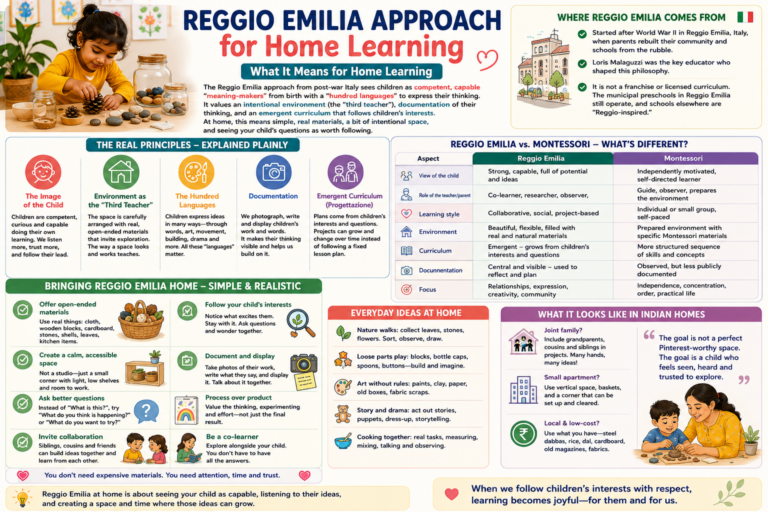
The Reggio Emilia approach is an early-childhood philosophy from post-war Italy that treats children as competent, capable “meaning-makers” from birth, expressing their thinking through many forms — words, art, movement, building — described as their “hundred languages.” Its core practices…
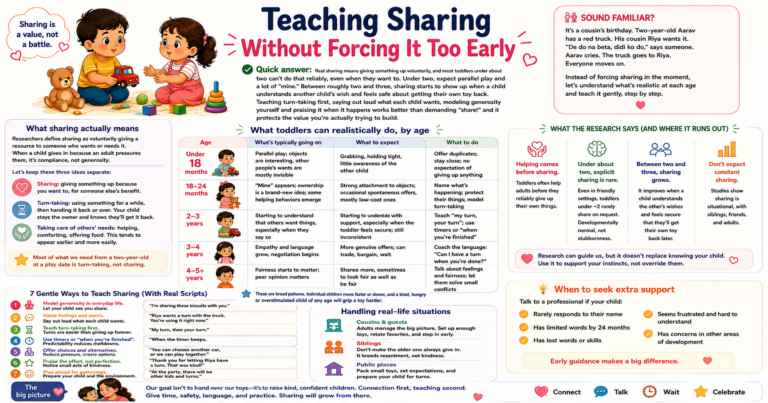
Quick answer: Real sharing means giving something up voluntarily, and most toddlers under about two can’t do that reliably, even when they want to. Under two, expect parallel play and a lot of “mine.” Between roughly two and three, sharing…
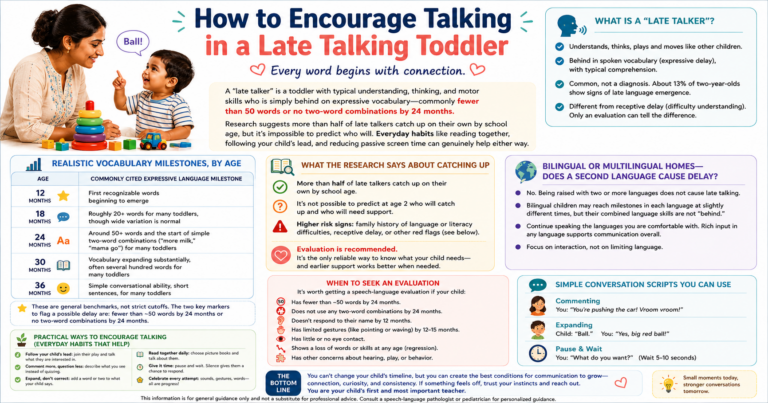
A “late talker” is a toddler with typical understanding, thinking, and motor skills who is simply behind on expressive vocabulary — commonly defined as fewer than 50 words or no two-word combinations by age 24 months. Research suggests more than…
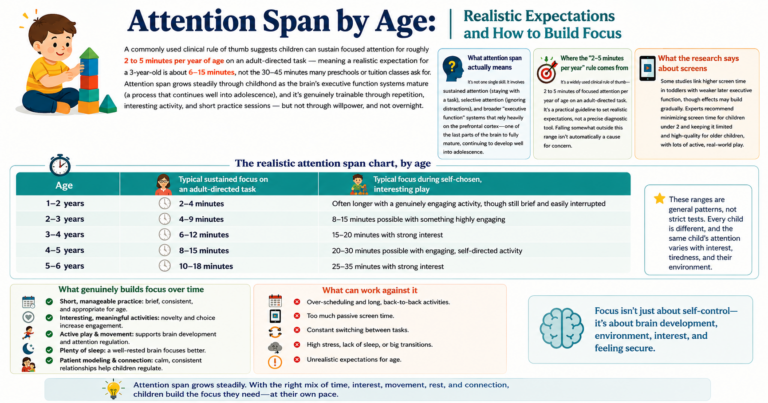
A commonly used clinical rule of thumb suggests children can sustain focused attention for roughly 2 to 5 minutes per year of age on an adult-directed task — meaning a realistic expectation for a 3-year-old is about 6–15 minutes, not…
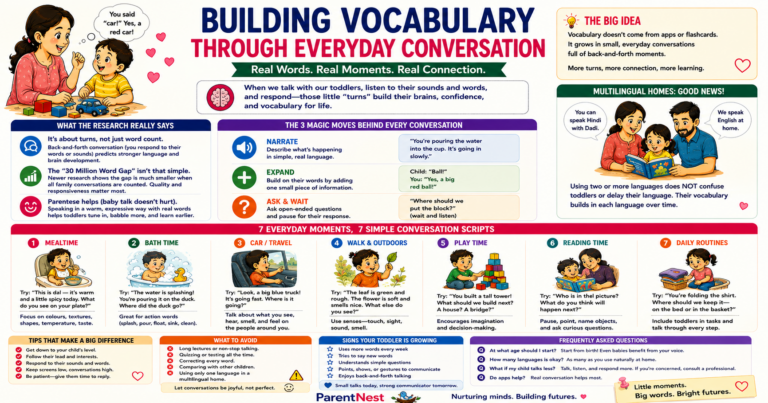
Vocabulary builds through responsive, back-and-forth conversation woven into everyday moments — not through flashcards, apps, or simply talking more in volume. Research consistently points to the quality and responsiveness of conversation (“turns,” where a child’s sound or word gets a…
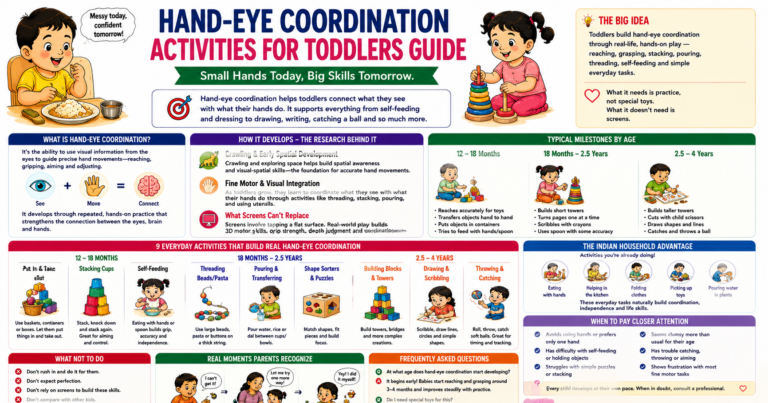
Hand-eye coordination — the ability to use visual information to guide precise hand movement — develops steadily through toddlerhood via hands-on, physical activity: threading, stacking, throwing, pouring, self-feeding, and simple household tasks. It doesn’t require special toys or classes; most…
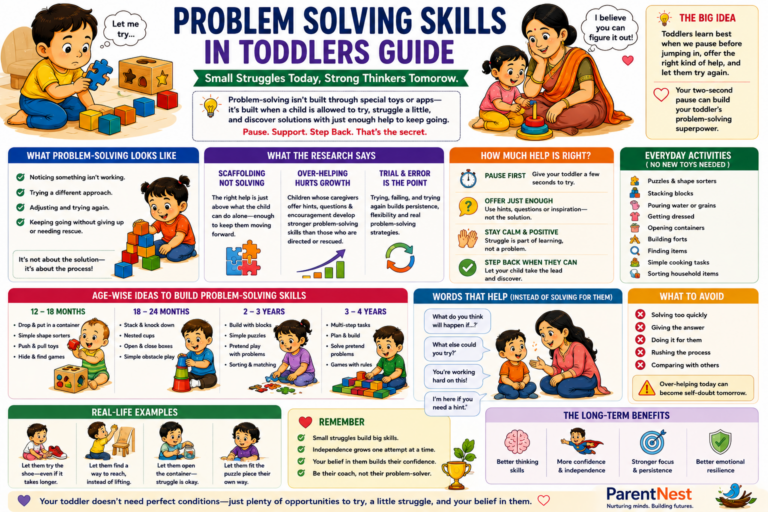
Problem-solving in toddlers isn’t built through special toys or apps — it’s built through ordinary daily moments where a child is allowed to struggle briefly, try a few approaches, and get just enough help to keep going, rather than having…
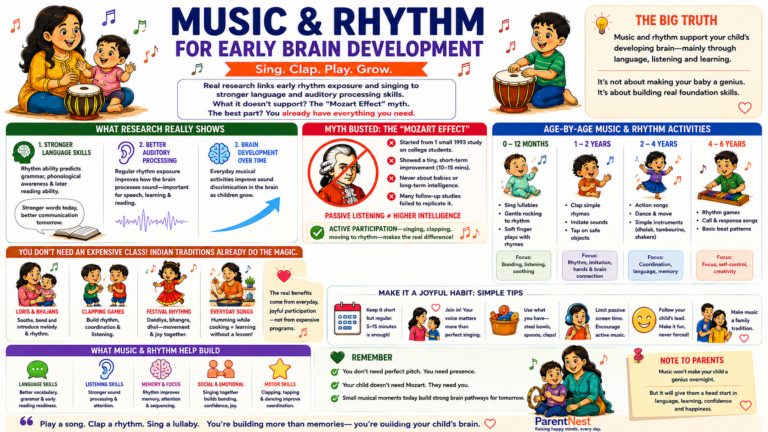
Music and rhythm do genuinely support early brain development — but not in the “make your baby a genius” way marketing often implies. Real research links early rhythm exposure and singing to stronger language and auditory processing skills, through mechanisms…
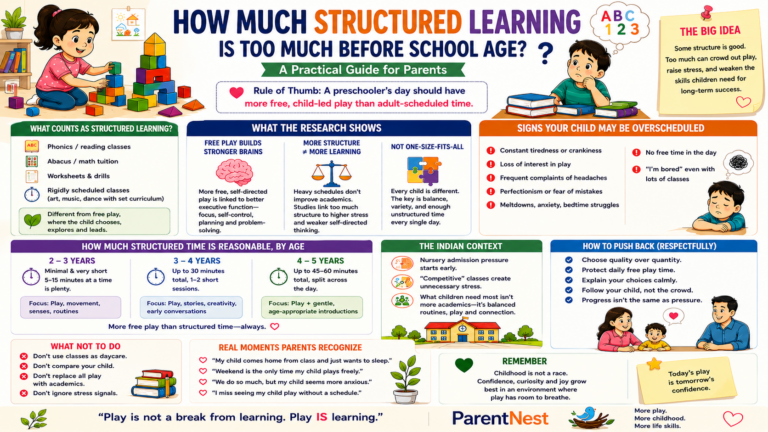
There’s no single magic number of hours, but research on young children consistently points in one direction: preschoolers need substantial daily unstructured free play, and when adult-directed, structured activity — classes, tuition, worksheets — starts crowding that out entirely, several…
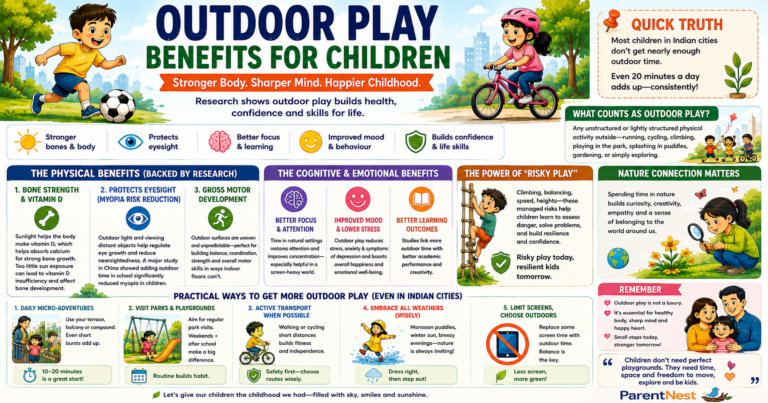
Outdoor play does more than tire a child out before dinner — research links it to stronger bones, better motor skills, a measurable reduction in the risk of nearsightedness, improved attention and mood, and even better long-term risk assessment through…