
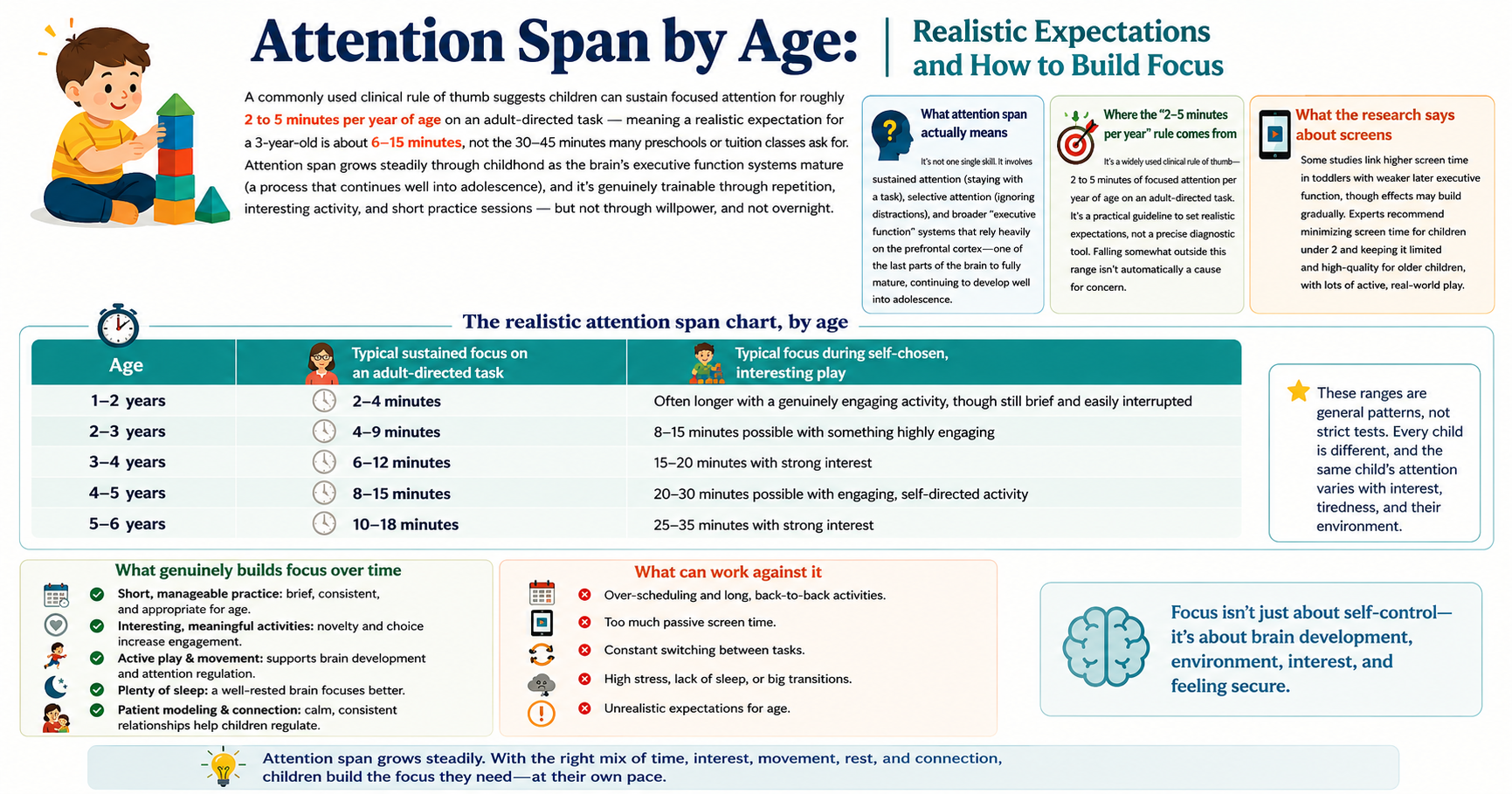
A commonly used clinical rule of thumb suggests children can sustain focused attention for roughly 2 to 5 minutes per year of age on an adult-directed task — meaning a realistic expectation for a 3-year-old is about 6–15 minutes, not the 30–45 minutes many preschools or tuition classes ask for. Attention span grows steadily through childhood as the brain’s executive function systems mature (a process that continues well into adolescence), and it’s genuinely trainable through repetition, interesting activity, and short practice sessions — but not through willpower, and not overnight.
Attention Span by Age: Realistic Expectations and How to Build Focus
There’s a specific moment that tends to trigger this exact worry: a teacher mentions your child “gets distracted easily,” or a relative compares your three-year-old unfavourably to a calmer cousin, or you watch your toddler abandon four different toys in the space of ninety seconds and wonder if something’s actually wrong. It’s an uncomfortable spot, made worse by the fact that most of us don’t actually know what “normal” attention span looks like at a given age — so every distracted moment starts to feel like evidence of a problem rather than what it usually is, which is completely typical development.
This article lays out a realistic, research-informed chart of attention span by age, explains where the popular “minutes per year of age” guideline actually comes from, looks honestly at what the screen-time research does and doesn’t show, and covers what genuinely builds focus over time — including a few common household habits that might be quietly working against it.
Table of Contents
What attention span actually means at this age
Attention span in young children isn’t one single skill — it involves sustained attention (staying with a task over time), selective attention (ignoring distractions to focus on one thing), and the broader “executive function” systems that coordinate this, which rely heavily on the prefrontal cortex, one of the last parts of the brain to fully mature, continuing to develop well into adolescence. This matters because it means expecting long, sustained focus from a very young child isn’t a matter of effort or discipline — the underlying neurological machinery for it is still under construction, quite literally.
The realistic attention span chart, by age
| Age | Typical sustained focus on an adult-directed task | Typical focus during self-chosen, interesting play |
|---|---|---|
| 1–2 years | 2–4 minutes | Often longer with a genuinely engaging activity, though still brief and easily interrupted |
| 2–3 years | 4–9 minutes | 8–15 minutes possible with something highly engaging |
| 3–4 years | 6–12 minutes | 15–20 minutes with strong interest |
| 4–5 years | 8–15 minutes | 20–30 minutes possible with engaging, self-directed activity |
| 5–6 years | 10–18 minutes | 25–35 minutes with strong interest |
These ranges are drawn from a widely used clinical guideline (discussed below) and should be read as a general pattern, not a precise or strict test — some healthy, typically developing children fall meaningfully outside these ranges in either direction, and the same child’s attention span varies a lot depending on how interested they are, how tired they are, and what else is happening around them.
Where the “2-3 minutes per year” rule actually comes from
This is worth being specific and honest about, since it gets repeated constantly without much context. The commonly cited guideline — roughly 2 to 5 minutes of focused attention per year of age on an adult-directed task, with the lower end applying to less interesting tasks and the upper end to more engaging ones — is a widely used clinical rule of thumb, treated as a reasonable general marker of developmentally normal attention by child development professionals, rather than a rigorously measured, universally fixed statistic. It’s a useful, practical heuristic for gauging whether an expectation is reasonable (asking a 3-year-old to sit through a 30-minute lesson is likely asking for more than is developmentally typical), but it isn’t a precise diagnostic tool, and a child falling somewhat outside this range isn’t automatically a cause for concern on its own.
What the research says about screens and attention
This is an area where it’s easy to overstate the evidence in either direction, so it’s worth being careful here. A longitudinal study tracking British toddlers from age 2 to 3 found that screen time at age 2 was associated with somewhat weaker executive function development over the following year, even after accounting for other factors — though the same study found no immediate, same-time association, suggesting the effect (if real) may build up gradually rather than showing up instantly. Broader reviews of research on children under 6 describe this age range as a period of particular sensitivity in executive function development, and several studies point toward screen media, especially fast-paced or multitasking media use (like switching between a show and a tablet game), as a possible risk factor during this window.
That said, the picture isn’t uniformly alarming — a separate study looking specifically at attention in slightly older children (ages 6–10) found no clear direct relationship between screen time and attention performance on the specific tasks measured, and researchers have suggested the real relationship may be more complex than a simple “more screens, worse attention” pattern, potentially depending heavily on content type, context, and other factors in a child’s life. The most defensible, honest summary: there’s real reason for caution, particularly with fast-paced or background media in the youngest years, but the research doesn’t support treating all screen time as uniformly and severely damaging to attention in every case.
What genuinely builds focus (and what doesn’t)
Repetition and open-ended play
Watching a toddler pour water from one cup to another, or stack and knock down the same tower repeatedly, can look aimless to an adult — but this kind of repetitive, self-directed play is widely considered a genuine mechanism through which young children practice and strengthen attention and related neural pathways. The “boring” repetition is often exactly where the skill-building is happening.
Interest matters more than willpower
A child who “can’t focus” on a worksheet for five minutes might comfortably focus on building a block tower for twenty. This isn’t inconsistency or a lack of discipline — genuine interest measurably extends a young child’s sustained attention beyond what the same child manages on a less engaging, adult-directed task. Choosing genuinely engaging activities is a more effective attention-building strategy at this age than trying to build tolerance for boring tasks directly.
Short, structured practice sessions
Where more structured practice is useful (working toward the kind of sustained attention formal schooling will eventually require), short sessions matched to a realistic attention span for the child’s age — a few minutes, not thirty — with a real break in between, tend to work better than one long, difficult session that ends in frustration and a battle to keep going. Consistency over weeks matters more than the length of any single session.
Everyday habits that quietly work against attention span
A few common household patterns are worth a second look, since they can work against exactly the skill many parents are trying to build:
- Feeding a toddler while a phone or TV plays to keep them distracted: This is an extremely common and understandable habit for getting through a meal, but it removes the everyday practice of sitting with one task (eating) without an external distraction competing for attention — worth reducing gradually rather than eliminating overnight, given how genuinely useful it can feel in the moment.
- Constant background noise or a TV left on in a shared living space: In many joint family homes, a television running continuously in the background adds a steady stream of competing stimulation that can make sustained, quiet focus on any one activity harder to practice.
- Jumping in to redirect a child the moment they seem to lose interest: Occasionally letting a child sit briefly in a moment of “nothing to do” before offering a new activity gives them practice generating their own next step, which is part of what sustained attention actually involves.
- Expecting long sit-still periods well before they’re developmentally typical: Enrolling a very young child in tuition or structured classes that require 30–45 minutes of adult-directed focus, when the realistic range for their age is closer to a third of that, sets up a frustrating mismatch that isn’t really about the child’s capability.
When to pay closer attention (ADHD vs. normal variation)
Most attention differences at this age reflect completely normal developmental variation, temperament, or simply a mismatch between the task and what’s realistic for the age — not a disorder. It’s worth mentioning to your pediatrician, not as an emergency, just as a conversation, if you notice a pattern, not a single moment, involving:
- Attention or impulsivity difficulties that are significantly more pronounced than same-age peers, showing up consistently across multiple different settings (home, preschool, with different caregivers), not just in one specific context
- Difficulty with attention alongside other signs like significant impulsivity, difficulty waiting turns, or constant, high-intensity restlessness well beyond typical toddler energy
- A noticeable, sudden change or regression in a previously typical attention pattern
None of this is meant to suggest a diagnosis from an article, and a short attention span on its own, especially in a toddler or preschooler, is overwhelmingly likely to be completely normal — a proper evaluation by a pediatrician or specialist is the right path if a genuine, persistent, cross-setting concern exists, not a checklist comparison online.
Real moments parents recognize
You might watch your three-year-old abandon a puzzle after ninety seconds to chase the family dog, then circle back to the puzzle ten minutes later, and wonder if that’s a sign of a short attention span — when in fact that’s a fairly typical amount of sustained focus for the age, especially on a task that isn’t especially engaging to them in that particular moment.
Or a well-meaning relative might comment that your child “just won’t sit still like [cousin] did at that age,” and it’s worth remembering that individual variation within a completely normal range is wide, and one cousin’s calmer temperament isn’t a fair yardstick.
Or you might notice that mealtimes without the phone or TV running in the background take noticeably longer and involve more fussing at first — and it’s worth expecting that adjustment period rather than reading it as evidence the change isn’t working; the initial resistance is often part of the process, not a sign to abandon it.
Frequently Asked Questions
How long can a 2-year-old focus on an activity? On an adult-directed task, typically around 4 to 9 minutes, based on a widely used clinical rule of thumb; with a genuinely engaging, self-chosen activity, focus can run somewhat longer. Wide individual variation is normal at this age.
How long can a 4-year-old pay attention? Roughly 8 to 15 minutes on an adult-directed task is a reasonable expectation, extending to 20–30 minutes with highly engaging, self-directed play. Asking for much longer sustained focus consistently is likely asking for more than is developmentally typical.
Where does the “2-3 minutes per year of age” attention rule come from? It’s a widely used clinical guideline treated by child development professionals as a reasonable general marker of typical attention span, not a precisely measured or universally fixed statistic. It’s useful for gauging whether an expectation is reasonable, not as a strict diagnostic test.
Does screen time affect attention span in kids? The evidence is genuinely mixed. Some longitudinal research links screen time in early toddlerhood to somewhat weaker later executive function development, particularly with fast-paced or multitasking media, while other studies in slightly older children find no clear direct relationship. Caution with fast-paced or background media in the earliest years is reasonable, but the research doesn’t support treating all screen time as uniformly damaging.
What’s the difference between a short attention span and ADHD? A short attention span alone, especially at a young age, is very often completely normal developmental variation. Signs worth discussing with a pediatrician include attention difficulties significantly beyond same-age peers occurring consistently across multiple different settings, alongside other signs like marked impulsivity — not just occasional distractibility in one context.
Can a child’s attention span actually be improved or trained? Yes, gradually — through repetition, genuinely engaging activities, and short, consistent practice sessions matched to a realistic length for the child’s age, rather than through willpower or one long difficult session. Meaningful change tends to build over weeks, not days.
Is it normal for my toddler to switch activities constantly? Yes, this is typical for the age, particularly under age 3. Frequent switching between activities reflects a still-developing attention system, not a lack of discipline or an underlying problem.
Does feeding my toddler with a phone or TV on affect their attention span? It’s a common, understandable habit, but doing it very consistently removes everyday practice at sitting with one task (eating) without a competing source of stimulation, which is part of what builds sustained attention over time. Reducing it gradually is more realistic than stopping abruptly.
Should preschools or tuition classes expect very young children to sit for 30-45 minutes? Based on typical attention span ranges, this is likely asking for meaningfully more sustained, adult-directed focus than is developmentally realistic for most children under 5, and may explain restlessness that isn’t really about the child’s ability or effort.
When should I actually worry about my child’s attention span? When difficulties are significantly beyond what’s typical for the age, appear consistently across multiple settings (not just one), and are accompanied by other signs like marked impulsivity — as a pattern over time, not a single distracted moment, which is worth discussing with a pediatrician rather than self-diagnosing.
Final thoughts
Most of what looks like a short attention span in a toddler or preschooler is simply an accurate, healthy reflection of where their brain actually is in its development — not a discipline problem, not a comparison to lose, and not usually something that needs fixing quickly. The realistic path here is patient and a little unglamorous: engaging activities over willpower, short sessions over long battles, and a gradual reduction in the habits — the mealtime phone, the constant background noise — that quietly compete with the very skill everyone’s hoping to build. It grows. Just on its own, slower timeline, not the one the tuition brochure or the comparison at a family gathering implies.