
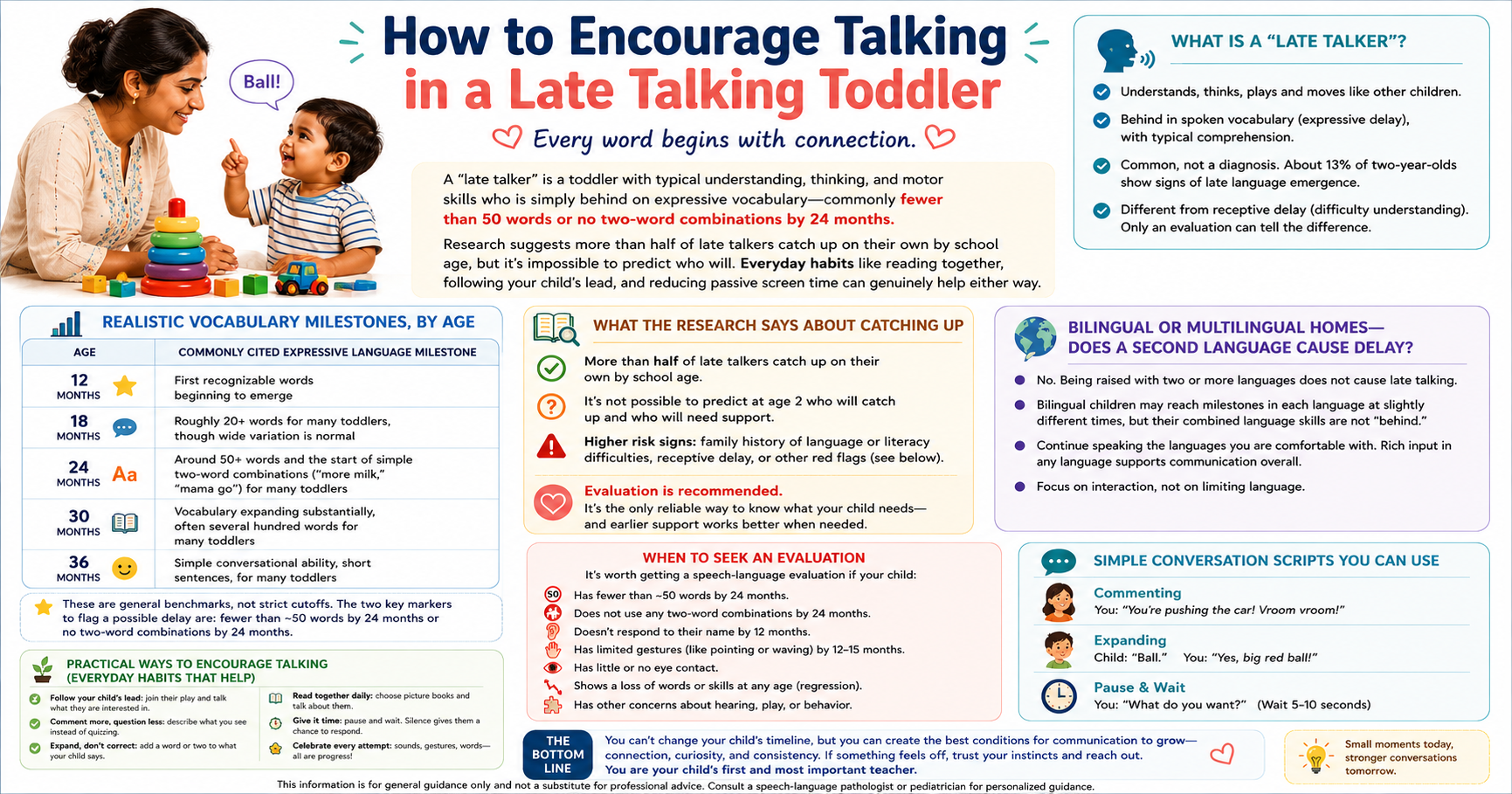
A “late talker” is a toddler with typical understanding, thinking, and motor skills who is simply behind on expressive vocabulary — commonly defined as fewer than 50 words or no two-word combinations by age 24 months. Research suggests more than half of late talkers catch up on their own by school age, but it’s genuinely impossible to predict which children will and won’t need extra support, which is why a speech-language evaluation is worth pursuing rather than waiting indefinitely, especially if other signs (limited gestures, not responding to their name, little eye contact, or any language regression) are also present. Certain everyday habits — reading together, following your child’s lead instead of quizzing them, and reducing passive screen time — genuinely help either way.
How to Encourage Talking in a Late Talking Toddler
There’s a very specific kind of worry that builds slowly and then all at once — a friend’s toddler, three months younger than yours, chatting in short sentences at a birthday party, while yours points and grunts and you laugh it off in front of everyone and then Google it that night. It gets more complicated in a lot of Indian households because someone in the family, usually with total confidence, will tell you it’s nothing — “boys talk late,” “his father also didn’t speak until he was three,” “don’t compare, every child is different.” Sometimes that reassurance is completely accurate. Sometimes it delays a conversation that was actually worth having sooner.
This article walks through what a late talker actually is, realistic milestones to check against, what research says about the odds of catching up, specific things that genuinely help — with real scripts, not just general advice — and a clear, calm answer for when this is worth an actual evaluation.
Table of Contents
What a “late talker” actually is
According to the American Speech-Language-Hearing Association (ASHA), “late language emergence” describes a child whose language development is behind expectations for their age, with no other diagnosed disability or delay in cognitive or motor development — in plain terms, a toddler who understands things normally, plays and moves typically, but is specifically behind on spoken vocabulary. This is commonly called being a “late talker.” It’s worth knowing this term specifically refers to expressive delay (behind on talking) alone; some late talkers also have a receptive delay (behind on understanding language too), which is a meaningfully different and often more significant picture, and generally something only a proper evaluation can distinguish reliably.
Late talking is genuinely common — research estimates suggest roughly 13% of two-year-olds show signs of late language emergence, so a parent noticing this is far from alone in the experience.
Realistic vocabulary milestones, by age
| Age | Commonly cited expressive language milestone |
|---|---|
| 12 months | First recognizable words beginning to emerge |
| 18 months | Roughly 20+ words for many toddlers, though wide variation is normal |
| 24 months | Around 50+ words and the start of simple two-word combinations (“more milk,” “mama go”) for many toddlers |
| 30 months | Vocabulary expanding substantially, often several hundred words for many toddlers |
| 36 months | Simple conversational ability, short sentences, for many toddlers |
These are commonly cited general benchmarks, not strict cutoffs — individual variation is wide and normal, and a toddler somewhat behind on this table isn’t automatically a cause for alarm. The two most commonly used markers for flagging a possible late talker specifically are: fewer than roughly 50 words by 24 months, or no two-word combinations by that age.
What the research says about catching up
This is the part worth knowing honestly, since it cuts both ways. Research on late talkers has found that a meaningful majority — commonly cited as more than half — do catch up to typical language levels on their own, without needing formal intervention. At the same time, researchers are clear that it’s genuinely not possible to reliably predict, at age 2, which individual child will catch up naturally and which will continue to need support. Certain factors are considered risk indicators for a delay being more persistent — including a family history of language or literacy difficulties, and especially the presence of a receptive language delay alongside the expressive one, or other red-flag signs covered further below.
Given this honest uncertainty, most speech-language professionals recommend evaluation rather than an indefinite “wait and see” approach — not because every late talker needs therapy, but because an evaluation is the only reliable way to tell which situation you’re actually in, and earlier support, when it is needed, is generally considered more effective than support started later.
Bilingual and multilingual homes — does a second language cause delay?
This deserves direct, specific reassurance, since it’s an extremely common worry in Indian households where a toddler might hear Hindi, English, and a regional or family language across different caregivers in the same week. Being raised bilingual or multilingual does not cause late talking, and it is not the explanation for a genuine language delay if one exists. Bilingual children may show slightly different vocabulary patterns in each individual language when measured separately, but their combined vocabulary across all languages is generally comparable to monolingual peers. If a true delay is present, it will typically show up across all the languages a child is exposed to, not just one — and the appropriate response is the same as for a monolingual child: rich, responsive interaction (in whichever languages the family speaks naturally) and, if warranted, a proper evaluation, not simplifying the home down to a single language in an attempt to “fix” things.
8 things that genuinely help, with real scripts
- Follow their lead instead of quizzing them. Rather than repeatedly asking “what’s this called?”, join whatever your toddler is already doing and narrate it: instead of holding up a toy car and asking “what is this,” say “oh, you’ve got the car — vroom, it’s going so fast!”
- Expand what they do say or gesture, without demanding a repeat. If your toddler points at a ball and says “ba,” respond with “yes! ball! a big red ball” rather than “say ball properly” — the expansion models the fuller word without turning it into a test.
- Use gestures and pointing alongside your words, since research on early communication finds that gesture use and later word use are closely linked — pointing, waving, and simple signs (like “more” or “all done”) give a toddler an additional, lower-pressure way to communicate that often supports spoken language rather than replacing it.
- Read together daily, and let your toddler drive the pace. A real, low-cost intervention studied specifically with late talkers — dialogic reading, where an adult pauses, asks about the pictures, and follows the child’s interest rather than reading straight through — has shown genuine benefit for expressive vocabulary recovery in research with late-talking toddlers.
- Offer choices instead of open questions that can be answered with a gesture alone. Instead of “what do you want,” try “do you want the ball or the block?” while holding up both — this gives a toddler a simple word they can imitate (“ball”) rather than an open field that invites just pointing.
- Narrate your day in short, simple phrases, especially during routines — “washing hands,” “shoes on,” “opening the door” — repeated consistently across days, since predictable, repeated language during the same routines is easier for a developing brain to pick up and eventually reproduce.
- Pause and wait after you speak, resisting the urge to fill every silence — a few extra seconds of expectant waiting after a question or comment gives a toddler genuine space to attempt a response, verbal or gestural, that gets talked over too quickly in a fast-paced conversation.
- Use every language your household naturally speaks, consistently, rather than restricting communication in an attempt to simplify things — per the bilingual guidance above, this doesn’t cause delay, and rich interaction in a family’s natural languages remains genuinely valuable.
Everyday habits worth adjusting
- Reduce passive screen time, especially without an adult co-viewing and talking about it — passive media doesn’t provide the responsive back-and-forth interaction that supports language development, and displacing that interaction time is a more relevant concern than the screen itself in isolation.
- Notice how often a want gets met before it’s expressed — if a toddler only needs to point or fuss for a sibling or grandparent to immediately hand over what they want, there’s less natural opportunity or need for them to attempt a word; briefly pausing (not withholding, just pausing) to invite an attempt can help, when done gently and without pressure.
- Be cautious about over-correcting or repeatedly demanding a “proper” pronunciation before your toddler is ready — this can sometimes reduce a hesitant talker’s willingness to attempt words at all, compared with simply modeling the correct word warmly in response.
Red flags — when this needs professional evaluation
Most late talking, especially with no other signs, tends to be an isolated, often temporary expressive delay. It’s worth pursuing a proper evaluation with a pediatrician or speech-language pathologist — not as an emergency, but reasonably promptly rather than waiting indefinitely — if you notice any of the following alongside late talking:
- Limited or absent use of gestures like pointing, waving, or showing objects to share interest
- Not consistently responding to their own name being called
- Limited eye contact or reduced interest in back-and-forth social interaction generally
- Difficulty understanding simple instructions or words (a receptive delay), not just difficulty producing words
- Any noticeable loss of words or skills previously present (regression)
- A family history of language, learning, or developmental disorders
These specific signs, especially in combination, can sometimes point toward something broader than an isolated late-talking pattern, which is exactly why a proper evaluation — not a checklist read online — is the right next step; only a qualified professional can accurately assess what’s actually happening for your specific child.
Handling family pressure (“wait and watch”)
This is often the real practical obstacle, more than the delay itself. A grandparent’s confident reassurance usually comes from genuine love and, often, an honest memory of a relative who did talk late and turned out fine — it’s not dismissive by intent. A few things help without turning it into a confrontation:
- Frame an evaluation as information-gathering, not an accusation of a problem: “hum bas check karwa lete hain, taaki pata chale sab theek hai” (let’s just get it checked, so we know everything’s fine) tends to land better than a debate about whether a concern is valid.
- It’s fine to seek an evaluation even if you ultimately turn out not to need ongoing therapy — an assessment that comes back reassuring is a genuinely good outcome, not a wasted effort.
- If a relative’s own child was a late talker and caught up fine, that’s a real, relevant data point — and also not a substitute for an actual evaluation given how much individual variation research shows in outcomes.
Real moments parents recognize
You might sit through an entire birthday party watching another toddler the same age chatter through a full sentence, and go home replaying every word your own child has or hasn’t said that week — and it’s worth remembering that one comparison at one party isn’t a diagnosis, in either direction.
Or a grandparent might say, with complete confidence, “uske papa bhi teen saal tak nahi bole the, bilkul theek hain ab” (his father also didn’t talk until three, he’s completely fine now) — and it’s worth holding both things at once: that story might be entirely true, and getting a professional opinion is still a reasonable, non-alarming thing to do.
Or you might notice yourself asking your toddler “what’s this, what’s this, what’s this” rapid-fire through an entire book, hoping repetition will eventually produce a word — and shifting to simply narrating what you see on each page, without demanding a response, might get further with a hesitant talker than the quiz ever did.
Frequently Asked Questions
What is a late talker? A late talker is a toddler with typical understanding, thinking, and motor development who is specifically behind on expressive (spoken) vocabulary for their age, commonly defined as fewer than 50 words or no two-word combinations by 24 months.
How many words should a 2-year-old say? Many 2-year-olds have around 50 or more words and are beginning simple two-word combinations, though individual variation is normal. Fewer than roughly 50 words or no word combinations by this age are the commonly used markers for a possible late talker.
Will my late talker catch up on their own? Research suggests more than half of late talkers catch up to typical language levels without formal intervention, but it isn’t possible to reliably predict which children will and which will need extra support at age 2 — which is why an evaluation, rather than indefinite waiting, is generally recommended.
Does bilingualism or a multilingual home cause late talking? No. Being raised with two or more languages doesn’t cause a genuine language delay. If a real delay exists, it typically shows up across all the languages a child is exposed to, and the appropriate response is the same as for a monolingual child — rich interaction and, if warranted, an evaluation.
Does screen time cause speech delay? Screen time itself isn’t clearly established as a direct cause, but passive screen use displaces the responsive, back-and-forth interaction that genuinely supports language development, which is the more relevant concern than screen exposure in isolation.
What’s the difference between a late talker and a speech delay more broadly? “Late talker” specifically refers to an isolated expressive vocabulary delay with typical understanding and development otherwise. A broader speech or language delay can also involve difficulty understanding language (receptive delay) or other developmental areas, which is a different and often more significant picture that only a proper evaluation can distinguish.
Is it true that boys talk later than girls? Some research suggests a modest average difference in early language development between boys and girls, but this is a general population pattern, not a reliable individual predictor, and it shouldn’t be used to dismiss a genuine, specific concern about a particular child.
When should I actually worry about my toddler not talking? Worth a professional evaluation if late talking is accompanied by limited gesture use, not responding to their name, reduced eye contact or social interaction, difficulty understanding simple instructions, any loss of previously present skills, or a family history of language or developmental disorders.
What activities genuinely help a late talker? Following your child’s lead rather than quizzing them, expanding what they say or gesture, reading together daily using a responsive (dialogic) style, using gestures alongside words, offering simple choices, and pausing to give genuine space for a response all have research or clinical support.
Should I take my late talker to a speech-language pathologist even if family says to wait? It’s a reasonable, non-alarming step regardless of family opinion — an evaluation that comes back reassuring is a good outcome, and it’s the only reliable way to know whether ongoing support might genuinely help, given that outcomes for individual late talkers can’t be predicted with confidence at this age.
Final thoughts
Most late-talking toddlers are exactly what the term describes — a little behind on spoken words for now, with everything else developing typically, and a real chance of catching up entirely on their own. The honest, slightly uncomfortable truth is that nobody can tell you in advance, with certainty, which category your specific child falls into — which is exactly why getting an evaluation is a reasonable, calm step to take, not an overreaction, whatever a well-meaning relative says at the next family gathering. In the meantime, the words you say alongside your child today — narrated, expanded, patiently waited for — are already doing real, useful work.