
In May, in a small flat in Nagpur, Meera sat on the floor with her three-month-old daughter and a wet cloth.
The baby’s neck was red. Tiny pink dots had spread across her back and shoulders. She was crying that thin, tired cry that every parent knows. The fan was on full speed. The curtains were shut. The temperature outside was well above 40°C.
Meera had done everything “right.” She had bought the cutest frocks and rompers. One was a shiny, soft, frilly piece a relative had gifted. It looked so pretty in photos. And the baby had worn it for six hours that afternoon.
Then her neighbour, a retired school teacher, came in with a bowl of dal and looked at the baby for two seconds. “Beta, yeh kapda hatao. Isme garmi phas jaati hai. Ek patli malmal ki cotton pehnao.”
The next morning, the rash was already fading.
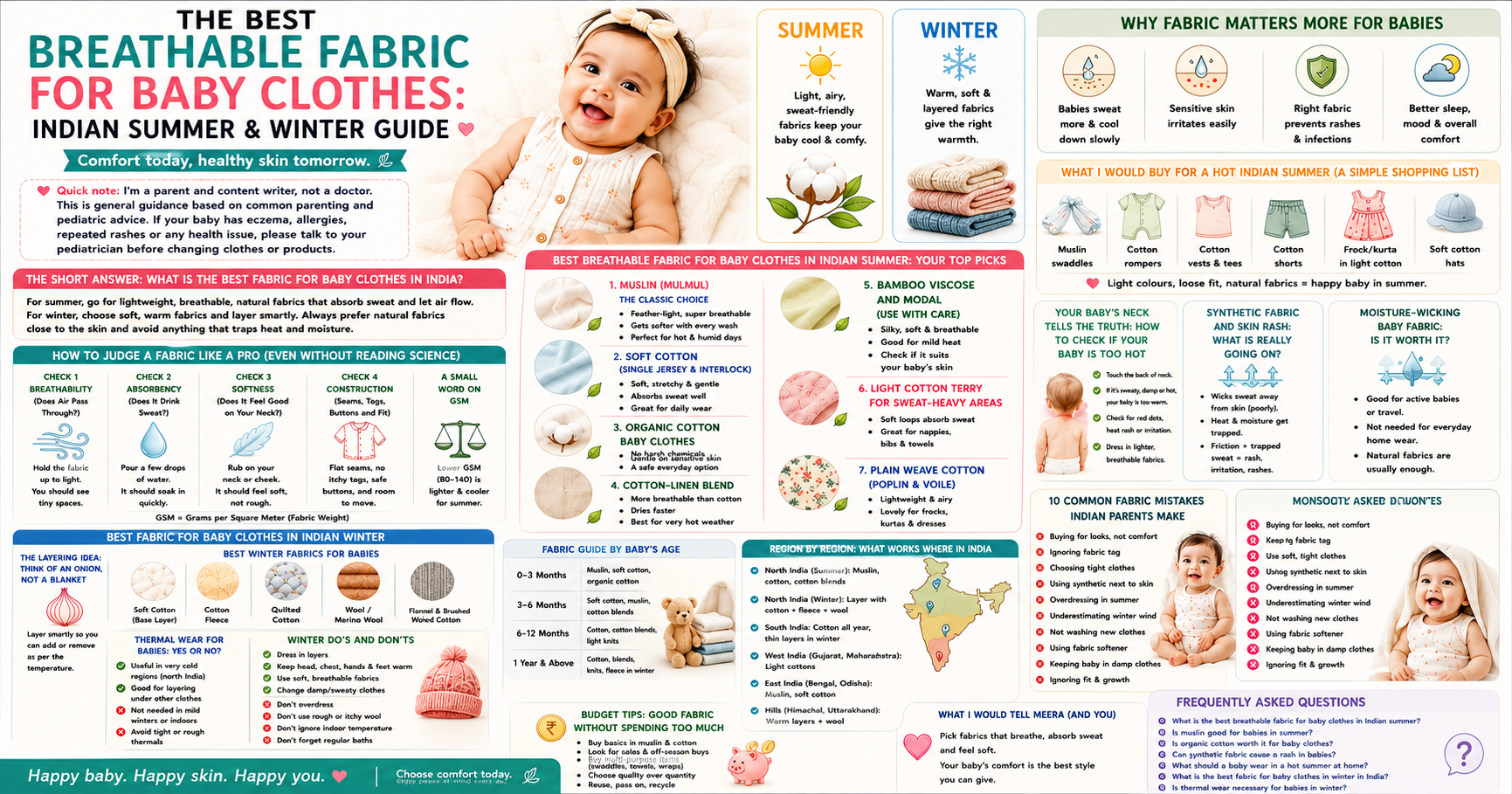
Best Breathable Fabric for Baby Clothes Indian Summer and Winter Guide
That day, Meera understood something no baby shop had told her. The cutest clothes are not always the safest clothes. And in India, where summer can feel like an oven and winter can bite in the north, fabric is not a small detail. It is the whole story.
If you are searching for the best breathable fabric for baby clothes Indian summer brings out, or you want to know what to dress your baby in for winter, you are in the right place. I will explain it the way I would explain to a friend, with no big words, and with real examples from Indian homes.
Quick note: I am a parent and content writer, not a doctor. This is general guidance based on common parenting and pediatric advice. If your baby has eczema, allergies, repeated rashes or any health issue, please talk to your pediatrician before changing clothes or products.
Table of Contents
The Short Answer: What Is the Best Fabric for Baby Clothes in India?
For Indian summer, the best breathable fabric for baby clothes is soft, lightweight, loosely woven cotton, such as muslin, mulmul or organic cotton. For winter, choose soft cotton layers with a warm, gentle outer layer like brushed cotton or fleece, and avoid scratchy wool and tight synthetic clothes next to the skin.
Here is the quick comparison:
| Season | Best choice | Okay choice | Avoid or limit |
|---|---|---|---|
| Summer (hot and dry) | Muslin, mulmul, light cotton, organic cotton | Cotton-linen blend, thin bamboo viscose | Polyester, nylon, satin, heavy prints |
| Monsoon (hot and humid) | Light cotton that dries fast, muslin | Thin cotton-modal blend | Thick denim, damp-holding fabrics, heavy synthetics |
| Winter (cold) | Soft cotton inner layer + brushed cotton or fleece outer layer | Fine merino wool (only if baby tolerates it) | Scratchy woolen sweaters on bare skin, tight synthetic thermals |
| All year, next to skin | 100% cotton | Cotton-rich blends | 100% synthetic |
Now let me explain the “why.” Because once you know the reason, you can shop like a pro, even when the shop has no labels in English.
Why Fabric Matters More for Babies Than for Adults
When I was learning this, one fact changed how I shop. A baby is not a small adult. A baby’s body works differently.
1. Baby skin is thinner and more delicate. It loses moisture faster and reacts faster to rough, tight or chemical-treated fabrics.
2. Babies cannot control their body heat as well as adults. They cannot take off a layer when they feel hot. They cannot tell you, “I am sweating.” Parents have to guess from the neck, the back and the hair.
3. Babies sweat in a different way. Their sweat glands are still developing. In hot, humid weather, sweat can get trapped under the skin and cause tiny red bumps. We call it prickly heat, and many Indian families know it as ghamauri or pitti.
4. Babies spend long hours in one position. A baby lies on a bed or in your arms for hours. A rough seam, a hard button or a stiff collar presses on the same spot again and again.
5. Babies put everything in their mouth. Sleeves, collars, bibs and blankets end up in the mouth. So the fabric should be clean and gentle.
This is why parents ask about synthetic fabric skin rash so often. It is not because synthetic is always “bad.” It is because trapped heat plus baby skin plus long hours is a recipe for trouble.
How to Judge a Fabric Like a Pro (Even Without Reading Science)
You do not need a lab. You need four simple checks. I use them every time I touch a baby garment in a shop.
Check 1: Breathability (Does Air Pass Through?)
Hold the fabric up to the light. Can you see a bit of light through it? Now blow on it from one side and put your hand on the other side. Do you feel the air?
Loosely woven fabrics, like muslin and mulmul, let air move easily. Tightly woven or coated fabrics, like satin, thick polyester or fleece, hold air and heat in.
Check 2: Absorbency (Does It Drink Sweat?)
Put a drop of water on the fabric. Cotton soaks it in quickly. Many synthetic fabrics make the drop sit on top or spread slowly. When a fabric cannot absorb sweat, the sweat stays on your baby’s skin.
Check 3: Softness (Does It Feel Good on Your Neck?)
Please do not test softness on your palm. Your palm is tough. Rub the fabric on the inside of your wrist or on your neck. If it feels even slightly scratchy or stiff there, it will bother your baby.
Check 4: Construction (Seams, Tags, Buttons and Fit)
Turn the garment inside out. Look at the seams. Are they flat and smooth, or thick and raised? Are tags stitched at the neck? Are there hard buttons, glitter, beads or lace that touch the skin?
A beautiful fabric can still fail the baby test if the stitching is rough.
A Small Word on GSM
You may see “GSM” on some labels. It means grams per square metre, and it tells you how heavy a fabric is. Lower GSM means lighter and thinner. Higher GSM means thicker and warmer. For summer, look for lighter fabrics. For winter, look for slightly heavier ones. But do not obsess over the number. Your hand and your common sense are good guides too.
Best Breathable Fabric for Baby Clothes in Indian Summer: Your Top Picks
Here is the heart of this article. These are the fabrics I would trust for a hot Indian summer, in the order I would choose them.
1. Muslin (Mulmul): The Classic Choice
If there is one fabric I would put on every summer baby list, it is muslin fabric for baby.
Muslin is a very light, loosely woven cotton fabric. In India, we call a similar fabric mulmul or malmal. Our grandmothers used it for generations, long before baby shops existed. They did not need a study to tell them it worked. They just felt how cool it was in the heat.
Why it works in summer:
- Very light and airy, so heat escapes easily.
- Soft and gentle on newborn skin.
- Gets softer with each wash.
- Dries quickly, even in humid weather.
- Can be used for clothes, swaddles, burp cloths, bibs and light sheets.
What to watch for:
- Very thin muslin can feel see-through, so for daytime wear, you may want a double layer.
- It wrinkles easily, but that does not matter for a baby.
- Cheap, rough “muslin-look” fabric is not the same. Touch it first.
Best for: newborn to 12 months, swaddling, daytime wear, sleepwear in hot nights, and as a layer under other clothes.
2. Soft Cotton (Single Jersey and Interlock)
Cotton is the most popular choice for baby clothes in India, and there is a good reason for it. It is breathable, absorbs sweat, and is easy to wash.
But not all cotton is the same. Here are the two types you will meet most often:
- Single jersey cotton: light, stretchy, and used for T-shirts, bodysuits and vests. Great for summer.
- Interlock cotton: a little thicker and smoother, with a soft feel on both sides. Good for spring, early monsoon and light winter layering.
For summer, pick light single jersey cotton in simple designs. Skip heavy prints that feel plastic-like or stiff. They can reduce how much air passes through.
3. Organic Cotton Baby Clothes
Parents often ask me, “Is organic cotton baby clothes really worth the extra money?”
Here is my honest answer.
Organic cotton is grown without synthetic pesticides and fertilisers, and the farming follows certain standards. Many parents like it because they want fewer chemicals around a baby. The fabric is usually soft and breathable, just like good regular cotton.
But the word “organic” on a label does not guarantee everything. Look for a trusted certification, like GOTS (Global Organic Textile Standard) or OEKO-TEX, on the tag or product page. These certifications check things like how the fabric is grown, processed and dyed.
My view: If your budget allows, organic cotton is a great choice for newborn vests, swaddles and sleepwear, because these touch the skin the most. If not, plain, soft, well-washed 100% cotton is still a very good option. Do not feel guilty if you cannot buy organic for everything.
4. Cotton-Linen Blend
Linen is made from the flax plant, and it is very cool and breathable. A thin cotton-linen blend can be a good choice for older babies and toddlers in peak summer.
The catch: pure linen can be a bit rough, especially when new. It softens after many washes. For tiny babies, I would pick a cotton-rich blend, not pure linen.
5. Bamboo Viscose and Modal (Use With Care)
You will see soft, silky baby clothes labelled “bamboo” in shops and online. These are usually made from bamboo viscose, a fibre made from bamboo pulp through a manufacturing process. They feel very soft and often drape nicely.
They can be comfortable in summer. But I would suggest checking the fabric on your own baby’s skin first, reading the care label, and buying from a brand you trust. Marketing claims are sometimes bigger than the fabric itself.
6. Light Cotton Terry for Sweat-Heavy Areas
A thin cotton terry cloth can be useful as a sweat-catching layer, such as a small towel placed under the baby’s head or back while sleeping. Change it when it gets damp. Do not use thick terry as clothing in summer. It is too warm.
7. Plain Weave Cotton (Poplin and Voile) for Frocks and Kurtas
For festive or daytime outfits, light plain-weave cotton, such as voile and soft poplin, can be a good choice. Look for lined garments where the lining is also cotton. A pretty outer cotton with a nylon or polyester lining defeats the purpose.
What I Would Buy for a Hot Indian Summer (A Simple Shopping List)
If you are a first-time parent and the shop is full of choices, this list can save you from over-buying:
- 5 to 7 light cotton or muslin vests or bodysuits for daily wear.
- 4 to 6 light cotton shorts, pyjamas or loose rompers.
- 3 to 4 muslin swaddles or wraps for sleeping, car rides and feeding.
- 2 to 3 thin cotton caps or sun hats for outdoor time (cotton, soft, wide enough to shade).
- A few extra muslin cloths to wipe sweat and spit-up.
Avoid buying large quantities of clothes in one size. Babies grow very fast, and many outfits get worn only a few times.
Your Baby’s Neck Tells the Truth: How to Check If Your Baby Is Too Hot
Parents ask me, “How will I know if the fabric is working?” Here is a simple method.
Put your hand on the back of your baby’s neck or between the shoulder blades. If the skin feels hot, damp or sweaty, your baby may be too warm. Do not rely on feeling the hands or feet. They are often cooler than the rest of the body, even when the baby is comfortable.
Signs your baby may be too hot:
- Red, flushed face
- Damp hair and sweaty neck
- Fast breathing or restlessness
- Heat rash on the neck, chest, back or skin folds
What to do: move to a cooler, shaded place, remove a layer, change into dry cotton clothes, and offer a feed. If your baby seems very unwell, very sleepy, or has a fever, please call your doctor straight away.
Overheating is also something doctors warn about for sleeping babies, so for sleep, keep the room comfortable and avoid piling on heavy clothes or blankets. Your pediatrician can tell you the right room setup for your baby’s age.
Synthetic Fabric and Skin Rash: What Is Really Going On?
This is the part I get the most questions on, so let me explain it carefully and fairly.
Synthetic fabrics like polyester, nylon, acrylic and many satin-type fabrics are made from man-made fibres, usually from petroleum-based materials. They are cheap, strong, colourful, and do not wrinkle much. That is why so many cute party outfits are made of them.
But when it comes to synthetic fabric skin rash, here is the main concern:
- They often do not absorb sweat well, so sweat stays on the skin.
- They can trap heat, especially if the fabric is tight or thick.
- Some people react to dyes, finishes or stiff coatings used on them.
- Rough lace, sequins, zip and elastic can rub the skin.
This does not mean that every synthetic fabric will give every baby a rash. Some babies wear them without any problem. But in hot Indian weather, the risk goes up. So my simple rule is:
Keep synthetic fabrics away from the baby’s bare skin in summer. If you must use a party outfit, put a cotton vest underneath, keep the time short, and remove it as soon as the function is over.
That way, you get the photo and the baby gets comfort.
Moisture-Wicking Baby Fabric: Is It Worth It?
You may have seen “quick-dry” or “moisture-wicking” tags on sports clothes, and now also on some baby clothes. So let me explain what they mean.
Moisture-wicking fabric is designed to pull sweat away from the skin to the outer surface, where it can dry quickly. In theory, that sounds perfect for hot weather. Adults wear these clothes for running and the gym, and they often work well.
For babies, though, I would be careful. Here is why:
- Most moisture-wicking fabrics are synthetic or have synthetic finishes.
- Babies are not running marathons. They are lying down, sleeping and being carried. The fabric does not get airflow like it does on a runner.
- Some finishes can bother very sensitive skin.
- A soft, light cotton or muslin already does a good job in most Indian homes.
So my view is simple. For everyday baby clothes, I would stay with cotton and muslin. If you are planning a long outdoor trip, a hot train journey or a hike, and you want a fast-drying layer, a cotton-rich blend with some wicking ability can be tried. But watch your baby’s skin closely, and keep it away from the bare skin where possible.
Monsoon: The Season Parents Forget
Everyone talks about summer and winter. But in much of India, monsoon is the season when babies get skin trouble the most.
The air is damp. Clothes take a long time to dry. The skin stays moist in the neck folds, under the arms, behind the knees and in the nappy area. Fungal rashes and prickly heat both love this weather.
Here is what helps:
- Choose light cotton or muslin that dries quickly.
- Avoid thick, heavy fabrics that stay wet for days.
- Always dry clothes fully, using a fan, a clean indoor rack, or a dryer. Iron them if they feel even slightly damp.
- Keep two or three extra changes of clothes ready, because babies sweat even when it is not hot.
- Store clothes in a dry cupboard. Put a small cloth bag of dry neem leaves or a silica gel pack (kept away from the baby) to reduce the damp smell.
- Do not let your baby sit for long in a damp nappy or wet clothes.
If you see a rash with red patches, a shiny look or little pimples in the folds that does not improve in a few days, show it to your pediatrician.
Best Fabric for Baby Clothes in Indian Winter
Now let me turn to winter. Winter in India is not one thing. In Delhi, Punjab, Haryana, Uttarakhand, Himachal and Kashmir, it can be freezing. In Pune, Hyderabad or Bengaluru, it is cool but mild. In Chennai or Kerala, you may not need winter clothes at all.
So the right choice depends on where you live and how cold it actually gets.
The Layering Idea: Think of an Onion, Not a Blanket
The smartest way to dress a baby in winter is in thin layers, not one thick heavy piece. Layers trap warm air between them, and you can remove or add one as the day changes.
A simple three-layer system:
- Inner layer (next to skin): soft cotton vest or full-sleeve bodysuit. This layer touches the skin and should always be soft and breathable.
- Middle layer (for warmth): a cotton pyjama set, brushed cotton or a light knitted layer.
- Outer layer (for cold or going outside): a soft sweater, fleece jacket or a warm wrap, which you take off when you come inside.
In a cold room, add a cotton cap, socks and mittens. Take them off when the baby gets warm.
Best Winter Fabrics for Babies
1. Soft cotton (as the base layer). Even in winter, cotton should be the layer that touches your baby’s skin. It absorbs sweat so your baby does not get damp and cold.
2. Brushed cotton or cotton flannel. The surface is gently raised to make it fluffy and warm, while still being cotton. A good choice for night suits and baby blankets.
3. Interlock cotton. A bit thicker than single jersey, smooth and warm without being heavy. Great for cool, not freezing, weather.
4. Fleece (as an outer layer only). Fleece is warm and light, and babies love how soft it is. But it is a polyester-based fabric, so it can make a baby sweat when worn indoors or for long hours. Use it as a top layer for outings and take it off indoors. Do not use it next to the skin.
5. Wool and merino (only if your baby tolerates it). Fine merino wool is soft, warm and can handle moisture well. But regular wool can feel itchy and may cause rashes in some babies. If you choose woolen sweaters, always put a cotton layer between the wool and the skin, and watch for redness.
6. Cotton-wool or cotton-acrylic knitted sweaters. Very common in India. They are fine as an outer layer. Check that the inside is soft, with no loose threads to catch tiny fingers and toes.
Thermal Wear for Babies in Winter: Yes or No?
This is the most-asked question I get from parents in North India. Thermal wear for baby winter has become very popular, but it needs thought.
Thermal wear is made to hold body heat close to the skin. Good thermals made from soft cotton or a cotton-rich blend can be useful on really cold days, especially in states like Delhi, Punjab, Uttarakhand or Himachal. They can be worn as an inner layer under a pyjama set or sweater.
But be careful with:
- 100% synthetic thermals. They can trap sweat and cause rashes if worn for many hours.
- Tight-fitting thermals. They can press on the baby’s skin and make movement hard.
- Wearing thermals plus sweaters plus blankets all together. This can make your baby too hot and sweaty. When a baby sweats and then goes out in cold air, that is not good either.
My simple rule: use thermals only when the weather really needs it, pick the softest cotton-rich ones, and remove them when the baby is indoors in a warm room.
Winter Do’s and Don’ts
Do:
- Keep the baby’s head, hands and feet covered in cold weather.
- Check the back of the neck to see if your baby is warm, not hot.
- Wash new woolens and thermals before use, using a mild detergent.
- Keep the room at a comfortable temperature, not hot and stuffy.
Don’t:
- Do not wrap your baby in many heavy layers and then close all the windows.
- Do not put a baby to sleep with a cap, scarf, or loose blanket over the face. Please ask your pediatrician about safe sleep setup for your baby’s age.
- Do not use a room heater or blower directly near the baby, or leave it on in a closed room.
- Do not use a tight sweater with a small neck opening.
Fabric Guide by Baby’s Age
| Age | What matters most | Fabric suggestion |
|---|---|---|
| Newborn (0 to 3 months) | Softest, gentlest, easiest to change | Muslin, soft cotton, organic cotton. Front-open styles for easy dressing |
| 3 to 6 months | Rolling around, more sweating, drooling | Cotton jersey, muslin, soft interlock. Easy-to-wash pieces |
| 6 to 12 months | Crawling, rubbing knees and elbows | Sturdy but soft cotton. Pants with soft knees |
| 1 to 3 years | Play, dirt, frequent washing | Cotton blends are fine. Strong stitching, easy to wash |
As the baby grows, you can relax a little. A toddler with healthy skin can handle more fabric types than a newborn. But breathable cotton is still the winner for hot weather.
Region by Region: What Works Where in India
India is huge, and no single rule fits every home. Here is a rough guide.
Hot and dry (Rajasthan, Gujarat, Madhya Pradesh, Vidarbha, Telangana, much of the interior): Summer is intense. Choose muslin, mulmul and light cotton. Keep the baby shaded, hydrated (as per your doctor’s advice on feeding) and in loose clothes. Winter is mild to cool, so light layers are enough.
Hot and humid (Mumbai, Kolkata, Chennai, Kerala, coastal Andhra, Odisha): Sweat does not dry easily here. Pick light, quick-drying cotton and muslin. Keep extra changes ready. Winter clothing is rarely needed, just a light layer at night.
Cold winters (Delhi NCR, Punjab, Haryana, Uttar Pradesh, Uttarakhand, Himachal, Kashmir): Layering is key. Cotton base, brushed cotton or woolen middle layer, and a warm outer layer. Hot summers still need muslin and cotton.
Hills and cool regions (Bengaluru, Pune, Shimla, Ooty, Darjeeling): Weather changes in a day. Layers you can add or remove are your best friend.
10 Common Fabric Mistakes Indian Parents Make
We all make them. I made a few myself while learning. Here are the ones I see again and again:
- Buying clothes for looks, not comfort. Frills, lace, sequins and shiny fabrics look lovely in photos, but are not great for long wear.
- Putting a baby in synthetic party wear for hours in summer. A short event is okay. A long day is not.
- Skipping the first wash. New clothes need a wash before first use.
- Using fabric softener and strong detergent. They leave residue that can irritate skin.
- Over-dressing in winter. Too many layers can make a baby sweaty and uncomfortable.
- Putting woolen sweaters directly on skin. Wool can itch. Use a cotton layer under it.
- Buying too many clothes in one size. Babies grow quickly.
- Trusting labels blindly. “Organic,” “bamboo” and “natural” are sometimes marketing words. Check for certifications and touch the fabric.
- Ignoring the tag and seams. A hard tag at the neck can bother the baby all day.
- Not drying clothes fully in monsoon. Damp clothes cause smell, mould and skin trouble.
A Simple Buying Checklist Before You Pay
Keep this on your phone when you go shopping:
- Is the fabric soft on my wrist or neck?
- Does it have a good amount of cotton (ideally 100% for next-to-skin wear)?
- Is it light enough for the season?
- Are the seams flat and smooth?
- Are tags soft, or can I cut them off safely?
- Are there any hard buttons, beads, glitter or rough lace?
- Is the neck opening wide enough to pull over the head easily?
- Are the colours very dark or heavily printed? (Deep dyes and thick prints can be harder on very young babies.)
- Is it machine-washable and easy to dry?
- Does it have a trusted certification, if it says “organic”?
If the answer is yes to most of these, you have found a good one.
How to Care for Baby Fabrics So They Stay Soft
Even the best fabric becomes rough if it is not cared for well.
- Wash new clothes before use with a mild, fragrance-free detergent.
- Do not use too much detergent. Rinse well.
- Skip fabric softeners.
- Dry cotton and muslin in shade or soft sun. Very strong sun for many hours can make dark colours fade.
- Wash woolens and thermals as per the care label, usually gently and in cool water.
- Store clothes in a clean, dry place. Avoid mothballs near baby clothes, and ask your pediatrician if you want to use any storage product.
(For a deeper guide to keeping baby laundry clean and safe, see our article on washing baby clothes separately from family laundry.)
Budget Tips: Good Fabric Without Spending Too Much
Not every family can spend a lot, and you do not need to.
- Buy fewer, better pieces for the clothes that touch the skin the most, such as vests, swaddles and sleepwear.
- Plain cotton from a local market can be as good as a branded piece, if it is soft and well-stitched. Wash it a couple of times before use.
- Accept hand-me-downs from friends and family. Used cotton clothes are often softer and have already been washed many times. Just wash them well.
- Buy off-season during sales, but check the size you will need later.
- Skip fancy party outfits unless you really need them. A simple cotton outfit with a nice cap can look just as sweet.
What I Would Tell Meera (and You)
Go back to Meera on that Nagpur afternoon, with her baby’s red neck and her tired eyes.
Here is what I would tell her. Take off the shiny frock. Put on a thin cotton or muslin set. Keep her in a cool, shaded room. Check the back of her neck, not her hands. Keep a dry cloth nearby. And forgive yourself, because you were only trying to do your best.
That is the real lesson. The best breathable fabric for baby clothes in Indian summer is the one your grandmother already knew: soft, light, loosely woven cotton. For winter, it is layers, with cotton on the skin and warmth on top. Everything else is detail.
You do not need the costliest brand or the cutest outfit. You need a baby who is comfortable, dry, and not too hot or too cold. If you can check those three things, you are doing a wonderful job.
Frequently Asked Questions
What is the best breathable fabric for baby clothes in Indian summer?
Soft, lightweight cotton, especially muslin (mulmul) and light single jersey cotton, is the best breathable fabric for baby clothes in Indian summer. Organic cotton is also a great option if it fits your budget.
Is muslin good for babies in summer?
Yes. Muslin is light, airy and soft, so it lets heat and sweat escape easily. It is also quick to dry, which helps in humid weather. It works well for swaddles, clothes and light sheets.
Is organic cotton worth it for baby clothes?
It can be, especially for clothes that touch the skin all day, like vests and sleepwear. Look for trusted certifications like GOTS or OEKO-TEX. If it is out of budget, soft, well-washed regular cotton is also a good choice.
Can synthetic fabric cause a rash in babies?
It can in some babies, mainly because synthetic fabrics often trap heat and sweat. This is more likely in hot, humid weather or when the fabric is tight. For summer, keep synthetic fabrics away from bare skin, and use a cotton layer underneath.
What should a baby wear in a hot summer at home?
A light cotton or muslin vest or shorts is often enough in a cool or fan-cooled room. Keep the baby in loose clothes, and check the back of the neck to see if your baby is too warm.
What is the best fabric for baby clothes in winter in India?
A soft cotton inner layer with a brushed cotton or fleece outer layer works for most families. In very cold places, add a woolen or knitted sweater over a cotton layer. Do not put scratchy wool directly on the skin.
Is thermal wear safe for babies in winter?
Soft, cotton-rich thermals can be used on very cold days as an inner layer. Avoid tight or fully synthetic thermals, and avoid layering too many clothes. Take off layers when the baby is in a warm room.
Is fleece good for babies?
Fleece is warm and soft, but it is polyester-based and can make babies sweat. Use it as an outer layer for outings, not next to the skin or for long hours indoors.
Is moisture-wicking fabric good for baby clothes?
It can help in some cases, like hot travel or outdoor trips, but most moisture-wicking fabrics are synthetic. For everyday wear, cotton and muslin are usually safer and more comfortable for babies.
How do I know if my baby is too hot or too cold?
Feel the back of the neck or the chest. If it is sweaty or very hot, remove a layer. If it feels cool, add a layer. Hands and feet are often cooler even when the baby is comfortable, so do not go by them.
Should I wash new baby clothes before using them?
Yes. Wash all new baby clothes with a mild, fragrance-free detergent before the first wear to remove dust and finishing chemicals.