
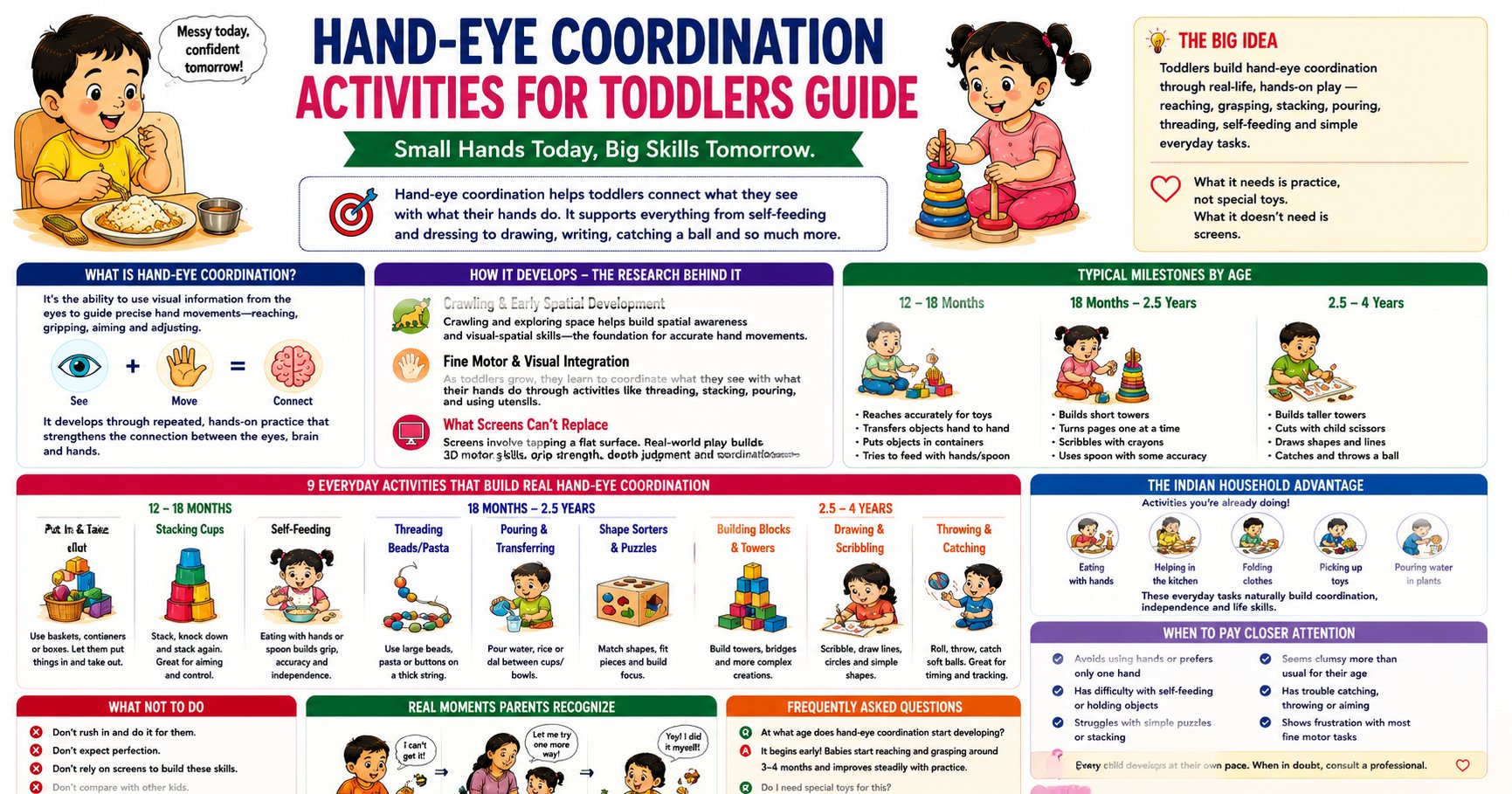
Hand-eye coordination — the ability to use visual information to guide precise hand movement — develops steadily through toddlerhood via hands-on, physical activity: threading, stacking, throwing, pouring, self-feeding, and simple household tasks. It doesn’t require special toys or classes; most of the genuinely useful activities are things many Indian households already do, from eating rice with hands to helping roll dough in the kitchen. What it does need is repeated, hands-on practice — something a screen, however colourful, can’t substitute for.
Hand-Eye Coordination Activities for Toddlers Guide
There’s a moment that happens in almost every household with a toddler around the eighteen-month mark: a fistful of rice, aimed vaguely in the direction of a mouth, ends up mostly on the cheek, the tray, and occasionally the family dog. It’s messy, it’s slow, and it’s incredibly tempting to just pick up the spoon and feed the child yourself to get through dinner in under forty-five minutes. It turns out that messy fistful of rice is doing something genuinely useful — it’s one of dozens of small, ordinary moments where a toddler’s brain is learning to connect what the eyes see with what the hand does, a skill that eventually shows up in everything from catching a ball to holding a pencil.
This article looks at what hand-eye coordination actually is, how it develops, typical milestones by age, and specific everyday activities — many of which are probably already part of your household routine — that build this skill without needing a single new toy.
What hand-eye coordination actually is
Hand-eye coordination refers to the brain’s ability to take in visual information through the eyes and use it to guide precise, controlled movement of the hands — reaching for the right spot, adjusting grip based on an object’s size, timing a catch based on how fast a ball is moving toward you. It’s a genuinely foundational skill: it underlies self-feeding, dressing, drawing, writing, and eventually sports and most everyday physical tasks. It develops through the combined maturing of visual processing, fine motor control, and the neural pathways that connect the two — which is why it can’t really be taught directly through instruction; it develops through repeated, hands-on physical practice.
Table of Contents
How it develops — the research behind it
Crawling and early spatial development
It might seem unrelated, but crawling plays a real, documented role here. Research on infant motor development has found that the experience of crawling — and more broadly, independently moving through space — measurably supports the development of spatial awareness and visual-spatial skills that later feed into refined hand-eye coordination. Babies who get plenty of floor time to crawl and explore are building the spatial groundwork that later shows up in tasks like reaching accurately or catching a ball.
Fine motor and visual integration
As toddlers move past infancy, hand-eye coordination becomes increasingly tied to fine motor skill — the precise, small-muscle movements of the hands and fingers. Occupational therapy research describes this as the integration of visual processing and motor control: a toddler doesn’t just need functioning eyes and functioning hands, they need the neural pathways connecting the two to develop through repeated practice at tasks that require both — threading, stacking, pouring, and using utensils among them.
What screens can’t replace
This is worth stating plainly, since it’s an increasingly common substitute for hands-on play time. A screen — however engaging or “educational” the app claims to be — asks a toddler’s eyes to track and respond to something, but it doesn’t require the physical, three-dimensional motor practice (grasping, adjusting grip, aiming, releasing) that actually builds hand-eye coordination. Tapping a flat screen is a fundamentally different motor task than picking up a bead, aiming it at a string, and threading it through. Time spent on genuinely hands-on manipulation of real objects isn’t easily substituted by screen-based activity, however visually engaging that activity is.
Typical milestones, by age
| Age | What’s typically emerging | What this looks like |
|---|---|---|
| 12–18 months | Simple stacking, dropping objects into containers, early spoon attempts | Stacking two to three blocks, putting a ball into a box, scooping with a spoon (messily) |
| 18 months–2 years | Improved grasp and release control, simple throwing | Throwing a ball a short distance (without much aim yet), turning pages, scribbling with a fist grip |
| 2–3 years | Better aim and timing, more controlled tool use | Attempting to catch a large, softly thrown ball, stringing large beads, using a spoon with less mess |
| 3–4 years | Refined precision, early tool-based tasks | Cutting with safety scissors along a line, threading smaller beads, catching a ball two-handed with reasonable success |
These are general patterns, not strict deadlines — the range of typical development here is wide, and a few months of variation in either direction is common and usually not a concern.
9 everyday activities that build real hand-eye coordination
12–18 months
- Container drop-and-fill play: Let your toddler drop small (safely large, non-choking-hazard) objects into a container and dump them out repeatedly — the “in and out” motion builds targeting and release control.
- Simple stacking: Blocks, plastic cups, or stackable rings encourage a toddler to visually judge placement and adjust their hand movement accordingly.
- Self-feeding with fingers or a spoon: Messy as it is, this is genuine, repeated hand-eye coordination practice — aiming food toward the mouth based on what the eyes see.
18 months–2.5 years
- Rolling and gently throwing a soft ball back and forth: Start close and slow; the timing and targeting involved builds toward later catching skill.
- Simple large-bead threading: Chunky beads on a shoelace or pipe cleaner require watching the hole, aligning the bead, and pushing it through — a direct hand-eye coordination task.
- Playdough manipulation: Rolling, flattening, and poking playdough with fingers or simple tools builds the fine motor control that supports coordination, alongside hand strength.
2.5–4 years
- Pouring and scooping with water or dry rice/lentils: Pouring from one container to another (over a tray to manage mess) requires watching the target and adjusting hand angle and speed continuously.
- Catching a large ball with two hands: Gradually increasing throw distance and reducing ball size as skill improves builds timing and spatial judgment.
- Simple lacing cards or safety scissors with adult supervision: Both require close visual tracking paired with careful hand control, building toward the precision needed for later writing.
The Indian household advantage — activities you’re already doing
A lot of families spend money on “developmental” toys without realizing several ordinary Indian household and cultural practices are already doing genuinely useful hand-eye coordination work.
- Eating with hands: The traditional practice of eating rice, roti, and dal with the hands requires continuous visual-motor coordination — judging portion size, guiding food to the mouth, adjusting grip on a piece of roti. It’s not just cultural preference; it’s a legitimate, repeated coordination exercise that a spoon-fed toddler gets less practice with.
- Helping in the kitchen: Letting a toddler help roll small balls of dough, mix batter with a spoon, or pour a measured cup of water into a bowl (with supervision) combines several coordination-building motions in a task that also builds a sense of contribution and independence.
- Threading marigolds or beads for a garland: If your household strings flowers for pooja or festivals, a toddler “helping” with large, soft flower heads and a blunt needle-free thread setup is essentially a bead-threading activity with cultural meaning built in.
- Traditional games: Simple versions of catching a ball, rolling marbles (kanche) under supervision for older toddlers, or spinning a large, soft top all involve the same visual-tracking-plus-hand-control skill the research points to.
- Rangoli with large dots or stencils: Guiding a finger or a simple tool to connect dots or fill in a pattern builds the same visual-motor integration as more “formal” tracing activities.
None of this means store-bought puzzles or lacing kits are unnecessary — they’re genuinely useful too — but it’s worth recognizing that a lot of valuable practice is likely already happening in your home without a specific “activity” label attached to it.
When to pay closer attention
Most variation in hand-eye coordination development is completely typical, and skill differences between children of the same age are normal. It’s worth mentioning to your pediatrician — not urgently, just as a conversation — if you notice:
- Persistent, significant difficulty with tasks most same-age peers manage reasonably well (like very inconsistent reaching, or an inability to attempt catching even a large, softly thrown ball by age 3)
- A strong, one-sided preference or difficulty using one hand consistently well before the age hand dominance typically settles
- Noticeable regression in a skill your toddler previously had
- Hand-eye coordination difficulty alongside other developmental concerns (speech, gross motor delays, general coordination issues)
None of these points are meant to suggest a diagnosis — coordination difficulties in young children have a wide range of causes and outcomes, and a pediatrician or, if recommended, an occupational therapist is the right person to properly assess a specific concern rather than trying to judge it from a checklist online.
What not to do
- Don’t rush to feed your toddler yourself every time self-feeding gets messy or slow — the mess is often where the actual coordination practice is happening.
- Don’t rely on screen-based “educational” games as a substitute for hands-on manipulation of real objects — the physical grasping, aiming, and releasing involved in real objects isn’t replicated by tapping a flat screen.
- Don’t set expectations based on an older sibling’s or a neighbour’s child’s pace — the typical range for these skills is genuinely wide.
- Don’t discourage traditional practices like eating with hands in favour of “neater” alternatives purely for convenience — there’s a real developmental trade-off being made there, even if it’s a minor one.
- Don’t wait for a “proper” activity kit before starting — most of the useful practice can begin today with things already in your kitchen.
Real moments parents recognize
You might spend an entire meal watching your toddler miss their mouth more than they hit it and feel the urge to just take over with the spoon — and it’s worth reminding yourself that the aiming attempt itself, however messy, is the actual skill-building happening in that moment.
Or you might hand your toddler a few large marigolds to “help” with a garland before a family puja, expecting mostly chaos, and notice them genuinely concentrating on getting the flower onto the thread — a small, unplanned moment of real coordination practice.
Or you might watch a two-year-old attempt to catch a ball and simply hold their arms out a beat too late, again and again, and wonder if something’s wrong — when in fact that timing gap is exactly what’s expected at this age, and it closes gradually with repeated, low-pressure practice, not correction.
Frequently Asked Questions
What age does hand-eye coordination develop in toddlers?
It develops steadily throughout the toddler years, roughly ages 1 to 4, building on earlier infant milestones like reaching and grasping. Simple stacking and dropping emerge around 12–18 months, with more refined skills like catching and threading small beads developing by ages 3–4.
When should a toddler be able to catch a ball?
Most toddlers begin attempting to catch a large, softly thrown ball with reasonable success somewhere between 2 and 3 years old, with accuracy and two-handed control improving noticeably by age 3–4. Wide individual variation here is normal.
Does screen time affect hand-eye coordination?
Screen-based activities involve visual tracking but not the physical, three-dimensional motor practice (grasping, aiming, releasing real objects) that builds hand-eye coordination. Time spent on hands-on manipulation of real objects generally isn’t replaced by screen-based activity, however visually engaging.
How does crawling help with hand-eye coordination?
Research links the experience of crawling and independent movement through space to the development of spatial awareness and visual-spatial skills, which later support more refined hand-eye coordination tasks.
Is eating with hands actually good for a toddler’s development?
Yes — it requires continuous visual-motor coordination (judging portion, guiding food to the mouth, adjusting grip), making it a genuine, repeated coordination-building practice, not just a cultural or convenience choice.
Is threading beads good for toddlers?
Yes, particularly with larger, easier-to-manage beads for younger toddlers, progressing to smaller beads as coordination improves. It directly practices the visual-targeting-plus-hand-control skill central to hand-eye coordination.
What are signs of poor hand-eye coordination in a toddler?
Persistent, significant difficulty with age-typical tasks (like an inability to attempt catching even a large ball by age 3), a strong one-sided hand preference well before typical, or regression in a previously mastered skill are worth mentioning to a pediatrician — though a wide range of typical development exists.
Does playdough help hand-eye coordination?
Yes — manipulating, rolling, and shaping playdough builds fine motor control and hand strength that support coordination, alongside offering a low-pressure, tactile activity toddlers generally enjoy.
How can I improve my toddler’s hand-eye coordination at home without buying new toys?
Everyday activities already available at home work well — self-feeding, kitchen helping tasks (pouring, mixing), ball rolling and catching, and traditional practices like helping thread flowers or draw simple rangoli patterns all build genuine coordination skill.
Should I worry if my toddler is clumsier than other kids their age?
Occasional clumsiness and a wide range of coordination skill among same-age toddlers is typical. It’s worth a conversation with your pediatrician if the difficulty is persistent, significant, or paired with other developmental concerns, rather than something to diagnose from comparison alone.
Final thoughts
None of this requires a shopping trip. A fistful of rice at dinner, a few marigolds handed over before a puja, a ball rolled back and forth on the living room floor — these ordinary moments are doing real, measurable developmental work, whether or not anyone in the room thinks of them as an “activity.” The mess, the missed catches, the wonky rangoli dots are not signs of a child falling behind; they’re what the actual skill-building looks like while it’s still in progress.
Read Also
- Play-Based Learning vs Academic Preschool: An Honest Look at the Research
- Gross Motor Milestones by Age (0-3 Years): The Complete Guide
- How Much Structured Learning Is Too Much Before School Age? Guide
- Music and Rhythm Activities for Early Brain Development: What Actually Helps
- Problem Solving Skills in Toddlers: Everyday Activities That Build Them