Physical Address
304 North Cardinal St.
Dorchester Center, MA 02124
Physical Address
304 North Cardinal St.
Dorchester Center, MA 02124

Your baby will outgrow four sizes in twelve months. Your budget does not have to outgrow itself with them.
Stay with me for a few minutes. By the end of this article, you will know a simple three-number formula that tells you exactly how much to spend on baby clothes in the first year, and where most Indian parents quietly lose money without noticing.
Aarti stood in the middle of her living room in Surat with a shopping bag in each hand and a smile that was slowly going soft at the edges.
It was the third big sale of the season. She had found a pack of twelve baby outfits at a price that looked almost too good to be true. “Sirf itne mein?” she had said to her husband on the phone, holding up the screen. “Yeh toh lena hi padega.”
He had agreed. Why not? It was a bargain.
That night, she opened the bags on the bed and started sorting. Newborn size. 0-3 months. 3-6 months. 6-9 months. Some of it was cute. Some of it she did not remember ordering. And then she looked at the cupboard, the one with three shelves already full of gifts from relatives, and she felt a small cold feeling in her stomach.
Her baby was five weeks old.
By the time the baby grew into half of those clothes, the sale price would have been forgotten, the season would have changed, and some of the tags would be a year old. She did the maths on the back of an envelope, because that is what tired parents do at midnight. And the number she wrote down was larger than she had ever imagined spending on clothes for someone who could not yet hold her own head up.
“Itna kyun kharid liya maine?” she asked the empty room.
The answer was not that Aarti is careless. She is one of the most careful people I know. The answer is that baby clothes are designed to make us spend. They are tiny, adorable, always on sale, always a gift idea, and always “just one more.” No one teaches us how much is enough.
So in this article, I will teach you. We will look at how much to spend on baby clothes in the first year in India, with three realistic budget levels you can pick from. I will show you where the money really goes, how to stop overbuying, and 12 proven ways to save without making your baby uncomfortable or your cupboard sad. And at the end, I will show you how to track it all in a simple way, so the numbers never surprise you again.
Quick note: I am a parent and content writer, not a financial advisor. The rupee figures in this article are illustrative examples built from simple, round numbers so that you can see how the maths works. Real prices change by city, brand, shop and season. Please replace my numbers with your own local prices. For serious money decisions, talk to a qualified advisor.
There is no single right number, but most families can dress a baby well in the first year on a budget of roughly Rs 10,000 to Rs 25,000, depending on how many pieces they buy and how many arrive as gifts and hand-me-downs. The smartest way to decide is a simple formula: pieces you must buy, times your average price per piece, plus a small extras fund.
Here is the same answer in an illustrative table. Please remember, these are examples, not official prices.
| Budget level | Pieces you buy yourself | Average price per piece (example) | Extras and one festive outfit | Illustrative first-year total | Per month |
|---|---|---|---|---|---|
| Lean | About 55 | Rs 150 | About Rs 2,100 | About Rs 10,000 to Rs 11,000 | About Rs 900 |
| Balanced | About 75 | Rs 250 | About Rs 3,700 | About Rs 21,000 to Rs 23,000 | About Rs 1,900 |
| Comfort | About 90 | Rs 400 | About Rs 6,500 | About Rs 40,000 to Rs 43,000 | About Rs 3,500 |
So, the baby clothes cost per month can be as low as about Rs 900 for a lean family, or as high as Rs 3,500 or more for a comfort-first family. All three can be good choices. The important thing is that you choose the level on purpose, instead of drifting into it one sale at a time.
Now let me show you where these numbers come from, so you can make them your own.
Before we build a budget, let us understand why we overspend. When you know the traps, you can step around them.
1. Babies outgrow clothes quickly. A newborn, a three-month-old and a nine-month-old are three very different sizes. A garment that fits for only a few weeks is a poor deal per wear, however low the price.
2. Everything is adorable. Tiny clothes trigger a soft spot in all of us. It is hard to say no to a mini kurta with a tiny border.
3. Gifts arrive from everywhere. Relatives, neighbours and friends all bring clothes. This is lovely, but it means you may already have a lot before you buy anything. (We explained how to handle this in our guide on newborn vs 0-3M size.)
4. Sales feel like savings. A big discount makes a purchase feel smart, even if you did not need the item. A bargain on something you will not use is not a saving. It is a cost.
5. Festivals and functions. Naming ceremonies, first festivals, weddings and visits to the village all create pressure to dress the baby in something special.
6. We buy for the baby we imagine, not the baby we have. Many of us buy a full wardrobe in one size, before we know if the baby will be small, average or big.
7. Fear. New parents worry about running out of clothes at midnight. So we buy extra, “just in case,” and the extras pile up.
8. We do not track. Many families never add up what they spent on baby clothes. A small purchase here and there feels harmless, until the total arrives.
If you recognise yourself in even three of these, you are in good company. Now let us fix it, kindly.
Here is the formula that makes a baby clothes budget easy. You only need three numbers.
First-year clothes budget = (Pieces you need to buy) × (Average price per piece) + Extras fund
Let me explain each number, step by step.
This is the most powerful number, because it is the one you can change most easily.
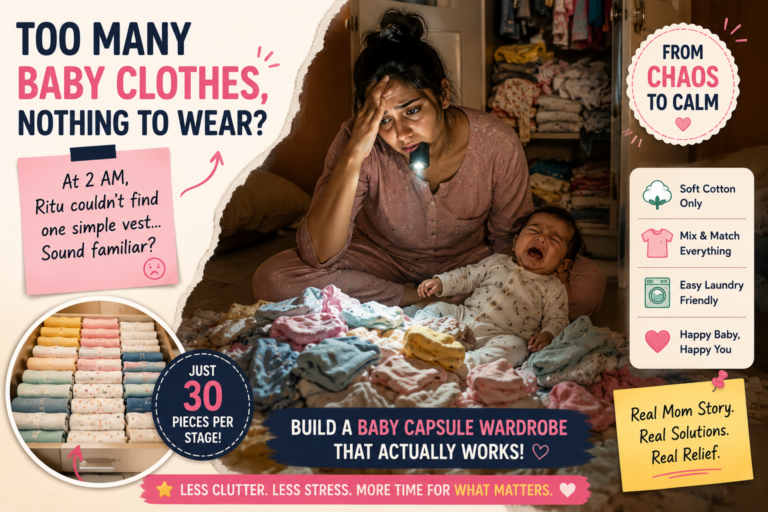
Start with the total number of pieces your baby needs in the first year. In our baby capsule wardrobe guide, I suggested about 30 pieces per size stage for a family that washes every two days, and about 24 for a family that washes daily. Over a year, a baby passes through about four size stages, but many items (swaddles, towels, bedsheets, some loose pieces) carry over. So a reasonable total for the first year is about 80 to 100 pieces.
Now, subtract what you will not have to buy:
The number you are left with is the number of pieces you need to buy. For example:
This depends on where you shop. Some families buy from local markets, some from online stores, some from boutique brands. Think about the average price of a simple cotton top, a pair of pyjamas, a bodysuit and a swaddle in your usual shop. Add them up, and divide by four.
For my examples, I use round numbers: Rs 150, Rs 250 and Rs 400. Please use your own.
This covers the things that are not size-specific: socks, mittens, caps, bibs, burp cloths, towels, one festive outfit, and a small buffer for surprises like a big leak week or a sudden cold spell. A small extras fund of about 10 to 15 percent of the main budget is a good starting point.
Suppose you decide on the Balanced level:
Now try the same formula with your own numbers. You will be surprised how clear it feels once it is on paper.
If you remember only one idea from this article, let it be this one: do not judge a baby outfit by its price. Judge it by its cost per wear.
Cost per wear is simply the price divided by how many times the outfit is worn. Here is an illustrative example.
| Item | Price (example) | Times worn | Cost per wear |
|---|---|---|---|
| Soft cotton top, daily wear | Rs 250 | 20 | Rs 12.50 |
| Cotton pyjama, daily wear | Rs 200 | 25 | Rs 8 |
| Fancy party frock | Rs 800 | 2 | Rs 400 |
| Sale outfit in the wrong size | Rs 99 | 0 | Rs 99 for nothing |
| Muslin swaddle | Rs 300 | 100 | Rs 3 |
See what happens? The cheapest-looking item in the sale (Rs 99) can be the most expensive, because it is never worn. And the swaddle that costs more than a top is one of the cheapest items you own, because you use it every day.
This is why I said earlier that the shorter a size fits, the more expensive it is per wear. Newborn size is the shortest. Party wear is worn the least. Soft daily cotton is worn the most.
So the rule is simple: spend more where wear count is high, and spend less where wear count is low.
Here is a guide to how you might divide your clothes budget. These percentages are illustrative, not rules.
| Category | Suggested share | Why |
|---|---|---|
| Daily wear (tops, bottoms, bodysuits) | About 45 percent | Worn most, wears out most |
| Sleepwear | About 15 percent | Comfort and fit matter at night |
| Swaddles, towels, cloths | About 10 percent | Used daily, long-lasting |
| Layers (sweaters, jackets) | About 10 percent | Season-dependent, may be small in warm regions |
| Extras (socks, caps, mittens, bibs) | About 8 percent | Small items, but easy to lose |
| Special outfit and festive wear | About 7 percent | Worn rarely, so keep it modest |
| Buffer | About 5 percent | For surprises |
If you live in a warm, southern climate, you can shift the layers share to daily wear. If you live in a cold northern region, layers will take a bigger share, and you may want to use the winter plan in our newborn winter clothes guide.
Now, the heart of the article. These twelve habits work together. You do not need to follow all of them. Even four or five can cut your spending by a lot, and make your cupboard calmer.
This sounds too simple, but it is the single biggest thing. Most overspending happens because there is no number. When there is no number, every purchase feels small.
How to do it:
A small tip: many families do better with a slightly higher budget for the first two months (when you set up the basics) and the sixth month (when growth is fast), and a lower budget in between. You do not need to spend the same amount every month.
What this saves you: the silent leaks. When you can see the total, you stop the “just one more.”
Most online guides say a newborn needs 10 to 12 outfits, or even more. But if you wash baby clothes every day and dry them in the sun, 6 to 8 everyday outfits are often enough for the first weeks. (See our guide on how many clothes a newborn needs in India, and our capsule wardrobe guide.)
The less often you wash, the more you need to buy. So the cheapest way to cut your clothes budget is to wash more often, and buy fewer pieces.
What this saves you: potentially 20 to 30 percent of the pieces you would otherwise buy. (This is an illustrative range, not a guarantee, because it depends on your home.)
Newborn size is the shortest-lived size. Many babies wear it for only a few days to a few weeks, and some skip it. Buy only 3 to 5 pieces, keep the tags on, and put most of your money into 0-3 months. (We explained this fully in our guide on whether to buy newborn size or 0-3 months.)
What this saves you: the “worn twice” clothes. In a lean budget, that can be a few hundred rupees. In a comfort budget, it can be a few thousand.
Go back to the cost-per-wear idea. Spend a little more on the things your baby wears every day, like soft cotton tops, bodysuits, sleepwear and muslin swaddles. Spend very little on party outfits, fancy frocks, tiny shoes and accessories.
A simple way to remember: “Soft and daily gets the money. Pretty and rare gets the minimum.”
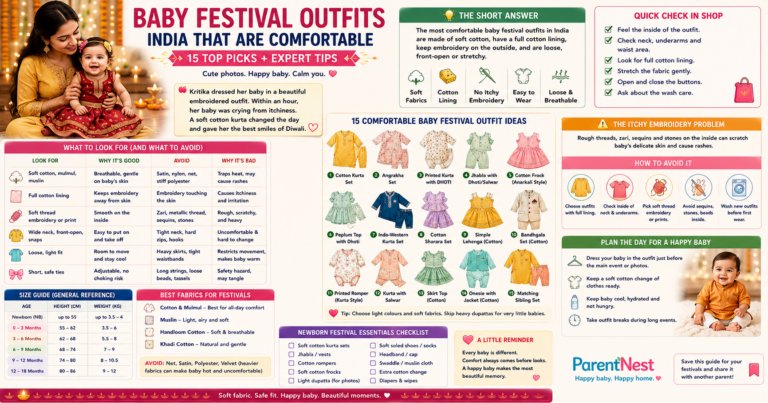
For festivals, choose one comfortable outfit and keep it simple. (Our guide to comfortable baby festival outfits shows how to look lovely without overspending.)
What this saves you: many families find that their biggest single “waste” is one or two expensive outfits that were worn for an hour.
Sales can save real money, but only if you use them with a plan. A sale is a good deal when you were going to buy that item anyway, in a size you will need soon, at a lower price.
A sale is a trap when:
How to use sales wisely:
In India, parents commonly see price drops around Diwali and big festival sales, end-of-season sales, Republic Day and Independence Day sales, and large online shopping events. Exact dates and offers change every year, so please check the current ones.
What this saves you: real discounts on items you were going to buy, without the “wrong size” regret.
Baby clothes are among the most re-usable things in the world, because babies outgrow them long before they wear them out. Many families happily pass them on.
How to use hand-me-downs well:
What this saves you: this one habit can easily cover a large part of the pieces you need. It also gives an old, soft cotton garment a second life.
Gifts are a big part of baby clothes in India, and they are given with love. But if everyone gives newborn and 0-3M sizes, you will have too many small clothes, and too few for later.
A kind way to guide gifts:
What this saves you: the “gifted clothes too small” problem, and a lot of money you would otherwise spend on the sizes that did not arrive.
Some of the softest, most practical baby clothes in India do not come from a famous brand. They come from a good local market, or a skilled tailor.
A caution: do not compromise on safety. Avoid hard buttons, long strings, rough lace and loose beads, even in handmade clothes.
What this saves you: the “brand premium” on simple daily pieces. For basic cotton clothes, softness matters more than a label.
A pack of five or ten outfits looks like a bargain. But if the size runs small, the fabric is rough, or the colour bleeds, you have just bought ten problems.
The test-piece rule:
This is especially useful for brands with unclear size charts. (See our baby clothing size chart guide for how to compare sizes across brands.)
What this saves you: the cost of a whole pack of wrong-size or rough clothes.
Many of us buy something, tuck it away, and by the time we try it, the return window has closed. A little discipline can save a lot.
A simple return routine:
What this saves you: a surprising amount. Even returning three or four wrong pieces in a year can pay for a good cotton swaddle.
When a size is finished, do not let the clothes sit in a bag forever. Move them on, and recover some of the cost.
Options:
What this saves you: it recovers part of what you spent, and keeps your cupboard clear. Even a small amount from selling outgrown clothes can fund the next size.
This is the habit that helps most with the emotional part of shopping.
The 24-hour pause: when you find something you love, add it to your cart or wishlist, and wait one day. Ask three questions: Do I need it? Is it in the right size and season? Will it mix with what I already have? Most impulse buys will not survive the next morning.
The one-in-one-out rule: when a new piece comes into the cupboard, an old piece goes out (outgrown, worn out, passed on). This keeps the numbers steady, and stops the slow pile-up. (This is part of our system for reducing baby clothes clutter, in the capsule wardrobe guide.)
What this saves you: impulse buys, which are usually the most wasteful.
Let us turn the numbers into a calendar. This is an illustrative plan for the Balanced level (about Rs 22,000 for the year). You can scale it up or down, and it will still work.
| Stage | What you buy | Illustrative spend |
|---|---|---|
| Before birth (month 8 to 9) | The basics: a few newborn and 0-3M pieces, swaddles, towels, bedsheets, a going-home outfit | About Rs 6,000 |
| Months 1 to 3 | Top up 0-3M, based on how the baby actually wears clothes | About Rs 2,500 |
| Months 4 to 6 | 3-6M clothes, bibs, a few extra tops (drool and mess phase) | About Rs 4,500 |
| Months 7 to 9 | 6-9M clothes, sturdy pants, rompers | About Rs 4,500 |
| Months 10 to 12 | 9-12M clothes, shorts and soft pants, a first birthday outfit | About Rs 4,500 |
| Total | About Rs 22,000 |
Notice how the biggest spend is before birth, which is when most parents feel the most excited and anxious. And notice that the spending is spread across the year, because you buy one size at a time. This is how you avoid a huge up-front purchase that does not fit.
All three are valid. Your budget is not a measure of how much you love your baby. It is a measure of how well you plan.
Your region affects what you buy, and how much.
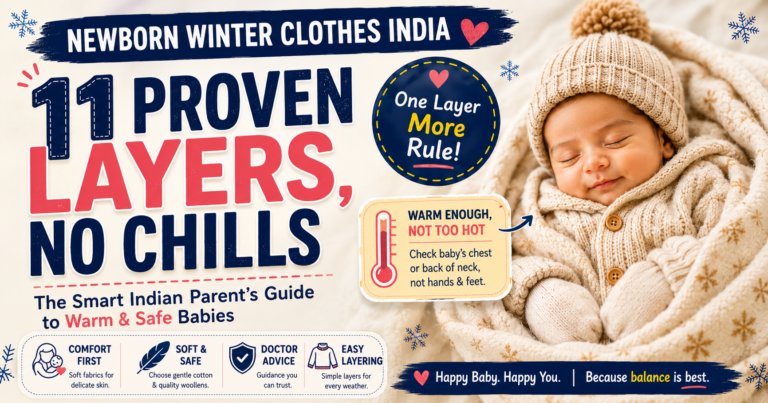
Cold regions (Delhi NCR, Punjab, Haryana, UP, Uttarakhand, Himachal, Kashmir): you need more layers, so the layers share of the budget goes up. Buy one good outer layer, a couple of soft cardigans, thermals if needed, and socks. Accept hand-knit sweaters, and see our newborn winter clothes guide for what you need.
Hot and humid regions (Mumbai, Kolkata, Chennai, Kerala): you need thin, quick-drying cotton, and more sets for sweat. Layers can be tiny. The money goes to daily cotton and swaddles.
Monsoon months: add a small buffer for extra sets, since drying is slow.
Mild climates (Bengaluru, Pune, hill towns): a balanced mix, with a few light layers.
Plan your spending by the season your baby will be in, not just by age. A winter-born baby needs warm layers early, and light cotton later.
Festivals and family functions are where budgets quietly break. A naming ceremony, a first Diwali, a wedding visit, a first birthday: each seems to deserve a new outfit.
A simple plan:
Many parents forget that gifts reduce the number of pieces they need to buy. Here is a simple way to account for them.
This is also a good time to guide family on what to gift next. “We have lots of 0-3 months. We would love 6-9 months, or swaddles.”
How do you know you have overbought? Look for these signs:
What to do:
A budget only works if you can see it. The good news is that tracking baby clothes spending takes about ten minutes a month. Here is a simple system.
Write down your pieces to buy, your average price, and your extras fund. Multiply, and you have your first-year total. Divide by 12 for your monthly number.
In your Baby Budget Planner, or in a notebook or phone note, write down each clothes purchase: the date, the item, the size, the price, and where you bought it. Add a column for “return by” date, so you do not miss it. [Insert link to ParentNest Baby Budget Planner]
Here is a sample row, to show you how simple it can be:
| Date | Item | Size | Price (example) | Shop | Return by |
|---|---|---|---|---|---|
| 12 Nov | Cotton pyjama set (2) | 3-6M | Rs 400 | Local market | 22 Nov |
On the same day each month, add up the spending. Compare it with your monthly number. If you are over, skip clothes shopping next month. If you are under, keep the extra in your buffer for a growth spurt.
Check which size your baby is in, and which is coming next. Write down what you still need in that size. This stops you from buying duplicates.
When your baby turns one, look at what you spent, what you wore, and what stayed unworn. Write down three lessons. This will help you with your second baby, or help a friend with their first.
A budget does not need to be perfect. It needs to be visible. When you can see the number, you make better choices without trying.
Here are the mistakes I see most often, and I have made some of them too.
If you want to begin right now, here is an easy week.
By the end of the week, you will have a clear plan, and a calmer cupboard.
Go back to Aarti, standing in her living room in Surat, with a shopping bag in each hand, and a pile of tags she was already worried about.
Here is what I would tell her. You are not careless. You are a loving parent in a world that makes tiny clothes irresistible. Tomorrow, sort the bags by size, and check which pieces you can still return. Write down a number for the year, and divide it by twelve. Keep the soft, daily cotton, and pass the extras to someone who needs them. Next time there is a sale, open your list first, and buy only what is on it. And forgive yourself for the midnight maths. It is the first step to a calmer year.
So, if you have been wondering how much to spend on baby clothes in the first year in India, here is the answer in one breath: choose a budget level on purpose, use the three-number formula (pieces to buy, price per piece, extras fund), spend on wear count, and use the twelve ways in this article to keep the number steady. For many families, that lands somewhere between Rs 10,000 and Rs 25,000, but your own numbers matter more than mine.
Babies do not need a big wardrobe. They need soft clothes, a warm cuddle, and parents who are not stressed about money. A painless baby clothes budget gives you all three.
It depends on your choices, but many families spend roughly Rs 10,000 to Rs 25,000 in the first year, with some spending more. A simple formula is: pieces you need to buy, times average price per piece, plus an extras fund. Please use your own local prices.
Dividing a first-year budget by 12 gives a monthly number. In my illustrative examples, that is about Rs 900 for a lean budget, Rs 1,900 for a balanced budget and Rs 3,500 for a comfort budget. You can spend more in the early months and less in between.
A baby may need about 80 to 100 pieces across the first year, including carry-over items like swaddles and towels. Subtract gifts and hand-me-downs, and you have the number you need to buy. Daily washing can reduce the number.
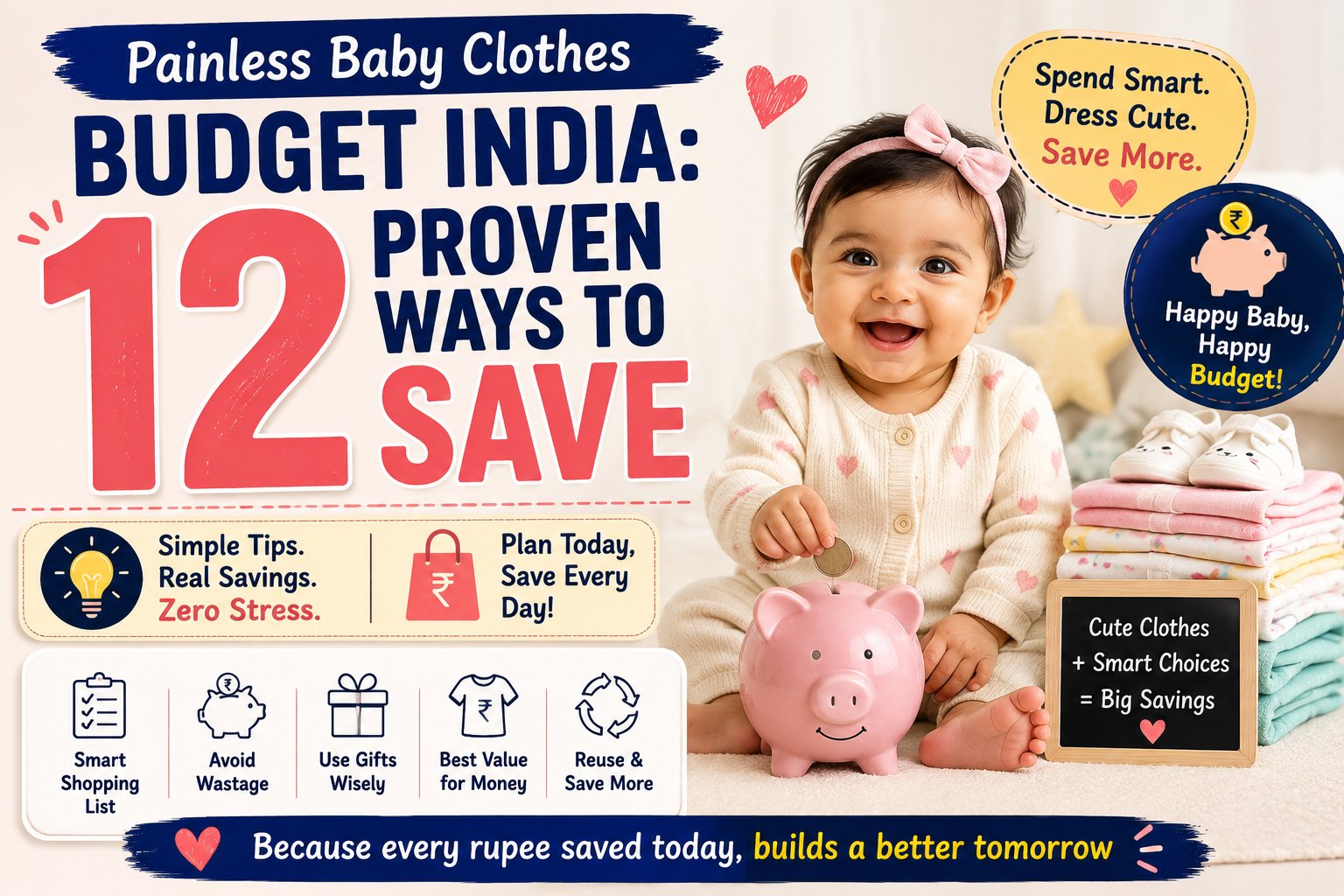
Set a monthly budget, buy by your laundry routine, buy very little in newborn size, spend on daily wear, use sales wisely, accept hand-me-downs, guide your gifts, use local markets and tailors, test one piece before a pack, track returns, resell outgrown clothes, and use a 24-hour pause.
Yes, if you buy items from your list, in a size you will need soon, at a real discount. It is not worth it if you buy sizes or items you do not need. Always check the return policy and the size chart.
Set a budget, keep a list of what you need, sort gifts before buying, use a one-in-one-out rule, and wait 24 hours before buying anything you do not need right now.
It is the price divided by the number of times worn. A soft daily top worn 20 times costs far less per wear than a fancy frock worn twice, even if the top costs a little more. Spend more on high-wear items.
Sort them into three bags: use now, use later and pass on. Count the usable ones against your budget, exchange extras if you can, and kindly guide family to gift larger sizes or swaddles.
Buy only a few, about 3 to 5 pieces, since newborn size is worn for the shortest time. Put most of your money into 0-3 months. If your baby may be small or early, buy a few more.
Many parents sell or swap clean, good-quality used baby clothes in local parents’ groups and online marketplaces. You can also donate them after asking whether the charity accepts used clothes.
Keep it modest. A simple cotton set is often enough, and many families spend a small share of the year’s budget. Borrow, share or stitch locally if you can. A comfortable outfit worn happily is worth more than an expensive one worn for an hour.
No. A very cheap outfit that is the wrong size or rough on the skin can cost more per wear than a better one. Judge by softness, fit and how often it will be worn.