Physical Address
304 North Cardinal St.
Dorchester Center, MA 02124
Physical Address
304 North Cardinal St.
Dorchester Center, MA 02124

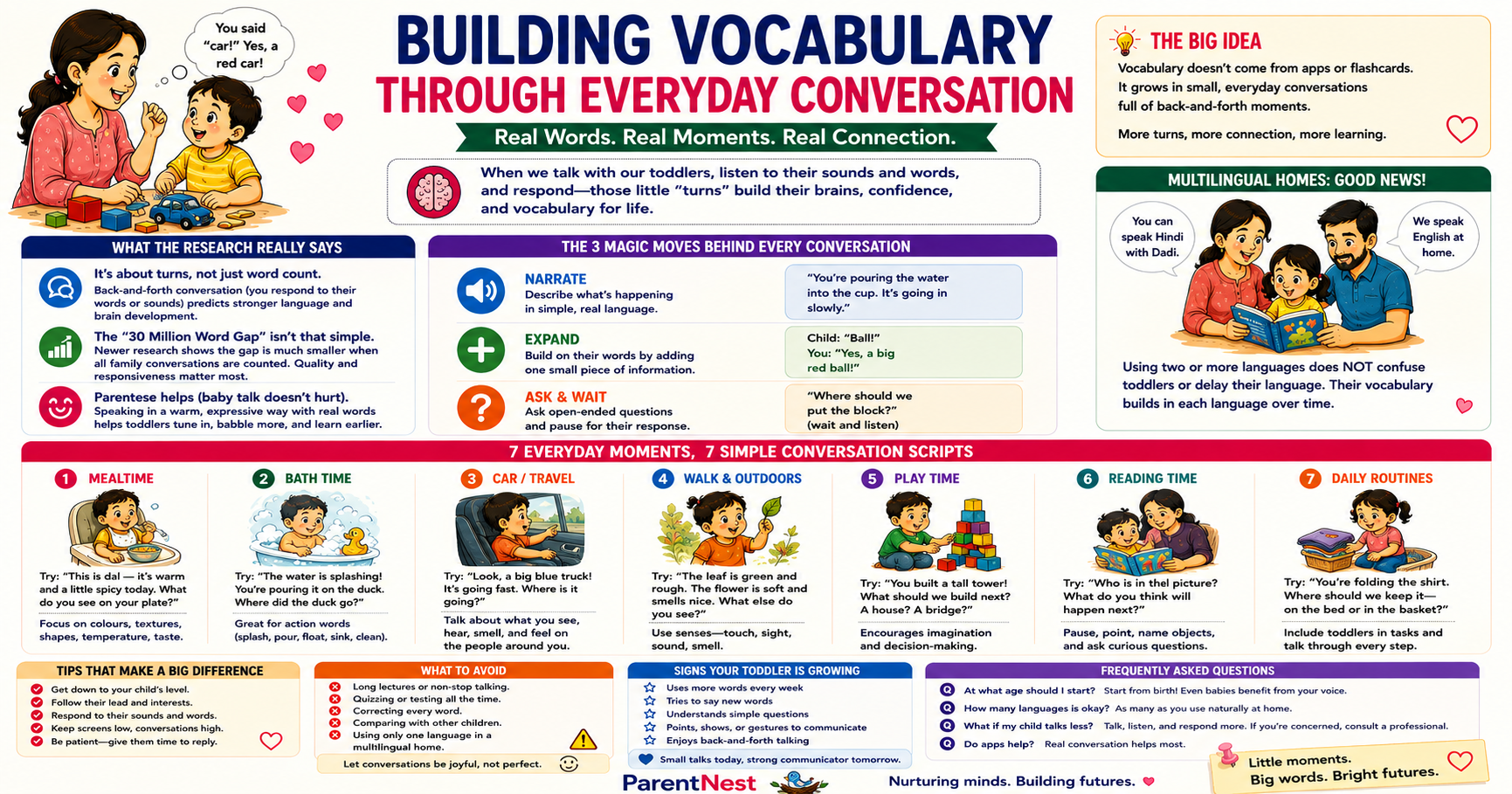
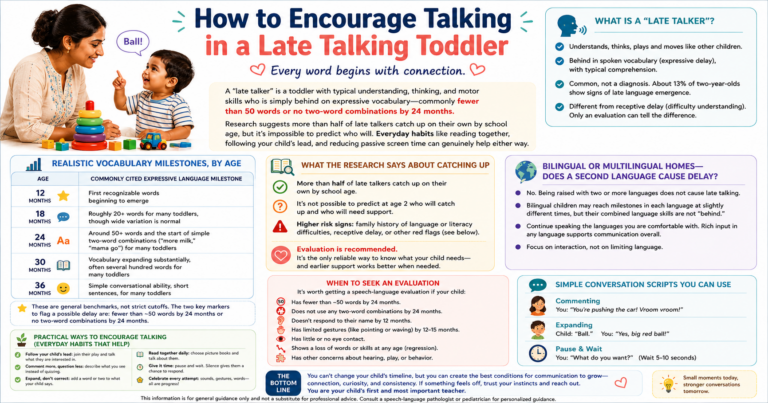
Vocabulary builds through responsive, back-and-forth conversation woven into everyday moments — not through flashcards, apps, or simply talking more in volume. Research consistently points to the quality and responsiveness of conversation (“turns,” where a child’s sound or word gets a real reply) as the strongest driver, more than raw word count. And if your household runs on two or three languages, the research is reassuring: this doesn’t confuse or delay a toddler’s language development — it just means their vocabulary is building across more than one label system at once.
Every parenting article says “talk to your toddler,” which is true and also almost useless in the actual moment — because most of us, mid-morning, mid-chore, mid-exhaustion, don’t have a script in our head for what to say beyond “eat your food” or “come here” or “no, don’t touch that.” The advice isn’t wrong, it’s just incomplete. What’s missing is the part where someone hands you the actual words.
This article covers what the research really supports about building vocabulary through conversation — including a more honest look at some famous, often-repeated findings — and then gets specific: real scripts for mealtime, bath time, the car ride, the walk to the market, and other ordinary moments that already happen in your day, whether your household runs in Hindi, English, a regional language, or some daily mix of all three.
A meaningful body of more recent research — building on earlier work and using recordings of actual family conversations — has found that the number of back-and-forth “conversational turns” between a parent and child (a child babbles or says something, an adult responds, the child responds again) is a stronger predictor of language development and even measurable differences in brain processing than the sheer number of words a child hears. This matters practically: a parent narrating a monologue at a child isn’t doing the same thing as a parent having a genuine, if simple, back-and-forth exchange — even a very short one (“ball!” “yes, a red ball, can you roll it to me?” “roll!”) counts as more valuable than a much longer one-directional stream of talk.
It’s worth being honest about a widely cited but increasingly contested finding here. A well-known 1995 study proposed what became known as the “30 million word gap” — a large difference in the number of words children from higher- and lower-income families heard by age 3. This finding shaped a lot of parenting advice for decades. More recent attempts to replicate it, however, have found a much smaller gap once researchers accounted for all the speech a child actually hears — including conversation between other family members in the room, not just speech directed straight at the child, which the original study didn’t measure. This doesn’t mean the underlying idea (more rich language exposure generally helps) is wrong, but it’s more accurate to say the specific “30 million” figure has been meaningfully challenged, and the quality and responsiveness of interaction — not simply a race to a bigger cumulative word count — is the more consistently supported piece of this research today.
Contrary to a common instinct to avoid “baby talk” as somehow lesser, research on what’s called “parentese” — a higher-pitched, slower, exaggerated, but still grammatically real style of speech — has found it genuinely helps engage a young child’s attention and appears to support earlier babbling and word use. The key distinction: parentese still uses real, correct words (a clearer, more melodic way of saying “ball,” not a made-up nonsense sound for it). Simplified, exaggerated delivery of real words is genuinely useful; substituting invented baby words for real ones for a long stretch isn’t necessary and may just add an extra translation step later.
Before the specific scripts below, it helps to know the three moves most of them use, sometimes summarized by researchers and specialists as some version of “tune in, talk more, take turns”:
Every script below uses some combination of these three moves.
Instead of: “Eat your food.” Try: “This is dal — it’s warm and a little spicy today, isn’t it? What do you think is in your plate — is that a carrot or a potato? Can you show me with your finger?” (Narrates texture and taste words, asks a genuine identifying question, invites a gesture-based response if words aren’t there yet.)
Instead of: silence, or just “hold still.” Try: “The water feels warm on your tummy, doesn’t it? Look, the bubbles are floating — where do you think they’ll go? Should we pour some water over your feet now?” (Introduces sensory and spatial words, asks an open prediction question, offers a simple choice that invites a response.)
Instead of: “Arms up, quick, we’re getting late.” Try: “First the shirt goes over your head — there we go! Now which arm goes in first, this one or that one? Your socks are so soft today, can you feel that?” (Sequences actions verbally, offers a genuine choice, adds a texture word.)
Instead of: general silence or a phone in your hand. Try: “Look, that truck is so big and loud! I wonder where it’s going. Can you see any dogs out the window? What colour is that building we just passed?” (Narrates the passing world, invites observation and a simple open question, works even with very limited vocabulary since pointing counts as a response.)
Instead of: rushing through with minimal talk. Try: “This is a tomato — it’s round and red. Feel how heavy this bag is! Should we ask for two kilos or three? Do you want to help carry the small bag?” (Introduces concrete nouns and simple quantity/weight concepts, offers a real decision to weigh in on, connects language to a task with purpose.)
Instead of: rushing straight into “sleep now.” Try: “What was the most fun part of today? You played with the blocks — did the tower fall down or stay up? Tomorrow, do you want to go to the park or stay home and draw?” (Uses simple past-tense recall questions, which build both vocabulary and early narrative skill, and offers a genuine choice about tomorrow.)
Instead of: quietly watching or being on your own phone nearby. Try: “Your car is going so fast! Is it going up the ramp or down? What sound does it make when it crashes — can you show me?” (then pause and actually wait for an answer, verbal or not) (Narrates action verbs, asks a directional question, invites imitation as a form of response.)
This is genuinely one of the most persistent anxieties among urban Indian parents, particularly when a child is expected to eventually do well in an English-medium school, but the home naturally runs in Hindi, a regional language, or some mix, especially with grandparents involved in daily care.
The research here is reassuring and worth repeating clearly: exposure to multiple languages does not confuse a toddler’s brain or cause language delay. A bilingual or multilingual child’s total conceptual and linguistic understanding is comparable to a monolingual child’s — the difference is simply that some of that understanding gets a label in one language and some in another, rather than all of it sitting under a single language’s vocabulary. A toddler who knows the word “kutta” but not yet “dog” hasn’t failed to learn the concept of a dog; they’ve learned it, just with a different label attached first.
A few practical points worth holding onto:
You might catch yourself getting through an entire dinner using only “eat,” “no,” and “sit properly,” and realize afterward that the meal offered a dozen easy opportunities for real conversation that simply didn’t occur to you in the moment — which is exactly why having a few scripts ready in advance, even mentally, makes a real difference.
Or you might feel a flicker of guilt watching your toddler answer you in Hindi when you asked something in English, wondering if you’re “doing bilingual wrong” — when in fact that kind of mixed response is a completely typical part of bilingual development, not a sign of confusion.
Or you might notice, on a walk to the sabzi wala, that your toddler suddenly points and says a vegetable’s name in the language your mother-in-law uses at home rather than the one you use — and it’s worth feeling reassured rather than corrective in that moment, since it means the conversations happening around them, in whichever language, are genuinely landing.
Yes, but the research increasingly points to the responsiveness and back-and-forth quality of conversation — actual “turns” where a child’s sound or word gets a genuine reply — as more important than sheer volume of words spoken at a child.
No. Research consistently finds that bilingual and multilingual exposure doesn’t confuse a child’s understanding or cause language delay — it simply means their concepts and vocabulary develop labels across more than one language rather than all under a single one.
Not in the specific form researchers call “parentese” — a higher-pitched, slower, exaggerated but grammatically real style of speech, which research links to better attention and earlier language milestones. What matters is using real words, not invented nonsense words, in that style.
There’s no fixed target number of words. Research increasingly emphasizes responsive, back-and-forth conversational turns woven into everyday moments over a raw volume target, so frequent, genuine exchanges throughout the day matter more than one long talking session.
The original finding has been meaningfully challenged by more recent replication attempts, which found a much smaller gap once all speech a child hears (not just speech directed straight at them) was measured. The broader idea that rich language exposure helps still holds, but the specific figure is now considered contested.
Either, or both — the research doesn’t favor English over a mother tongue for cognitive or vocabulary development. What matters most is rich, responsive conversation in whatever language or languages a caregiver speaks naturally and comfortably.
Yes — this typically adds valuable, responsive language exposure rather than causing confusion, and multiple caregivers speaking different languages is a common, well-studied pattern in successful multilingual households.
Repeat back what they said with one small addition rather than a full correction — if they say “ball,” respond with “yes, a big red ball!” rather than “no, you should say a red ball,” which tends to shut down the exchange rather than extend it.
Questions that can’t be answered with a single yes/no work best — “what do you think will happen next,” “how does that feel,” “where do you think it went” — paired with genuinely waiting for a response, verbal or not.
Research generally finds live, responsive conversation more effective for vocabulary building than passive or even interactive screen use, since screens can’t reliably provide the responsive, back-and-forth “turn-taking” that appears to matter most.
None of the seven scripts above require anything you don’t already have — they’re built entirely out of moments your day already contains. The shift isn’t about adding more to an already full schedule, it’s about noticing that the mealtime, the bath, the walk to the market are already conversations waiting to happen, whichever language or mix of languages they happen in. Say the words. Wait for the answer. That’s most of it.