
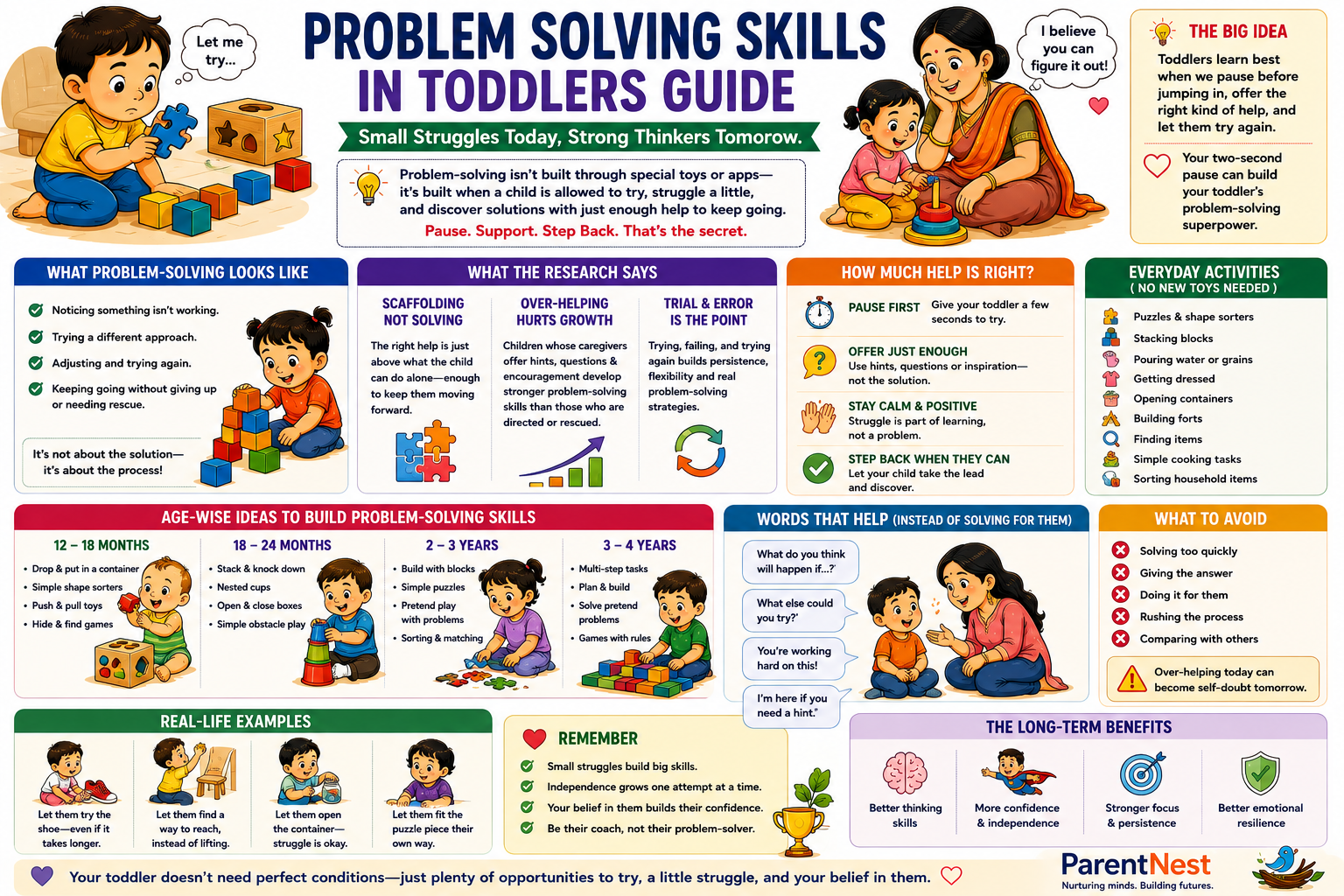
Problem-solving in toddlers isn’t built through special toys or apps — it’s built through ordinary daily moments where a child is allowed to struggle briefly, try a few approaches, and get just enough help to keep going, rather than having the problem solved for them. Research on parental “scaffolding” consistently finds that children whose caregivers offer support without taking over develop stronger problem-solving strategies than children who are either left completely unaided or rescued immediately. The single biggest shift most families can make isn’t a new activity — it’s a two-second pause before stepping in.
Problem Solving Skills in Toddlers Guide
There’s a specific scene that plays out in a lot of Indian homes, usually within about four seconds of a toddler struggling with anything. The puzzle piece won’t fit, the block tower wobbles, the shoe won’t go on the right foot — and before the child has even finished registering the difficulty, a hand reaches in. Sometimes it’s yours. More often, if Dadi or Nani is in the room, it’s theirs, and it’s usually already done by the time you’ve decided whether to intervene at all. Nobody in this scene is doing anything wrong exactly — it comes from care, not carelessness — but research on how children actually develop problem-solving skills suggests that reach, however loving, is often the thing quietly getting in the way.
This article looks at what genuinely builds problem-solving skill in toddlers, what the research says about how much help is actually useful (and how much becomes a hindrance), and specific everyday activities — no new toys required — that build this skill at each age.
Table of Contents
What problem-solving actually looks like in a toddler
At this age, problem-solving isn’t complex reasoning — it’s the much more basic ability to notice something isn’t working, try a different approach, and keep going without immediately giving up or needing rescue. In very young toddlers, this looks like turning a shape multiple ways to see if it fits a hole, or scooching and reaching repeatedly before figuring out how to roll toward a toy. As toddlers get older, it grows into things like moving a stool to reach something, trying several ways to open a container, or figuring out how to get a toy unstuck from under furniture. The skill being built isn’t the specific solution — it’s the underlying pattern of noticing a problem, generating an attempt, adjusting, and trying again.
What the research says about help — “scaffolding,” not solving
What scaffolding actually means
Researchers use the term “scaffolding” for the right kind of parental help during a child’s problem-solving — support that’s calibrated to just above what the child can currently do alone, enough to keep them moving forward without doing the task for them. This idea comes from developmental psychologist Lev Vygotsky’s concept of the “zone of proximal development” — the gap between what a child can do independently and what they can do with a bit of well-timed help. Scaffolding lives specifically in that gap: not so little help that the child gives up in frustration, not so much help that the child never has to do the actual thinking themselves.
What happens when adults over-help
Multiple studies observing parents helping children through problem-solving tasks have found that the kind of help matters more than how much attention or warmth a parent shows. Research specifically comparing different levels of parental support — from simple verbal encouragement up through fully demonstrating or doing the task for the child — has found that children whose parents gave calibrated, autonomy-supporting help (hints, questions, encouragement to try again) developed stronger independent problem-solving strategies than children whose parents intervened more directly or took over the task. One study specifically found that children’s own strategic thinking skills — noticing patterns, planning their approach — predicted how well they performed problems on their own, and that the style of parental support (supportive versus overly directive) shaped how well those strategic skills developed in the first place.
Trial and error is the point, not a failure
It’s worth naming directly: struggling, failing an attempt, and trying again isn’t a sign a toddler is behind or that an activity is too hard for them — it’s frequently described in child development research as the actual mechanism through which problem-solving skill develops in early childhood. A toddler turning a puzzle piece the wrong way three times before it fits isn’t wasting time; that repeated attempting is doing real developmental work, in the same way a toddler scooching and reaching repeatedly before figuring out how to roll toward a toy is building the same underlying persistence and strategy-adjustment skill.
How much help is actually appropriate
A useful, practical guideline drawn from this research: pause for a few seconds before stepping in, and when you do help, offer the smallest amount that keeps your child moving forward, rather than the most efficient fix.
- If your toddler is trying different approaches and isn’t visibly distressed, hold back — this is the productive struggle where the actual learning happens
- If frustration is building but hasn’t tipped into real distress, offer a hint or a question (“what if you turned it the other way?”) rather than the answer or the action itself
- If real distress sets in — genuine tears, escalating frustration well past productive struggle — it’s fine and appropriate to step in more directly; scaffolding isn’t about withholding help when a child genuinely needs it, it’s about not defaulting to full intervention as the first response
- Narrate your own thinking sometimes rather than just acting (“hmm, that side didn’t work, let me try turning it”) — this models the actual thought process you want your child to eventually do themselves
Everyday activities that build real problem-solving, by age
12–18 months
- Let your toddler work at fitting shapes into a shape sorter or stacking cups themselves before adjusting it for them, even if it takes several attempts
- Place a toy slightly out of reach (not frustratingly far, just enough to require effort) and let them figure out how to get to it
- Offer simple cause-and-effect toys — buttons that make sounds, lids that open — and let them experiment with the mechanism themselves rather than demonstrating it immediately
- When something doesn’t work on the first try, narrate rather than rescue: “hmm, that didn’t work, try again”
18 months–2.5 years
- Give simple two-step problems, like a container with a lid that needs to be removed before reaching a toy inside, and resist opening it for them unless real frustration sets in
- Let your toddler attempt basic self-care tasks that double as problem-solving — putting on their own shoes (even on the wrong feet), pulling on a t-shirt — before jumping in to correct or finish it
- Use simple wooden puzzles with a small number of pieces, and pause before pointing out which piece goes where
- Hide a favourite toy partially under a cushion or box and let them figure out how to retrieve it
2.5–4 years
- Introduce basic building challenges with a goal (“can you build a tower taller than this cup?”) and let towers fall and be rebuilt without stepping in to stabilize them
- Pose simple real-world problems during the day — “the ball rolled under the sofa, how do we get it out?” — and let your child propose ideas before offering your own
- Use more complex puzzles (12–24 pieces) and encourage them to sort edge pieces or group by colour themselves, offering a question rather than the answer when they’re stuck
- Introduce simple pretend-play problem scenarios — a “broken” toy car that needs “fixing,” a stuffed animal who’s “lost” — since pretend play at this age often becomes a genuine space for rehearsing problem-solving
The joint family over-help problem (and how to handle it gently)
This is often the real obstacle, more than a parent’s own instincts. In many Indian households, a grandparent’s quick intervention — untangling a toy, redoing a puzzle “properly,” putting on a shoe correctly the moment it goes on the wrong foot — comes from deep affection and a generational habit of caretaking, not from any intent to hold a child back. Still, if it happens consistently, it can meaningfully reduce a toddler’s opportunities for the small, everyday struggles that build this skill.
A few things help without turning it into a conflict:
- Frame it in terms familiar to the family rather than clinical language: “usko khud karne do thodi der, phir seekhega” (let them do it themselves for a bit, that’s how they’ll learn) tends to land better than an explanation about developmental psychology
- Give the grandparent a specific, positive role instead of asking them to simply do less — “aap uska hausla badhaiye, hum dekhte hain woh khud kaise karta hai” (you cheer them on, let’s see how he manages) reframes their involvement rather than removing it
- Pick your moments — it’s not necessary to intervene on every single instance; a consistent pattern over weeks matters more than any one shoe put on for a child in a hurry to leave the house
- Model the pause yourself, visibly — grandparents often absorb this shift faster by watching it in action than by being told about it directly
What not to do
- Don’t jump in the moment frustration appears — some frustration is a normal, useful part of the process, not a sign something’s wrong.
- Don’t finish tasks “properly” after a toddler’s attempt (redoing a puzzle piece placement, refastening a poorly done button) where they can see it — it quietly signals that their attempt wasn’t good enough or didn’t count.
- Don’t offer the full answer when a hint would do — resist the urge to be maximally efficient; efficiency isn’t the goal here.
- Don’t set up challenges so difficult that a toddler experiences mostly failure with no chance of success — the productive zone is a stretch, not an overwhelm.
- Don’t treat every household object mishap as an emergency requiring adult intervention — many small mishaps (a stuck drawer, a toy that fell behind furniture) are genuine, low-stakes problem-solving opportunities in disguise.
Real moments parents recognize
You might watch your toddler try to fit a square block into a round hole for the fourth time and feel your hand twitch toward it, wanting to just show them — and holding that pause for even a few more seconds is often exactly where the useful struggle is happening.
Or you might notice that every time your toddler struggles with something at Nani’s house, the toy or puzzle is solved and back in their hands within seconds, faster than you could have even offered a hint — and it’s worth having the gentle conversation, not because anyone’s doing anything wrong, but because those small moments add up over weeks.
Or you might catch your own frustration rising faster than your toddler’s while watching them struggle with a shoe, and realize the urge to intervene is sometimes more about your own discomfort with the delay than about your child actually needing help.
Frequently Asked Questions
How much help should I give my toddler when they’re struggling? Pause a few seconds before stepping in, and offer the smallest amount of help that keeps them moving — a hint or a question rather than doing it for them. Step in more directly only if frustration moves past productive struggle into real distress.
Does helping my toddler too much actually hurt their development? Research on parental scaffolding suggests that children whose caregivers over-help or take over tasks tend to develop weaker independent problem-solving strategies than children given calibrated, autonomy-supporting help. It’s the type of help, not the amount of attention or warmth, that seems to matter.
When do toddlers start problem solving? In a basic sense, from infancy — turning a shape multiple ways to fit a hole, or reaching and adjusting to get a toy, are early forms of the same skill. It develops in complexity steadily through toddlerhood and the preschool years.
Should I let my toddler struggle with a puzzle? Yes, within reason — brief struggle with trial and error is generally where the real skill-building happens. Step in with a hint if frustration is building, or more directly if real distress sets in, rather than solving it at the first sign of difficulty.
What is scaffolding in child development? Scaffolding is calibrated parental support — help pitched just above what a child can currently do alone, enough to keep them progressing without doing the task for them. It comes from Vygotsky’s concept of the “zone of proximal development.”
Why does my toddler give up so easily? This can have several causes, but one common contributor is a pattern of adults consistently stepping in before a child has a chance to attempt or struggle with something themselves, which can reduce a child’s practiced tolerance for frustration over time.
How do I handle grandparents who always solve things for my toddler? A gentle reframe tends to work better than a direct request to “stop helping” — giving them a specific, positive role (cheering the child on, narrating encouragement) rather than asking them to do less can make the shift feel additive rather than corrective.
Is trial and error actually good for toddlers, or does it cause frustration? Some frustration is a normal and even useful part of trial-and-error learning. The goal isn’t to eliminate frustration entirely, but to keep it in a manageable range where a child can keep trying rather than being overwhelmed or rescued immediately.
What are signs of good problem-solving skills in a toddler? Trying multiple approaches when something doesn’t work, increasing persistence after frustration, simple planning (like moving a stool to reach something), and eventually cooperative problem-solving with peers are all signs of developing problem-solving skill.
Do problem-solving toys or apps actually help more than everyday activities? Not necessarily — the research points to the style of adult support during any activity (calibrated help versus taking over) as more influential than the specific toy or app used. Everyday household moments work as well as, or better than, specialized products.
Final thoughts
None of this requires a new toy, an app, or a special class. It mostly requires noticing the small, ordinary moments — a puzzle piece, a stuck shoe, a toy under the sofa — and doing the harder thing in the moment, which is often simply waiting a few seconds longer than instinct suggests. The research is fairly consistent on this point: the help that looks like love in the moment (solving it quickly, quietly, before the child even struggles) isn’t always the help that builds the skill in the long run. A toddler who’s allowed to turn the puzzle piece the wrong way a few times is doing exactly what they’re supposed to be doing.