
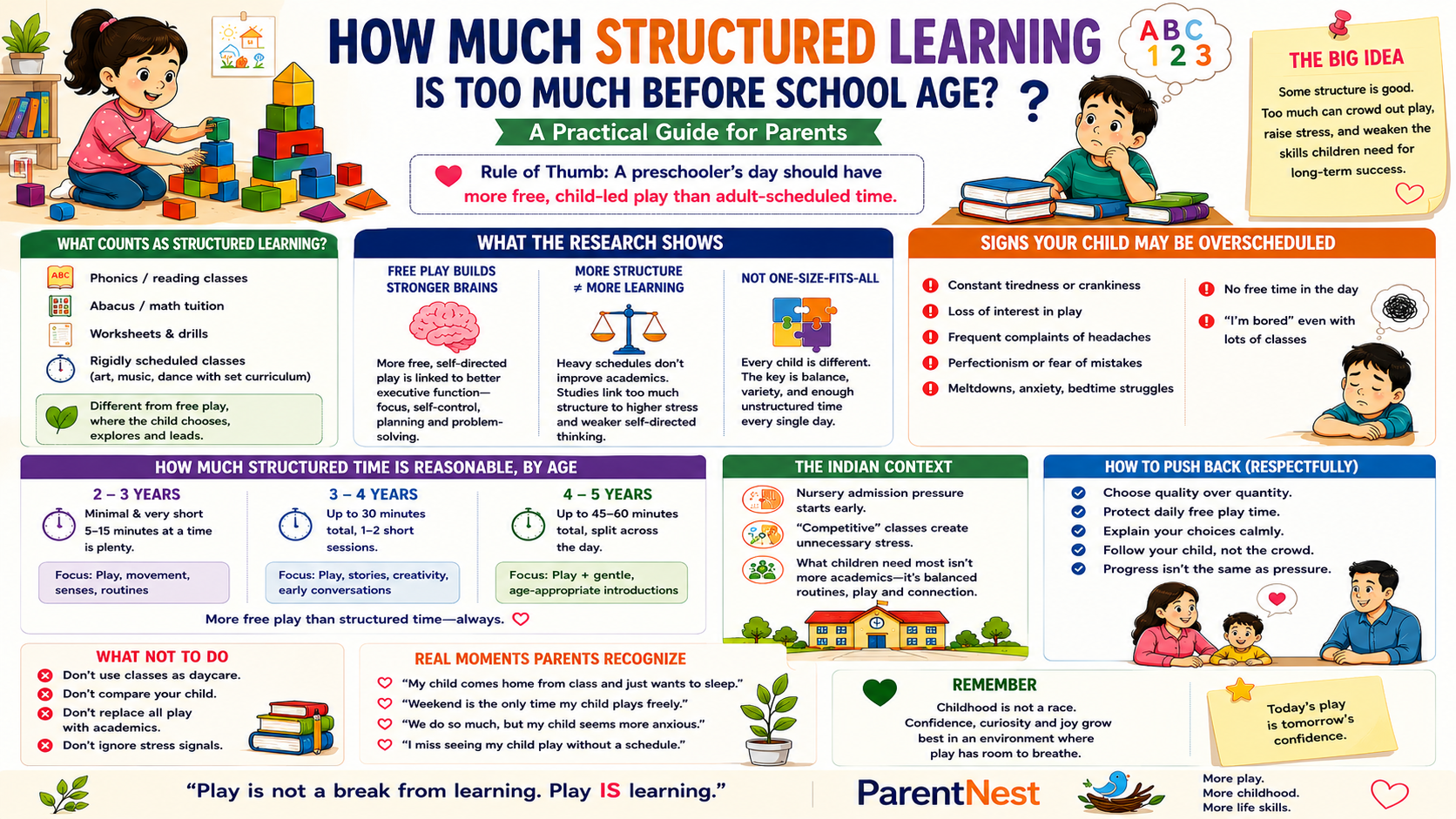
There’s no single magic number of hours, but research on young children consistently points in one direction: preschoolers need substantial daily unstructured free play, and when adult-directed, structured activity — classes, tuition, worksheets — starts crowding that out entirely, several studies link it to weaker self-directed thinking skills and higher stress, not better preparation for school. A useful rule of thumb many child development specialists suggest: a preschooler’s day should have noticeably more free, child-led time than adult-scheduled time, not the reverse.
How Much Structured Learning Is Too Much Before School Age? Guide
There’s a particular kind of nursery admission season anxiety that seems to arrive earlier every year — the WhatsApp group message about which playgroup “focuses on phonics,” the neighbour mentioning her three-year-old is already doing an abacus class twice a week, the quiet math happening in your own head about whether your child is behind because their days still involve mostly play. It’s an uncomfortable spot to be in, wanting to genuinely prepare your child well without turning their toddlerhood into a packed timetable that looks more like your own office calendar than a childhood.
This article looks at what “too much” structured learning actually means before school age, based on research rather than the competitive instinct that drives so much of early academic pressure — and gives you concrete signs to watch for in your own child, at your own pace, regardless of what the WhatsApp group is doing.
Table of Contents
What counts as “structured learning” at this age
Structured learning, for this purpose, means any activity where an adult sets the goal, the method, and often the pace — a phonics class, an abacus or math tuition session, a formal worksheet-based “homework” routine, a rigidly scheduled art or music class with a set curriculum. This is different from unstructured or child-led play, where the child decides what to do, how to do it, and when it’s finished — building with blocks, pretend play, drawing freely, running around outside without an assigned game.
Both have real value. The question this article addresses isn’t whether structured learning is bad — it clearly isn’t, in reasonable amounts — but at what point it starts displacing enough free play to cause problems.
What the research actually shows
The link between free play and executive function
A frequently cited study published in the journal Frontiers in Psychology had parents track how six-year-olds spent a full week, then measured how much time each child spent in structured activities (defined as anything organised and directed by an adult, like a lesson or a class) versus less-structured activities (anything where the child decided what to do and how to do it, including all forms of free play). The researchers found that children who spent more time in free play, self-directed activity showed stronger executive function — the set of mental skills involved in planning, self-control, and flexible thinking that underlies a lot of later academic and life success. Children with heavier structured schedules showed comparatively weaker executive function in the same measures. It’s worth being precise about what this shows: the study found a correlation, and its own researchers were careful to note it doesn’t prove that structure directly causes weaker executive function — other explanations are possible. But it’s a meaningful data point in a research picture that consistently points the same direction.
Why more structure doesn’t necessarily mean more learning
Separate research on overscheduling in children more broadly has found that heavily scheduled children can show more stress, more difficulty with sustained attention, and reduced opportunities for the kind of creative, self-generated thinking that comes from figuring out what to do with unstructured time. Child development specialists studying this pattern have pointed out something worth sitting with: many adults assume play is “something kids do when they aren’t doing something important” — when the research actually treats structured free play as developmentally important work in its own right, not time that needs to be filled with something more serious to count.
What the research doesn’t prove
None of this research says every structured class is harmful, or that a child in two or three activities a week is being damaged. The clearest finding across these studies is about balance and total load, not about any single class being good or bad in isolation. A child with one thoughtfully chosen class and plenty of free time is in a very different position than a child whose entire day, including “playtime,” is adult-directed and scheduled down to the hour.
Signs your preschooler may be overscheduled
Rather than counting hours precisely, it helps to watch for how your child is actually responding. Commonly cited signs of overscheduling and early academic overload in young children include:
- Physical complaints without an obvious cause — frequent stomach aches, headaches, or unusual tiredness, especially clustering around class days
- Increasing resistance or meltdowns specifically before or during structured activities that used to be tolerated fine
- Trouble falling asleep or new sleep disruptions, particularly if evenings are packed with homework-style activities
- Noticeably reduced interest in imaginative or self-directed play, as if the child has lost the habit of deciding what to do with free time
- Increased irritability or clinginess that seems tied to a busy week rather than appearing randomly
- A child who seems to need constant direction or entertainment and struggles to occupy themselves for even short stretches without adult input
Any one of these on its own could have another explanation entirely — it’s the pattern, especially clustering with a heavier schedule, that’s worth paying attention to.
How much structured time is reasonable, by age
| Age | General guidance | What this can look like |
|---|---|---|
| 1–2 years | Little to no formal structured “class” time needed; unstructured play and everyday interaction do most of the work | A caregiver-led rhyme or song session is fine; formal academic classes aren’t necessary |
| 2–3 years | At most one or two short, genuinely play-based structured sessions weekly, if any | A playgroup or a short activity class, with the rest of the week largely unstructured |
| 3–4 years | A modest number of structured activities (roughly one to three weekly), balanced with daily free play | One class (art, music, movement) alongside substantial daily unstructured time at home |
| 4–5 years (pre-K) | Slightly more structure is developmentally reasonable, but free play should still make up the larger share of the day | A couple of classes or a preschool program with embedded play, plus daily free time at home |
These are general benchmarks drawn from broad early-childhood development guidance, not a strict rule — a highly enthusiastic child asking for more of one specific activity is different from a child being scheduled into activities they show no interest in.
The Indian nursery-admission pressure problem
This is where the research collides with a very specific, very real cultural pressure. Competitive nursery and school admissions in many Indian cities have pushed formal academic preparation — recognising letters, writing, basic phonics, sometimes even interview-style question practice — down to ages 2 and 3, well before most child development guidance suggests it’s necessary or even useful. Add tuition classes, abacus training, and worksheet-based “homework” from a young age, and it’s easy for a toddler’s week to end up more tightly scheduled than a working adult’s.
A few things are worth holding onto here:
- Most reputable nursery admission processes are assessing general readiness and comfort with a school-like setting, not advanced academic skill — a child who’s calm, curious, and can follow simple instructions is usually better positioned than one who’s been drilled on worksheets but is stressed and resistant in unfamiliar settings.
- The research above doesn’t support the idea that more hours of formal instruction before age 5 produces better long-term outcomes — if anything, several studies point the other way, toward well-balanced free play building the underlying skills (attention, self-regulation, flexible thinking) that actually predict later success.
- It’s reasonable to feel the social pressure and still make a different choice for your own child — the WhatsApp group’s collective anxiety isn’t evidence of what’s actually best, it’s evidence of shared uncertainty.
How to push back — practically and respectfully
- With family: A simple, confident line like “we’re keeping things light for now, the research actually supports lots of play at this age” tends to land better than an argument, especially paired with genuine, visible engagement (reading together, counting during play) that shows you’re not simply doing nothing.
- With schools or tuition centres: It’s reasonable to ask directly what a program’s daily structured-vs-free-play ratio actually looks like before enrolling, rather than assuming “academic” branding means better preparation.
- With yourself: If the anxiety driving a decision is “everyone else is doing this,” it’s worth separating that from “this specific activity clearly benefits my specific child” — they’re not the same justification, even though they can feel identical in the moment.
- With your child: If they’re already in several classes and beginning to show signs of overload, it’s fine to reduce the number mid-year rather than waiting for a natural end point — a child’s wellbeing doesn’t need to wait for a term to finish.
What not to do
- Don’t assume that a fully academic-looking timetable at age 3 or 4 guarantees a stronger position for later schooling — the research doesn’t support that trade-off.
- Don’t treat unstructured play time as “nothing happening” that needs to be filled with something more serious — it’s doing real developmental work.
- Don’t add a new class purely in reaction to another family’s choices without asking whether your own child actually wants or needs it.
- Don’t ignore physical or behavioural signs of overload (sleep trouble, stomach aches, meltdowns before class) just because the schedule looks reasonable on paper.
- Don’t assume all structure is equally taxing — a single genuinely enjoyable, low-pressure class is very different from a full week of adult-directed sessions with little else.
Real moments parents recognize
You might sit through a school orientation and hear another parent casually mention their two-year-old is “already doing phonics,” and feel your stomach drop, wondering if the block-building and story time at home suddenly counts as falling behind.
Or you might notice your four-year-old, normally chatty and imaginative, going oddly quiet and clingy on the evenings after their new second weekly class — and it’s worth treating that shift as information, not just a phase to push through.
Or you might catch yourself explaining to a relative, almost apologetically, that your toddler “just plays most of the day” — and it’s worth remembering that this apology isn’t necessary; the research is quietly on your side here, even if it doesn’t feel that way at a family gathering.
Frequently Asked Questions
How many hours of structured learning should a preschooler have?
There’s no fixed number, but general guidance suggests structured, adult-directed time should make up a smaller share of a preschooler’s day than free, child-led play — particularly under age 4, where formal academic instruction isn’t developmentally necessary.
How do I know if my child is overscheduled?
Watch for physical complaints without clear cause, increasing resistance before structured activities, new sleep disruptions, reduced interest in self-directed play, and irritability clustering around busy weeks — any of these, especially in combination, is worth paying attention to.
Is too much academic pressure bad for preschoolers?
Research on overscheduling and structured activity generally links heavier adult-directed schedules with more stress and, in at least one notable study, weaker executive function compared with children who had more free-play time — though the research shows correlation, not definitive proof of direct cause.
Are worksheets bad for preschoolers?
Not inherently, in small, low-pressure amounts, but worksheets aren’t necessary for genuine learning at this age and shouldn’t crowd out substantial daily free play — the research doesn’t support worksheet volume as a meaningful predictor of later academic success.
When should formal academics actually start?
Most early-childhood development guidance suggests formal, worksheet-based academic instruction isn’t necessary before kindergarten, with younger children benefiting more from play-based exposure to early literacy and numeracy concepts.
Is it okay if my toddler has zero structured classes?
Yes — unstructured play and everyday interaction with caregivers do most of the developmental work needed at this age; formal classes are optional additions, not a requirement, particularly under age 3.
How do I handle family pressure to enroll my child in more classes?
A calm, confident explanation (“we’re keeping things light for now, this is actually what the research supports”) tends to work better than debate, especially paired with visible engagement at home that shows genuine involvement, not neglect.
Does a heavy academic schedule actually help with competitive nursery admissions?
Most admission processes assess general readiness, comfort in unfamiliar settings, and basic social-emotional skills rather than advanced academic ability — a calm, curious child often does better than a drilled but stressed one.
Can too much structure affect a child’s creativity?
Research on overscheduling suggests reduced unstructured time can limit opportunities for self-generated, creative thinking, since that kind of thinking tends to develop through open-ended, child-led activity rather than adult-directed lessons.
What’s a reasonable number of classes for a 4-year-old?
General guidance suggests roughly one to three structured activities weekly is reasonable at this age, provided the rest of the week still includes substantial daily free play — the right number varies by the individual child’s interest and temperament.
Final thoughts
There’s no scoreboard that rewards a preschooler for the most classes attended before age 5, whatever the WhatsApp group’s collective anxiety might suggest. The research on this is more consistent than the marketing around early academics would have you believe: young children build the thinking skills that actually matter later — attention, self-regulation, flexible problem-solving — largely through unstructured play, not through more hours of adult-directed instruction. A thoughtfully chosen class or two is fine. A toddler’s week that looks like a corporate calendar probably isn’t doing what it feels like it’s doing.