Physical Address
304 North Cardinal St.
Dorchester Center, MA 02124
Physical Address
304 North Cardinal St.
Dorchester Center, MA 02124

There’s a particular kind of loneliness that sneaks up on parents of older kids.
When your children were small, connection felt automatic. You held them, fed them, carried them, read to them seventeen times in a row because they couldn’t turn the pages themselves. The sheer physical closeness of early childhood meant that even the hard days were full of contact — full of you and them, all day long.
Then they grew up a little. They stopped needing to be held every ten minutes. They got their own friends, their own opinions, their own interest in things you don’t entirely understand. They started spending time in their room. They started saying “I know, I know” when you tried to share something important. They started looking at their phone in the car instead of looking out the window and asking questions about clouds.
And somewhere in the middle of all that perfectly normal development, you realized: you miss them. They’re right there, and you miss them.
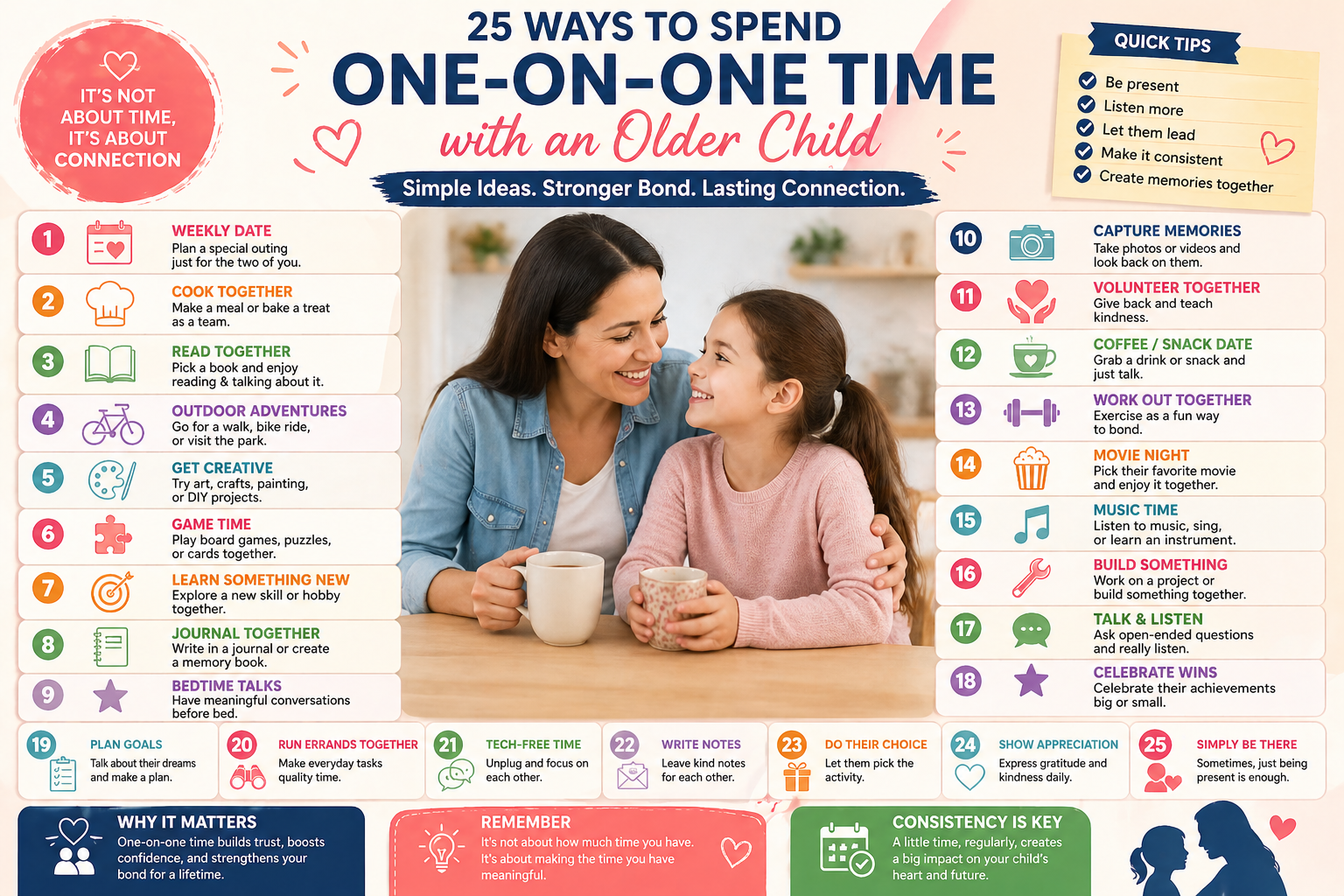
If that resonates with you, this post is for you. Because one-on-one time with an older child is one of the most underrated investments a parent can make — and it looks completely different than it did when they were four years old.
Here’s the thing about parenting younger children: they don’t really require effort to connect with. You show up, you play, you read, you exist in the same space — and connection happens almost automatically. They seek you out. They climb on you. They insist on your attention fifty times a day.
Older kids have learned, somewhere along the way, to stop insisting. Not because they need you less — research consistently shows that children’s need for parental connection doesn’t actually diminish through the tween years; it just changes shape — but because they’ve internalized the idea that pulling away is what growing up is supposed to look like.
The result is a generation of preteens who desperately want to be known by their parents and have absolutely no idea how to ask for it. They shrug off invitations. They say “whatever” and mean something much more vulnerable underneath it. They agree to things halfheartedly and then light up the moment you’re actually in it together.
One-on-one time breaks through that wall. Not grand gestures — those can feel performative to a twelve-year-old with a finely tuned radar for inauthenticity. But regular, low-stakes, dedicated time that sends one consistent message: I want to be with you specifically. Not as part of this family. Not as one of my kids. You.
That message is extraordinarily powerful to a child who spends the bulk of their day trying to figure out whether they matter.
Before we get into specific ideas, let me share a few things I’ve learned — some the hard way — about making one-on-one time actually work with older kids.
Let them have input. Nothing kills the vibe faster than a parent who has planned a “fun bonding day” without asking whether the kid finds any of it remotely interesting. Ask. Give options. Let them steer. Your job is to show up, not to produce the perfect experience.
Put the phone away. Completely. Not on the table face-down. Not in your pocket where you can feel it buzzing. Away. Older kids are acutely aware of when they don’t have your full attention, and they will test this constantly at first — half expecting you to get distracted — and then relax into it once they believe you’re genuinely present.
Don’t make it a therapy session. One-on-one time is not an interrogation. It’s not the appropriate venue for bringing up grades, friendship drama you’ve been saving up, or the three things you need them to change about their behavior. If you use this time to talk at them rather than with them, they’ll start dreading it.
Consistency beats occasion. One enormous “special day” every six months is not as valuable as thirty minutes of regular one-on-one time every week or two. It’s the pattern that builds trust, not the event size.
Follow their lead on conversation. Sometimes deep conversations happen. Sometimes they don’t. Both are okay. Don’t evaluate the success of your time together based on whether they opened up about their feelings. Sometimes the value is in the parallel experience — two people who love each other, doing something side by side.
1. Go for a drive with no destination
There is something almost magical about a car ride with an older kid. Maybe it’s the fact that you’re both looking forward instead of at each other — it removes the pressure of eye contact that can make honest conversation feel like a confrontation. Some of the best conversations I’ve had with older kids happened in the car, going nowhere in particular, with the radio off and the windows cracked.
Put them in charge of the music. Let the conversation drift wherever it goes. Don’t push. Just drive.
2. Explore somewhere neither of you has been
Pick a neighborhood, a trail, a town, a park — somewhere genuinely new to both of you. The shared experience of being in unfamiliar territory creates a natural sense of adventure and collaboration. You’re not the expert showing them around; you’re two people discovering something together. That equality matters to older kids who are starting to chafe against always being the less-experienced one.
3. See a movie they choose — and actually talk about it after
This sounds basic, but hear me out. Let them pick the movie. Don’t comment on whether you would have chosen it. Watch it with genuine attention. Then, on the way home or over food afterward, ask real questions — not “did you like it?” but “what was the part that surprised you most?” or “would you have made the same choice the main character did?”
You’ll learn more about how your kid thinks in that thirty-minute conversation than in a month of parallel existence at home.
4. Try a sport or activity they’re into — as a genuine beginner
If your kid is into skateboarding and you have never been on a skateboard, go with them and let them teach you. If they love rock climbing, try a beginner wall together and be actually bad at it. If they’re into tennis, play a wildly incompetent game of tennis and laugh at yourself.
There are two things happening here. First, they get to be the expert for once — they get to show you their world, and that reversal of the usual dynamic is enormously validating. Second, they see you being vulnerable and imperfect at something, which tells them more about how to handle failure and growth than any speech you could give.
5. Volunteer together
Serving others together is one of the most quietly transformative things you can do with an older child. It pulls both of you outside your individual concerns and points you toward something larger. Animal shelters, food banks, community cleanup events, library reading programs — find something that aligns with what they care about and do it alongside them.
The conversations that happen while you’re doing something purposeful are different from the conversations that happen at the dinner table. They go deeper without feeling forced.
6. Farmers markets, flea markets, or thrift shopping
Give them a small budget and turn them loose. Let them make their own choices about what’s worth buying. Follow their curiosity. Ask questions about what they’re drawn to and why. Markets and secondhand shops are low-pressure environments full of interesting things to notice — and they require no plan, no agenda, and no arrival time.
7. Take them to a place that was meaningful to you at their age
Not in a nostalgic monologue way — not “let me tell you about everything I used to do here” for forty-five minutes. But showing an older child a school you attended, a neighborhood you grew up in, or a park where something significant happened makes you three-dimensional to them in a way that matters. You stop being just their parent and become a person who was also, once, their age. That humanization is valuable for both of you.
8. Attend something they care about
A friend’s game. A local concert with a band they’re into. A convention for a hobby or interest. A school event. Going to something they love — not something you’re dragging them to, but something in their world — communicates respect for what matters to them. You’re not there to supervise. You’re there because what they love is worth your Saturday.
9. Take a day trip without a packed itinerary
Not a vacation. Not a planned excursion with twelve activities booked. Just a day trip — pick a destination an hour or two away, get in the car, and see what happens. Eat somewhere random. Stop when something looks interesting. Let the day be unscripted.
Older kids, who spend most of their life being scheduled and structured, often respond extraordinarily well to unplanned time. The freedom itself becomes the bonding agent.
10. Do a physical challenge together
A 5K. A long hike. A beginner yoga class. A challenge course or ropes course. Physical effort shared is bonding in its most elemental form — there’s a reason military experiences and sports teams build such powerful connections. When you sweat alongside someone, work hard alongside them, encourage each other through difficulty, something shifts.
And if you’re genuinely working hard, there’s no awkward pressure to make conversation. You’re just breathing and moving and being in it together.
11. Cook something new together — from scratch
Not the same three weeknight dinners you rotate. Something that requires effort, technique, and probably a few mistakes. Pick a cuisine neither of you knows well. Let them be the sous chef, the researcher, the taster. Cooking together at that level requires communication, collaboration, and shared investment in the outcome.
And then you get to eat it together, which is its own kind of satisfaction.
12. Start a show that’s just yours
One show, not watched with siblings or the other parent — a show that’s specifically the two of yours. You watch it together, you talk about it, you text each other reactions when one of you accidentally watched ahead. This sounds small, but it creates a private world between you — an ongoing reference point that belongs to just the two of you.
13. Play a game that requires actual thinking
Chess, Scrabble, Catan, Pandemic, Settlers, a good card game — something that requires them to engage their full brain and that you can’t coast through on autopilot. The competitive element of games creates a contained intensity that’s actually bonding — there’s something about playing hard against someone you love that’s more connecting than a lot of activities that are explicitly designed to be “bonding.”
Let them win honestly. Don’t throw the game. Nothing is more insulting to an intelligent older kid than a parent who is obviously letting them win.
14. Work on a project together
Build something. Fix something. Create something. A bookshelf, a garden bed, a simple piece of furniture, a bird feeder, a mural in the garage. The project matters less than the collaborative effort toward a shared goal. The side-by-side nature of physical work creates exactly the kind of low-pressure space where real conversations tend to emerge — not because you’re trying, but because you’re focused on something else together and the words just come.
15. Ask them to teach you something they know
This is one of the most powerful and underused tools in a parent’s kit. Does your older child know how to do something you don’t? Edit a video? Play a particular game? Do a card trick? Speak some of a language they’re learning? Explain a topic they’ve been studying?
Ask them to teach you. Be a genuinely humble student. Ask follow-up questions. Be impressed by what they know, not in a performative way, but in the honest way of someone who is genuinely learning. Watching a child step into the role of expert and guide — watching them realize you see their competence as real and worthy — is something else entirely.
16. Look through old photos or videos together
Pull out photos from when they were young — or even from before they were born — and just look through them together. Let the conversation go wherever it goes. Ask about what they remember versus what they don’t. Tell them stories from the years they can’t recall. This kind of shared memory work builds a sense of family narrative — the story you’re both living inside — that children need, especially as they start to develop their own individual identity apart from the family.
17. Let them be in charge of a whole evening
Hand over control of an entire evening and let them plan it — dinner, activity, schedule, everything. Give them a realistic budget if needed. Tell them you trust their choices. Then follow their lead without second-guessing or adjusting their plan.
This exercise in autonomy and trust tells them something important: I believe you are capable of making good choices. I’m not here to manage you. I’m here to be with you.
18. The regular errand that becomes a ritual
Sometimes the most meaningful one-on-one time doesn’t announce itself as special. It’s the Saturday morning hardware store run that you always take together. It’s the Tuesday coffee shop stop after school pickup. It’s the Sunday walk around the block that nobody would describe as a “bonding activity” but that both of you look forward to without ever quite saying so.
Look for the ordinary moments in your existing routine that could become a quiet, unspoken ritual between you and this specific child. Regularity and consistency matter more than novelty.
19. Sit in the same room, doing your own things
Sometimes connection doesn’t require activity at all. Being in the same room — you reading, them drawing, both of you doing your own thing in comfortable silence — is a form of closeness that older kids respond to deeply. It says: I want to be near you even when we’re not talking. Your presence is enough.
Don’t underestimate the power of simply occupying the same space on purpose.
20. Drive them somewhere and listen without advising
Pick them up from a practice, a friend’s house, a school event — and on the way home, ask one open-ended question and then just listen. Don’t fix. Don’t advise unless they ask. Don’t tell them what you would have done. Just listen, and follow up with questions that show you were paying attention.
The car is a confessional. Use it gently.
21. Let them vent without trying to solve it
One of the most connecting things you can do with an older child — and one of the hardest — is to hear their frustration about something and not immediately try to fix it. Just validate what they’re feeling. Sit with the discomfort. Let them finish. Ask if they want advice or if they just needed to say it out loud.
That question alone — “do you want me to help solve it or did you just need to say it?” — tells them that their emotional experience is the priority, not your need to be useful.
22. Go to a bookstore or library together
With no specific purpose. No book they’re required to read, no title you’ve already picked for them. Just wander. See what they pick up. Ask what sounds interesting and why. Let them spend an hour following their curiosity through shelves without any adult agenda attached to it.
Then, ideally, get them the book they chose and ask about it when they finish.
23. Early morning time before everyone else is up
For families with multiple kids, the house is usually quiet early — before siblings are awake and before the day has made demands on everyone. If your older child is an early riser, that quiet window can become something precious. Even thirty minutes of early-morning conversation over cereal, before the noise starts, can feel more intimate and meaningful than an entire planned “special day.”
24. Let them introduce you to their online world
This one requires some humility, but it’s worth it. Ask your older child to show you the things they’re interested in online — the YouTube channels, the gaming community, the music, the creators they follow. Not to monitor. Not to evaluate. Just to understand what their world looks like.
The willingness to enter their world on their terms — without judgment, without concern-trolling, without immediately pivoting to a lecture about screen time — communicates respect in a language they actually understand.
25. Write them a letter, and invite them to write back
This sounds old-fashioned, but there’s something about written words that changes the register entirely. Write your older child a letter — not a birthday card, a letter — that tells them something genuine: what you admire about who they’re becoming, a specific memory you treasure, something you want them to know about themselves.
Leave it on their pillow. No expectation of a response. Some kids will write back. Some won’t. But they will read it more than once. They will almost certainly keep it.
Here’s a truth that nobody puts on parenting posters: older kids will sometimes reject your attempts to connect. They’ll roll their eyes at your invitation. They’ll say they’re busy. They’ll come along and spend the first twenty minutes of your one-on-one time looking at their phone.
This is not a sign that they don’t want connection. It’s a test.
Older children who are in the process of separating their identity from their parents — which is exactly what children between the ages of eight and sixteen are developmentally supposed to do — often push against closeness to see whether you’ll keep offering it. They’re checking: If I make this hard, will you give up? If I don’t immediately reward your effort, will you stop trying?
The answer they need is no.
Keep the invitations warm and consistent. Don’t make a big deal out of being rejected. Don’t sulk. Don’t give them the guilt trip. Just show up again next time with the same easy warmth, the same offer, the same message: I want to spend time with you. I’m not going away.
Over time — sometimes it takes weeks, sometimes it takes months — something shifts. They start saying yes. They start initiating. They start sitting next to you on the couch when they could have sat anywhere else. Not because you convinced them, but because you showed them, through pure consistency, that your interest in them is not performance. It’s just true.
The evidence behind individual parent-child time is genuinely compelling, even if the popular conversation about it focuses mostly on young children. Here’s what research indicates for older kids specifically:
Emotional security doesn’t age out. Studies in developmental psychology consistently show that secure attachment — the sense that a parent is reliably present and emotionally available — remains a significant predictor of positive outcomes well into adolescence. One-on-one time is one of the most direct ways to maintain that attachment signal as children grow.
Adolescents who feel connected to parents take fewer risks. Large-scale studies including the National Longitudinal Study of Adolescent to Adult Health found that adolescents who reported feeling close to and loved by parents were significantly less likely to engage in early substance use, risky sexual behavior, and violence. The mechanism isn’t supervision — it’s connection.
Individual attention buffers against peer pressure effects. Research from developmental psychologists including Laurence Steinberg suggests that adolescents with strong parental connection are better able to resist negative peer influence, not because of rules or monitoring, but because the parental relationship provides a stable identity anchor.
Quality beats quantity, but quantity matters too. The classic “quality vs. quantity” debate in parenting research has largely resolved to a both-and answer: the quality of interactions is crucial, but adequate frequency of those interactions is necessary for the quality to accumulate into something meaningful. Thirty minutes of genuine attention every week is more valuable than an annual “special day.”
None of this requires you to structure your relationship like a research study. It just underscores that the impulse to spend dedicated time with your older child — even when they seem like they don’t care, even when it’s inconvenient, even when they push back — is not sentimentality. It’s good parenting with real developmental stakes.
Some parents reading this are nodding along and thinking of specific children who have resisted every overture they’ve made. So let’s talk about that directly.
If your older child consistently declines one-on-one invitations, here are a few things to consider:
Lower the stakes. A “special outing” can feel like too much — too formal, too clearly an attempt to connect, which can feel awkward to a kid who is uncomfortable with emotional intimacy. Instead, offer something small and offhand. “Hey, I’m going to get a coffee — want to come?” is much easier to say yes to than “I’d really like some one-on-one time with you this weekend.”
Let go of the agenda. If your kid suspects that one-on-one time is a vehicle for a serious conversation you want to have, they’ll avoid it. Make sure they know the time is genuinely just time — no agenda, no topics you’re planning to bring up, nothing expected.
Ask what they would want. Directly. “If we were going to spend some time, just the two of us, what would you actually want to do?” Then do that. Exactly that, without modification.
Keep the door open without pressure. You can say something once — “I’d really love to do something with just you sometime” — and then not repeat it. Let it be known, and then let them come to it in their own time. Some kids need to feel like the invitation isn’t urgent or needful before they can accept it without feeling like they’re doing you a favor.
Consider what’s underneath the resistance. Sometimes older children pull away from one-on-one time because something is wrong — not wrong between you, but wrong internally. Anxiety, depression, social difficulty, or something they’re carrying alone can all manifest as withdrawal. If the resistance is accompanied by other signs — mood changes, loss of interest in things they used to love, changes in appetite or sleep — it may be worth a gentle, private conversation about how they’re really doing.
If you’re managing two or three or more children, you know that one-on-one time doesn’t happen by accident. It has to be made — not in a way that makes the other children feel left out, but in a way that each child can feel the unmistakable reality of your individual love for them specifically.
It doesn’t have to be elaborate. It can be as simple as: one child comes to the grocery store with you while the others stay home. One child gets to stay up thirty minutes later one night a week and that time is theirs alone. One child rides with you to drop something off and you stop for ice cream on the way back.
The regularity — the sense that their individual time with you is something that always comes back — is what makes it meaningful. Not the size of it.
Your older child is going to leave home. Maybe not for a while, but someday — and closer than it currently feels — they will be an adult with their own life, their own home, their own reasons to be busy.
The relationship you build with them right now, in these tween and preteen years when everything feels loud and complicated and like they barely tolerate you half the time, is the foundation for what you’ll have when they’re twenty-five. When they’re going through something hard and decide whether to call you or not. When they’re home for the holidays and decide whether they want to talk or just survive the visit. When they have their own children someday and are deciding what kind of parent to be.
The one-on-one time you give them now doesn’t just matter to them now. It tells them, in the language of action rather than words, that they are worth your individual attention. That they are specific and particular and irreplaceable to you. That you are interested in who they are, not just what they’re doing or how they’re performing.
That message lands. Even when they don’t show it. Even when they roll their eyes and say “I know, Dad” and go back to their phone. It lands, and it stays, and it matters in ways you may not see for years.
Keep showing up. Keep offering. Keep choosing them.
There’s no single right answer, but most child development professionals suggest that even 20–30 minutes of dedicated one-on-one time per week makes a measurable difference in a child’s sense of security and connection. The key is regularity — your child knowing that their individual time with you is something that reliably returns — rather than the frequency itself.
Keep offering without pressure. Lower the stakes — instead of planned “special time,” try casual, low-commitment invitations like running an errand together or grabbing food. Let them choose the activity. Make sure they know there’s no hidden agenda. Resistance is often a test of whether your interest in them is genuine and consistent, not a sign that they’ve stopped needing connection.
Yes, and for a specific reason: individual attention tells a child something that family time simply cannot — that you value them as a specific person, not just as a member of the group. Even in close, warm families, children need to feel individually seen and chosen. One-on-one time delivers that in a way that group experiences don’t replicate.
Let them lead. The goal isn’t to find shared hobbies — it’s to spend time in their world and let them know you’re genuinely curious about what they love. Ask them to introduce you to their interests. Be a humble student. Your willingness to enter their world is far more connecting than insisting on activities you already have in common.
Consistency matters more than size. Small, regular moments — one child comes along on an errand, one stays up a little later on a specific night, one rides with you while others stay home — distributed reliably across all your children, are more impactful than rare large events. Build individual time into the existing rhythms of your week rather than treating it as a separate obligation to schedule.
The shift usually becomes noticeable around ages 8–10. Activities that worked beautifully at five — playgrounds, simple crafts, basic games — start feeling babyish to older children. Follow their lead about what feels right. The more you let them steer the content and tone of your time together, the more naturally it will fit where they actually are developmentally.
Absolutely. Shared presence — being together without a heavy conversational agenda — is genuinely connecting, especially for older kids who can feel interrogated by conversation-heavy interactions. Some of the most meaningful one-on-one time involves very little talking. The value is in the attention, not the output.
Make it a rule for yourself before you go in: no topics you’ve been saving up, no behavioral corrections, no grades, no friendship concerns. If something important comes up organically, that’s different — but the time shouldn’t be used as a venue for issues you’ve been wanting to address. If your child learns that one-on-one time is the place where they get the serious talk, they’ll stop wanting it.