Physical Address
304 North Cardinal St.
Dorchester Center, MA 02124
Physical Address
304 North Cardinal St.
Dorchester Center, MA 02124

There is a version of family life that gets sold to us constantly.
It involves tickets. It involves entrance fees and gift shops and the particular financial sinkhole of theme park food. It involves kids in matching outfits at resorts, families at waterparks, parents handing over a credit card for experiences that were supposed to produce joy but mostly produced a receipt and a three-year-old who had a meltdown in the parking lot.
The marketing behind this version of family life is extremely good. It has convinced enormous numbers of people that the quality of their family experiences is directly proportional to how much those experiences cost. That a great weekend requires a plan and a budget. That if you’re not doing something, you’re wasting the weekend. That presence plus money equals memory.
None of that is true. And most parents, if they’re honest, already know it.
The memories that tend to actually stick — the ones that children carry into adulthood and talk about when they’re grown — are almost never the expensive ones. They’re not usually the theme park days or the resort vacations or the tickets to the big thing. They’re the Saturday afternoon that turned into something unexpected. The game that went on too long and ended in everyone laughing about something they can’t fully explain. The walk that became a tradition. The dough that didn’t rise and somehow produced the best afternoon of the whole month.
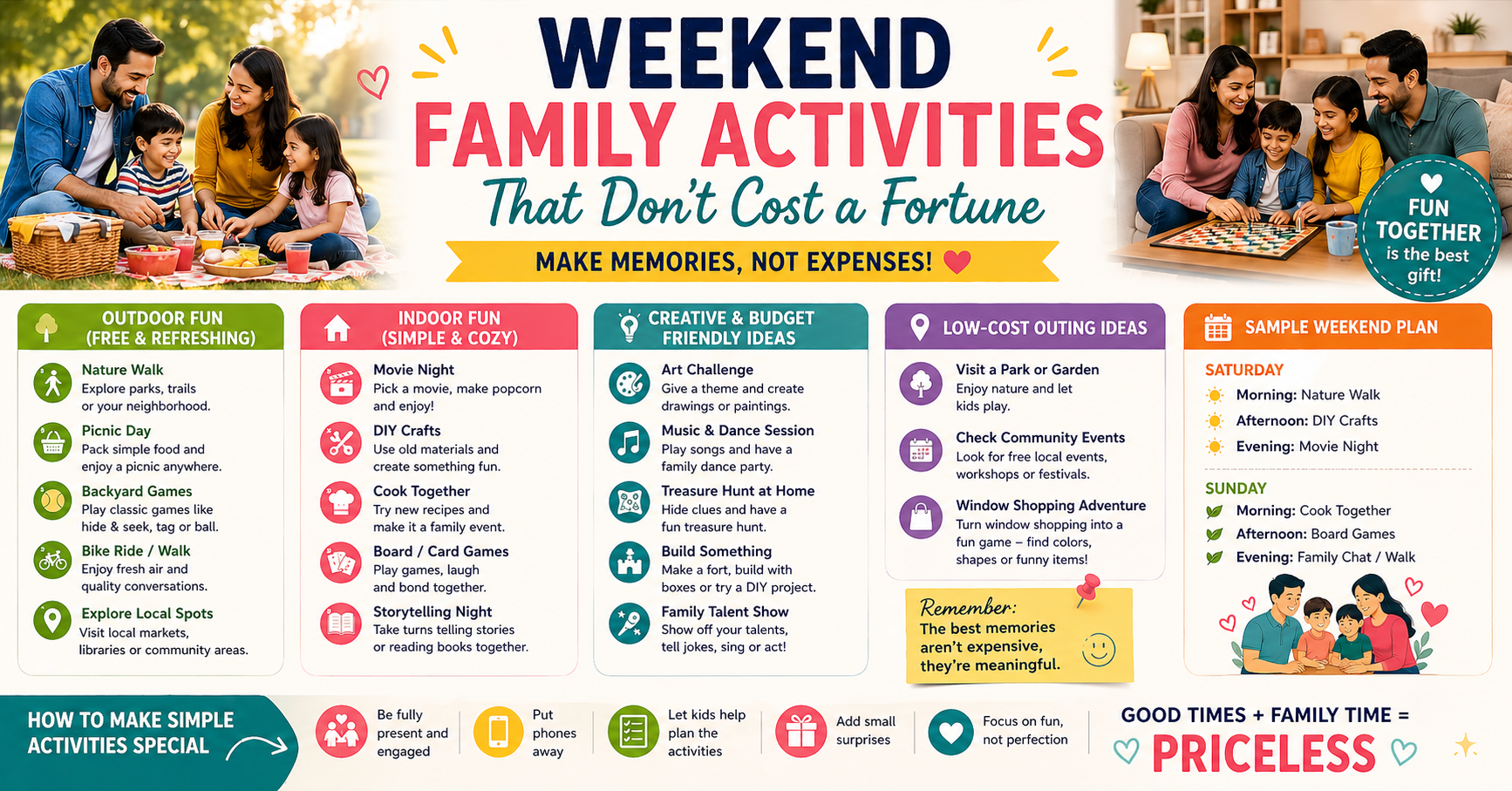
This is a list of those things. Real, usable, genuinely enjoyable weekend family activities that don’t require a budget, a booking, or a credit card. Some of them are ideas. Some of them are frameworks. Some of them are things you used to do as a child and forgot about. All of them work.
Before we get into the list, it’s worth understanding why budget-friendly activities often produce better family experiences than expensive ones — because this isn’t just consolation for a tight month. There’s something genuinely true here.
Expensive activities often front-load pressure. When you’ve spent $200 on a day out, there is an invisible weight on the whole experience: it needs to be worth it. This pressure lands on everyone — parents who feel they need to justify the spending, children who sense the expectation that they should be having the time of their life, a family dynamic that is navigating performance rather than simply being together. Free activities have no such weight. They just are what they are.
Unstructured time is where children play most deeply. Research in developmental psychology consistently shows that the most beneficial play for children — the kind that builds creativity, executive function, and social skills — is unstructured, child-directed play. The expensive experience at the trampoline park is external entertainment delivered to the child. The afternoon with a pile of cardboard boxes in the garden is internal entertainment generated by the child. Both have value, but they’re not equal in terms of developmental benefit.
Shared experience doesn’t require novelty. We tend to assume that meaningful family experiences need to be new, special, or out of the ordinary. But the research on memory formation tells a different story: repetition and ritual are actually more reliably associated with strong, warm family memories than novelty is. The pancakes every Saturday. The walk to the park that you always take the same way. The movie you’ve seen seventeen times. Familiarity is not boredom. It is the architecture of belonging.
Kids often prefer simple. Ask most children under ten what their favorite activity is and you will get something that costs nothing: playing with a specific toy, doing something in the garden, baking, a game with you. The elaborate and the expensive are not what children are usually asking for. They’re asking for your attention and your time, which is a different currency entirely.
1. The Neighborhood Scavenger Hunt
This one takes five minutes to prepare and can absorb an entire afternoon. Write a list of things to find in your neighborhood or local park — a red leaf, something that makes a sound when the wind blows, something older than your house, a bird’s nest, something soft, something that wasn’t there last week. Give each child a bag or a notebook. Walk together and search.
The genius of the scavenger hunt is that it turns an ordinary walk into an adventure without requiring anything to actually be different. The neighborhood is the same. The children’s attention to it is completely transformed. And the walk that would have produced complaints after ten minutes becomes the one they want to do again next weekend.
2. A Picnic Anywhere At All
The location is almost irrelevant. The backyard. The front steps. The park five minutes from your house. A corner of the school playing field on a weekend when it’s empty. The act of carrying food outside and eating it on a blanket rather than at a table changes the experience completely and costs exactly what lunch would have cost at home anyway.
Add a thermos of something warm in cooler months. Let the children pack their own section of the picnic. Make it slightly ceremonial without being complicated, and it becomes something people look forward to.
3. Hiking and Trail Walking
Most families have access to at least some version of a walkable natural space — a park, a wood, a towpath, a coastal path, a nature reserve — within a reasonable distance. Most of these are free. Most of them are underused by the families who live closest to them.
The things that make a hike work with children are mostly not about the hike itself: bring snacks, lower your expectations for distance, let children set the pace for at least part of the walk, give them something to look for rather than just walking, and don’t attach the experience to arriving anywhere in particular. A forty-five-minute loop that everyone enjoys is vastly better than a two-hour trail that produces misery after the first hour.
4. Bike Rides With No Particular Destination
If your family has bikes — even if some of those bikes are small and slow and require someone to run alongside them — a weekend bike ride ranks among the activities that children reliably look back on warmly. The combination of movement, fresh air, speed, and the mild adventure of going somewhere without a plan produces a particular kind of good mood that is difficult to manufacture any other way.
Bike paths along rivers and canals, quiet neighborhood streets on a weekend morning, park circuits — all of these work. The goal is not exercise, though that’s a happy side effect. The goal is moving through the world together.
5. Exploring Somewhere Local You’ve Never Actually Been
Most families have a radius of five to fifteen miles around their home that contains places they’ve driven past a hundred times and never stopped at. A viewpoint. A small village with a main street. A local heritage site. A beach or lake or river access that technically exists but has never been visited. A cemetery with old headstones that tells local history. A neighborhood that’s different from yours.
Give the weekend an exploratory premise — we’re going somewhere we’ve never been within twenty minutes of home — and let children help navigate. The bar for “interesting” is low when the frame is exploration rather than entertainment.
6. Stargazing
This requires darkness and a clear sky and essentially nothing else. Spread blankets on the grass or the car roof, download a free stargazing app if you want help identifying what you’re seeing, bring something warm to drink, and lie there together looking up.
The conversations that happen during stargazing are often the best conversations. Something about darkness and scale and the particular beauty of the sky opens people up in ways that other settings don’t. Children ask questions they don’t usually ask. Parents say things they don’t usually think to say. It costs nothing and produces the kind of memory that stays.
7. The Garden or Park Obstacle Course
Set up an obstacle course using whatever is available — garden furniture, hoops, chalk lines, buckets, sticks, rope. Add challenges: hop on one foot between these two points, crawl under this, spin three times, balance on that. Time it. Compete. Redesign it. Let the children add their own elements.
This is the kind of activity that expands to fill the time available and produces the specific combination of physical effort and laughter that makes for a genuinely good afternoon. It works across ages — older children design it, younger children run through it, everyone has a role.
8. The Rain Walk
This is the contrarian one. Most families retreat indoors when it rains at the weekend, which is understandable but represents a missed opportunity. A deliberate walk in the rain — with proper clothing, without any expectation of staying dry, with the specific intention of enjoying the rain rather than tolerating it — is one of those childhood experiences that gets remembered long after the dry weekends have blurred together.
Jump in puddles. Look at how the light changes. Listen to the sound it makes on leaves and pavement. Get genuinely wet if it comes to that. The adventure of doing something that runs against the usual rules is its own reward.
9. A Proper Baking Project
Not a kit. An actual baking project, from scratch, that requires effort and produces something real. Bread. Pizza dough. Cookies from a recipe that involves creaming butter. A birthday cake for no particular birthday. The point is not the outcome — though eating what you made together is enormously satisfying — it is the process. The measuring, the mixing, the waiting, the checking, the slightly anxious moment of opening the oven.
Baking with children is one of the most reliably connecting domestic activities precisely because it requires genuine collaboration, produces visible results, and ends in eating together. The mess is part of it. Don’t clean as you go.
10. A Family Film Festival
Choose a theme — all the films of one director, all the films in a franchise you haven’t seen, all the animated films from a particular decade, all the films set in one country — and dedicate a weekend to it. Make it ceremonial: a good snack setup, blankets, the right lighting, maybe a handwritten “program” if you have children who enjoy that sort of thing.
The theme elevates it from “watching TV” to “doing something.” Children who are old enough to participate in choosing the theme feel the investment of having shaped the experience. And watching multiple things in a shared context gives you something to compare and discuss and reference for weeks afterward.
11. Board Games and Card Games — Properly
Not the games you always play, with the rules you half-remember and the missing pieces you’ve been compensating for. Actually properly. New games, or old games played by the actual rules, with the table cleared and the time protected and the genuine intention of playing rather than going through the motions.
For families who haven’t explored recent board games, the variety and quality of what’s available now is remarkable — Ticket to Ride, Pandemic, Catan, Codenames, Dobble, Exploding Kittens, and dozens of others are genuinely excellent for different age ranges. The library often has games available to borrow. A charity shop near you almost certainly has a shelf of them.
12. Building Something With What You Have
The cardboard box as the highest form of children’s entertainment is a cliché precisely because it is true. Cardboard boxes, tape, scissors, paint if you have it, and a free afternoon produce constructions of extraordinary ambition and almost no monetary cost. A fort. A castle. A spaceship. A town. A robot costume. A puppet theater.
If you don’t have boxes, use the cushions from the sofa. Use blankets and chairs. Use what’s in the recycling. The materials don’t matter — the permission to build without constraint is the actual gift.
13. A Home Science Afternoon
Baking soda and vinegar, food coloring, water, oil, a few kitchen staples and some searching on free educational websites produces a home science afternoon that children who are into experiments will genuinely love. Volcanoes, density experiments, color-mixing, making slime, growing crystals — most of these cost under a dollar in materials if they cost anything at all.
The PBS Kids and Smithsonian websites have free experiment ideas for every age and supply level. Pick three or four, gather the materials, spread newspaper on the table, and let them go.
14. Family Karaoke or Music Night
The barrier to entry here is a phone and a YouTube karaoke channel, which is a barrier of essentially zero. Pull up a karaoke playlist for whatever genre produces the most enthusiasm in your household, and just do it. No skill required. No audience required. The silliness is the point.
For families with instruments, even very basic ones, a family jam session or a “show” where each family member performs something — a song, a magic trick, a poem, a stand-up bit — produces the specific combination of creativity and shared laughter that is extremely difficult to buy.
15. A Jigsaw Puzzle Weekend
Put a puzzle on the dining table on Friday evening and leave it there through the weekend, available for anyone to work on whenever they feel like it. This low-commitment, low-pressure format works beautifully — it doesn’t require everyone to be there at once, it allows for natural coming and going, it’s deeply satisfying when pieces fit, and it creates a shared project that draws people back repeatedly.
The conversation that happens while working on a puzzle together is some of the most natural conversation there is, because the puzzle gives everyone something to look at and work on without the pressure of direct engagement.
16. The Recipe-From-Memory Cooking Challenge
Everyone in the family picks a recipe they know — or think they know — from memory. No looking it up. They write down the ingredients and method from what they remember, and then everyone’s recipe gets made (or the most promising one, or one per weekend). The results are often spectacular in their wrongness, and the wrongness is the entertainment. This is the kind of low-stakes family game that produces stories that get told for years.
17. Backyard Camping
Put up a tent in the garden. Or string a tarp between two points. Or build a lean-to from branches if you’ve got access to a wood. Sleep outside, or just do the pre-sleep portion outside and then migrate back indoors — whatever the temperature and your children’s tolerance for adventure permits. Toast something over a small fire or a camping stove. Look at the sky. Tell stories in the dark.
The backyard camping experience costs nothing and produces the specific magic of camping — the containment, the closeness, the doing-something-out-of-the-ordinary — without the logistics of going anywhere.
18. The Public Library — Really Using It
Most people’s relationship with their public library is transactional: go in, get books, leave. But a library is also events, storytelling sessions, holiday programs, free access to audiobooks and e-books, museum passes in some areas, and a genuinely comfortable space to spend a few hours. Most public libraries have dedicated children’s programming that is excellent and free.
If your family hasn’t been to the library recently, go with no particular agenda. Let children browse and pick whatever they want. Check what events are coming up. Get a card if you don’t have one. It’s the most underused free resource most families have access to.
19. Local Farmers Markets and Street Markets
These are free to attend and often excellent entertainment even with no purchasing budget. The variety of produce, the crafts, the smells, the conversations, the small samples — a Saturday morning market visit is an experience that is both stimulating and relaxed, particularly good for curious children who like to look at things and ask questions about them.
Give each child a small amount to spend if the budget allows. Let them make their own decisions about it. The decision-making itself is part of the value.
20. Free Museum Days and Local Galleries
Many national and local museums have free entry days, free children’s admission, or simply free entry full stop. Local art galleries are almost universally free. Small local museums — the ones that tell the history of your specific town or region — are often free and frequently fascinating in ways that large national institutions can’t replicate because they’re about the specific place you live.
Search what’s available within a reasonable distance. Make a list. Work through it over the course of a year. Some of these places will surprise you enormously.
21. Volunteering Together as a Family
This one takes a little coordination but produces something that is genuinely different in character from entertainment-based activities. An afternoon at an animal shelter, a park cleanup, a community garden, a food bank. Older children especially are moved by the experience of being useful in ways that go beyond their immediate world — and the conversations that happen during and after volunteering tend to be among the most meaningful and substantive that families have together.
22. Attending a Local Sporting Event
Not the professional game with the expensive tickets. The local amateur league game that happens in the park on Saturday mornings and has no entrance fee. The children’s football match where parents line the pitch and cheer. The local athletics meet. The community swimming gala.
These events are free, immediate, and full of the particular energy of people who are playing for the love of the game rather than for income. For children who play sports themselves, watching others play is genuinely engaging. For families with no particular sporting connection, it’s a window into a world that is pleasant and human and completely free to enter.
23. Community Events, Festivals, and Fairs
Almost every community runs events through the year — summer fairs, autumn harvest festivals, Christmas markets, outdoor movie screenings, community days — that are free or very low cost to attend. These events are often listed on local council websites or community Facebook groups. Build a habit of checking what’s happening in your area before assuming a weekend is empty.
Spring:
Summer:
Autumn:
Winter:
One of the things that transforms an ordinary weekend activity into something more meaningful is the conversation that happens during or around it. Here are questions worth having at the table, on the walk, in the car, over the puzzle:
These questions don’t require special circumstances. They work on a walk, during a meal, in a car on the way to anywhere. The activity creates the relaxed context; the question opens the space.
One of the most practical things you can do with this list is turn it into a family resource rather than a one-time read. Here’s how:
Create a “weekend ideas jar.” Write each activity on a slip of paper and put them in a jar. On Friday evening or Saturday morning, when someone asks “what are we doing this weekend?” pull two or three from the jar and choose together. This removes the decision fatigue that makes many weekends default to screens by accident, and it gives children genuine agency in what happens.
Keep a running family list on the fridge. Activities you want to try, places you want to go, things you want to make. Add to it whenever someone has an idea. Work through it over time.
Take a photo or keep a simple record. Not for Instagram — for yourselves. A family photo album that records ordinary weekends is eventually a more treasured record of family life than the formal photos from special occasions. The Saturday afternoon baking mess has more of real life in it than most posed vacation shots.
The pressure on weekends — to be productive, to do something, to give children experiences worth having — is real and often counterproductive. Some of the best family weekends are the ones where not much happens. Where everyone sleeps in and someone makes pancakes and the afternoon goes slowly and nobody looks at a clock and somehow by Sunday evening there’s a sense of having been genuinely together rather than jointly scheduled.
The activities in this list are not a mandate. They’re an inventory of options for the weekends when you want to do something and can’t think of what, or when money is tight and the weekend needs to be good anyway, or when screen time has taken over and you want to offer an alternative.
The thread connecting all of them is this: the best family time is usually the time when everybody is genuinely in it — present, engaged, doing something that creates shared experience rather than parallel consumption. That experience doesn’t require a budget. It requires attention, willingness, and the willingness to let an ordinary Saturday become something worth remembering.
Most ordinary Saturdays will, if you let them.
Some of the most reliably enjoyable free activities for families with young children include local park visits with a scavenger hunt element, baking projects at home, building forts from blankets and cushions, public library visits, backyard or garden obstacle courses, and seasonal nature activities like leaf collecting or puddle jumping. The key for young children is low planning investment — activities that can flex around nap times and short attention spans tend to work better than anything requiring sustained focus or travel.
Start with something that has a physical or creative element — baking, building, outdoor play — as these naturally compete with screens in ways that passive activities don’t. Having a prepared list of options removes the decision-fatigue moment where screens win by default. Giving children some agency in choosing the activity also increases buy-in significantly. A weekend jar with activity ideas written on slips of paper works extremely well for families with multiple children who can’t agree.
Yes — significantly more than most families realize. Public libraries, local parks and nature reserves, community events, free museum entry days, local sporting events, farmers markets, and community volunteer opportunities are all free or nearly free. Most families have a radius of options around their home that they’ve never fully explored. A deliberate effort to research what’s available locally — through council websites, community groups, and library noticeboards — usually produces a longer list than expected.
Framing and intention do most of the work here. An activity that is presented as something the family is choosing to do — rather than something you’re making do with — lands completely differently. Small ceremonial touches help: a special breakfast before the activity, a handwritten “program” for a movie day, a theme for the afternoon. Children respond to the investment of thought and care, not the investment of money. A deliberately planned free day often feels more special than an expensive outing that happened by default.
Activities that allow different levels of participation work best for mixed-age families. Scavenger hunts can be calibrated by age. Baking gives everyone a different job. Board games with teams can balance older and younger players. Building projects can have different roles. Hiking works at a pace set by the youngest. The key is avoiding activities where older children are bored or younger children are excluded — and being willing to let the activity run differently than you planned when the natural energy of the group takes it somewhere unexpected.
There’s no specific frequency that research prescribes, but most family wellbeing experts suggest that regular, recurring shared experiences — even simple ones — are more beneficial than occasional elaborate ones. One meaningful shared activity per weekend, even if it’s as simple as a walk or a meal made together, is a reasonable and sustainable target. The goal isn’t a packed schedule; it’s consistent connection woven into the existing rhythm of the week.
A: Boredom is not actually the enemy — it’s the precondition for creative play, and children who are given unstructured time rather than entertainment often surprise themselves with what they end up doing. For children who genuinely resist every suggestion, try offering only two options rather than an open field of possibilities. Give them genuine agency within defined parameters. And be willing to start something yourself — begin building, begin baking, begin drawing — without requiring them to join. Curiosity usually wins eventually.