Physical Address
304 North Cardinal St.
Dorchester Center, MA 02124
Physical Address
304 North Cardinal St.
Dorchester Center, MA 02124

If you have ever bought a brand-new pair of shoes for your toddler only to find they barely fit two months later, you are not alone. Fast-growing toddler feet are one of the most genuinely surprising parts of early parenthood. One week everything fits perfectly, and the next you notice your little one walking on tiptoe or curling their toes inside shoes that looked completely fine last Tuesday. Getting toddler shoe sizing right is one of the most important things you can do for your child’s foot health, balance, and overall development — and yet most parents are never properly taught how to do it.
This complete toddler shoe sizing guide covers everything from how to measure your child’s feet at home with zero special equipment, to understanding the difference between US, UK, and European sizing, to knowing exactly when those shoes need to go. We will also look at width fittings, the best toddler shoe size charts available, common mistakes parents make, and a full FAQ covering every question you have ever had about growing toddler feet.
Adult feet are largely done growing. Toddler feet, on the other hand, are not only growing rapidly — they are also actively developing their internal structure. A child’s foot at age one still contains mostly cartilage that has not yet hardened into bone. The bones themselves do not fully ossify until the teenage years, which means that wearing incorrectly sized shoes during the toddler years can have real long-term consequences for foot shape, arch development, and even gait.
Research published in pediatric orthopedic journals consistently shows that wearing shoes that are too tight during the critical growth window between ages one and three can cause toe deformities, blistering, ingrown toenails, and altered walking patterns that persist into adulthood. This is not meant to alarm you — it is meant to help you understand why getting your toddler shoe sizing guide knowledge right matters far beyond just buying the correct size.
Most pediatric podiatrists agree that toddler feet grow roughly half a size every one to three months between the ages of one and three. Between ages three and five, growth slows slightly to about half a size every two to four months. This means that on average, you can expect to buy new shoes for your toddler somewhere between four to six times per year during peak growth phases — more frequently for some children, less for others.
Here is a general growth rate breakdown you can reference:
| Age Range | Growth Rate | Approx. New Shoes Needed |
| 12 – 18 months | ~1 size per 2-3 months | 4-6 pairs per year |
| 18 – 24 months | ~0.5 size per 2-3 months | 3-5 pairs per year |
| 2 – 3 years | ~0.5 size per 3 months | 3-4 pairs per year |
| 3 – 5 years | ~0.5 size per 4 months | 2-3 pairs per year |
| 5 – 8 years | ~1 full size per year | 1-2 pairs per year |
Keep in mind these are averages. Some toddlers — particularly those going through a growth spurt — can jump a full size in just three to four weeks. Checking your child’s toddler shoe size every four to six weeks is a habit worth building, even if it feels excessive at first.
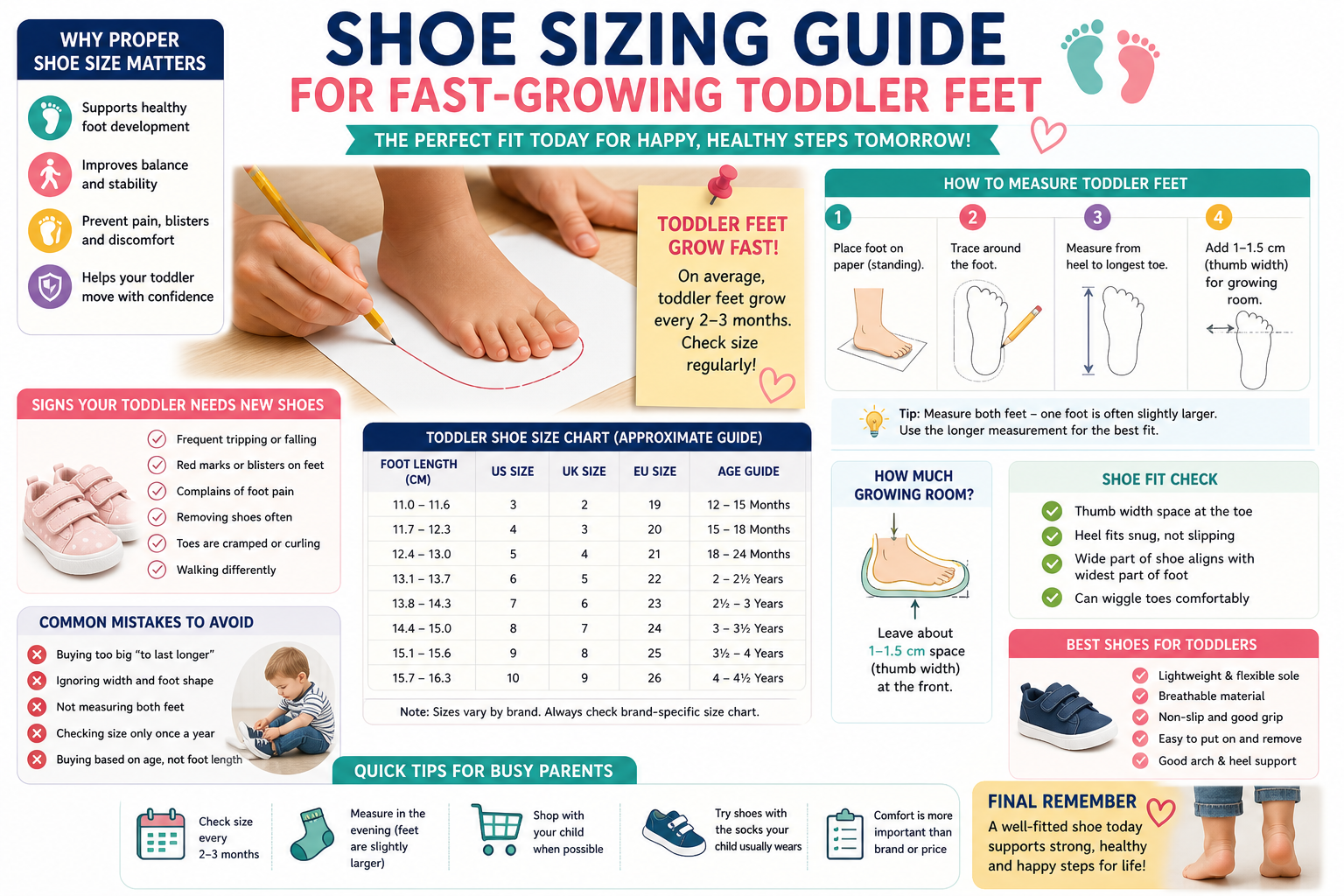
You do not need to visit a specialty shoe store to measure your toddler’s feet accurately. All you need is a piece of plain white paper, a pencil or pen, and a ruler or measuring tape. Here is how to do it properly so you can use any toddler shoe sizing guide confidently.
shoe size conversion chart (see below) to find your child’s current toddler shoe size.
Pro Tip: Always measure your toddler’s feet in the afternoon or evening. Feet naturally swell slightly throughout the day, so a morning measurement may result in buying shoes that feel tight by lunchtime.
Use this comprehensive toddler shoe sizing chart as your go-to reference:
| Approx. Age | Foot Length (cm) | Foot Length (in) | US Size | UK Size | EU Size | Mondopoint |
| 9-12 months | 11.0 | 4.3 | 3.5 | 3 | 19 | 110 |
| 12-18 months | 11.7 | 4.6 | 4 | 3.5 | 20 | 117 |
| 18-24 months | 12.3 | 4.8 | 5 | 4 | 21 | 123 |
| 2 years | 13.0 | 5.1 | 6 | 5 | 22 | 130 |
| 2.5 years | 13.7 | 5.4 | 7 | 6 | 23 | 137 |
| 3 years | 14.3 | 5.6 | 8 | 7 | 24-25 | 143 |
| 3.5 years | 15.0 | 5.9 | 9 | 8 | 26 | 150 |
| 4 years | 15.6 | 6.1 | 10 | 9 | 27 | 156 |
| 4.5 years | 16.3 | 6.4 | 11 | 10 | 28 | 163 |
| 5 years | 17.0 | 6.7 | 12 | 11 | 29-30 | 170 |
Note: Sizes listed are approximate averages. Always use your measured foot length — not age alone — when consulting any kids shoe sizing chart. Age is a rough guide only.
Length gets all the attention in most toddler shoe sizing discussions, but width is equally important — especially for toddlers with growing toddler feet that tend to be naturally chubby and wide during the early years. A shoe that is the correct length but too narrow will cause just as many problems as one that is too short.
| Width Code | Description | Typical Fit For | Common Brands Offering It |
| N / Narrow | Slim fit | Petite or slender feet | Stride Rite, Clarks |
| M / Medium | Standard fit | Average-width feet | Most brands standard line |
| W / Wide | Roomy fit | Naturally wide toddler feet | New Balance, Stride Rite Wide |
| XW / Extra Wide | Very roomy | Toddlers with very wide or chubby feet | New Balance 990, Plae |
The easiest way to check width at home: place your traced foot outline flat and measure the widest point across the ball of the foot. Compare this measurement to the manufacturer’s width chart for that specific shoe. Width tolerances vary between brands, so do not assume a brand’s wide in one style matches another brand’s wide.
Toddlers cannot always tell you their feet hurt. They do not yet have the vocabulary to describe “my shoe is pinching at the toes” or “my heel is slipping.” This means parents need to know what to look for visually and behaviourally. Here are the key signs that it is time to consult your toddler shoe sizing guide and size up:
Important: Do not wait until all of these signs appear. Even one or two consistently should prompt you to re-measure your child’s growing toddler feet immediately.
This is one of the most commonly asked questions in any toddler shoe sizing guide, and the answer is more nuanced than most people think.
Most pediatric footwear specialists recommend leaving between 9 and 12 millimetres (roughly 3/8 to 1/2 inch) of space between the tip of the longest toe and the end of the shoe. This translates roughly to:
Going above 15–18mm of toe room is equally problematic — it creates an unstable fit where the foot slides forward in the shoe with every step, causing the toes to jam into the front on stairs or slopes. More toe room is not always better in kids shoe sizing — it needs to be just right.
Half sizes are not available in every brand of children’s footwear, but when they are, they can be genuinely useful for toddlers who fall between sizes. If your measured foot length places your child between a size 5 and a size 6, and the brand offers a 5.5, it is usually worth trying.
However, be cautious about buying half sizes “just in case” — a shoe that is a full half-size too big for a toddler who is actively learning to walk can cause tripping and instability just as easily as one that is too tight.
The golden rule: always size to the measured foot, not to your hopes about how long the shoe will last. Buying shoes that are too big in anticipation of growth is a very common parenting mistake — and one that every solid toddler shoe sizing guide will tell you to avoid.
Getting the number right is only part of the equation. Here is what else matters when choosing shoes for fast-growing toddler feet:
A toddler’s shoe sole should flex easily when you bend it. Pick up the shoe and try to fold the toe toward the heel — it should bend at roughly the ball of the foot with moderate resistance. A sole that does not flex at all prevents the foot from moving naturally through each step, which can impede muscle development.
Heavy shoes tire toddler legs quickly and can alter gait. Look for shoes that weigh as little as possible for their size. Mesh uppers, synthetic materials, and minimalist designs generally offer the best weight-to-support ratio for growing toddler feet.
Toddler feet sweat — a lot. Breathable mesh or genuine leather uppers allow airflow that reduces moisture, bacterial growth, and odor. Avoid fully synthetic non-breathable shoes for everyday wear.
Velcro closures are generally the best choice for toddlers — they allow for quick adjustment, accommodate slight size variations in the width dimension, and teach children to manage their own shoes as they get older. Slip-on styles without a proper fastening system tend to allow too much foot movement inside the shoe.
For everyday toddler shoes, avoid any elevated heel — including small heel wedges marketed as “baby heels” for fashion purposes. A flat, level sole promotes healthy weight distribution and posture during the critical period when toddlers are developing their natural arch and gait pattern.
Not all children’s shoe brands are created equal when it comes to accommodating fast-growing toddler feet with proper anatomical design. Here are the brands most frequently recommended by pediatric podiatrists and children’s footwear specialists:
One of the most established names in children’s footwear in the US, Stride Rite offers a particularly wide range of widths (narrow, medium, wide, and extra-wide) which makes them especially useful if your child does not fall into the “average” width category. Their SRT Motion series features flexible soles with targeted support zones designed specifically for how toddlers walk.
New Balance is widely praised in the pediatric footwear community for their consistently accurate sizing, excellent width range, and durable construction. Their 990 series and Cruz models in toddler sizes are particularly popular for active children with wider growing toddler feet.
Clarks offers one of the most thorough fitting services in the UK, with trained staff who use proper measuring devices — not just Brannock devices — to assess both length and width. Their Doodles range is designed with growing feet in mind and uses genuine leather that softens around the foot over time.
See Kai Run specializes exclusively in developmental footwear for children under six. Every shoe they make is designed around a natural foot-shaped last, which means the toe box is wide enough to allow natural toe splay. This is particularly important for toddlers who spend time barefoot and have not yet had their toes “trained” into narrow adult-shaped shoes.
Plae shoes feature an innovative modular strap system that allows parents to customize the fit as the foot changes shape — useful for toddlers who are in between growth spurts and whose foot dimensions do not quite match standard half-size increments. Their recycled materials and washable designs are also practical for active children.
Even parents who consider themselves well-informed about toddler shoe sizing regularly make these mistakes:
This is probably the most universal toddler shoe sizing mistake. A shoe that is one or two full sizes too large does not just create a tripping hazard — it actually forces the foot to work harder to keep the shoe on, which can cause abnormal muscle tension and gait problems. Buy for now, not for later.
A size 6 in one brand is not necessarily the same as a size 6 in another. Always measure fresh and compare to the manufacturer’s own size guide rather than assuming consistency across different brands.
Given how fast toddler feet grow, measuring every six to eight weeks is not excessive — it is sensible. Many parents remeasure and find their child has jumped a full size in less than two months, particularly during seasonal growth spurts that tend to occur in spring and autumn.
The thickness of the sock your child wears with a shoe changes the effective internal volume significantly. Always try or measure shoes with the type of sock your child will typically wear — not barefoot, unless the shoes are designed for barefoot use.
The age ranges on any toddler shoe size chart are averages based on population data. Individual children vary widely. A large two-year-old may be in a size 8 while a petite two-year-old is still in a size 5. Age is a starting point for shopping, not a substitute for actual measurement.
Online shoe shopping for toddlers carries extra risk because you cannot try the shoe before buying. Here is how to minimize returns and get the right toddler shoe size the first time:
There is some clinical evidence suggesting that children’s feet grow slightly faster during the spring and summer months, which correlates with the general pattern of accelerated growth seen in children during longer daylight hours. While the evidence is not definitive, many parents anecdotally report needing to buy new shoes more frequently in the spring.
Additionally, summer shoes — sandals, water shoes, and flip flops — often fit differently than closed-toe shoes. For growing toddler feet, open-toe sandals in particular should still be measured with the same care as closed-toe shoes. The toe room and heel security rules apply equally regardless of the season.
One thing many toddler shoe sizing guides fail to mention is that the best shoe for a toddler is often no shoe at all. Numerous pediatric orthopedic studies have found that children who spend more time barefoot on varied surfaces develop stronger foot muscles, better proprioceptive awareness, and more natural arch development than those who are kept in shoes most of the time.
Barefoot time on safe indoor surfaces — clean floors, grass, sand — is actively beneficial for foot development. Shoes should be used primarily for protection against terrain and temperature rather than as a constant requirement. This does not reduce the importance of getting your toddler shoe sizing guide right — it simply means that quality over quantity is the right approach when it comes to toddler footwear.
Every four to six weeks between the ages of one and three, and every six to eight weeks between three and five. During known growth spurts, check even more frequently. Given how fast growing toddler feet can change, this is the single most effective habit you can build to ensure correct shoe fit at all times.
Try turning it into a game. Let them hold the pencil, draw their own outline, or measure a stuffed animal’s foot first. Measuring right after bath time when they are relaxed and in a good mood tends to work well. Some parents find that doing the measurement while watching a favourite short video or show reduces resistance significantly.
Measure the width across the widest part of the ball of the foot and compare it to the manufacturer’s width chart. Visually, a child with wide feet will often show the sides of their foot pressing against the upper of a standard-width shoe, or you may notice the tongue being pushed to one side. Many toddlers between 12 and 24 months have naturally chubby, wide feet that narrow out as they become more active — but some maintain a naturally wider foot throughout childhood.
Most pediatric podiatrists advise against it for primary everyday shoes, and here is why: shoes mold to the wearer’s foot shape and gait pattern over time. A second-hand shoe that was worn by a child with a different gait — such as one who pronates (rolls inward) — will have a compressed inner sole that can actually reinforce poor biomechanics in your child. For occasional use, lightly worn second-hand shoes in excellent condition are generally acceptable. For daily wear, buy new where possible.
Always go up — but only by half a size if available. A shoe that is very slightly too big is safer than a shoe that is too small, provided the fit is still reasonably secure around the heel and midfoot. If the shoe is more than half a size too large, the instability risk outweighs the benefit of the extra room. Some kids shoe sizing brands accommodate this by offering quarter sizes or an adjustable-fit system.
Press your thumb down firmly at the front of the shoe when your child is standing up straight. You should be able to feel approximately one thumb’s width of space between the longest toe and the end of the shoe. If you feel toes right at the end, the shoe is too small. If your thumb disappears into significant empty space, the shoe is too big.
Yes, significantly. Shoes that are too small can cause toddlers to walk on their tiptoes to relieve pressure, which over time can shorten the calf muscles and contribute to a walking pattern that is difficult to correct later. Shoes that are too large can cause shuffling, tripping, and a hesitant, foot-dragging gait as the child compensates for the instability. Correct shoe fit is genuinely important for toddler foot development.
No. Healthy toddlers with normally developing feet do not require corrective or orthopedic footwear. The most important features for typical toddler feet are a flexible sole, a natural toe box shape, secure fastening, and correct sizing. Rocker-bottom soles and structured orthotics are for children with specific diagnosed conditions such as flat feet, hypermobility, or gait abnormalities, and should be prescribed by a pediatric orthopedist rather than purchased off the shelf.
You are not alone — having two feet of slightly different sizes is extremely common, in both children and adults. Always buy for the larger foot. If the difference is significant (half a size or more), some specialty children’s shoe brands or stores will sell mismatched pairs. Alternatively, seek out shoes with adjustable fastenings that can be set differently on each foot to accommodate the size difference.
The ‘M’ in toddler shoe sizing stands for ‘medium’ width — it is the standard, average-width fitting. You will also see ‘W’ for wide, ‘N’ or ‘B’ for narrow, and sometimes ‘XW’ for extra wide. Always check the width designation as well as the length number when using a toddler shoe sizing guide for shopping.
Foot growth slows noticeably around age five to six, when children transition from the “toddler” phase to early childhood. Growth continues through the teens, but the pace shifts from half a size every few months to roughly one full size per year by early school age. The fastest growth window is almost always between 12 months and three years.
Yes — several footwear brands have developed smartphone apps that use the camera to measure foot dimensions. Nike, Stride Rite, and a number of European brands have offered these tools. However, independent testing has shown mixed accuracy results, particularly for children who do not hold still during the scan. The paper tracing method described in this toddler shoe sizing guide remains the most reliably accurate DIY approach.
Use the four-point check: (1) one thumb of space at the toes, (2) your finger fits snugly but not tightly at the heel, (3) the shoe does not twist or bend sideways when you try to rotate the toe and heel in opposite directions, and (4) when your child walks, there is no visible slipping at the heel. If all four pass, the fit is likely good.
Almost all toddlers have flat feet — the arch does not typically become visible until around ages two to four as the foot muscles strengthen and the fat pad around the arch thins out. True flat feet that persist beyond age six may be worth discussing with a pediatric orthopedist, particularly if the child complains of pain, tires easily, or shows unusual gait patterns. But in isolation, flat-looking feet in a toddler are not a cause for concern and do not require special shoes unless a specialist recommends otherwise.
Look at the shoe from above when your child is wearing it and standing flat. The upper should follow the natural outline of the foot without visible compression at the sides. If the foot is pushing out over the sole edge, or if the laces or velcro are pulled to maximum tension just to close the shoe, the shoe is too narrow. If the upper has significant excess fabric bunching at the sides, the shoe may be too wide or too large.
Getting toddler shoe sizing right is not a one-time task — it is an ongoing part of parenting a fast-growing child. The good news is that once you build the habit of measuring every four to six weeks and you understand the core principles in this toddler shoe sizing guide, it becomes second nature. You stop second-guessing at the shoe store, you stop buying shoes that are too big “just in case,” and you stop missing the signs that your toddler has already grown out of the pair you bought two months ago.
The fundamentals are straightforward: measure both feet, size for the larger one, check for toe room and heel security, consider width, and re-check frequently. The details — understanding kids shoe sizing charts across international standards, knowing which brands run true to size, and recognizing the signs that growing toddler feet need a new pair — come with practice and with guides like this one.
Your child’s feet are the foundation they will walk on for the rest of their lives. Taking the time to get this right is one of the quietest and most meaningful things you can do for their long-term health and comfort.