Physical Address
304 North Cardinal St.
Dorchester Center, MA 02124
Physical Address
304 North Cardinal St.
Dorchester Center, MA 02124

It was 9:47 PM on a Tuesday, and I was sitting on the bathroom floor, forehead resting against the cold cabinet door, listening to my four-year-old scream for the eleventh night in a row.
We had done everything right. Or at least, everything the parenting books told us was right.
Bath at 7:15. Pajamas by 7:30. Two books — no more, no less. Dim lights. White noise machine humming in the corner. A lavender-scented stuffed bunny whose entire job was to signal to my son’s brain that sleep was coming.
And still. Every. Single. Night.
He fought it. I fought him. My husband fought me. And then we all lay awake afterward, too wired from the conflict to sleep ourselves.
That bathroom floor moment was when I started asking myself an uncomfortable question: what if the routine itself was the problem?
This post is about what happened when my family decided to stop the strict bedtime routine cold turkey. Not the idea of a routine, but the rigid, clock-watching, checklist-driven approach that had turned bedtime into a nightly battle. Stopping a strict bedtime routine sounds counterintuitive — even reckless — but for us, it was one of the most peaceful parenting decisions we ever made.
I know that’s not what the sleep consultants say. I know it contradicts a lot of well-meaning advice. And I’m not here to tell you what to do with your kids.
But I am going to tell you our story, what the research actually says, what changed in our home, and why flexibility might matter more than any ten-step bedtime plan.
Let me back up a little.
When my son was born, I read every sleep book I could find. I mean that literally — there was a stack of them on my nightstand that my husband quietly called “the sleep cult library.” The message across all of them was consistent and clear: routine, routine, routine.
Kids thrive on predictability. The same sequence of steps every night trains their brain and body to recognize that sleep is coming. It sets their circadian rhythm. It reduces cortisol. It makes everyone calmer.
And for a while — honestly — it worked. From about six months to two years, our son went down relatively smoothly. Bath, books, bed. We felt like we had cracked the code.
But around his third birthday, something shifted. He became more aware, more verbal, more present. He started noticing when we deviated by ten minutes. He’d ask for one more book, one more song, one more glass of water with a precision that suggested he had an internal clock running in the background specifically designed to delay sleep.
The routine that had once given him comfort became, somewhere along the line, a set of rules he was determined to negotiate around.
We doubled down. Made the routine more consistent. Moved bedtime earlier. Added a reward chart. Tried weighted blankets. Tried no blankets. Tried a nightlight. Tried no nightlight.
And that’s how I ended up on a bathroom floor at 9:47 PM on a Tuesday, rethinking everything.
I want to be specific here because I think a lot of parents will recognize this pattern.
Our routine had become so rigid that any deviation caused a total meltdown — and not just from my son. From me. I was so stressed about getting the steps right, so anxious about hitting that 7:30 window, that I couldn’t be present during the routine itself.
I was rushing through storytime. I was checking my phone at 7:28 to see if we were on schedule. I was whispering urgently at my husband to dim the lights at exactly the right moment.
The routine had stopped being about my child and started being about my anxiety.
A friend of mine — a pediatric occupational therapist — said something that stuck with me during a conversation about this. She said, “Kids pick up on parental stress more than they pick up on any routine cue. If you’re tense during bedtime, they’ll be tense.”
I hadn’t considered that. I thought I was giving my son consistency. I was actually giving him a nightly window into my stress.
So one night, about three weeks after the bathroom floor moment, we just… stopped.
I want to be very clear: we didn’t go chaotic. We didn’t suddenly let our son stay up until midnight playing video games. We didn’t throw out sleep entirely.
What we did was stop treating bedtime like a military operation with a fixed timetable.
Here’s what changed:
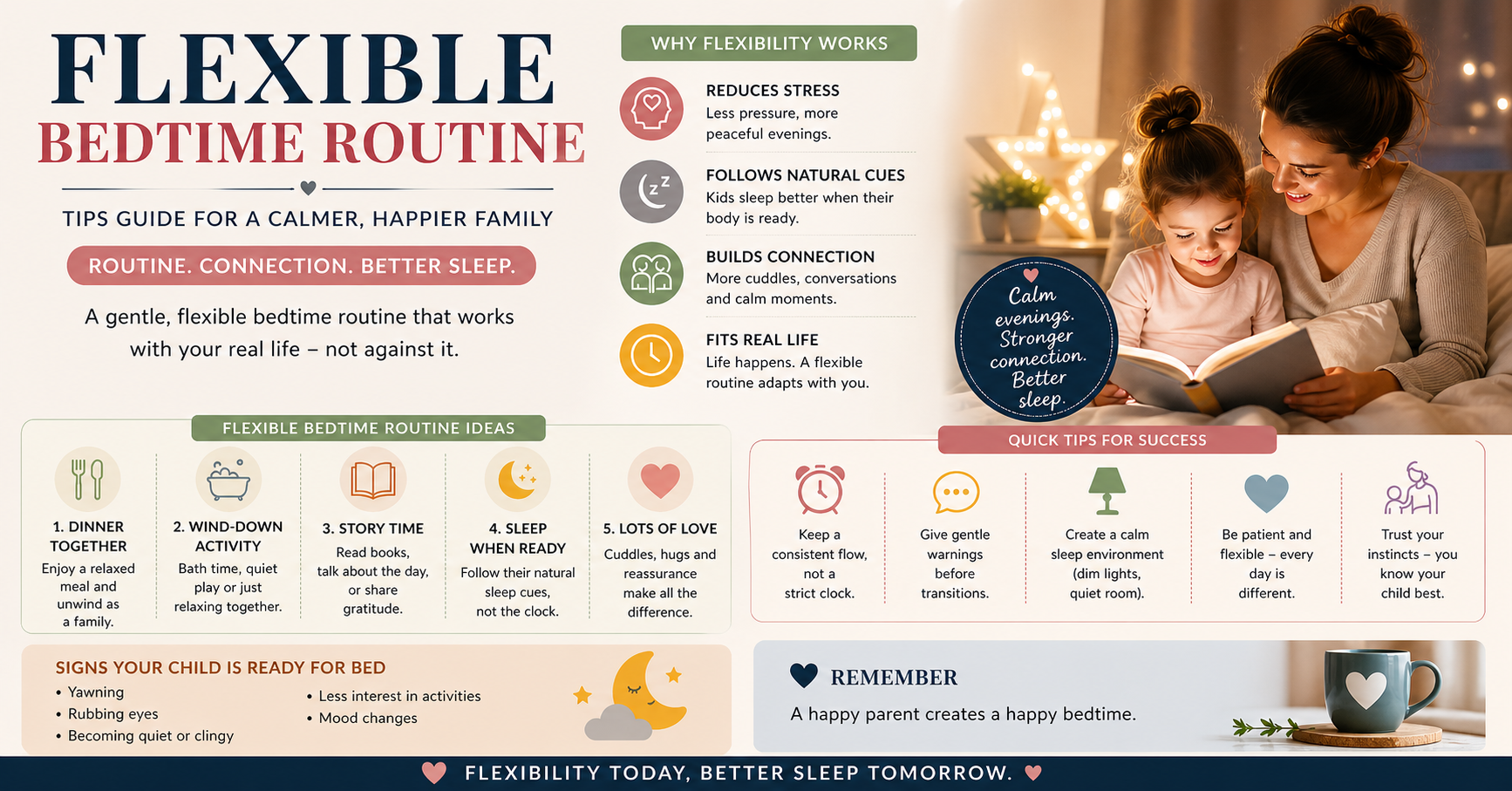
We dropped the rigid 7:30 bedtime. Instead of watching the clock, we started watching our son. When he started rubbing his eyes, getting emotional over small things, or losing interest in play, we began the wind-down. Some nights that was 7:00. Some nights it was 8:15. We followed his cues instead of our schedule.
We made the routine flexible in sequence. Some nights we did bath. Some nights we skipped it. Some nights we read three books. Some nights we read one and talked about his day instead. The activities stayed similar, but the order and timing became fluid.
We stopped treating bedtime like a deadline. This was the hardest shift for me mentally. I had to unlearn the idea that a late bedtime was a parenting failure. Some nights he wasn’t tired at 7:30. That was okay.
We moved bedtime out of my bedroom. Instead of lying next to him waiting for him to fall asleep (and watching the clock tick past 9pm in silent anguish), we started letting him lie in his own bed, lights dimmed, with an audiobook or calm music playing. We checked in every ten minutes or so. No more hovering.
We stopped making sleep the enemy. Instead of “It’s bedtime — lights out NOW,” we started saying things like, “It looks like your body might be getting ready for sleep. Want to go get cozy?” It sounds small but it reframed the whole experience.
The first week was messy. He tested us. He pushed bedtime to 9:30, then 10:00. We held firm on the window — roughly 7pm to 8:30pm — but stayed flexible within it.
By the second week, something unexpected happened.
He started coming to us around 7:45 and saying he was tired.
He started initiating bedtime.
I genuinely cried. Not dramatic movie-style crying, just a sudden, quiet release of months of tension. My husband and I looked at each other across the hallway and didn’t say anything because we didn’t have to.
By week three, he was falling asleep within 20 to 30 minutes of getting into bed — compared to the 90-minute battles we’d been having. The screaming stopped. The negotiating mostly stopped. He still asked for water sometimes, because he’s four and that’s apparently a universal child behavior, but it wasn’t a stall tactic anymore. It was just a request.
Now, a few months later, bedtime in our house is genuinely one of the nicer parts of our day. Not perfect. Not always smooth. But not a battle.
Okay, I know some of you are reading this and thinking: but the research supports bedtime routines. And you’re right — it does. I’m not arguing against bedtime routines. I’m arguing against rigid, anxiety-driven, inflexible bedtime routines.
Let me walk you through what the science actually shows, because there’s more nuance here than most sleep advice acknowledges.
Bedtime routines do help children sleep. A widely cited 2009 study published in the journal Sleep found that a consistent bedtime routine was associated with improved sleep outcomes across multiple age groups — from infants to school-age children. Kids who had a routine fell asleep faster, woke up less during the night, and had longer total sleep duration. That’s real, and I’m not dismissing it.
But “consistent” doesn’t mean “rigid.” The research supports predictability — a child knowing roughly what comes next — not a clock-to-the-minute schedule. There’s a significant difference between “we always do something calming before bed” and “lights out must happen at exactly 7:32 PM.”
Parental stress during bedtime matters enormously. Research on family systems and child sleep consistently shows that parental anxiety is one of the most significant predictors of childhood sleep problems. A 2016 study in the Journal of Child Psychology and Psychiatry found that parents’ bedtime cognitions — their beliefs and anxieties about sleep — had a direct effect on children’s sleep quality. A tense bedtime routine can be actively counterproductive.
Children’s sleep needs vary. There’s no universal sleep schedule that works for every child at every age. Circadian rhythms differ. Temperament differs. A highly sensitive child may need a longer wind-down period. An energetic child might need vigorous play earlier in the evening before they can calm down. Imposing the same rigid routine on every child ignores this variation.
Sleep pressure matters. Children fall asleep best when they have sufficient sleep pressure — the biological drive to sleep that builds throughout the day. If a child isn’t tired at 7:30 PM, forcing them to lie in a dark room doesn’t create sleep. It creates frustration, for everyone.
The takeaway from all of this isn’t “throw out the routine.” It’s “make the routine serve your child rather than making your child serve the routine.”
Here’s something that frustrates me about a lot of sleep advice — and parenting advice generally.
It’s written as though all children are the same, all families are the same, and all situations are the same.
Your child might genuinely need a rigid routine. Some kids, especially those with sensory processing differences, autism spectrum traits, or high anxiety, genuinely do better with extremely consistent structure. That’s real and valid and this post isn’t saying otherwise.
But a lot of us have been handed a one-size-fits-all routine and told that if it isn’t working, we are doing it wrong. We’re not consistent enough. We’re not firm enough. We need to white-knuckle it for three more weeks.
The possibility that the routine itself might not be the right fit for our particular child, our particular family, or our particular season of life rarely gets much airtime.
That’s what I want to offer here: permission to look at what isn’t working and be willing to try something different.
Not every family needs to do what we did. But here are some signs that your current routine might be making things worse rather than better:
Bedtime has become the most stressful part of your day. A bedtime routine should wind you down too, at least a little. If you’re dreading 7pm every day, something needs to change.
Your child seems more wired after the routine than before it. Some children actually become more anxious and stimulated when they sense a parent’s bedtime urgency. If your routine seems to increase their energy rather than calm it, that’s worth paying attention to.
You’re more focused on the clock than on your child. If you’re watching the time more than you’re watching your child’s cues, the routine may have taken on a life of its own.
The routine has expanded to include so many steps that one wrong move derails everything. When the routine becomes this fragile, it’s doing more harm than good.
You’ve tried consistent implementation for months and nothing is improving. At some point, more of the same thing that isn’t working is just stubbornness.
Your child is older and the routine feels developmentally mismatched. A routine that worked beautifully at two may be completely wrong at four or five, when children are developing autonomy and testing limits.
If you’re considering loosening up your own bedtime routine, here are the approaches that made the biggest difference for our family:
Follow sleep cues, not the clock. Learn what your child looks like when they’re actually tired — not overtired, not fighting sleep, but genuinely ready. For my son it’s: slightly glassy eyes, less creative play, starting to get emotional about minor things. Watch for those signals and respond to them.
Keep the vibe consistent even when the steps aren’t. What we kept was the atmosphere: dimmer lights after dinner, calmer voices, quieter activities. The sequence within that varied. Consistency of energy matters more than consistency of steps.
Give your child some control. Letting kids choose between two books, or pick the song, or decide whether they want the door open or closed gives them ownership without giving up the general structure. This is huge for strong-willed children.
Separate yourself from the outcome. Your child’s sleep is not a report card on your parenting. Some nights they’ll sleep beautifully. Some nights they won’t, for reasons that have nothing to do with what you did or didn’t do.
Build a bedtime window instead of a bedtime. Instead of aiming for exactly 7:30, aim for “between 7:00 and 8:30.” This gives you flexibility without abandoning all structure.
Make winding down earlier so sleep pressure can build naturally. This means reducing screens and high-stimulus activities in the early evening — not as a rigid rule, but as a general pattern.
Stay calm when things go sideways. This is the hardest one. But when you can manage your own response to bedtime disruptions without escalating, you model the regulation you want your child to develop.
I didn’t expect stopping the strict bedtime routine to affect much beyond bedtime itself. I was wrong.
The relief that rippled through the evening was real. We stopped feeling like we had to race through dinner to start the bedtime countdown. We could stay at a friend’s house a little longer without the low-grade panic of being 20 minutes off schedule. We could let our son help clean up from dinner without watching the clock.
My husband and I also stopped snapping at each other at 7:15pm. That one was unexpected and deeply welcome.
There’s also something to be said for what it modeled for our son. We were effectively showing him that we could read his body’s signals, respond to them, and trust that sleep would come when it was ready. We were showing him that rest doesn’t have to be forced. That his body knows things.
He’s started noticing when he’s tired and saying so. That feels like a genuine life skill — the ability to listen to your own body — and I don’t think we would have given him space to develop it if we’d stayed locked in the rigid routine.
I want to be really clear that we didn’t abandon structure entirely. There are things we kept and things that stayed consistent:
A general wind-down window. The hour or so before bed is quieter, dimmer, calmer.
No screens in the 45 minutes before sleep. This one we held firm on because the evidence on screens and melatonin suppression is solid enough to take seriously.
Some version of reading or storytelling most nights. Not because it’s on a checklist, but because my son loves it and it genuinely signals rest for him.
A consistent response to waking at night. When he wakes — which happens occasionally — we have a predictable, calm response. This consistency feels more important than the pre-sleep steps.
A generally consistent wake time. Sleep research is pretty clear that consistent wake times anchor the circadian rhythm more than consistent sleep times. So we kept that relatively steady even when bedtime varied.
Everything above reflects our experience with a four-year-old. The calculus looks different at different ages.
Newborns and young infants don’t have developed circadian rhythms yet, so bedtime routines for this age group are really about creating a calming signal rather than a schedule. Flexibility here often looks like following feeding and sleep cues.
Toddlers (1–3) are in the prime routine-loving years for many kids. Some genuinely thrive on the rigidity. Others — particularly strong-willed or spirited children — fight it intensely. If you’re in month three of battle and nothing is changing, that’s a sign worth taking seriously.
Preschool age (3–5) is where we were, and where I see the most benefit in introducing flexibility. Children this age are developing autonomy and will often push back harder against control precisely because they’re developmentally supposed to.
School-age children (6+) often do well with collaborative approaches — actually discussing sleep and why it matters, having input into their own routine, and gradually taking ownership of their bedtime.
Teenagers are a whole different category. Adolescent biology genuinely shifts sleep timing later, and fighting that shift is often counterproductive. Flexibility here may be less of a parenting choice and more of a biological reality.
I spent about two weeks feeling like I was failing my child by dropping the strict routine.
The parenting internet is not kind to parents who deviate from received wisdom. There’s a lot of implicit judgment baked into sleep advice — the suggestion that if you just did it right, it would work. So not doing it “right” feels like failing.
What helped me was reminding myself of this: the goal was never to have a routine. The goal was for my child to sleep well and for our evenings to be peaceful. The routine was supposed to be a tool toward those goals, not the goal itself.
When the tool stopped working — or more accurately, when I realized it was creating more problems than it was solving — changing the approach wasn’t failure. It was responsiveness.
Good parenting isn’t following the playbook perfectly. It’s watching your child, listening to your child, and being willing to adapt.
For some families, yes — especially when a rigid routine has become a source of nightly stress rather than calm. Flexibility doesn’t mean no structure. It means adapting the structure to what actually works for your child’s temperament and sleep needs. If your toddler is consistently resisting a strict routine after months of consistent application, loosening the approach may actually improve sleep outcomes.
Replace it with what sleep researchers call a “flexible routine” — a consistent wind-down atmosphere (dimmer lights, quieter activities, no screens) without a rigid step-by-step timetable. Follow your child’s sleep cues rather than the clock, and allow some variation in sequence while keeping the overall tone of the hour before bed calm and predictable.
Not necessarily. Research supports the concept of predictable cues and wind-down signals, but a rigid minute-by-minute schedule is not what the science requires. Many children sleep better when parents reduce their own bedtime-related anxiety, because children pick up on and respond to parental stress.
A flexible routine still has consistent elements — perhaps always reading before bed, always dimming lights in the evening, always avoiding screens before sleep — but it doesn’t require a fixed start time or an exact sequence every night. No routine at all, with no wind-down signals, can genuinely disrupt sleep. The key is keeping the calming cues while releasing the rigid timetable.
If your strict routine is working and everyone in your household is relatively peaceful about it, there’s no reason to change it. This post is for families where the routine isn’t working, not for families where it is. Some children genuinely thrive with more rigidity. Trust your knowledge of your own child.
Preschool age (roughly 3–5) is often when flexibility becomes more viable and even necessary, as children develop autonomy and begin testing boundaries around control. School-age children (6+) can often participate in designing their own flexible routine. Infants and very young toddlers may still benefit from more consistent signals, though “consistent” doesn’t have to mean “military precision.”
For our family, the first week was an adjustment period. By week two we saw improvement, and by week three the shift was significant. Anecdotally, many parents report that within two to three weeks of reducing routine rigidity and following sleep cues more naturally, bedtime battles decrease. Individual results will vary based on your child’s temperament and what caused the original resistance.
This is a valid concern. School-age children do need adequate and reasonably consistent sleep for learning, memory, and emotional regulation. A flexible routine doesn’t mean chaotic or insufficient sleep — it means the timing and sequence have some give while still ensuring your child gets enough total sleep. Keeping a consistent wake time, even when bedtime varies slightly, helps anchor their circadian rhythm.
If you are lying on your bathroom floor at 9:47 PM, exhausted and questioning everything, I want to tell you what nobody told me.
The routine is not sacred. The goal is sleep, connection, and an evening that doesn’t leave everyone in the family depleted. If the routine is serving those goals, keep it. If it isn’t, you’re allowed to change it.
You know your child better than any book, any sleep consultant, any parenting website. The advice — including this piece — is a starting point. Your child, and your family’s particular rhythms, is the actual data.
We stopped a strict bedtime routine and our nights got better. That might not be true for everyone. But if you’ve been doing everything “right” for months and it still isn’t working, maybe the answer isn’t more rigidity.
Maybe it’s a little more trust. In your child. In the process. And in yourself.