Physical Address
304 North Cardinal St.
Dorchester Center, MA 02124
Physical Address
304 North Cardinal St.
Dorchester Center, MA 02124

Here is something that took me an embarrassingly long time to understand: my children do not share a need for me.
That sounds obvious when I say it out loud. Of course they don’t. They are separate people with separate interior lives, separate insecurities, separate ways of experiencing the world, separate things they carry to bed with them at night and separate reasons they sometimes wake up in the middle of it. They happen to live in the same house and share the same parents and sit at the same dinner table — but they are not, in any meaningful sense, interchangeable.
And yet for years, I operated as though the love and attention I gave to the family unit was automatically distributed to each of the individuals within it. I thought that a good family dinner counted equally for all of them. That a fun Saturday together filled everyone’s tank in roughly the same proportion. That as long as nobody was obviously suffering, everyone was fine.
Some of them were fine. Some of them were quietly waiting for something that never quite came — something that group time, no matter how warm or frequent or intentional, simply cannot deliver. And the thing they were waiting for was this: me, just for them, for a little while.
If you have more than one child, this post is about why that matters more than most of us realize — and how to actually do it in a life that is already stretched past capacity.
There is a particular kind of invisibility that can happen inside a loving family.
It doesn’t look like neglect from the outside. The kids are fed and safe and generally happy. There are family meals and bedtime stories and birthday parties and weekend outings. The parents are present, attentive, doing what parents are supposed to do. From any reasonable distance, the family looks — and largely is — good.
But inside that good family, each child is having a private experience that none of the others can fully see. The oldest child has a set of worries that come with being first, with having the most responsibility, with watching parents navigate parenthood for the first time on them. The youngest child has their own particular ache — the sense that everyone else got there first, that there’s already an established order they have to fit themselves into. And the children in the middle have perhaps the most complex experience of all: belonging completely to neither the oldest nor youngest category, sometimes overlooked in the shuffle because they seem to need the least.
None of these children’s inner experiences come out fully during family time. They can’t. Family time is, by definition, a shared space — which means everyone is moderating themselves for the group. The child who is anxious doesn’t reveal the full depth of her anxiety when her siblings are there, because she’s aware of the audience. The child who is struggling doesn’t ask the question he most needs to ask, because asking it in front of everyone feels too exposed.
Individual attention is the only context in which a child gets to simply be themselves — fully, without the social editing that happens automatically in a group. And what comes out in that space is often surprising, important, and deeply worth knowing.
The research on this topic is more consistent than the popular conversation around it suggests. Here is what the evidence actually shows:
Children perceive parental attention as a limited resource. Studies in developmental psychology consistently find that children in multi-sibling households are aware — consciously or not — of competition for parental attention. This awareness shapes behavior in ways parents often don’t connect back to its source: a child who acts out at dinner may be doing the only thing that reliably gets a parent’s focused, individual gaze.
Differential treatment is perceived even when parents believe they’re being equal. Research by developmental psychologist Gene Brody and colleagues found that children in the same family often report meaningfully different levels of warmth, responsiveness, and involvement from their parents — even when parents believe they are treating their children consistently. The differences children perceive are not always about favoritism; sometimes they reflect temperament fit, birth order dynamics, or simple logistics. But the perception itself matters. A child who believes they receive less parental attention than a sibling shows higher rates of anxiety, lower self-esteem, and more behavioral difficulty — regardless of whether the perception is objectively accurate.
Individual time with a parent predicts outcomes beyond group family time. A 2019 study in the Journal of Child Psychology and Psychiatry found that one-on-one parent-child interactions predicted children’s emotional and behavioral outcomes independently of overall family cohesion. In other words, how well the family functioned as a unit did not fully account for how well individual children were doing — what mattered additionally was the quality of each child’s dyadic relationship with their parent.
Secure attachment requires individual attunement. The attachment research that began with John Bowlby and Mary Ainsworth and has been extended across decades consistently shows that secure attachment — the foundation of healthy emotional development — is built through interactions that are specifically responsive to the individual child’s cues, needs, and signals. Group settings, even loving ones, cannot replicate the fine-grained attunement that happens in a one-on-one exchange. You simply cannot track one child’s specific signals, respond to them immediately, and repair when you misread them — the core mechanics of secure attachment — when you are simultaneously managing multiple children.
This does not mean group time is bad. It means it is not sufficient on its own.
Birth order dynamics are more complex than the popular shorthand suggests — firstborns aren’t simply “responsible,” youngest children aren’t simply “spoiled,” and middle children aren’t simply “overlooked.” But there are real patterns in how sibling position shapes a child’s relationship to parental attention, and understanding them helps parents be more intentional about how they give it.
The oldest child has, in one sense, had the most individual parental attention — they were, after all, an only child for some period of time before siblings arrived. But that early monopoly on attention comes with a specific kind of pressure: the oldest child often receives the most parental anxiety, the most expectation, and the clearest experience of watching themselves be replaced as the center of parental focus.
Older children frequently become the manager of the sibling group — they’re asked to help, to be patient, to set the example, to wait their turn because they’re old enough to understand. They are praised for their maturity and competence, which is genuinely meaningful — but it also means they are rarely the recipient of parental attunement that isn’t conditional on their performance. What they often need from individual time is something different from the leadership role they play in the family: the chance to be young, to be uncertain, to be helped rather than helpful, to not be the example for once.
The research on middle children is genuinely interesting, and it cuts against both the “middle child syndrome” hysteria and the dismissal of that syndrome as mere stereotype. Middle children do, on average, receive less individual parental time — not because parents love them less, but because they fall into the gap between the demands of the oldest and the physical dependency of the youngest.
Middle children are also the least likely to have a clearly defined family role. They’re not the pioneer, and they’re not the baby. This ambiguity in identity makes the individual parent-child relationship more important, not less — because the family’s natural narrative tends to be organized around everyone else. Individual time gives the middle child an explicit message: you have a specific place in my heart that is not defined by where you fall in the birth order. You are not the gap between your siblings. You are someone I specifically chose to be with today.
The youngest child often appears to receive abundant parental attention — and in some forms, they do. Parents tend to be more relaxed, more experienced, and less anxious with their youngest, which can produce warmer, less fraught interactions. But the youngest child also grows up in a family that has its own established culture, its own rhythms, its own jokes and references that predate them.
The youngest frequently has less individual parental time than the middle or oldest, because by the time they arrive, family life is organized around the older children’s schedules, school activities, and needs. The youngest often experiences family life as being swept along in a current that isn’t particularly designed for them. Individual attention for the youngest child creates something that can be otherwise hard for them to find: a space that is just for them, not for the family, not for the older siblings who set the pace — just for them.
Children who were only children and then gained a sibling deserve particular mention. The transition from having all parental attention to sharing it is one of the most significant early childhood experiences, and its effects can linger far longer than parents expect. Individual time with a formerly-only child — deliberately carved out and protected — communicates that the addition of a sibling did not actually diminish their place in the family. It is still theirs. The love did not divide; it expanded. But children don’t believe this from a speech. They believe it from evidence.
Parents often ask, reasonably, why group family time isn’t sufficient. They do things together. They eat together. They go places together. The family is close and warm and engaged. Why isn’t that enough?
Here are the specific things that individual time provides that group time structurally cannot:
Full parental attention without competition. When you are with all your children, your attention is by definition divided. You are tracking multiple children’s needs, moods, and behaviors simultaneously. Even the most present parent cannot give complete, undivided attention to one child when other children require management, mediation, and response. Individual time removes the competition. It tells your child: right now, there is nobody else to look at.
The child’s authentic self, not their group self. Every child in a sibling group plays a role — the funny one, the responsible one, the creative one, the easygoing one. These roles are not fake, but they are partial. They are the version of the child that has been shaped by the sibling group dynamics. In individual time, the role falls away. A child who is always the clown in the family often reveals a more reflective, serious self when they’re alone with a parent. A child who is always the “easy” one often finally surfaces a worry they’ve been carrying alone. Individual time creates the conditions for a child to be more fully themselves.
The specific conversations that don’t happen in groups. There are questions children don’t ask in front of their siblings. Fears they don’t name. Confessions they won’t make. Things they’ve been thinking about that feel too exposing or too personal for the family audience. Individual time is the only context in which those things can surface — because the safety of privacy makes them possible.
Attunement and repair. Good relationships are not built on the absence of misunderstanding but on the ability to misunderstand and repair. When a parent misreads a child’s cue in a group setting — responds to the wrong child, mistakes one child’s mood for another’s, responds generically rather than specifically — there is rarely the opportunity for a clean repair before the moment has moved on. Individual time creates the space for the fine-grained attunement that keeps relationships genuinely close.
The message that they are chosen. There is something irreplaceable about being specifically chosen by someone who had other options. When a parent creates individual time with a child, they are sending a message that no amount of group warmth can replicate: Of all the things I could be doing with this hour, I chose to be with you. Specifically you. Not the family. You.
That message lands differently in each child’s heart. And it is one that every child needs.
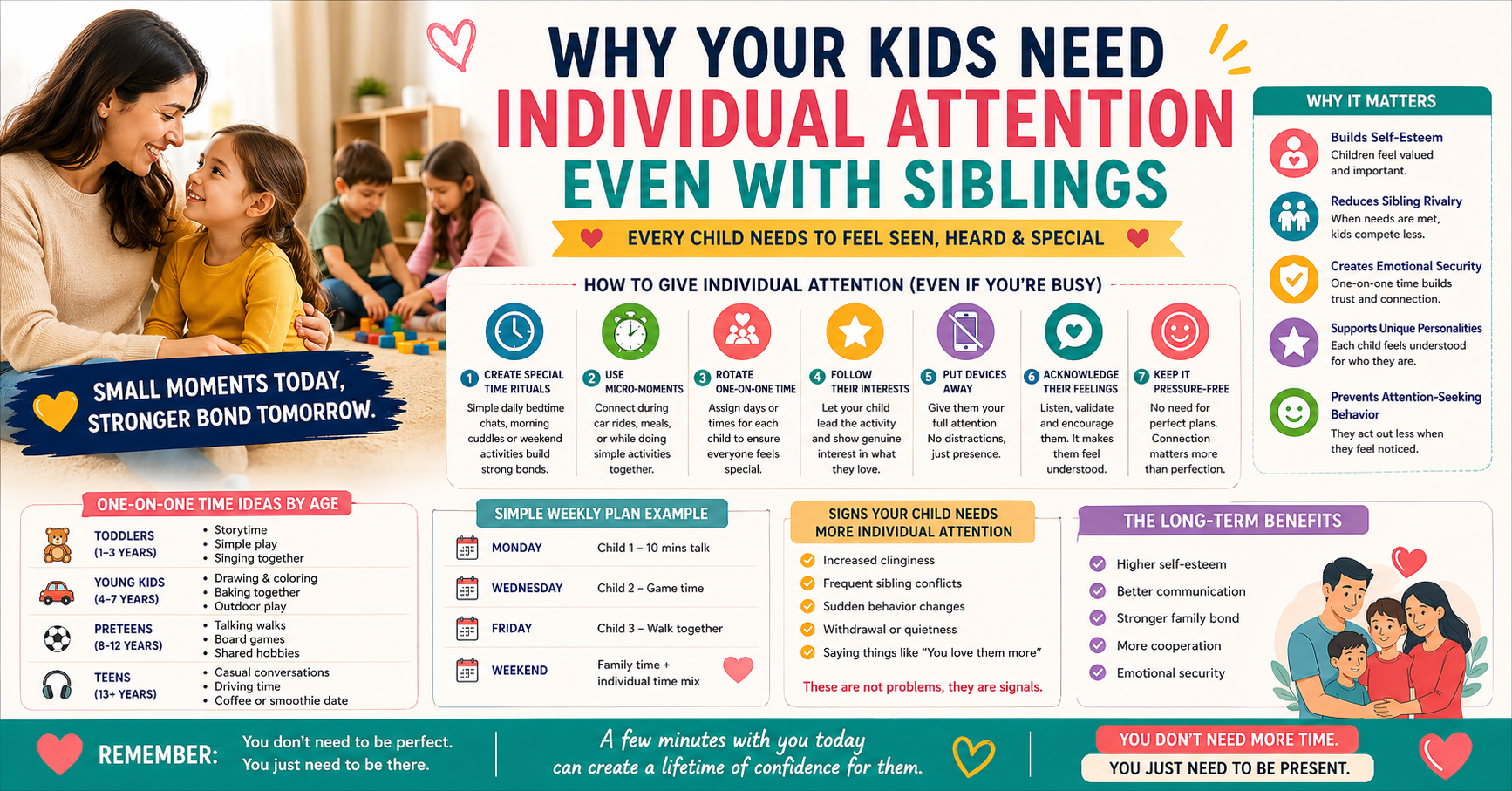
Sometimes children tell you directly that they need more one-on-one time. More often, they say it sideways — in behavior, in mood, in the particular ways they try to get what they need when they don’t have the words to ask for it.
Here are some of the signals to watch for:
Acting out specifically around the other siblings. If a child’s most difficult behavior tends to happen in the presence of siblings — particularly behavior that creates parental attention, even negative attention — this is often a signal that they have found a reliable method for breaking through the noise and getting you to themselves, even briefly.
Clingy behavior with a parent at unexpected times. A child who suddenly becomes very attached and demanding of a parent during times that are otherwise low-key — when everyone is relaxed, when there’s no apparent stress — may be trying to capture the individual attention that isn’t available when the whole family is operating at full capacity.
Telling you they feel like you love their sibling more. Even if this is clearly not objectively true, take it seriously rather than rushing to disprove it. The child is not making an accusation — they’re expressing a felt experience, and the felt experience is worth understanding. Ask what makes them feel that way. Listen without defending yourself. Often, what you’ll hear is a very specific, addressable gap in individual attention.
Seeming more withdrawn or quiet in family settings. A child who is noticeably quieter in group family situations than they are in other contexts may have learned that the group isn’t where they get to fully be themselves. They’ve adapted to the competition by pulling back. Individual time can reverse this — slowly, as the child experiences that there is a place where they don’t have to compete.
Regressive behavior. Older children who suddenly revert to behaviors associated with younger ages — baby talk, wanting to be carried, increased thumb-sucking or comfort object use — are often expressing a need for the kind of individual, close parental attention that they associate with being younger and having had more of it.
Performing or showing off for you. A child who constantly performs for a parent — look at me, watch me, see what I can do — is often seeking an individual beam of attention in the only way they know how to create it in a group context. The performing is the bid. Individual time answers it before it has to be that loud.
Knowing that individual attention matters is one thing. Building it into a life that is already operating at capacity is another. Here is what actually works for families across a range of sizes, schedules, and circumstances:
Make it regular, not occasional. The goal is not a once-a-month special outing. The goal is a reliable rhythm — something each child can count on coming back, week after week. Even twenty minutes of guaranteed individual time per week is more valuable than a quarterly “special day” because the regularity is itself the message: your time with me is not a treat. It’s a standing part of how we live.
Let each child choose. Give your child genuine input over what you do during individual time. Not unlimited options — you don’t need to be booking restaurants and buying tickets — but real choice within reasonable parameters. “Do you want to go for a walk, bake something, or play a game?” The act of choosing is itself part of the value. It tells them: this time is shaped around you.
Protect it from sibling intrusion. One of the most important things about individual time is that it is actually individual. That means the other children are not there. This requires some logistical management — the other children need to be occupied, cared for by another adult, or doing something independent. But this logistical effort is worth it, because individual time that is repeatedly interrupted by siblings loses much of its meaning.
Keep the phone away. Every single time. No exceptions. A parent who is checking their phone during individual time is communicating something specific and damaging: I am here, but not fully. You have me, but not all of me. Children read this immediately and respond to it by disengaging — often so quietly that the parent doesn’t notice, which makes it worse.
Start small if you need to. If your life genuinely cannot accommodate thirty-minute individual sessions with multiple children each week, start with ten. Start with the car ride to school when it’s just the two of you. Start with the five minutes after bedtime when everyone else is settled and you sit with one child in the dark and just talk. Small and real consistently beats large and theoretical.
Rotate deliberately. Keep informal track of whose individual time has been recently prioritized and whose hasn’t. This doesn’t need to be a spreadsheet — it can be a casual mental note. But without any tracking, the child who demands attention most loudly or most effectively tends to get more of it, and the quiet, adaptable child who seems fine tends to get less. Deliberate rotation ensures that the child who never asks is not also the child who never receives.
Use existing routines as anchors. You don’t have to invent new time — you can transform time that already exists. The child who always comes with you to the hardware store runs. The child whose bedtime you always do solo. The child who sits with you at the kitchen table on Saturday mornings before anyone else is up. These existing moments can become the anchor for individual connection without requiring any additional time in a schedule that has no room.
Do ordinary things. One of the most liberating realizations for busy parents is that individual time does not have to be a special experience. It does not require an outing, a plan, an activity, or a budget. It requires only that you be genuinely with one child. Grocery shopping together. Driving to pick something up. Sitting in the garden. Watching something they like. The ordinariness of the activity is not a failure of the connection — it is, often, exactly what makes the connection feel real and sustainable rather than performed.
Beneath all the specific strategies and all the research and all the practical guidance is something simpler and more essential. Each of your children needs to know — not just believe theoretically, but actually feel in their bones — one thing:
I am not just one of my parents’ children. I am their child. Specifically. They know who I am — not who the family is, not who my siblings are, but who I am. They are interested in me in particular. They would choose to be with me even if they weren’t required to be.
This knowledge — deeply held, evidence-based, renewed regularly through experience rather than just asserted through words — is what individual attention provides. It is what no amount of family warmth can substitute for and what no number of siblings can give one another.
You are the only one in your child’s life who can give it to them. And the gift of it — the gift of being truly, individually known by the person whose love matters most — is one they will carry with them long after they’ve forgotten the specific afternoons and errands and games and conversations that delivered it.
Give it to them, one child at a time.
Research doesn’t prescribe an exact number, but most developmental experts suggest that even 15–30 minutes of dedicated, device-free one-on-one time per week per child makes a measurable difference in a child’s sense of security and connection. The key factor is regularity — children benefit most when individual time is a reliable, recurring part of the week rather than a rare special event.
Equal in quantity — almost never, and that’s okay. What matters more than perfect equality of time is that each child feels individually seen and valued. Different children at different ages and stages need different amounts and types of parental attention. The goal isn’t identical distribution; it’s ensuring each child experiences enough individual focus that they don’t feel lost in the group.
Yes. Children who prefer group time with siblings may still benefit enormously from individual parental attention, even if they don’t actively seek it out. A preference for sibling company doesn’t mean a child’s need for individual parental attunement has been met. Some children who seem happiest in the group are the ones most quietly waiting for individual time — they’ve simply stopped asking for it because they’ve adapted to not getting it.
This is one of the most practical challenges of multi-child parenting. Options include having another parent or caregiver present, scheduling individual time during a sibling’s nap or school time, using independent play time for older children, or simply being clear with older kids that this time belongs to their sibling and theirs will come. When individual time is a regular part of the family rhythm rather than a special exception, siblings generally adjust to it with less protest than parents expect.
Follow that. Children who are going through developmental transitions, social difficulties, anxiety, grief, or any form of challenge will temporarily need more individual parental attention — and giving it to them is not favoritism. It’s responsive parenting. The goal is meeting each child’s actual need, not distributing a fixed resource equally regardless of circumstances. The other children, if they are secure in their own individual relationship with you, can generally tolerate a period of unequal distribution without lasting damage.
No — these meet fundamentally different needs. Sibling relationships are enormously valuable and contribute to children’s social development, conflict resolution skills, and sense of family belonging. But they cannot replicate the specific thing that individual parent-child time provides: the experience of being fully attended to by the primary attachment figure. These are complementary, not interchangeable.
A: Lower the stakes and keep the door open. Some children, particularly those who have adapted to receiving less individual attention, become uncomfortable when it is suddenly offered — it can feel too intense, or they may be testing whether the offer is genuine and consistent. Try low-key, side-by-side activities that don’t require direct emotional engagement. Keep invitations light and pressure-free. Don’t require them to respond warmly. Given enough consistent, unpressured invitations, almost all children eventually relax into individual time.
The concern about “spoiling” children through attention is not well-supported by developmental research. Children cannot be harmed by receiving too much genuine, attuned parental attention. What can be problematic is attention that is inconsistent, conditional on performance, or substituted for appropriate boundaries and structure. Attuned individual attention — where a parent is warm, genuinely responsive, and present — does not spoil children. It builds the secure foundation from which they explore the world, tolerate frustration, and develop independence.
You don’t need to divide yourself perfectly between your children.
You just need to show each one:
“I see you. I hear you. You matter.”
Even a few minutes of intentional connection can shape how your child feels about themselves—and your relationship—for years to come.