Physical Address
304 North Cardinal St.
Dorchester Center, MA 02124
Physical Address
304 North Cardinal St.
Dorchester Center, MA 02124

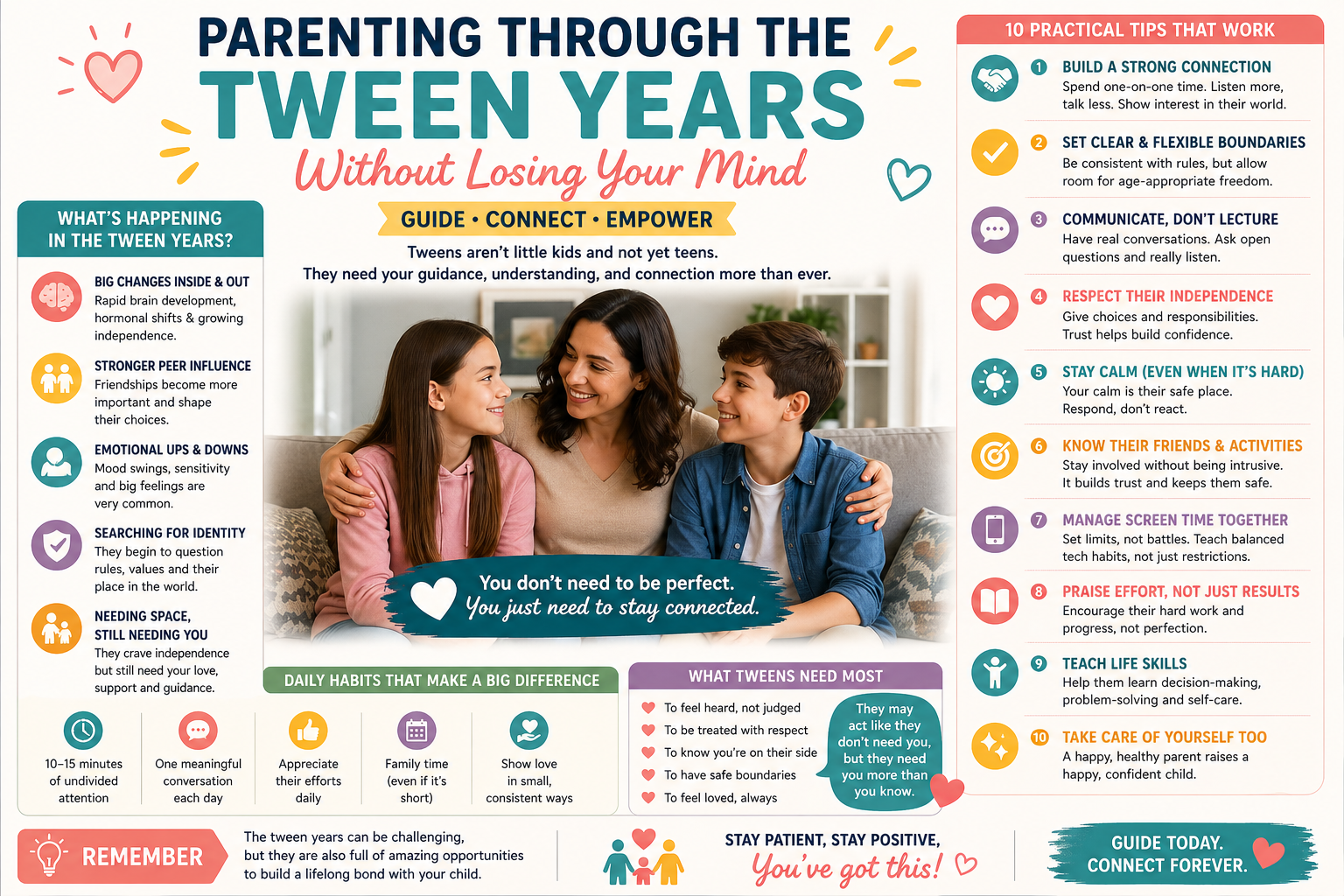
Nobody tells you about the tween years when they’re warning you about the hard parts of parenting.
They tell you about newborn sleep deprivation. They tell you about the tantrum years, the back-arching two-year-old on the floor of the grocery store, the threenager who has very strong feelings about which cup their water comes in. They tell you that teenagers are difficult, that the door-slamming and the eye-rolling and the “you don’t understand me” years are coming and to brace yourself.
What they don’t tell you — what nobody quite prepares you for — is the murky, disorienting stretch in between. The tween years. Roughly ages nine through twelve, give or take a year in either direction depending on the child. The years when your kid is simultaneously too old to be handled like a young child and too young to be given the independence of a teenager. The years when the child you thought you knew starts to become someone slightly different, someone with an interior life that is increasingly not shared with you, someone who finds your jokes less funny and your presence at school events more complicated and your opinions on their friends increasingly irrelevant.
The tween years are, in many ways, the loneliest stretch of parenting. Because you didn’t lose a relationship to obvious rupture. You lost it to growing up, which is exactly what was supposed to happen and somehow still feels like something is being taken from you.
This post is an honest look at what the tween years actually involve — what’s happening developmentally, why they behave the way they do, what stops working, what starts working instead, and how to stay genuinely connected to a child who is actively, necessarily pulling away. Not a perfect guide. A real one.
Before any parenting strategy makes sense, it helps to understand what is actually going on inside your tween — because a lot of what parents interpret as attitude, defiance, or emotional instability is actually the fairly predictable output of a brain in the middle of significant structural renovation.
The prefrontal cortex — the part of the brain responsible for impulse control, rational decision-making, understanding consequences, and regulating emotional responses — is in the middle of a major developmental remodeling process that begins in early adolescence and isn’t fully complete until the mid-twenties. During the tween years, this region is not yet reliably online. What is online, and increasingly active, is the limbic system — the emotional, reward-seeking, socially-attuned part of the brain that is exquisitely sensitive to peer perception, status, and belonging.
What this means in practice is not complicated: your tween is running on an emotional engine that is bigger and more powerful than ever before, in a body and brain that doesn’t yet have the regulatory capacity to manage it smoothly. The mood swings are not performance. The outsized reactions to small provocations are not manipulation. The apparent inability to see that their behavior is affecting you is not selfishness, exactly — it is the genuinely limited perspective-taking capacity of a prefrontal cortex that is not fully developed.
This doesn’t mean the behavior gets a pass. It means it gets a different response than you’d give to an adult who made the same choice. Understanding why they do what they do is the foundation of responding to it effectively — and of not taking it personally, which is perhaps the most important skill a tween parent can develop.
Sleep deprivation is real and underappreciated. Most tweens are significantly sleep-deprived. Their circadian rhythm has already begun the biological shift toward later sleep and wake times that peaks in adolescence, but school start times haven’t moved. The result is a child who is chronically running on less sleep than their brain and body need — and sleep deprivation in a developing brain amplifies every emotional response, reduces impulse control, and generally makes everything harder. Before attributing your tween’s behavior entirely to attitude or developmental phase, consider whether they’re getting enough sleep. Many behavioral improvements in tweens follow a simple adjustment in sleep volume.
Peer relationships have become biologically primary. This is not a choice your tween is making. Their brain has reorganized itself to weight peer belonging above almost everything else — including, temporarily, their relationship with you. The anxiety your tween feels about fitting in, about what their friends think, about social position and status and belonging is not shallow. It is, from their nervous system’s perspective, survival-level urgent. Understanding this doesn’t mean capitulating to peer pressure — but it means meeting their social concerns with something other than dismissal.
Part of what makes the tween years so disorienting for parents is that the tools that worked beautifully in earlier childhood simply stop working. The strategies that were reliable and effective become sources of eye-rolls and escalation, seemingly overnight. Understanding what stops working — and why — is as important as understanding what to do instead.
Direct commands and authority-based compliance. The young child who did what you said largely because you said it has been replaced by a person who is in the biological process of establishing autonomous identity and who experiences authority-based compliance as a direct threat to that identity. “Because I said so” lands very differently on a ten-year-old than it did on a five-year-old. Not because they’ve decided to be difficult, but because their developmental task right now is to become someone who can think independently — and every time you invoke pure authority, you’re in direct conflict with that task.
Emotional expressiveness that was welcome before. The six-year-old who was absolutely fine being kissed in front of friends, who held your hand in the parking lot without thinking about it, who asked you to come into class for a moment — that child has been replaced by someone for whom public parental affection is a complex social calculation. This is not rejection. It is appropriate developmental self-consciousness about peer perception. Expecting the same level of easy physical and emotional expressiveness from a tween that you had with your younger child will disappoint you and embarrass them.
Reasoning through long explanations. A brain that is running hot emotionally and is not yet reliably regulated by the prefrontal cortex is genuinely not in the best state to process a detailed logical explanation of why their behavior was inappropriate. Long lectures during or immediately after conflict are not effective with tweens — not because they’re not intelligent, but because the emotional activation of conflict reduces access to the reasoning parts of the brain. Less is more. Say less, mean it, and come back to the conversation when everyone is calmer.
Asking directly how they’re feeling. “How are you feeling?” and “Is something wrong?” are questions that often produce exactly the opposite of what a parent wants when directed at a tween. Direct emotional inquiry can feel invasive, high-pressure, or performatively therapeutic to a kid who is already ambivalent about how much of their inner world to share with you. It often produces a shrug or a “I’m fine” not because nothing is happening but because the question itself creates a kind of pressure that makes genuine response harder.
Praise that sounds generic. “Good job!” and “I’m so proud of you!” — which were meaningful to a younger child — often land as hollow to a tween who is developing a more sophisticated sense of what constitutes genuine feedback. They know when praise is specific and earned versus when it’s automatic and reflexive. Generic praise from a parent can actually feel condescending to a kid who is working hard to be taken seriously as a more capable person.
Listening without solving. The single most consistently effective thing a parent can do with a tween is to hear them out without rushing to fix, reframe, or advise. When your tween tells you about something that happened with a friend, they are almost never asking for your strategic analysis of the situation. They’re telling you because they needed to say it out loud. The response that keeps them coming back is the one that makes them feel heard — “that sounds really hard,” “I get why you’re upset about that,” “what happened next” — not the one that immediately offers a solution they didn’t ask for.
The side-by-side conversation. This comes up repeatedly in research on adolescent communication for a reason: tweens and teens are significantly more likely to open up in conversations that don’t involve direct eye contact. The car, a walk, cooking side by side, doing something parallel together — these create a context where talking feels less like being examined and more like talking. If you’re struggling to get your tween to talk, stop trying to have face-to-face conversations and start creating side-by-side situations. You’ll be surprised by what comes out.
Short, clear, non-negotiable boundaries stated once. Rather than long explanations, tweens respond better to clear, brief limits that are stated calmly and held consistently. “That’s not okay. We’ll talk about this when you’re calmer” is more effective than a ten-minute lecture in the moment. The conversation can happen later, when the emotional temperature has come down and reasoning is more accessible. The limit needs to be clear. The consequence needs to be real. And you need to follow through every time — inconsistency in consequence is more damaging to a tween’s trust in your authority than strictness is.
Specific, genuine acknowledgment. Instead of generic praise, try specific observation. “I noticed that you handled that situation with your brother differently than you would have six months ago” lands completely differently than “good job.” “That was a really thoughtful thing to say” lands differently than “I’m so proud of you.” Specificity tells a tween that you’re actually paying attention — and being actually seen by your parent is one of the things tweens want most even while they appear to want the opposite.
Curiosity over interrogation. Questions that come from genuine curiosity — “what was the best part of your week?” “is there a teacher this year you actually like?” “what does your friend think about that?” — feel different from questions that feel like parental surveillance. The tone matters as much as the content. Questions that communicate “I’m interested in your world” open conversations. Questions that communicate “I’m tracking your behavior” close them.
Negotiation and earned autonomy. Tweens are developmentally driven to establish autonomy — it’s not optional for them, any more than a toddler’s drive to do things themselves was optional. Parents who fight this drive create escalating power struggles. Parents who work with it — by identifying areas where autonomy can be genuinely extended, by negotiating rather than simply dictating — get a child who is more willing to respect genuine limits because they don’t feel like every limit is arbitrary control.
This doesn’t mean no rules. It means explaining the reasoning behind rules. It means involving your tween in setting some of the terms. It means distinguishing between the things that are non-negotiable (safety, basic respect, school attendance) and the things that actually don’t matter that much (what they wear, how they arrange their room, what music they listen to) — and then letting go of the latter category with genuine grace.
Here is the paradox that sits at the heart of tween parenting: your child needs your connection more than ever, and is simultaneously making it harder to maintain than it has ever been.
They need it more because they are navigating more. More social complexity, more identity questions, more academic pressure, more awareness of a larger world and their uncertain place in it. The tween years are, for most children, the period when anxiety first becomes a significant presence — when the social landscape becomes treacherous enough that it generates real fear, and when the stakes of belonging and fitting in feel genuinely high. Your connection to your tween is not sentimental. It is protective. It is the anchor that keeps them from being entirely at the mercy of peer dynamics and social media and the relentless pressure to become whoever they think they’re supposed to be.
And they’re making it harder to maintain because maintaining it requires you to completely change how you offer it. The connection strategies that worked in early childhood — physical closeness, clear expressions of love, active parental involvement in their activities and friendships — often feel intrusive or embarrassing to a tween. The connection has to go underground. It has to become more subtle, more patient, more willing to operate on their timeline rather than yours.
What connection looks like with a tween:
It looks like being physically present without demanding emotional presence. Sitting in the same room while they do homework. Being in the kitchen while they get a snack. Driving them places without requiring that the drive produce meaningful conversation.
It looks like following up on small things they mentioned without making a big deal of the follow-up. They said something about a project they were working on last Tuesday. You ask how it went on Saturday. Not in a “I’ve been tracking everything you say” way — in the way of someone who was listening and stayed curious.
It looks like finding one thing in their world that you can be genuinely interested in, rather than performatively interested in. The game they play, the YouTube creator they watch, the sport they’re obsessed with. Not understanding everything about it — just caring enough to ask, and listening to the answer.
It looks like staying in their orbit when they push you away, without crowding them when they’re asking for space. It looks like the open door rather than the insistent knock. It looks like “I’m here when you’re ready” practiced with actual patience rather than anxious hovering.
It looks, sometimes, like being in the same physical space and saying almost nothing, and trusting that the warmth of your presence is being received even when it isn’t being acknowledged.
Let’s spend a moment on the things that are hardest not to take personally. Because the tween years produce a specific category of parental pain that doesn’t get talked about honestly enough: the feeling of being mocked, dismissed, or treated with contempt by someone you love enormously and have given enormous amounts of your life to.
The eye roll. The heavy sigh. The “oh my god, Mom.” The way they look at you in front of their friends — that particular expression that communicates a kind of mortified distance, as if you are a mild social emergency they have to manage. The corrections of your slang. The announcement that your jokes aren’t funny. The request to please not sing in the car, please not wave at them from across the parking lot, please not tell stories about them to other adults in their presence.
These things sting. And there is a version of parenting advice that tells you to simply not let them sting — to develop a thick skin, to not take it personally, to remember it’s developmental. That advice is true but incomplete. It’s okay to feel the sting. It’s okay to feel the loss of the kid who used to be delighted by your company. It’s okay to grieve the phase that has passed.
What’s not useful is letting that sting drive your response.
Here is the truth about tween dismissiveness and attitude: most of it is not actually about you. It’s about them — about the excruciating self-consciousness of being eleven and having an audience and trying to project a version of yourself that is cool and capable and autonomous, and having a parent nearby who knows about the time you were afraid of the vacuum cleaner and still can’t quite separate you from that smaller, needier version of yourself.
The eye roll is not contempt. It’s performance — performed for peers, performed sometimes for themselves, as practice for an independence that is still more aspiration than reality. The “you’re embarrassing me” is not rejection. It’s the sound of a person who is trying to manage two worlds that feel impossible to hold at the same time: the world where they are still your child, and the world where they need very badly to not seem like anyone’s child.
Respond to the behavior, not the attitude. When behavior crosses into genuine disrespect — unkind words, dismissing you in ways that are actually hurtful, treating you with contempt that goes beyond the performative — address it. Calmly, briefly, clearly. “That was unkind. I don’t speak to you that way and I need you not to speak to me that way either.” Then drop it.
Don’t require an immediate apology that will be hollow. Don’t escalate. Don’t lecture. Just name it, hold the line, and move on. The relationship is more important than winning the moment.
There is no honest conversation about the tween years in 2024 that doesn’t address screens and social media, because they are not peripheral to the tween experience — they are central to it. Your tween’s social life, their sense of belonging or exclusion, their understanding of who they are relative to their peers, is happening substantially online. Pretending otherwise, or trying to remove screens entirely, is not a strategy that works for most families.
What does work is a combination of honest conversation, clear and consistently held limits, and genuine curiosity about what your tween’s digital life actually looks like.
The conversations worth having:
Talk about what they see online, not just what they post. Ask what’s funny to them, what they think is stupid, what made them uncomfortable, what they genuinely enjoy. These conversations are intelligence-gathering as much as they are connection — you are learning about the culture they’re inhabiting, which helps you parent it.
Talk about how social media makes them feel. Not in an evaluative way — not “you know that stuff isn’t real, right?” — but in a genuinely curious way. After they spend time on Instagram or TikTok, do they feel better or worse about themselves? Is there content they notice they feel bad after seeing? This kind of reflection builds the metacognitive awareness that is genuinely protective — a tween who can notice “this is making me feel bad about myself” has a tool that no parental filter can provide.
Talk about privacy, screenshots, and permanence. Not as a lecture, as a reality. What happens online has a longer shelf life than what happens in a hallway. This is worth understanding.
The limits worth holding:
No devices in bedrooms overnight. This is one of the most consistently supported recommendations in adolescent mental health research, and it is one of the more frequently not followed in practice. The overnight device in the bedroom disrupts sleep, exposes tweens to content and communication during hours when they are most vulnerable and least regulated, and is difficult to walk back once established. Establish it early and hold it.
Screen-free zones and times that protect real-world experience. Dinner, family time, and certain activities simply work better without devices, and modeling this as a family norm rather than a punishment makes it more sustainable.
What doesn’t work:
Pure prohibition. Tweens who are forbidden from social media that all of their peers are using don’t have no social media — they have secret social media, which is worse on almost every dimension. Complete prohibition without education or conversation trades one set of risks for another. Know what they’re doing. Stay in the conversation.
When you’re in the middle of the tween years — when the eye rolls are fresh and the conversations are short and the child you thought you knew seems to be in the process of becoming someone slightly unfamiliar — it can be genuinely hard to see what you’re building.
You are building the relationship you’ll have with them when they’re eighteen, twenty-five, thirty-five. You are building the version of you they’ll call when something goes wrong in their adult life and they need someone who knows them. You are building the proof, laid down in small daily actions rather than grand gestures, that you are a person who stayed interested in them even when being interested was not particularly rewarded.
The tween years feel like they’re all about what’s being lost — the easy affection, the uncomplicated companionship, the child who needed you in obvious ways and made no secret of it. But they’re also about what’s being built. A relationship with an equal. A friendship that is different in character from the parent-young child dynamic because it has to be, because they are different, because they are becoming someone.
That someone is worth knowing. The process of getting to know them — the real them, not the young child version but the emerging adult — requires patience, resilience, a willingness to be rejected without retreating, and a genuine curiosity about who they are becoming rather than grief for who they used to be.
Stay curious. Stay warm. Stay in it.
That is, ultimately, the whole of the strategy.
Do:
Don’t:
The tween years are generally defined as the period between childhood and adolescence — roughly ages 9 through 12, though some developmental experts extend the range to 8–13. The exact boundaries vary by child, as some children begin showing tween developmental characteristics earlier or later. What defines the tween phase is less about specific age and more about the developmental transitions involved: the beginning of puberty, the shift toward peer primacy, the increasing need for autonomy, and the rapid emotional development that precedes the teenage years.
Stop trying to create direct, face-to-face conversations and start creating conditions for side-by-side ones. The car, a walk, cooking together, doing parallel activities in the same room — these lower the pressure that makes direct emotional inquiry feel like an interrogation. Ask questions that are genuinely curious rather than evaluative. Share something from your own day or life first, without expecting reciprocity. Over time, tweens who feel that conversations don’t come with an agenda tend to start having them more freely.
Completely normal — and biologically driven. During the tween and early adolescent years, the brain reorganizes itself to prioritize peer belonging. This is not a parenting failure or a sign of a broken family relationship. It is developmental. Your job is not to compete with their friends but to remain a stable, warm presence in their life that they know they can return to. Families with strong parent-child connections often find that tweens who are very peer-focused still rely on parents for emotional support during difficult moments — they just don’t advertise it.
Distinguish between rules that are genuinely non-negotiable (safety, basic respect, school) and rules that are preferences rather than necessities. Invite your tween into the negotiation of rules they’re old enough to have input on — this reduces the power struggle dynamic significantly. For rules that are non-negotiable, state them clearly, hold them consistently, and follow through every single time with consequences that are proportionate and pre-established. Inconsistency is far more corrosive to a tween’s respect for parental authority than strictness.
Start by making genuine space to hear about it — not to fix it, but to understand it. Tween anxiety is extremely common and is often related to social dynamics, academic pressure, identity concerns, or consuming too much anxiety-provoking content online. Create conditions where your tween can talk without feeling like their concerns will immediately trigger problem-solving or alarm. If anxiety is significantly affecting their daily functioning, sleep, school performance, or social life, speak with your pediatrician and consider a referral to a therapist who works with adolescents.
More than a young child, less than a teenager — and increasing gradually as they demonstrate responsibility and trustworthiness. Tweens need private physical space (their room as a retreat), private emotional space (the right not to share everything), and private social space (friendships that don’t require full parental monitoring). What they don’t yet have the developmental maturity for is full digital privacy without any parental awareness — knowing what platforms they’re on and having occasional, non-punitive conversations about their online life is appropriate parenting, not surveillance.
You can’t remove peer influence, and trying to will usually backfire. What research consistently shows is that tweens with strong, warm parental connections are better able to navigate peer pressure because they have a stable identity anchor outside their peer group. The goal isn’t peer-proofing — it’s ensuring that your relationship with your tween is strong enough that when peer influence pushes against their values, they have somewhere else to stand. This is built through the consistent, non-judgmental connection that makes them want to talk to you when things get complicated.
ome conflict between tweens and parents is completely normal and even developmentally healthy — it is part of how they establish their own identity and perspective separate from yours. What matters is the character of the conflict: does it resolve, even if slowly? Is there genuine repair after difficult moments? Is there affection and warmth alongside the friction? If arguments are frequent but the underlying relationship is warm and your tween knows they are loved and valued, the arguing is a manageable feature of the developmental phase, not evidence of a damaged relationship.