Physical Address
304 North Cardinal St.
Dorchester Center, MA 02124
Physical Address
304 North Cardinal St.
Dorchester Center, MA 02124

Nobody warns you that parenting can make you feel absent even when you’re physically present.
You were there — technically. You made the dinners and signed the permission slips and drove them to practice and helped with the homework that you only half understood. But you were also somewhere else entirely. In your head. On your phone. Carrying the weight of a project deadline or a financial worry or a family crisis or just the particular kind of exhaustion that doesn’t have a clean name but settles into your bones and makes genuine presence feel like a distant luxury.
And now the busy season is winding down, or you’ve come up for air, or someone — maybe your child’s teacher, maybe your partner, maybe your own quiet conscience — has said something that made you look up and realize: there is a gap here. A distance that wasn’t there before. Your child seems further away than they were three months ago, and you’re not entirely sure how it happened or whether they even noticed.
Here’s what I want to say before anything else: they noticed. Kids always notice. But noticing is not the same as being damaged by it, and distance is not the same as broken. The gap that opened up during a hard or hectic season is absolutely closeable — and most of the time, it doesn’t take nearly as long to close as it took to open.
This post is about how to do that. Not in a grand, guilt-soaked way. Not by overhauling your entire life or drowning in apology. Just quietly, steadily, and with the kind of real intention that children recognize as love even before they have words for it.
Because it’s going to be in the room whether we address it or not.
Most parents who are reading this are doing so with some version of guilt already sitting on their chest. The guilt that you were distracted for too long. That your kid needed you and you were mentally somewhere else. That you chose work, or survival, or just getting through the day, in moments when you maybe could have chosen them.
Guilt is not entirely useless. It tells us something is out of alignment with our values. It’s the signal that we care — that we are the kind of parent who notices when we’ve fallen short of who we want to be. In that sense, feeling it is actually a sign you’re paying attention.
But guilt that stays at the feeling stage, that just loops and accumulates without converting into action, does nothing for your child. It only feeds a story about yourself as a bad parent — and that story, ironically, makes it harder to reconnect. It’s hard to show up with warmth and ease when you’re secretly convinced you’ve already failed.
So here’s the reframe: the busy season is over. What matters now is not what happened in it, but what you do next. Your child does not need a parent who performs elaborate guilt. They need a parent who comes back — genuinely, consistently, without drama. They need presence, not penance.
You’re already doing the right thing by being here, reading this, deciding to be intentional about what comes next. Give yourself credit for that, and then let’s actually talk about what comes next.
Before we get to strategies, it helps to understand what your child may have experienced while you were in the thick of it — because that context shapes how you approach the reconnection.
Young children (roughly ages 2–6) don’t have the cognitive framework to understand “mom or dad is really stressed at work right now.” What they do have is an exquisitely sensitive nervous system that reads the emotional temperature of the adults around them. When a parent is anxious, preoccupied, or frequently short-tempered, young children often respond in one of two directions: they become clingy and harder to soothe, or they quietly pull back and stop asking for things they’ve learned aren’t going to be well-received. Neither response looks dramatic. Both matter.
Middle childhood kids (ages 6–11) are old enough to notice patterns and draw conclusions from them. They may have registered that you seemed distracted, that you were shorter with them than usual, that bedtime felt more rushed or that certain conversations got cut off. They probably don’t hold this consciously or resentfully — but the read is there. They’re also deeply attuned to whether they’re a burden. If they sensed that your attention was a scarce resource during the busy season, they may have unconsciously dialed down their bids for connection.
Tweens and teens (ages 11 and up) are the most likely to have had a visible reaction — and the most likely to have said nothing about it. Older children who feel emotionally unattended often respond by becoming more self-sufficient in ways that look like independence but feel like loneliness. They stop sharing. They stop asking. They take their questions and worries somewhere else — to friends, to the internet, to no one. And then when you try to reconnect, they can seem uninterested or even slightly cold, which is not rejection. It’s self-protection from a kid who isn’t sure yet whether this new version of you is going to stick around.
None of this is meant to make the guilt heavier. It’s meant to help you see clearly what you’re working with — and to recognize that different ages will need somewhat different approaches to the same fundamental goal of rebuilding closeness.
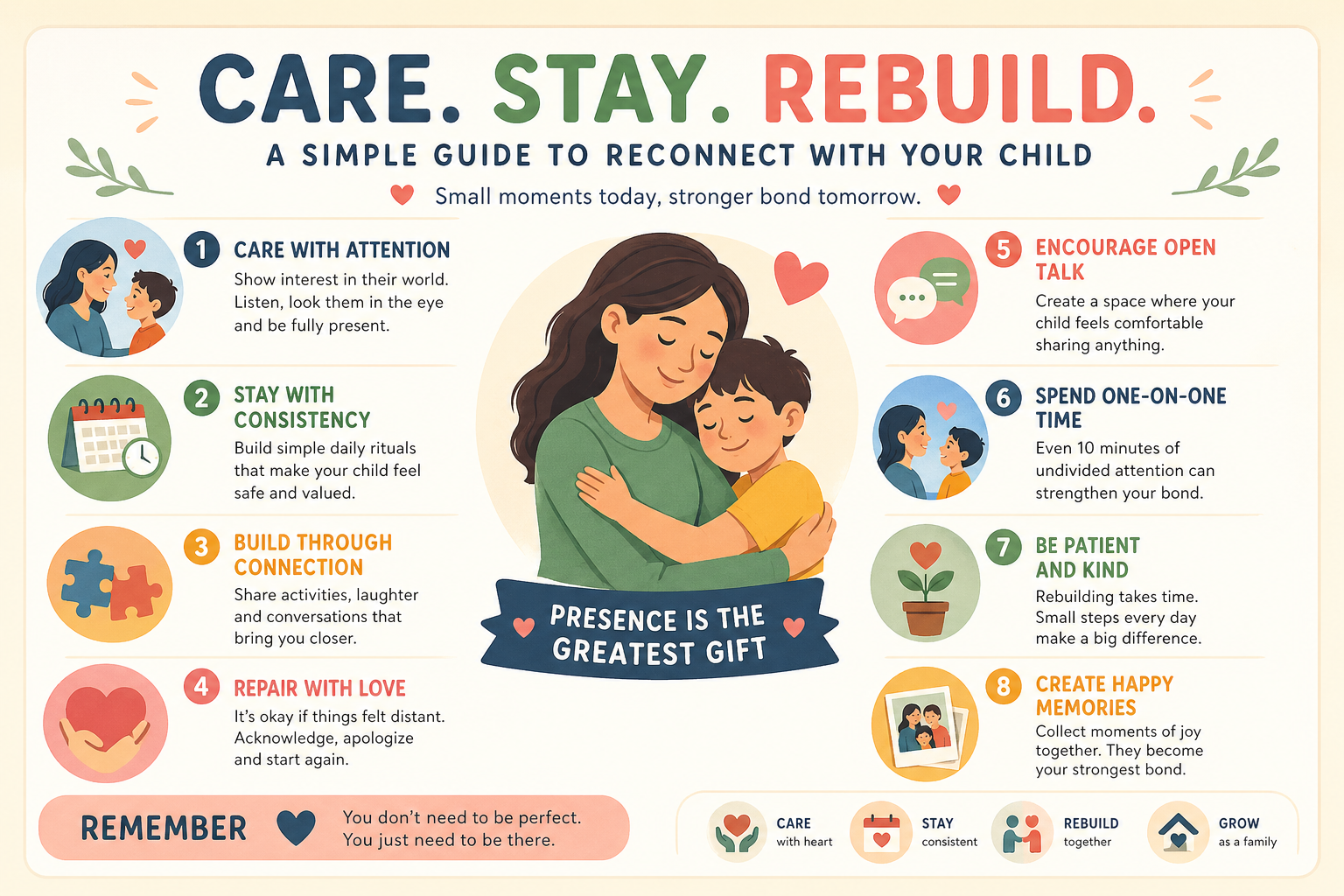
Before any specific strategy, there is one overriding principle that determines whether all of them will actually land: consistency over intensity.
When parents realize they’ve been disconnected from their kids, the instinct is often to overcorrect — to plan a big special event, to suddenly be extraordinarily present and emotionally available every single second, to go from zero to sixty in a way that is noticeable and sometimes overwhelming to children who have quietly adjusted to a different version of you.
Grand gestures are not bad. They can be meaningful. But they don’t rebuild connection the way that quiet, regular, reliable presence does. A child who experiences you showing up — warmly, attentively, without fanfare — for twenty minutes every day over the course of three weeks builds something far more durable than the child who gets one perfect day at the zoo and then goes back to the old pattern.
This is worth understanding because it removes the pressure to do something extraordinary. Reconnecting with your child after a busy season doesn’t require a vacation or a dramatic apology or a weekend retreat. It requires that you show up, a little more fully than before, a little more often than before, and that you keep doing that until the new rhythm becomes the new normal.
Everything else on this list is in service of that.
1. Begin With an Honest, Age-Appropriate Acknowledgment
You don’t owe your child a long explanation of everything that was happening in your life. You don’t need to turn your busy season into a teachable moment or process it together in a way that puts an emotional burden on them. But a simple, genuine acknowledgment — offered without drama and without any expectation of a particular response — goes a long way.
For a younger child, it might be as simple as: “I feel like I’ve been really busy and stressed lately, and I want you to know that I love you and I miss spending time with you.” For an older child: “I’ve been pretty heads-down the last few months and I know I wasn’t as available as I wanted to be. I’m really glad things have slowed down.”
Say it once. Mean it. Don’t require them to respond in any particular way. Then move forward. The acknowledgment is not the reconnection — it just signals that the shift is real and intentional.
2. Get on Their Physical Level
This one sounds almost too simple, but it consistently shows up in child development research as one of the most immediate signals of true engagement: get physically lower than you normally are. Sit on the floor. Kneel down. Lie next to them on the carpet. Whatever they’re doing, come down to their level rather than engaging from your full adult height.
This posture communicates something your body language cannot fake: I am fully here. I am not on my way somewhere else. I have time for this.
For young children especially, the shift in a parent’s physical orientation registers as meaningful before a single word is spoken. For older kids, sitting beside them rather than across from them removes the implicit power differential that can make conversation feel like an evaluation.
3. Make the First Connection Completely About Them
Whatever you do in the first deliberate moments of reconnection, make sure it is about what they want, what they’re interested in, and what they need — not about catching up on things you missed, not about communicating the things you need them to know, not about reassuring yourself that everything is fine.
Ask them what they’ve been into lately. Actually listen to the answer. Follow up on what they say. If they want to show you something they’ve made or something they’re building or something they’re excited about, stop and genuinely look at it. Not for thirty seconds while you nod and drift back to your phone. Look at it the way you would look at something that mattered, because to them it does.
4. Bring Back a Small Ritual That Got Lost
Most families, over the course of a genuinely hectic season, let small rituals slip — the weekend pancake tradition, the Friday night movie, the bedtime back scratch, the after-school snack at the kitchen table where nobody is rushing anywhere yet. These rituals feel minor, but they carry an enormous amount of relational freight. They are the recurring proof that this family has a particular shape, that you belong to each other in a specific and reliable way.
Think about what ritual got lost or diminished during the busy season. Bring it back without making a big announcement about it. Just do it. Kids notice when something that was missing quietly comes back.
5. Have One Full Meal Together With No Devices
Not a special occasion meal. An ordinary dinner where the phones are in another room, the television is off, and whoever is at the table is genuinely at the table. Ask questions that are actually interesting — not “how was school” but “what was the weirdest part of your day?” or “if you could change one thing about this week, what would it be?”
Research from Harvard consistently supports what most families intuit when they actually do this: shared meals where conversation happens are one of the most reliable predictors of family closeness and child wellbeing. The barrier is almost never knowledge — most parents know this. The barrier is the habit of phones and screens that has quietly colonized mealtimes. Remove the devices. Let the conversation be clunky at first. Give it a few nights.
6. Ask Questions That Actually Invite an Answer
There’s a particular kind of parental question that closes down conversation almost as soon as it opens — “How was school?” “Fine.” “Did anything happen today?” “No.” “Are you okay?” “Yeah.” These questions are fine, but they’re designed for information gathering, not for genuine connection.
Questions that rebuild emotional closeness tend to be more specific, more unusual, and more genuinely curious. “What’s something you’re kind of worried about lately?” “Who made you laugh this week?” “Is there anything going on with your friends that’s been kind of hard?” “What’s the thing you’re most looking forward to right now?”
These questions don’t always produce long answers. Sometimes they produce a shrug and a “I don’t know.” But the asking itself communicates something: I am interested in the actual texture of your life, not just the headline.
7. Do Something Side by Side Without Talking
One of the quieter truths about parent-child connection is that it doesn’t always require conversation. Sometimes the most connecting thing you can do is simply occupy the same space — working, reading, drawing, building — with no agenda beyond being near each other.
This is especially true for older children and for kids who find direct emotional engagement uncomfortable or overwhelming. If your child pulls away from conversations, try parallel presence instead. Sit at the table while they do their homework. Read in the same room. Work on separate things in close proximity. The nearness itself is a form of communication: I want to be close to you even when we don’t have anything particular to say.
Over time, silence that is comfortable rather than avoidant is one of the hallmarks of a genuinely close relationship.
8. Listen More Than You Talk
When reconnection finally does produce conversation — when your child starts to tell you something real — the instinct of most parents who have been in a guilty, catching-up mode is to respond with a lot of words. To offer advice, perspective, your own parallel experience, reassurance, or a solution to the problem they’ve just described.
Resist this. Most of the time, children who share something real with a parent are primarily looking to be heard, not fixed. The most powerful thing you can do with a child who has started opening a door is to simply walk through it carefully — with questions that extend the conversation, with validation of what they’re feeling, with the quiet signal that you can sit with whatever they’re telling you without rushing to make it better.
If your child says something and you’re unsure whether they want your advice or just your ears, ask: “Do you want me to help you think through it, or did you just need to say it out loud?” That question alone is more connecting than most advice.
9. Follow Up on Things They’ve Already Told You
This is one of the most underrated relationship-building moves there is, and it costs nothing. Remember something your child mentioned — even something small — and ask about it the next day or the next week. “Hey, how did that test go that you were nervous about?” “Did you and your friend ever figure things out?” “How’s the project you were working on coming along?”
This follow-up sends an unmistakable message: I was paying attention. What you told me stayed with me. You matter enough to take up space in my memory.
For a child who has sensed your distraction during a busy season, this kind of specific recall can be quietly stunning. It tells them that even when you were stretched thin, they were still in there somewhere.
10. Let Them See You Have Fun
Children who have spent weeks or months around an anxious, exhausted, or preoccupied parent sometimes lose track of the lighter version of you — the one who laughs easily, who is playful, who isn’t carrying the weight of everything. Showing that person again is itself a form of reconnection.
Play something. Be silly. Let yourself laugh at something genuinely stupid. Be the first one to be ridiculous. Your willingness to be genuinely light in your child’s presence tells them that things are actually okay now — not just better in theory, but better in the way you’re actually walking around.
11. Don’t Mistake Their Self-Sufficiency for Not Needing You
During a parent’s busy season, many kids — particularly older ones — quietly step up their own self-sufficiency. They start entertaining themselves more, asking for less, figuring things out without you. From the outside, this can look like healthy independence. Inside, it is often a form of adaptation to perceived unavailability.
When you start trying to reconnect, these kids can seem like they don’t need it — like they’ve got it handled without you. This is where it’s most important to gently, persistently offer presence without making it about your need to be needed. They may rebuff you at first. Keep going. The self-sufficiency is a shell, not a replacement for you.
12. Apologize Simply, If an Apology Is Warranted
If you lost your patience during the busy season in ways that were unfair — if you snapped at your child, or said something you regret, or were visibly unkind in moments of stress — a simple, direct apology is warranted. Not an elaborate processing session. Not a tearful breakdown. Just: “I was really short with you last week and that wasn’t fair. I’m sorry.”
Children don’t need you to be perfect. They need you to be honest about imperfection and committed to doing better. A parent who apologizes when they’re wrong models something invaluable about accountability, and it repairs the specific rupture in a way that pretending it didn’t happen simply cannot.
13. Say Yes More Than You Usually Do
When you’re in the middle of a busy season, “not now” becomes a reflex. “In a minute.” “Maybe later.” “I can’t right now.” These deferrals are sometimes necessary — but over weeks and months, they accumulate into something that feels, from the child’s side, like a door that is mostly closed.
Swinging it back open means practicing a different reflex. When your child asks something during the reconnection period — to play, to come see something, to read, to help, to do something together — the answer should be yes far more often than it is. Not every request, not at the cost of your own legitimate needs, but with a bias toward yes that communicates: the door is open again. I’m available. You don’t have to wonder whether it’s the right moment to ask.
14. Acknowledge What They Handled Without You
If your child managed something hard during the busy season — a difficult week at school, a friendship conflict, a disappointment, a challenge you weren’t fully available for — name it now. Tell them you noticed. Tell them you think it took real courage or resilience or heart. Let them know that even when you weren’t as present as you wanted to be, you were watching enough to see who they were in those moments.
This kind of specific acknowledgment is deeply connecting because it tells a child that they were visible even when they may have felt unseen. It affirms their experience without requiring them to have needed more from you — and it lands very differently from generic praise.
15. Create a New Shared Interest
Sometimes the most natural reconnection doesn’t happen through revisiting old rhythms but through finding something new — a show you both start watching, a hobby you try together, a project you take on as a team. New shared experiences don’t carry the weight of what happened before. They’re just the two of you, in fresh territory, discovering something together.
Ask your child if there’s anything they’ve been curious about that they haven’t tried yet. Pick something neither of you knows anything about. Learn it together. The shared beginner status is equalizing and often hilarious, and it gives you something to talk about that belongs entirely to now.
16. Build in a Weekly Touchpoint That’s Non-Negotiable
Choose one thing — one small thing — that happens every week between you and each of your children individually. A walk. A breakfast. A car ride with music and no agenda. A specific show you watch together. It doesn’t have to be long or elaborate. It has to be reliable.
When this touchpoint becomes a fixture in the weekly rhythm, it functions as a promise: This time is yours. I will be here for it. You can count on me for this.
Children who know that their individual time with a parent recurs reliably don’t panic when life gets busy around the edges. They have evidence that the connection has a permanent home in the week — and that evidence is stabilizing in ways that go beyond what the actual activity provides.
17. Put the Phone Down Completely — Really
This deserves its own section because it is the most common way reconnection attempts fail. A parent who is physically present but mentally on their phone is not reconnecting. Children are extraordinarily good at detecting divided attention, and they generally respond to it by disengaging — not dramatically, but quietly, in the way of someone who has learned that competing with a screen is a losing game.
For the period when you are deliberately with your child, the phone goes somewhere else. Not face-down on the table where notifications still pulse through. Somewhere else. The difference in the quality of your presence when you are genuinely unreachable for an hour versus theoretically present but with one eye on your device is enormous — and children feel it.
18. Let the Reconnection Be Imperfect
Some of your reconnection attempts are going to be awkward. Some activities are going to fall flat. Some conversations are going to be short. Some evenings are going to go sideways because someone is tired or hungry or both, and the warm moment you’d envisioned becomes just another ordinary hard night.
This is fine. The point is not to produce a series of perfect connecting moments — the point is to show up so many times that the accumulation of imperfect presence becomes something your child can lean on. Reconnection doesn’t happen in a single breakthrough moment. It happens in a hundred small unremarkable ones.
19. Notice and Name the Good in Real Time
During the busy season, critical or corrective attention often outweighs positive attention simply because that’s the math of a stressed household — you respond to what requires immediate management, and warmth and affirmation get deprioritized. Part of reconnection is deliberately rebalancing that ratio.
In practical terms, this means noticing things your child does well or beautifully or generously and saying so — specifically, in the moment, without a caveat attached. “The way you handled that with your brother was really kind.” “I noticed how hard you worked on that this week.” “You are so funny — that made me actually laugh.” Not as a strategy. As the actual truth of what you see in them, finally spoken out loud.
20. Be Patient With a Lagged Response
This is the final and possibly most important thing to understand about reconnecting with your child after a busy season: the response you’re hoping for — the warmth, the openness, the renewed closeness — may not come right away.
Children, particularly older ones, sometimes need to see evidence of change over time before they trust it enough to relax into it. If your child was hurt by your unavailability during the busy season — if they withdrew as a self-protective move — they are not going to open back up on the first or second day of your renewed presence. They may keep you at arm’s length while they quietly observe whether you’re going to stay.
Your only job is to stay. Keep showing up, day after day, without pressure and without requiring them to reward your effort with a particular response. The warmth will come. It almost always does. But it comes on their timeline, not yours — and that’s exactly as it should be.
Since we’re being honest here, let’s talk about a few common mistakes.
Don’t compensate with gifts or screens. Buying your child something or suddenly allowing more screen time as a way of smoothing over distance is not reconnection. It’s transaction. Children can feel the difference, and what they feel often lands as: I couldn’t give you my attention, so here’s something instead. They’ll usually take the gift — but it doesn’t close the gap.
Don’t make the reconnection about your feelings. Your guilt, your grief about lost time, your desire to know that everything is okay — these are real feelings and they deserve to be processed. Just not with your child as the primary audience. Reconnection is about them, not about relieving your own discomfort.
Don’t rush the timeline. If you’ve been genuinely unavailable for three months, you’re not going to fully rebuild in a weekend. The pace of reconnection often frustrates parents who are eager to see evidence that things are back to normal. Give it time. The gap opened slowly; it closes slowly too.
Don’t go back to the old pattern too quickly. If the busy season was genuinely unavoidable — a job crisis, a family emergency, a health issue — try to learn something from it about what your baseline availability looks like and whether there are structural changes that could protect against it repeating. Not because one hard season damages children permanently, but because repeated cycles of connection and distance are harder to recover from than a single stretch.
I want to be realistic here, because I think some parenting content sets an impossible bar: the idea that reconnecting means you will now be available all the time, that the busy season was an aberration you will never allow again, that the lesson you take from this is to simply be less busy from here on out.
For most families, that is not the full truth. Life will get busy again. Work pressures will return. There will be other seasons when you are stretched thin and your presence is compromised. You are a whole person with demands beyond parenthood, and pretending otherwise does nobody any favors.
What reconnection teaches you is not that you must never be busy again. It’s that you know how to come back. That you have a practice — a set of intentional, human moves — for rebuilding closeness when it has been strained. That the gap between you and your child is not permanent, not irrecoverable, and not beyond your ability to close.
That is the actual skill. And having it makes the next hard season less frightening for everyone, including your kids — because they’ve seen what you do when you come back. They know you come back.
Beyond strategies and activities, beneath all the logistics of reconnection, there is something your child needs to feel — not from a speech you give, but from the accumulated weight of your renewed presence. They need to feel:
You see me. Specifically, particularly, completely. Not as one of the children, not as a category of responsibility, but as exactly the person I am.
You choose me. Not because you have to, not because it’s your job, but because you genuinely want to be with me.
You’re not going anywhere. The busy season ended and you came back and I can count on that happening again.
I am not a burden. My needs did not break anything. You can handle loving me even when things get hard.
You don’t have to say these things. You probably can’t — they would sound scripted if you tried. You communicate them through a hundred small choices: sitting on the floor, putting down the phone, following up on what they told you three days ago, saying yes when you might have said later, showing up again when they pushed you away.
These choices accumulate into something your child carries inside them — a sense of being held, a security that does not depend on everything going perfectly. It is the most lasting thing you can give them. And every ordinary Tuesday is an opportunity to give it.
It depends on the child’s age, temperament, and how long the disconnect lasted — but most families notice meaningful improvement within two to four weeks of consistent, deliberate reconnection. Younger children often respond faster than older ones, who may need more time to trust that the shift is real. The key is consistency: daily small moments of genuine presence accumulate faster than occasional grand efforts.
Yes. Children are remarkably good at appearing fine even when something has shifted emotionally. A child who seems unbothered by your recent unavailability may simply have adapted quietly — which is its own kind of concern. Reconnection doesn’t require your child to be visibly distressed; it’s a proactive investment in closeness that benefits children regardless of whether they are showing signs of strain.
Don’t meet their coldness with hurt or frustration — that will confirm the belief that you’re only available when things are easy. Instead, stay warm, stay consistent, lower the stakes of your attempts (small invitations rather than big events), and give them time. Anger and emotional distance in a child are often a sign that the connection mattered enough to feel the loss of. Keep showing up without requiring a particular response.
A simple, age-appropriate acknowledgment is usually beneficial — especially if you were noticeably short-tempered, distracted, or emotionally absent. You don’t need to over-explain or involve your child in the adult details of what was happening. Something honest and brief — “I know I’ve been really stretched lately and not as present as I want to be” — is enough. Say it once, mean it, and let your subsequent actions carry the weight.
Keep the invitations open and pressure-free. Older children especially may push back as a test of whether your renewed interest is genuine or temporary. Lower the commitment level of your invitations — suggest small, easy things rather than elaborate plans. Let them choose the activity when possible. And maintain your presence in adjacent ways: be in the same room, show interest in what they’re doing without requiring participation, follow up on things they’ve mentioned. Time and consistency almost always shift this.
One difficult season, handled with eventual awareness and genuine reconnection, does not permanently damage a parent-child relationship. Children are remarkably resilient, and secure attachment can be rebuilt after periods of disconnection. What matters most is not that it happened but what you do afterward. The research on rupture and repair in parent-child relationships consistently shows that the repair itself — the returning, the acknowledging, the renewed presence — can actually strengthen the relationship long-term.
You largely don’t — at least not at first. Reconnection is most effective when it’s individual. Each child had a somewhat different experience of your busy season based on their age, temperament, and what they needed from you that they didn’t get. Try to carve out some individual time with each child as part of the reconnection process, even if it’s brief. Family reconnection (meals together, family rituals reinstated) can happen alongside individual reconnection, not instead of it.
Often yes, because a significant portion of behavioral difficulty in children — particularly acting out, increased tantrums, attention-seeking behavior, and defiance — is driven by dysregulation that is related to feeling disconnected from primary caregivers. When connection is restored, the nervous system calms, and the behavior that was an expression of stress frequently diminishes. This is not always the case — some behavioral challenges have other roots — but it is consistently one of the first things to assess when behavior has worsened during or after a stressful family period.