Physical Address
304 North Cardinal St.
Dorchester Center, MA 02124
Physical Address
304 North Cardinal St.
Dorchester Center, MA 02124

Every child, at some point, needs more from you than they’re currently getting.
This is not an indictment of your parenting. It is not a sign that you have failed or that something has gone fundamentally wrong. It is simply one of the most human dynamics in family life: the needs of children are not static, and the attention that was sufficient last month may not be sufficient now. Life shifts. Seasons change. Your availability fluctuates. Your child grows into new developmental stages that bring new emotional requirements. And sometimes, the gap between what a child needs and what they’re receiving opens wider than either of you realized.
The signs your child needs more of your attention are not always obvious. They are not always loud. In fact, the most important signs — the ones with the most to tell you — are often the quietest ones. The slight behavioral shift you almost explained away. The mood change you attributed to a phase. The regression you assumed was temporary. The new clinginess you didn’t quite know what to do with.
These are not random. They are communication. Children who cannot yet articulate “I feel disconnected from you” or “I need more of your presence in my life” will find other ways to deliver that message. Understanding what those ways look like — and knowing how to respond when you recognize them — is one of the most valuable things a parent can learn.
This post is a comprehensive guide to the signs your child needs more of your attention, organized by the type of signal, the age group most likely to show it, and what a thoughtful parental response looks like. It is written for the parent who wants to catch these signals early, before a small gap becomes a larger one, before a child who needed more attention quietly stopped believing it was available.
Before we look at the specific signs your child needs more of your attention, it helps to understand why children communicate this need indirectly rather than simply saying what they need.
The answer is not complicated, but it is important: children do not have the emotional vocabulary or self-awareness to name what they’re experiencing as an attention deficit. A four-year-old who is not getting enough one-on-one time with a parent does not think “I am experiencing insufficient parental connection.” They think nothing so coherent. They simply feel a vague unease, a low-grade background anxiety, a pull toward something they cannot name. And that feeling comes out in behavior — behavior that is often, from the outside, confusing or frustrating precisely because its source is invisible.
Even older children — tweens who do have the vocabulary, who can in principle name their emotional experiences — often cannot clearly identify that what they need is more of your specific attention. They may know they feel bad. They may know they’re more irritable than usual, or that they’ve been crying more, or that school feels harder than it should. They may not connect any of this to the specific deficit of parental presence.
This is why recognizing the signs your child needs more of your attention is a parent’s job, not the child’s. They are not withholding a clear message. They simply don’t have one to give. What they have is behavior — and behavior is the message.
Signs of attention-seeking behavior in children are not manipulative. Understanding this reframe is perhaps the most important shift a parent can make before reading the rest of this post. When a child acts out for attention, they are not being calculating or cynical. They are doing the most effective thing available to them to get a need met. The behavior is the need, expressed in the only language the child currently has.
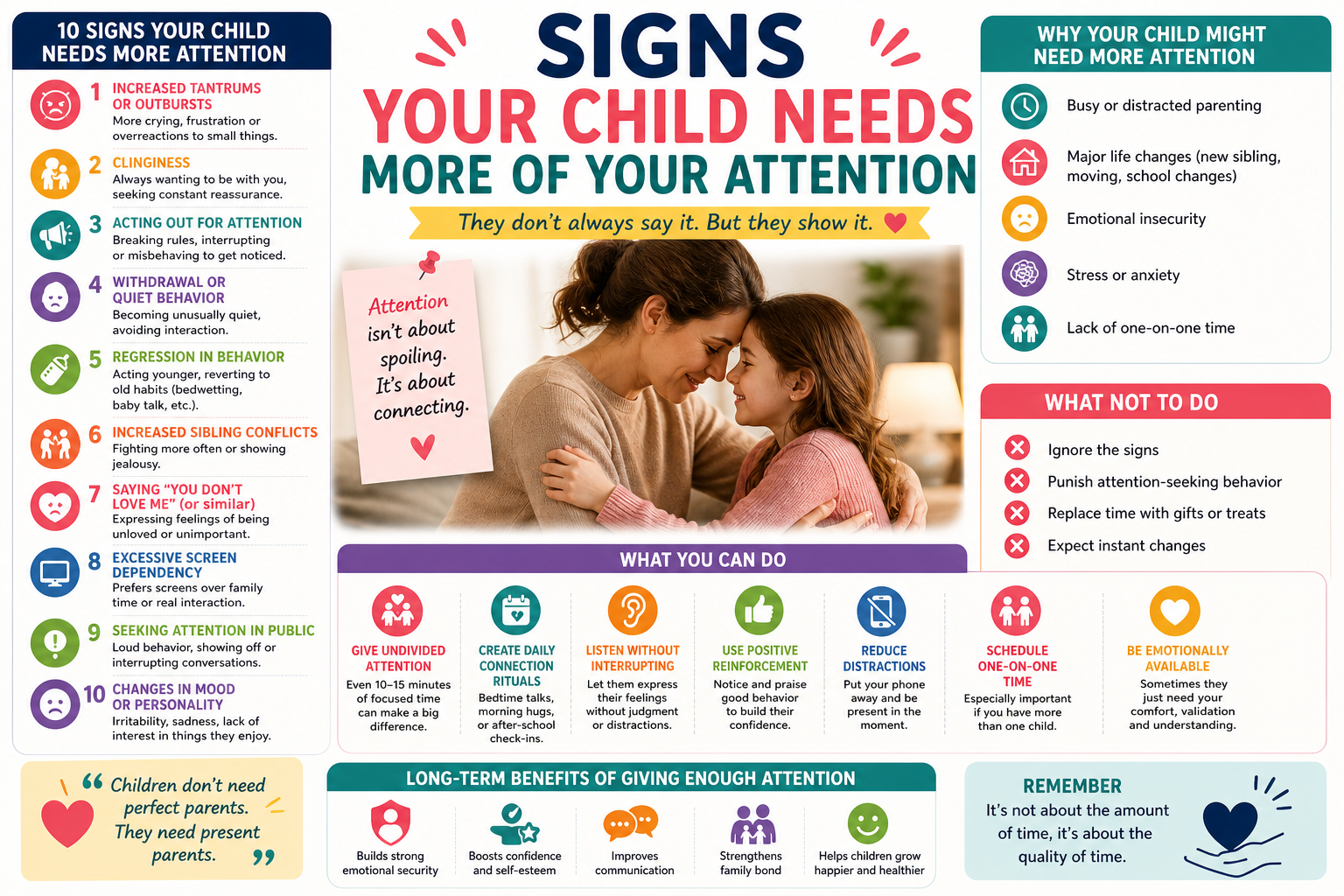
1. Increased Acting Out — Especially When You’re Busy
This is the most visible and most misunderstood sign your child needs more of your attention. A child who begins having more tantrums, more defiance, more conflict — specifically in moments when you are occupied with something else — is not being difficult on purpose. They have learned, through trial and error, that acting out is the most reliable way to get your focused, individual attention.
Even negative attention — the attention that comes when you put down your phone to address misbehavior, when you turn from your work to correct them, when you stop what you’re doing to manage a conflict — is still attention. It is still the focused parental presence they were seeking. A child who is regularly resorting to acting out for attention is a child whose other bids for connection have been going unmet long enough that they’ve escalated to what works.
The response is not stricter discipline — though clear limits still matter. The response is to look at the pattern: when does the behavior happen most? What immediately precedes it? Is there a connection between your unavailability and the eruption? If the answer is yes, you are looking at a sign your child needs more of your attention, not a sign your child has a behavior problem.
Child acting out for attention consistently correlates with unmet connection needs in developmental research. Address the need, and the behavior very often reduces without the need for escalating consequences.
2. Constantly Interrupting — Even When They Know Not To
The child who interrupts constantly — who cannot wait, who inserts themselves into every adult conversation, who physically comes between you and whatever you’re doing — is showing a specific form of signs of attention-seeking behavior in children. The interruption is a bid. It says: I need you to notice me right now, not when you’re done.
This is different from a child who simply hasn’t learned the skill of waiting. The child who has learned the skill and is choosing not to use it is generally a child whose waiting has been going unrewarded for long enough that they’ve stopped trying. Child needs more attention, and has found that interrupting delivers it.
3. Deliberately Breaking Rules They Know
When a child who knows a rule — genuinely knows it, has followed it many times before — begins breaking it repeatedly and almost theatrically, this is worth examining. The deliberate rule-breaking of a child who knows better is often not defiance for its own sake. It is a reliable method for creating focused parental response in a child who has not found a more effective way to get that response.
Child acting out for attention through deliberate rule-breaking is common in households where positive bids for connection go unnoticed — where the child’s good behavior produces no particular parental response but misbehavior reliably does. The child is not bad. They’re calibrating.
4. Showing Off Excessively or Performing for Your Attention
A certain amount of “look at me” is completely normal in children. But when a child is constantly performing — doing things specifically to attract your gaze, narrating their own actions for your benefit, requiring an audience for activities that don’t usually require one — this elevated need for witnessing is one of the signs your child needs more of your attention.
The performing child is asking to be seen. Specifically, consistently, by you. The performance is a bid, and the bid is saying: I need you to notice that I exist and that I matter and that I’m here.
5. Increased Clinginess or Separation Anxiety
A child who was previously comfortable with your absence and begins struggling — who cries when you leave, who follows you from room to room, who becomes distressed at transitions that were previously managed — is showing you a behavioral sign that something has shifted in their sense of security.
Clinginess is often treated as inconvenient and sometimes as something to be trained away. But before you address the clinginess as a behavior, consider what it is communicating: this child needs more parental attention, specifically needs proximity to you as evidence that you are available and present. The separation anxiety is a sign of attachment disruption — a child who is not sure they can count on your presence, and who is therefore holding on harder when they have it.
6. Heightened Emotional Sensitivity — Crying Over “Nothing”
A child who begins crying more easily, who reacts to small frustrations with disproportionate emotion, who seems to be emotionally on a shorter fuse than usual — this child is often carrying more emotional weight than their current level of parental connection is helping them manage.
Children co-regulate their emotions with adults — particularly parents — before they develop the capacity to regulate on their own. A child who is getting less parental attention than they need has less co-regulatory support. The result is a nervous system that is more easily dysregulated, emotions that escalate faster, and tears that seem out of proportion to the trigger because the trigger is not the actual source of the distress.
Signs of attention-seeking behavior in children often look like pure emotional dysregulation. The underlying driver is frequently a deficit of parental attention and co-regulation.
7. Increased Irritability and Low Frustration Tolerance
Closely related to heightened emotional sensitivity, a child who has become more irritable, more easily frustrated, more prone to blowing up at siblings or friends — without an obvious external cause — is often a child whose emotional tank is running low from insufficient parental connection.
This sign is easy to misattribute: to tiredness, to peer dynamics, to “just a phase.” Sometimes it is those things. But when irritability is sustained over time and the other obvious causes have been ruled out, a child needs more attention from parents and is showing it through emotional instability.
8. Mood Changes That Seem Unexplained
A child who is noticeably sadder, quieter, or more withdrawn than usual — whose general emotional tone has shifted without a clear precipitating event — is often communicating a slow-building emotional need rather than a specific situational distress.
Emotionally neglected child signs — even mild, unintentional emotional neglect resulting from a busy period rather than deliberate parental absence — can include exactly this kind of sustained mood shift. The child is not unhappy about any particular thing. They are unhappy about a general felt sense that something they need is not available, and that felt sense accumulates into a mood that parents often notice without knowing what to do about.
9. Returning to Earlier Behaviors (Regression)
Regression — when a child returns to behaviors associated with a younger developmental stage — is one of the clearest and most reliable signs your child needs more of your attention. A toilet-trained child who begins wetting themselves. An older child who resumes thumb-sucking or seeking a comfort object they’d set aside. A child who starts talking in a baby voice. A child who wants to be carried, fed, or otherwise treated as younger than they are.
These behaviors are not a child being manipulative or deliberately babyish. They are a genuine neurological response to stress — the nervous system seeking the safety it associates with an earlier developmental stage when more parental care was available. The regression is the child’s way of going back to a time that felt more secure.
Child needs more attention — specifically, the warm, close, physically present attention of early childhood — and is communicating this through behavior that recalls that period. The appropriate response is not to discourage the regression but to address the underlying need.
10. Bedtime Difficulties That Are New
When a child who previously went to bed without significant difficulty begins resisting sleep, calling out repeatedly after being put to bed, coming out of their room repeatedly, or needing a parent’s presence to fall asleep when they previously didn’t — this is a nighttime sign your child needs more of your attention.
Bedtime is a vulnerable time. The transition from wakefulness to sleep requires a child to let go of the day’s stimulation and settle into themselves. A child who is carrying unmet connection needs into bedtime finds this transition harder because they haven’t had the parental contact that helps their nervous system settle. The bedtime resistance is the unmet need surfacing in the only remaining window available.
11. New or Increased Sleep Disturbances
Related but distinct: new nightmares, waking in the night and calling for parents, being unable to go back to sleep alone, or generally disturbed sleep that is new — these nighttime manifestations often reflect daytime emotional deficits. A child who has had sufficient parental connection during the day is better resourced to manage the vulnerability of night. A child who has not often shows the deficit in their sleep.
Child needs parental attention during the day, and the disrupted nights are the most direct evidence of that unmet daytime need.
12. Seeking Negative Attention — Including From Other Adults
A child who is acting out specifically to attract parental attention will sometimes generalize this strategy to other adults — teachers, grandparents, relatives — when the parent is not available. A teacher reporting that your child is seeking attention disruptively in class, behaving in ways that feel performative or designed to provoke a response, is often telling you the same thing that the home behavior is telling you: signs your child needs more of your attention have spilled beyond the home.
13. Sudden or Escalating Sibling Conflict
A marked increase in conflict with siblings — particularly when the conflict seems designed to involve a parent, when it escalates in ways that seem to require adult intervention — is often a sign that a child is using sibling conflict as a reliable method for generating parental focus.
Child acting out for attention through sibling conflict is extremely common in families going through a busy period, after the arrival of a new sibling, or whenever parental attention has been redistributed in ways that one child feels acutely. The sibling is not really the problem. The attention deficit is.
14. Difficulty Playing Independently That Is New
A child who previously managed independent play well and begins suddenly needing constant parental involvement in their play — who can’t seem to sustain independent activity without pulling a parent in, who becomes dysregulated when left to play alone — is showing a regression in their self-regulation capacity that often correlates with reduced parental connection.
The ability to play independently is built on a foundation of secure attachment. A child who feels secure in their parental connection can venture away from it into independent activity because they trust it will be there when they return. A child who is uncertain about that security tends to hold on — to stay close, to pull parents into play, to struggle with independence that was previously comfortable.
15. Telling You Directly — Even If Indirectly
Sometimes children say it. Not always clearly, not always directly, but in ways that are worth listening to carefully. “You never spend time with me.” “You love your phone more than me.” “You’re always busy.” These statements, delivered with varying degrees of drama and accuracy, are direct verbal signs of attention-seeking behavior in children who have found words for the need.
The instinct is often to argue with the statement — “That’s not true, I just spent all day with you” — but the most effective response is to hear the emotional truth underneath the factual imprecision. The child is not making an accurate accounting of hours. They are telling you that they feel insufficient connection. That feeling is worth taking seriously regardless of whether the literal statement is fair.
16. Increased Complaints of Physical Ailments Without Medical Cause
Stomachaches before school. Headaches with no identifiable trigger. General physical complaints that arise regularly but don’t produce any findings when investigated medically — these somatic complaints are worth looking at through a psychological lens when they occur persistently.
Children who are carrying emotional weight they can’t articulate sometimes convert that weight into physical symptoms. The stomachache is real — it is not pretended — but its source is emotional rather than physical. A child who regularly develops mysterious physical ailments that resolve when they stay home with you or receive increased parental care is communicating an emotional need in one of the most direct ways their nervous system knows how.
Emotionally neglected child signs in this category are among the most commonly missed, because parents understandably focus on the physical complaint rather than the emotional need it may be expressing.
17. Changes in Appetite or Eating Patterns
A child who begins eating significantly more or significantly less than usual, or who begins using food in new ways — comfort eating, refusing meals, picking at food without appetite — may be showing somatic signs of emotional stress. Appetite is closely tied to emotional state in children, and sustained changes in eating that don’t have a physical explanation are worth examining in the context of the child’s overall emotional environment.
18. Withdrawal and Increasing Isolation
An older child or tween who begins withdrawing — spending more time alone, pulling away from family activities, becoming uncommunicative — is sometimes doing exactly what adolescent development requires. But when this withdrawal is accompanied by a flat or sad affect, when it represents a meaningful departure from the child’s previous engagement level, when it feels like retreat rather than healthy solitude — it may be one of the signs your child needs more of your attention rather than a sign they need space.
The difference matters. A child who is quietly solitary and seems content is using alone time. A child who is isolated and seems diminished by it is communicating something different. Child needs parental attention and has found that pulling away is less painful than seeking connection that doesn’t reliably arrive.
19. Declining Academic Performance Without Apparent Cause
A drop in school performance that appears without a clear academic explanation — no particular subject struggle, no learning difficulty that’s newly emerged, no change in teacher or curriculum — sometimes reflects an emotional load that is consuming bandwidth needed for focus and learning.
Children who are preoccupied with unmet emotional needs, including the need for parental connection, have less cognitive resource available for academic engagement. Signs your child needs more of your attention can show up at school before they show up at home, because school is the context in which sustained concentration and emotional regulation are most visibly tested.
20. Increased Risk-Taking or Attention-Seeking Through Peers
An older child or tween who begins taking unusual social risks — doing things specifically to be noticed by peers, engaging in behavior that seems designed to create a reaction, making choices that feel performative — may be seeking the witnessing and validation from peers that isn’t being adequately provided at home.
Peer attention-seeking in tweens is normal to a degree. But when it escalates, when it involves choices that are genuinely risky or out of character, signs of attention-seeking behavior in children have shifted into a territory that warrants real parental engagement rather than dismissal as teenage behavior.
Recognizing the signs your child needs more of your attention is only the first part. The response matters equally.
Start with acknowledgment, not action. Before you design a plan for giving more attention, simply acknowledge what you’ve noticed — to yourself, and where appropriate, to your child. “I think you’ve been needing more of me lately and I haven’t been as available as I want to be.” This acknowledgment, delivered simply and without drama, often produces immediate visible relief in children. Being seen is half of what they needed.
Increase connection before addressing behavior. If child acting out for attention has been the primary signal, the instinct is to address the behavior first. But addressing the behavior before addressing the underlying need tends to produce escalation, not resolution. Increase parental attention and connection first — deliberately, consistently, over days and weeks — and watch what happens to the behavior. In most cases, it reduces significantly without any additional behavioral intervention.
Create reliable daily touchpoints. Rather than occasional large gestures of attention, what children who are showing signs of attention needs most respond to is reliable, small, consistent connection. A ten-minute one-on-one period each day. A bedtime that is unhurried and warm. A meal where the phone is away and the conversation is actually happening. Regularity is the message: you can count on this. The connection has a permanent place.
Match your attention to what the child actually needs. Different children show signs your child needs more of your attention in different ways because different children have different primary needs. One child needs physical closeness. Another needs to be listened to. Another needs to play alongside you without being directed. Another needs to hear specific, genuine things about themselves. Know your child well enough to match the attention to the actual need rather than delivering generic presence.
Get off the phone completely during connection time. This deserves plain statement: a parent who is physically present but mentally on a device is not providing the attention that resolves the signs. Children need the real thing — focused, undivided, unhurried presence. Even twenty minutes of this is more healing than two hours of partial presence. How to give your child more attention almost always begins with this.
Address guilt without letting it drive the response. Most parents who recognize these signs experience guilt — sometimes intense guilt. That guilt is understandable and even appropriate as a signal that something needs to change. But guilt-driven parenting tends to produce inconsistency: bursts of intense attention followed by withdrawal, grand gestures followed by return to old patterns. What children need is not guilt expressed as performance. They need steady, quiet, reliable presence. Convert the guilt into consistency, and the consistency will do the actual healing.
In most cases, recognizing the signs your child needs more of your attention and responding with increased, consistent connection produces meaningful improvement within a few weeks.
But there are circumstances where additional support is warranted:
When the signs are severe or escalating. If a child’s behavior has become significantly dangerous — to themselves or others — or if withdrawal or emotional signs have progressed to the point of affecting daily functioning, school, eating, or sleep in serious ways, speak with your pediatrician and ask for a referral to a child psychologist or therapist.
When the signs persist despite genuine increased attention. If you’ve genuinely increased your parental connection and responsiveness and the signs are not improving after four to six weeks, something else may be contributing — anxiety, a learning difficulty, peer bullying, or other factors that aren’t addressed by parental attention alone.
When you’re not sure what you’re seeing. If your child’s signs feel outside the range of normal behavioral communication — if something about the presentation feels qualitatively different — trust that instinct and speak to a professional. The investment in getting a proper assessment is always worth it.
Here is what is worth knowing, as the parent of any child at any age: the need for your specific attention does not diminish as they grow older. It changes shape. It goes underground. It expresses itself in more complicated and sometimes more confusing ways. But it does not go away.
The ten-year-old who seems entirely self-sufficient needs your attention. The twelve-year-old who barely seems to tolerate your presence needs your attention. The teenager who is spending all their time with friends needs your attention. They have all learned, to varying degrees, not to show you how much they need it — because showing need is vulnerable, and being vulnerable is increasingly complicated as children get older.
Recognizing the signs your child needs more of your attention across all these ages and expressions is one of the most important parenting skills there is. Not because you can be perfect — you cannot, and they don’t need you to be. But because catching these signals early, before the gap widens and the patterns entrench, is always easier than rebuilding after the distance has set.
You don’t need to be endlessly available. You need to be reliably present. The child who knows your attention will come — consistently, warmly, specifically for them — is a child whose nervous system can relax into security rather than contracting into bids and signals and the escalating behaviors that come when bids go unanswered long enough.
Pay attention to the signals. Respond before they have to get louder.
The most common signs your child needs more of your attention include increased acting out — particularly when you’re occupied with something else — regression to younger behaviors, clingy or separation anxiety behavior that is new, emotional dysregulation and crying that seems disproportionate, sleep disturbances, somatic complaints like stomachaches without medical cause, and for older children, withdrawal or declining school performance. These signs range from highly visible to easily missed, and they span every age group from toddlers through tweens.
Signs of attention-seeking behavior in children are fundamentally different from manipulation, even though they’re often conflated. Manipulation implies a conscious, calculated strategy to control others. Attention-seeking in children is an unconscious expression of an unmet developmental need — the child has found that a particular behavior reliably produces parental focus and has repeated it without any cynical awareness of what they’re doing. Understanding this distinction changes how you respond: manipulation warrants boundary-setting; attention-seeking warrants addressing the underlying connection deficit.
There’s no single prescription, but developmental research consistently supports the value of at least 15–30 minutes of focused, one-on-one parental attention per child per day — time that is specifically about them, with devices away and genuine engagement present. The quality of this attention matters more than the quantity: twenty minutes of truly focused, warm presence is more valuable than two hours of partial, distracted presence. Children who receive reliable daily focused attention from a parent show significantly fewer signs of attention-seeking behavior over time.
This is a meaningful signal worth taking seriously. Children sometimes show their need for attention most clearly in environments outside the home, where there is more of an audience and the attention-seeking strategy hasn’t been as well established. A teacher observing consistent attention-seeking behavior in your child is often observing an emotional need that has its roots at home — not because you’re a bad parent, but because home is where the primary attachment relationship is, and that’s where the attention deficit is felt most acutely. Increasing one-on-one connection at home frequently reduces classroom attention-seeking without any school-based intervention.
The research on this is clear: children cannot be harmed by receiving too much warm, attuned parental attention. What can be problematic is attention that is conditional, inconsistent, or that substitutes for appropriate limits and structure. A parent who gives generous attention while still maintaining clear, reasonable expectations is not creating a dependent or spoiled child — they are building the secure attachment that actually enables independence over time. Children who feel securely attended to require less external reassurance, not more.
Most families notice meaningful behavioral and emotional improvement within two to four weeks of genuinely increased, consistent parental connection. Some children respond faster — particularly younger children and those whose needs were identified and addressed relatively early. Children who have been signaling unmet attention needs for longer, or older children who have built more protective patterns around the need, may take six to eight weeks or longer to visibly relax into the renewed connection. Consistency over that period is more important than intensity.
This is an important distinction that sometimes requires professional assessment to make clearly. In general, attention-related behavioral signs — including child acting out for attention — tend to be contextually specific (worse when the parent is unavailable), responsive to increased parental connection, and accompanied by a general mood pattern rather than being pervasive across all settings. Behavioral disorders tend to be more pervasive, less situationally triggered, and less responsive to changes in parental availability alone. If you’re uncertain, a consultation with a child psychologist is always worthwhile.
How to give your child more attention in a time-limited life starts with quality over quantity. Identify the transitions in your existing day — morning routines, car rides, mealtimes, bedtime — and invest those moments with genuine presence rather than distracted going-through-the-motions. Even five minutes of sitting fully with your child at the end of the day — phone away, genuinely present, asking something specific about their world — delivers more than thirty minutes of parallel presence with divided attention. The barrier is usually not time; it’s full presence within the time that already exists.