Divya ordered three packets of “0-3 months” baby clothes online, from three different brands, on the same day. She was seven months pregnant and very proud of herself. Free delivery. Easy returns. Everything cute and soft.
The boxes arrived on a Tuesday. She opened them on the bed, one by one, like a child on Diwali morning.
The first set of bodysuits was so big that when she held one up, she laughed. “Yeh toh mere dupatta jaisa hai.” It looked like it could fit a baby of six months.
Baby Clothing Size Chart India: 7 Proven Tips, Zero Regrets
The second set was so small she was sure it was a newborn size. She checked the label again. It clearly said 0-3 months. She stretched the neck with two fingers. Not a chance.
The third set was just right. Soft, roomy but not baggy. She felt a little relief.
Three packets. Same age on the label. Three completely different sizes.
She sat there on the bed with a pile of tiny clothes and a tired face. “Toh ab kaunsa size lena hai?” she asked her husband. He had no idea either. Neither did the customer care person she called later. Neither did the size chart on the website, which only said “0-3M: 50-60 cm,” a number that meant nothing to her.
If you have ever felt like this, please know that you are not bad at shopping. The problem is not you. The problem is that baby clothing sizes in India do not follow one standard. Every brand follows its own idea of what “3 months” or “6 months” means.
In this article, I will explain why this happens, how to read a baby size chart, and how to avoid wrong-size mistakes with 7 simple fixes. I will also give you a month-by-month size guide for India, with weight and height ranges, and I will explain brand size differences in a neutral way. I will not tell you that one brand is good and another is bad. I will show you how to understand all of them.
Quick note: I am a parent and content writer, not a doctor. The charts in this article are general guides, not medical growth charts. Babies grow at different speeds, and that is normal. For questions about your baby’s growth, please talk to your pediatrician.
Table of Contents
The Short Answer: What Is a Baby Clothing Size Chart in India?
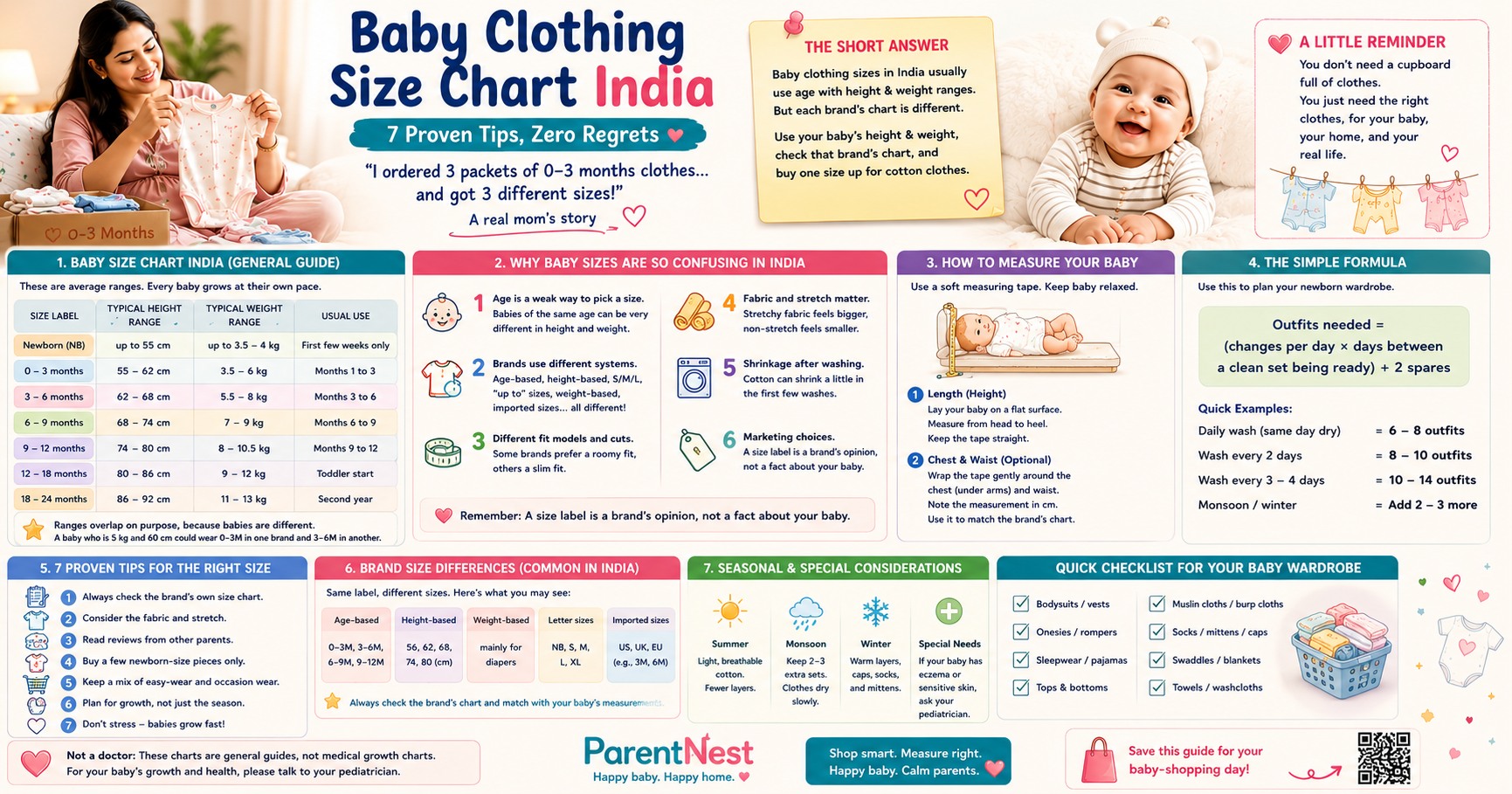
A baby clothing size chart in India usually lists sizes by age (like 0-3 months, 3-6 months) with a matching height and weight range. But because each brand makes its own chart, the safest way to choose a size is to use your baby’s height and weight, check that brand’s own chart, and buy one size up for cotton clothes.
Here is a quick, general guide. Please treat it as a starting point, not a rule.
| Size label | Typical height range | Typical weight range | Usual use |
|---|---|---|---|
| Newborn (NB) | up to about 55 cm | up to about 3.5 to 4 kg | First few weeks only |
| 0 to 3 months | about 55 to 62 cm | about 3.5 to 6 kg | Months 1 to 3 |
| 3 to 6 months | about 62 to 68 cm | about 5.5 to 8 kg | Months 3 to 6 |
| 6 to 9 months | about 68 to 74 cm | about 7 to 9 kg | Months 6 to 9 |
| 9 to 12 months | about 74 to 80 cm | about 8 to 10.5 kg | Months 9 to 12 |
| 12 to 18 months | about 80 to 86 cm | about 9 to 12 kg | Toddler start |
| 18 to 24 months | about 86 to 92 cm | about 11 to 13 kg | Second year |
These ranges are what many labels show, but they overlap on purpose, because babies are different. A baby who is 5 kg and 60 cm could wear 0-3 months in one brand and 3-6 months in another. That is exactly where the confusion starts.
Now let me show you why it happens, and how to stop it from happening to you.
Why Baby Sizes Are So Confusing in India
There is no single legal standard for baby clothing sizes in India that every brand follows. Because of this, a few things happen at once.
Reason 1: Age Is a Weak Way to Pick a Size
A label that says “3-6 months” is really guessing. Two babies of the same age can be very different in size. One may be 5.5 kg and another may be 8 kg, and both are healthy. Age is only a rough clue. Height and weight are better clues.
Reason 2: Brands Use Different Systems
In Indian shops and online stores, you will see:
- Age-based sizes: 0-3M, 3-6M, 6-9M, 9-12M.
- Height-based sizes: 56, 62, 68, 74, 80 (this means centimetres of baby height, often used by international brands).
- Words: NB, S, M, L, XL.
- “Up to” sizes: Up to 3 months, up to 6 months.
- Weight-based sizes: mainly for diapers.
- Imported or foreign sizes: US, UK or EU sizes that differ from Indian labels.
One brand may use “0-3M” for babies up to 6 kg. Another may use it for babies up to 5 kg. Both are following their own chart, and neither is lying.
Reason 3: Different Fit Models and Cuts
Every brand designs its clothes on a “fit model,” which is a baby size they believe is typical for their customers. Different brands have different customers, and different ideas of a typical baby. One may prefer a roomier fit for comfort. Another may prefer a neat, slim fit for style.
Reason 4: Fabric and Stretch
A stretchy cotton-lycra blend can feel generous on a baby who is a bit bigger. A non-stretch woven fabric, like a poplin frock, has no give at all. So two garments in the same size can feel very different on the body.
Reason 5: Shrinkage After Washing
Cotton is a natural fibre, and many cotton clothes shrink a little in the first few washes. Some brands use pre-shrunk fabric, and some do not. This is one of the main reasons a garment fits well in the shop and feels small after a wash.
Reason 6: Marketing Choices
Some brands may label a garment “newborn” or “0-3M” in a way that feels right for their shelf, their price, or their sales plan. This is a business choice, not a mistake. It simply means you cannot compare labels from two brands directly.
I want you to remember this line: A size label is a brand’s opinion, not a fact about your baby. Your baby’s real measurements are the facts.
Step One: How to Measure Your Baby (Without Stress)
Before you open any size chart, spend five minutes measuring. You do not need special tools. A soft measuring tape and a kitchen scale or a bathroom scale are enough. Or you can use the numbers from your baby’s latest pediatrician visit.
What to Measure
1. Length (height). Lay your baby on a flat surface, on their back. Straighten the legs gently (do not force them). Measure from the top of the head to the heel. Ask someone to help hold the baby still. A baby wriggles a lot, so take your time, and try twice.
2. Weight. Use the weight from the last clinic visit, or weigh your baby by holding them on a home scale and then subtracting your own weight. It is not perfect, but it gives a good idea.
3. Chest. Wrap the tape gently around the chest, just under the armpits. It should be snug but not tight.
4. Head circumference (for caps). Measure around the forehead, just above the eyebrows and ears.
Write these numbers down in your phone. You will use them again and again.
A tip I give every new parent: do not measure on the day you shop. Measure a few days before, so you are calm. And remember that babies grow fast. A measurement that is a month old may be out of date.
Measure a Garment That Already Fits
Here is a trick that works even better than a size chart. Take one outfit that fits your baby perfectly now, and lay it flat. Measure its length from shoulder to hem, and its width across the chest. Keep these numbers in your phone. When you shop online, compare them with the garment measurements on the product page, if available.
This single trick saves a lot of returns.
Baby Clothing Size Chart India: Month by Month
Now, the main part. Here is a stage-by-stage guide to what to expect. Remember, these are general ranges, and each baby is different. Use them with your own measurements.
Newborn (NB): The Smallest Size
Typical range: up to about 55 cm and up to about 3.5 to 4 kg.
This size fits many babies only for a few weeks, and some babies skip it. If your baby is born with a good weight, they may fit 0-3 months from day one. Babies born smaller, or early, will use newborn size for longer.
What I would do: buy only a few pieces in newborn size, as we explained in our guide to how many clothes a newborn needs in India. Wait until the baby is born and then buy more, based on the actual size.
0 to 3 Months
Typical range: about 55 to 62 cm and about 3.5 to 6 kg.
This is the first main size. Many babies wear it from the second week to the third or fourth month. It is also the size most gifts are bought in, so you may get many.
What to buy: soft, loose cotton. Jhabla, front-open tops, bodysuits with an envelope neck, and pyjamas with soft elastic. Do not buy tight clothes. A newborn’s neck is not strong, and tight collars can bother the baby.
3 to 6 Months
Typical range: about 62 to 68 cm and about 5.5 to 8 kg.
This is when many babies start to roll, kick and drool a lot. They wear out clothes faster. Look for softer, stretchy cotton, and bibs.
What to buy: bodysuits, simple tops, pants and rompers. Choose clothes that let legs and arms move freely. Many babies in this phase grow very fast, and you may feel like clothes fit for only a few weeks.
6 to 9 Months
Typical range: about 68 to 74 cm and about 7 to 9 kg.
Babies are sitting, crawling or trying to. Clothes get dirty more often. Knees and elbows rub on the floor.
What to buy: sturdy cotton with some stretch, pants with a bit of knee room, and soft, non-slip socks. A bodysuit with snaps is still handy, to keep tops from riding up.
9 to 12 Months
Typical range: about 74 to 80 cm and about 8 to 10.5 kg.
Many babies stand with support and start walking soon. Clothes need to allow movement. Avoid long, tripping frocks and slippery socks.
What to buy: two-piece sets, comfortable pants, and light tops. Some babies in this phase slim down as they become active, so waist adjusters or soft elastic help.
12 to 18 Months
Typical range: about 80 to 86 cm and about 9 to 12 kg.
Toddler life begins. Clothes get rough treatment. You want easy washing, soft cotton, and styles that are easy for diaper changes or early potty training.
18 to 24 Months
Typical range: about 86 to 92 cm and about 11 to 13 kg.
Many brands switch to toddler sizing around here, with labels like 2 years or 2T. Check the chart again, because the way sizes are labelled can change.
A Small Reality Check About Growth Charts
Many parents compare their baby’s size with the baby next door, or with a cousin, or with the chart on a shopping site. Please try not to.
Babies grow in their own way. Some are long and thin. Some are short and round. Some grow in sudden spurts, and then slow down for a few weeks. All of these can be healthy. Doctors track growth on proper growth charts over time, and they look at the pattern, not at one number.
A shopping size chart is a guide for clothes, not for your baby’s health. If you are worried about your baby’s weight or height, ask your pediatrician. Do not use a clothing chart to judge it.
Newborn vs 0 to 3 Months: Which One Should You Buy?
This is the question I hear the most from expecting parents. “Should I buy newborn size, or go straight to 0-3 months?”
Here is a simple way to think about it.
Newborn size is a short-term size. For many babies, it fits only for the first two to four weeks. A baby who is born at a good weight may fit into it for even less time. A baby born small or early may stay in it longer.
0 to 3 months is a longer-term size. It is also a size that is forgiving, because it is a little roomy at first, and fits for several weeks after.
So here is what I suggest:
- Buy a few newborn-size pieces, enough for the first week or two. Jhabla, a few bodysuits and swaddles. (Swaddles and wraps are mostly one-size anyway.)
- Buy most of your clothes in 0 to 3 months, because they will last longer.
- If you are expecting a small baby, a twin, or an early baby, buy a few more newborn pieces. If your family tends to have big babies, you may skip newborn size almost completely.
- Wait until the baby is born and then check the weight. Hospital staff usually tell you the weight at birth. Then you can shop with real numbers.
The best idea is to keep the bills and tags for the first week, in case you need to exchange.
Baby Clothes Size by Weight: A Simple Guide
Some brands, and almost all diaper brands, use weight as the main guide. Here is a simple way to match weight to a likely clothing size. Please remember that this is a general idea, not a rule.
| Baby’s weight | Likely clothing size | Notes |
|---|---|---|
| Up to about 3.5 kg | Newborn | Common for small and early babies |
| About 3.5 to 5.5 kg | 0 to 3 months | Many newborns land here |
| About 5.5 to 7.5 kg | 3 to 6 months | Active growth phase |
| About 7.5 to 9 kg | 6 to 9 months | Sitting and crawling phase |
| About 9 to 10.5 kg | 9 to 12 months | Standing and early walking |
| About 10.5 to 12 kg | 12 to 18 months | Toddler stage |
A few important points:
- Weight alone is not enough. A long, thin baby may need a bigger size than their weight suggests, and a short, round baby may fit a smaller size. Use both height and weight.
- Check the chest and tummy too. Some babies have a bigger tummy and need roomy clothes.
- For diapers, use the weight range printed on the pack. Diaper sizes are different from clothing sizes, so do not match them.
Brand Size Differences in India: A Neutral Explanation
This is the part that frustrates parents the most, and the part where I want to be extra fair. I will not name brands or tell you that one is “small” and another is “big.” That would not be useful or honest, because sizes change from one product to another, one season to another, and even from one batch to another. What I can do is explain why the differences exist, and how to handle them.
Why the Same Age Label Fits Differently
1. Different charts. Each brand writes its own size chart. One may say 0-3 months is up to 62 cm. Another may say up to 58 cm. Both are valid for their own clothes.
2. Different target babies. Brands think about who their customers are. Some design mainly for newborns and young babies. Some design for toddlers, and scale down. Some design mostly for export markets, and then sell the same sizes in India.
3. Different ideas of fit. Some brands prefer a snug, neat fit. Some prefer a loose, comfy fit. Neither is wrong. It is a style choice.
4. Different fabrics. A stretchy cotton jersey can have a lot of give. A woven cotton or a lined festive outfit has little. The same size can feel very different.
5. Different pre-shrink treatments. Some fabrics are washed or treated before stitching, so they shrink less. Others shrink more. Shrinkage is a big reason why an outfit feels fine on the first day and tight after a few washes.
6. Different age labels in different countries. Imported clothes may follow US, UK or European sizing. A “6 months” label in one country may not match “6 months” in another.
7. Handmade and local tailoring. Local tailors and small brands often cut by eye or by their own pattern. Their sizes can vary from batch to batch, which is not a flaw, it is just how handmade work is.
A Simple Way to Compare Two Brands Fairly
Here is what I do, and what I tell friends to do:
- Ignore the age label at first.
- Look for the height range in centimetres and the weight range in kg.
- Compare your baby’s measurements to that range.
- If your baby is at the top end of the range, choose the next size.
- If your baby is in the middle, choose the same size, or one up for cotton.
- Check the garment measurements (length, chest width), if the brand gives them.
- Read the reviews, especially ones that mention the baby’s weight and height, and whether the clothes shrank.
This gives you a fair, neutral comparison, without relying on anyone’s opinion about a brand.
Example: Same Baby, Three Brands
Imagine a baby who is 5.2 kg and 59 cm.
- Brand A says 0-3 months is 55 to 62 cm. The baby is in the middle. A 0-3 months size is a good fit.
- Brand B says 0-3 months is 50 to 58 cm. The baby is slightly above the range. Choose 3-6 months.
- Brand C says 0-3 months is 56 to 64 cm and gives a loose cut. The baby fits, with room to grow.
Same baby. Same age. Different sizes in different brands. And all three charts are correct. That is exactly why you should check numbers, not labels.
Size by Item Type: Not Every Piece Follows the Same Rule
A bodysuit, a sweater, a cap and a pair of socks do not all behave the same way. Here is a quick guide.
| Item | How to size | Tip |
|---|---|---|
| Jhabla and wraps | Usually flexible, due to ties | Buy the regular size, they fit across a wide range |
| Bodysuits and onesies | By height and weight | Choose an envelope neck, and check the snaps at the bottom |
| Pyjamas and pants | By height and waist stretch | Look for soft elastic and foldable cuffs |
| Footed sleepsuits | By height, with extra room for feet | Too small is uncomfortable for the toes, so size up |
| Sweaters and cardigans | One size up, as they are worn over layers | Check the neck opening and sleeve length |
| Caps | By head circumference | Soft, stretchy cotton, and not too tight |
| Socks and booties | By foot length, not age | Avoid tight elastic |
| Frocks and festive wear | Usually no stretch | Size up, and choose cotton lining |
| Swaddles and wraps | Mostly one size | Larger sizes are more useful |
| Diapers | By weight on the pack | Different from clothing sizes |
Sweaters, jackets and festive wear are the ones where sizing up helps the most, because they are worn over other clothes, and they are not stretchy.
7 Proven Fixes for Wrong-Size Mistakes
Now the main part of this article. These are seven simple habits that reduce wrong-size purchases. I am not saying they remove every mistake, because babies grow in surprising ways. But they will save you money, returns and frustration.
Fix 1: Measure Before You Buy (Do Not Trust Age Labels)
We covered this earlier, but it deserves to be fix number one. Measure your baby’s height and weight. Keep the numbers in your phone. Update them every few weeks. Use these numbers when you read any size chart.
Why it works: age is a guess, and measurements are facts.
Fix 2: Read the Brand’s Own Size Chart, Not Just the Age Label
On most online stores and many shop tags, there is a “size chart” link. Click on it. Look for height, weight and, if possible, garment measurements. Ignore the big age label for a moment.
If the brand does not give a chart, ask the shop or the customer service. If they cannot tell you, that is a good sign to choose another product or to buy only one piece first, as a test.
Why it works: each brand writes its own chart, and the chart is the only fair guide for that brand.
Fix 3: Buy One Size Up (When It Makes Sense)
This is the most popular tip, and also the most misunderstood. Let me explain when to buy one size up, and when not to.
Buy one size up for:
- Cotton clothes that can shrink after washing.
- Non-stretch fabrics, like woven frocks and festive outfits.
- Sweaters, jackets and layers worn over other clothes.
- Babies who are at the top end of the size range.
- Items you will wear for a longer time, such as everyday pants and sleepsuits.
- Baby who grows fast.
Do not buy one size up for:
- Newborns. Very oversized clothes can be hard to manage, can ride up around the face, and may be unsafe in sleep. A loose fit is fine. A huge one is not.
- Sleepwear and swaddles, where a safe, correct fit matters. Ask your pediatrician about safe sleep clothing.
- Caps and socks, which can slip off or fall over the eyes.
- Clothes that will not last long, like a single-use party outfit.
A simple rule I use: buy one size up for daily cotton, buy the right size for sleep and safety.
Why it works: cotton shrinks, babies grow, and a little extra room gives you more wearing time.
Fix 4: Wash a Test Piece First
If you are buying several pieces of a brand you have not tried, buy one or two first. Wash them two or three times the way you usually wash. Check how they feel and fit afterwards. Then buy more if you are happy.
This tiny habit prevents the sad moment of opening a stack of clothes that all shrink.
Also, if you hand wash with hot water or machine-dry, shrinkage may be more. If you use cool water and sun-dry, it may be less. Use your own laundry routine to judge. (If you want to know how to wash baby clothes safely, see our guide on washing baby clothes separately from adult clothes.)
Why it works: the first few washes tell you the real size.
Fix 5: Plan Size by Season, Not Just by Age
This is the fix that most parents forget. A baby will wear a size at a certain age, and that age falls in a certain season. So buy the right size for the right weather.
Example: if your baby is born in October, they will be in the 3-6 months size around January to March. That is winter or early spring. So for 3-6 months, buy a sweater and warm layers, not only summer cotton.
Another example: if your baby is born in March, the 6-9 months size will land around September to December. Monsoon is ending, and winter is coming. Plan for light layers.
Here is a simple way to do it. Write the baby’s birth month. Then count forward by three months for each size. Mark the season next to each size. Shop for that season.
This one habit saves you from buying a stack of cute summer rompers in a size that will be worn in winter.
Why it works: the right size in the wrong season is the wrong buy.
Fix 6: Choose Adjustable, Stretchy and Forgiving Designs
Some clothes are made to fit a range of sizes. These are your safest buys.
- Jhabla and wraps with ties. They fit across a range of chest sizes.
- Bodysuits with an envelope neck. They stretch.
- Pants with foldable cuffs. You can roll the cuffs when the legs are long, and unroll them as the baby grows.
- Soft elastic and drawstring waists (with short, safe ties).
- Footless sleepsuits, because there is no foot length to worry about.
- Cotton knit with some stretch, rather than stiff woven fabric.
- Snap-button side openings, which let you adjust.
The more forgiving the design, the lower the chance of a wrong-size mistake.
Why it works: adjustable designs forgive small sizing errors.
Fix 7: Keep a Size Log and a Return Plan
This is the habit that changed everything for me. Open a note on your phone, and call it “Baby Sizes.” Write down:
- Your baby’s latest height and weight, with the date.
- The brand name and size that fits well, for each brand you have tried.
- The brand and size that did not fit, and why (too small, too long, shrank).
- A measured garment that fits perfectly now.
Next time you shop, check the log first. After three or four purchases, you will have your own personal size chart, which is better than any chart on the internet.
Also, make a simple return plan. Before you buy:
- Check the return and exchange policy.
- Keep the tags on until you have tried the clothes.
- Wash only after you are sure you want to keep them (if the policy allows).
- Keep the bill or order screenshot for at least a couple of weeks.
Why it works: your own records beat any guess, and a good return plan makes mistakes cheap.
Baby Dress Size Guide for Special Situations
Not every baby follows the usual chart. Here are some common situations.
Premature or Small Babies
A baby born early or small may need sizes smaller than newborn, often called preemie or tiny baby sizes. Ask your hospital team what size clothes the baby needs, and when to move up. Their guidance matters more than a chart. Some hospitals also tell you how to dress a small baby so that the baby stays warm.
Big Babies
Some babies are born big, and skip newborn size completely. If your baby is long, check the length. A garment may fit around the chest but be too short for the legs.
Babies with a Big Tummy or Chunky Thighs
Waist and thigh room matter. Choose stretchy, loose pants and bodysuits with a roomy cut. Choose a size by the widest part, not by age.
Babies Who Grow in Spurts
Many babies seem to wear a size for a week and then outgrow it. Others seem to stay in a size for months. It is normal. Do not buy too many pieces in one size. Buy a few, then reassess.
Cloth Nappy Babies
Cloth nappies are bulky. If your baby wears cloth nappies, the clothes need more room around the hips and thighs. Choose loose pants, gowns and a slightly bigger size. (See our cloth diaper guide for more about nappy routines.)
Buying Baby Clothes Online in India: A Safe Checklist
Online shopping is convenient, but sizes are harder to judge. Here is a short checklist.
- Read the size chart and the garment measurements, not only the age label.
- Look at the fabric: cotton, stretch, woven or knit.
- Read reviews that mention height, weight and shrinkage.
- Look at photos of the garment on a real baby, if available.
- Check the return and exchange policy, and the window of days.
- Buy one piece first if you are trying a new brand.
- Avoid bulk packs of a new brand until you know the fit.
- Check if the neck opening is wide and if there are snaps.
- Read the care label: wash temperature, drying.
- Keep the order details until you are sure of the size.
Gifts and Hand-Me-Downs: Managing Sizes You Did Not Choose
Family and friends love to buy baby clothes, and they often choose a size by looking at the age on the tag. This leads to a pile of 0-3 months, because most people think a newborn is that size.
Here is what you can do:
- Ask for sizes. Politely tell family that your baby may be small or big, and suggest 3-6 months or 6-9 months for gifts.
- Keep tags and receipts for gifts, if the giver is okay with an exchange.
- Sort by size. Put each size in a labelled bag or box, so you can find it at the right time.
- Accept hand-me-downs, but wash them well, check elastic and buttons, and keep only what is in good condition.
- Pass on what you cannot use. Another family may need it.
Common Baby Size Mistakes (and How to Avoid Them)
Here are the ten mistakes I see most often.
- Trusting the age label. Use height and weight.
- Buying a full set of one brand without a test. Try one or two first.
- Ignoring shrinkage. Wash a test piece.
- Buying too many newborn-size clothes. It is the shortest-lived size.
- Buying only for the current weather. Plan for the season when the size will be worn.
- Choosing tight clothes. Tight clothes can rub the skin and limit movement.
- Choosing very oversized clothes for sleep. A safe, correct fit matters at night.
- Forgetting the nappy. Cloth nappies need roomier clothes.
- Not checking garment measurements. Chest width and length are very useful.
- Comparing your baby with other babies. Every baby grows at their own pace.
When Clothes Are Too Small: Signs to Watch For
Sometimes a baby outgrows an outfit before you notice. Here are signs that it is time to move up.
- Red marks on the skin from elastic, neck or sleeves.
- Snaps that are hard to close, or pull at the tummy.
- The garment rides up, and the tummy or back is exposed.
- Sleeves that stop short of the wrist, and pants that stop above the ankle (too short).
- The baby seems fussy when dressed, and relaxed when naked.
- You struggle to pull the garment over the head, or the neck leaves a mark.
If you see red marks or a rash that does not go away, please check with your pediatrician.
When Clothes Are Too Big: Safety Notes
A little extra room is fine. But too much can be a problem.
- Loose sleeves and pant legs can cover hands and feet, and make movement hard.
- Loose necklines can ride up toward the face.
- Loose sleepwear is not ideal for sleep. Choose a correct fit for sleep.
- Baggy clothes may make your baby trip once they start to walk.
Roll up the cuffs and sleeves if needed, and keep the very large clothes for daytime when the baby is awake and being watched.
A Simple 12-Month Size Planner (Copy for Yourself)
Take your baby’s birth month and fill in this plan. It helps you buy the right size for the right season.
| Baby’s age | Likely size | Season to check | Shopping tip |
|---|---|---|---|
| Birth to 1 month | NB or 0-3 | Birth season | Few pieces, soft cotton |
| 1 to 3 months | 0-3 | Birth month plus 1 to 3 | Main size, buy gently |
| 3 to 6 months | 3-6 | Birth month plus 3 to 6 | Check season, buy a few |
| 6 to 9 months | 6-9 | Birth month plus 6 to 9 | Sturdy cotton, knees |
| 9 to 12 months | 9-12 | Birth month plus 9 to 12 | Easy movement, standing |
| 12 to 18 months | 12-18 | Second year | Toddler sizing begins |
What I Would Tell Divya (and You)
Go back to Divya, sitting on her bed with three packets of tiny clothes, all labelled “0-3 months,” all different.
Here is what I would tell her. It is not your fault. Each brand is using its own chart. Measure your baby once the baby is born. Read each brand’s size chart, not the label. Keep the one that fits and exchange the others. Write down which brand fits which size, and next time you will know. And relax, because the baby will be happy in any soft cotton cloth, even one that is slightly too big.
So, if you are looking for a baby clothing size chart in India, month by month, use the table in this article as a starting point, but trust your baby’s measurements over any label. Buy one size up for cotton, buy the right size for sleep, plan for the season, and keep a small log of what works.
Sizing is not a test you can fail. It is a skill that gets easier with each purchase. Be kind to yourself, and to your wallet.
Frequently Asked Questions
What is the baby clothing size chart in India month by month?
A general guide is: newborn up to about 55 cm and 3.5 to 4 kg, 0-3 months about 55 to 62 cm, 3-6 months about 62 to 68 cm, 6-9 months about 68 to 74 cm, 9-12 months about 74 to 80 cm, and 12-18 months about 80 to 86 cm. Each brand has its own chart, so always check the brand’s chart.
Why do baby clothes sizes differ between brands in India?
There is no single standard that every brand follows. Brands use different size charts, fit models, fabrics, pre-shrink treatments and fit styles. A size label is the brand’s own system, so the same age label can fit differently.
What is the difference between newborn and 0-3 months size?
Newborn is the smallest size and fits for only a few weeks, mostly for small or early babies. 0-3 months is a bigger size that fits for a longer time, and is the main size for many babies.
Should I buy baby clothes by age or by weight?
Use weight and height, along with the brand’s own chart, because age is only a rough guide. Babies of the same age can be very different in size.
Should I buy one size up for baby clothes?
For everyday cotton clothes, sweaters and festive wear, buying one size up often helps, because cotton can shrink and babies grow fast. For newborns, sleepwear, caps and socks, choose the right fit for safety and comfort.
How do I measure my baby for clothes?
Lay your baby on their back and measure from head to heel for length. Use a recent weight from the clinic or a home scale. Measure the chest under the armpits and the head above the eyebrows. Write the numbers down.
How do I choose the right size when buying baby clothes online?
Ignore the age label at first. Read the brand’s size chart with height and weight, check garment measurements, read reviews that mention baby weight and shrinkage, and check the return policy. Buy one piece first from a new brand.
Do baby clothes shrink after washing?
Many cotton clothes shrink a little in the first few washes, especially with hot water and machine drying. Wash a test piece first, and choose a slightly bigger size for daily cotton wear.
How many newborn size clothes should I buy?
Only a few, enough for the first one or two weeks. Many babies outgrow newborn size quickly, and some skip it.
What size should I buy for a baby born in winter?
Think about the season when each size will be worn. A baby born in winter will be in 3-6 months by early summer, so buy light cotton for that size, and plan layers for the early sizes.
What if my baby is between two sizes?
For daily cotton clothes, choose the bigger size. For sleepwear, choose the one that fits safely. You can roll up cuffs and sleeves on the bigger size.
Is the size chart in this article a medical growth chart?
No. It is a general clothing guide. For growth and weight questions, please follow your pediatrician’s growth charts and advice.
Read Also
- 21 Must-Have Newborn Clothes for India (Stress-Free List)
- The Ultimate, Stress-Free Hospital Bag Checklist for First Baby (So You Feel Truly Ready)
- The Ultimate, Stress-Free Guide: What to Pack in Hospital Bag for Baby Delivery (So You Feel 100% Ready)
- What to Pack in Your Baby’s Daycare Bag — The Complete Honest Checklist