
In her eighth month, Sneha opened a shopping app on her phone and typed one question: “How many clothes does a newborn need?”
The answer was always the same. Ten to twelve outfits. Sometimes fifteen. One blog even said twenty.
So she did what every careful, excited, slightly scared mom-to-be does. She bought thirty. Her mother bought ten more. Her sister-in-law sent a big gift box. Two aunties brought frocks, caps and tiny shoes that no newborn could ever wear.
By the time the baby arrived in a hospital in Lucknow, her cupboard looked like a small baby shop.
How Many Clothes Does a Newborn Need India? 21 Stress-Free Picks
And then something strange happened. In the first two weeks, her baby wore the same six or seven outfits again and again. Because in her house, clothes were washed every single day. They dried on the terrace by afternoon. By evening, the same vests were back in the cupboard.
The tiny newborn-size frocks? Still in their packets. Some had tags on them. By the time she thought of wearing them, the baby had outgrown them.
“Itna sab kyun kharida?” her husband asked, looking at the pile.
Sneha laughed. And then she cried a little, because she was tired, and because she had spent money she could have saved.
If you are standing where Sneha stood, this article is for you. Global guides give you numbers that make sense for homes with a washing machine, a dryer and a weekly laundry day. Indian homes are different. We wash often. We dry in the sun. We have mothers, mothers-in-law and domestic help who handle laundry every day. So the real question is not just “how many clothes does a newborn need,” but “how many clothes does a newborn need in India, with the way we actually wash?”
Let me give you a clear, honest list, with numbers you can trust, and a simple formula you can use for your own home.
Quick note: I am a parent and content writer, not a doctor. This is general guidance based on common parenting advice. For questions about your baby’s skin, cord care, temperature, or health, please talk to your pediatrician or the hospital team.
Table of Contents
The Short Answer: How Many Clothes Does a Newborn Need in India?
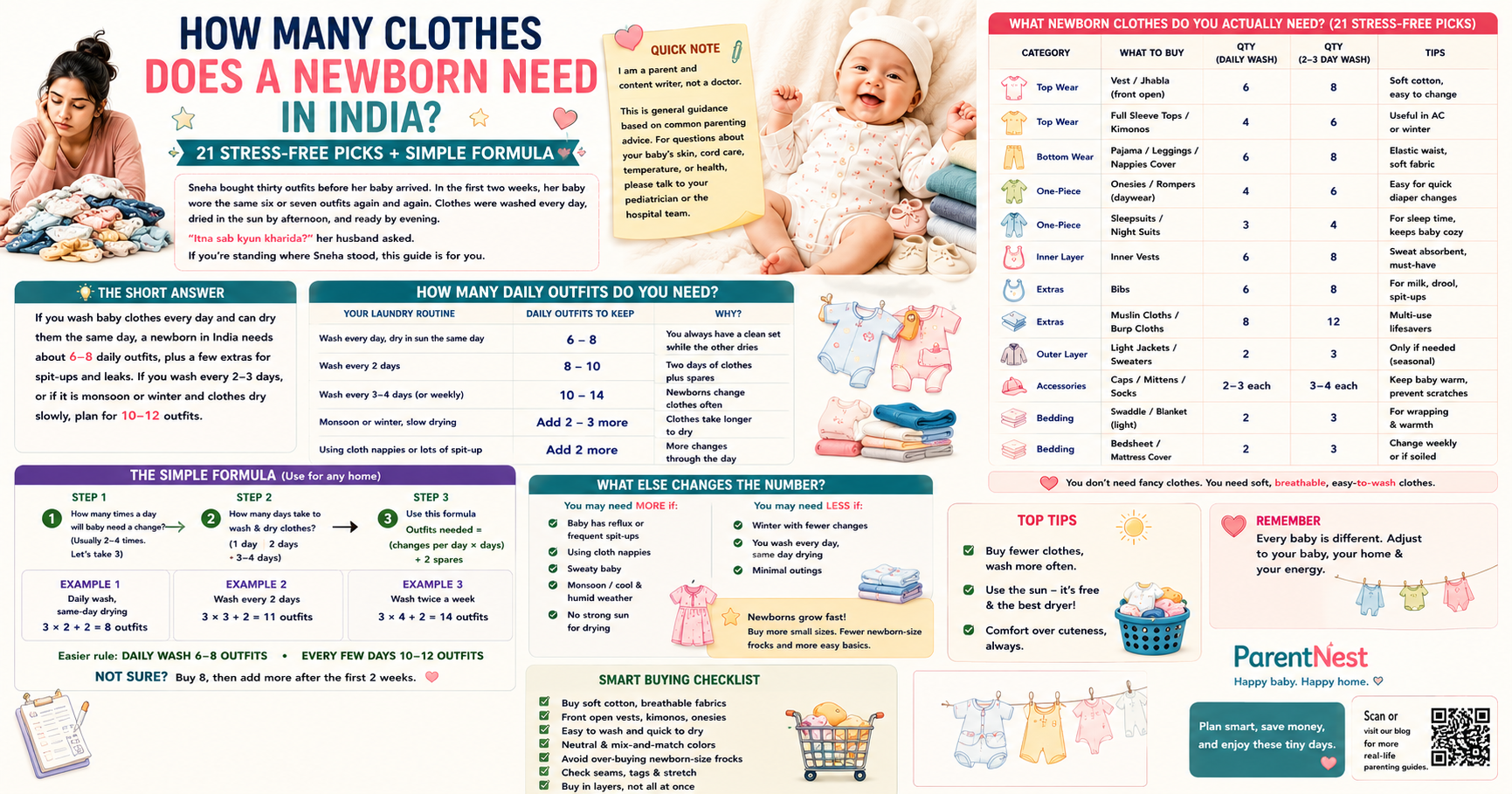
If you wash baby clothes every day and can dry them the same day, a newborn in India needs about 6 to 8 daily outfits, plus a few extras for spit-ups and leaks. If you wash every 2 to 3 days, or if it is monsoon or winter and clothes dry slowly, plan for 10 to 12 outfits.
Here is the same answer in a simple table:
| Your laundry routine | Daily outfits to keep | Why |
|---|---|---|
| Wash every day, dry in sun the same day | 6 to 8 | You always have a clean set while the other dries |
| Wash every 2 days | 8 to 10 | Two days of clothes plus spares |
| Wash every 3 to 4 days (or weekly) | 10 to 14 | Newborns change clothes often |
| Monsoon or winter, slow drying | Add 2 to 3 more | Clothes take longer to dry |
| Using cloth nappies or lots of spit-up | Add 2 more | More changes through the day |
That is it. No magic. But how did I get these numbers? Let me show you the simple thinking behind them, so you can adjust for your own home.
Why Global Guides Say 10 to 12 Outfits (and Why India Is Different)
Most baby checklists you find online are written for countries where:
- Families own a washing machine and a dryer.
- Laundry is done once or twice a week.
- Clothes are not sun-dried, so drying takes more time.
- Domestic help for daily laundry is not common.
In that kind of home, you need a bigger stock of clothes, because you wait several days before the next wash. So 10 to 12 outfits make sense.
In many Indian homes, the picture is different:
- Baby clothes are often washed daily, by hand or in a machine.
- We have the sun, at least for much of the year, and clothes dry in a few hours.
- Mothers, mothers-in-law and domestic helpers often share the laundry work.
- Baby clothes are small and thin, so they dry fast.
That is why, in many families, a smaller wardrobe works well. Not because babies need less. But because the same clothes can be washed and worn again quickly.
Of course, India is also very big. A family in a small flat in Mumbai during monsoon, a family in Delhi during a foggy winter, and a family in Jaipur in May all have different laundry situations. So I will give you a formula, not just a number.
The Simple Formula: How Many Newborn Outfits Do You Really Need?
Here is the easy way to plan, based on your own life.
Step 1: Count how many times your newborn may need a change in a day. In the first weeks, babies often need 2 to 4 outfit changes a day. Spit-ups, leaks, sweat and diaper blowouts all play a part. Let us say 3 for now.
Step 2: Decide how long clothes take to be washed and dry. If you wash in the morning and the clothes are dry by evening, you need about one day of clothes while the other is drying. If it takes two days (rain, fog, no sun), you need about two days of clothes.
Step 3: Use this formula.
Outfits needed = (changes per day × days between a clean set being ready) + 2 spares
Example 1: Daily wash, same-day drying. 3 changes × 2 days (one set in use, one set drying) + 2 spares = 8 outfits.
Example 2: Wash every 2 days. 3 changes × 3 days + 2 spares = 11 outfits.
Example 3: Wash only twice a week. 3 changes × 4 days + 2 spares = 14 outfits.
As you can see, the more often you wash, the fewer clothes you need. The number depends more on how you wash than on how many outfits the internet says.
If this feels like too much maths, here is a simple rule for you:
- Daily washers: buy 6 to 8 outfits and top up later.
- Washing every few days: buy 10 to 12 outfits.
- Not sure: buy 8, and add more after the first two weeks, once you see how your home works.
What Else Changes the Number?
A few things will make your list a little shorter or longer.
1. The season. In a hot Indian summer, babies wear very little at home, so fewer clothes are enough. In winter, you need more layers, not more outfits. In monsoon, you need extra sets because clothes dry slowly.
2. Your baby’s habits. Some babies spit up a lot. Some are very sweaty. Some barely need more than one change a day. You will know in a week or two.
3. Diapers or nappies. If you use cloth nappies (like langot), leaks may happen more, and you may go through a few more clothes. If you use disposable diapers, there are fewer leaks, but blowouts can still happen.
4. Who does the laundry. If you or your helper can wash daily, great. If laundry is hard to manage after delivery, because you are recovering and tired, choose a slightly bigger stock.
5. How fast your baby grows. Newborns grow quickly. The tiny “newborn” size may only fit for a few weeks, and some babies skip it. So do not overbuy the smallest size.
A Few Golden Rules Before You Shop
Before I give you the list of 21 must-haves, here are some rules I wish someone had told me.
Rule 1: Soft cotton first. Newborn skin is thin and delicate. Choose soft, breathable cotton, mulmul or muslin for the clothes that touch the skin. (If you want to understand fabric in detail, read our guide on the best breathable fabric for baby clothes in Indian summer and winter.)
Rule 2: Easy to put on and take off. A newborn cannot hold their head. You do not want a tight neck hole to pull over the head, or many small buttons to fasten at 3 AM. Front-open clothes, side ties, wide necks and stretchy openings make life easier.
Rule 3: Plain is better than fancy. Sequins, lace, beads and hard zips look pretty, but they bother baby skin. Save them for a special day, and keep them short.
Rule 4: Check tags and seams. Hard tags and thick seams rub on tender skin. Look for flat seams and soft labels, or cut off tags carefully.
Rule 5: Wash everything before the first wear. New clothes can carry dust and finishing chemicals. Wash them with a mild, fragrance-free detergent. (We explain how in our article on washing baby clothes separately from adult clothes.)
Rule 6: Do not overbuy. Gifts will come. Relatives will bring clothes. Wait and see what arrives before buying more.
Rule 7: Keep ties short and loose. Some baby clothes have strings and ties. Keep them short, and do not tie them tight around the neck. For sleep, choose clothes with no long strings or loose parts. Ask your pediatrician about safe sleep setup for your baby.
The 21 Must-Have Newborn Clothes for India (With Quantities)
Now, the heart of the article. I have grouped the 21 items into five simple groups, so you can shop one group at a time. The quantities are for a family that washes daily or every two days. If you wash less often, add a few more.
Group 1: Everyday Wear (Items 1 to 6)
These are the clothes your baby will wear most. Spend your effort here.
1. Jhabla (Front-Open Cotton Tops)
How many: 6 to 8 (5 to 6 if you wash daily)
If I could only choose one item on this list, it would be the jhabla for newborn babies.
A jhabla is a traditional, simple front-open cotton top, usually sleeveless or short-sleeved, that ties at the side or the front with small cloth ties. Our grandmothers used it for generations, and there is a good reason it has survived.
Why jhabla works so well for a newborn:
- You do not pull it over the head. You simply lay the baby on it and tie it.
- It leaves the tummy area free and does not press on the belly button area. (Always follow your doctor’s advice on cord care.)
- It is light, airy and perfect for hot weather.
- It is easy to change at night, with half-closed eyes.
- It is cheap, and easy to wash and dry.
What to look for: soft cotton or mulmul, short ties that you can tie loosely, flat seams, and no hard buttons.
A small caution: keep the ties short and loose, and do not leave long strings near the baby’s neck, especially during sleep.
2. Front-Open Full-Sleeve Tops (Kimono or Wrap Style)
How many: 4 to 6
These are similar to jhabla but with full sleeves, and are good for cooler nights, air-conditioned rooms and early winter. They are also useful for covering the baby’s arms, to stop scratches.
Choose tops that fasten with soft ties or snaps on the side, so there is nothing pressing on the baby’s tummy or chest.
3. Bodysuits (Snap-Bottom Vests)
How many: 4 to 6
Bodysuits, also called onesies or rompers, have snap buttons at the bottom, so they stay in place and do not ride up.
Choose ones with an envelope neck or wide neck that stretches, so you can pull them down over the shoulders, not just over the head, in case of a messy diaper. Short-sleeve cotton bodysuits are great for summer. Full-sleeve ones are useful in winter.
If your baby has a lot of poo blowouts, bodysuits with an envelope neck are a lifesaver.
4. Pyjamas, Leggings or Soft Pants
How many: 4 to 6
Soft cotton pyjamas with a gentle elastic, or a tie, go well with jhabla and front-open tops. Choose loose waistbands that do not press on the tummy. Pants with foldable cuffs, or footless style, are easy to use and grow with the baby.
In hot weather, you may often skip pants and use just a jhabla and a diaper or nappy. That is fine, if the room is comfortable.
5. Footed Sleepsuits or Rompers (Mostly for Cooler Nights)
How many: 2 to 4
A footed sleepsuit covers the baby from neck to toe in one piece. It is warm and does not need separate socks. In summer, you may barely use them, except in air-conditioned rooms. In winter, they are very handy.
Look for two-way zips or front snaps, because they make diaper changes at night much faster. Avoid anything with a hood or loose parts for sleep.
6. Open-Bottom Gowns or Kaftans
How many: 2 to 4
These are loose, simple gowns with an open or elasticated bottom. They are very popular in Indian homes, especially for newborn nights, because you can change the diaper without taking the whole outfit off.
Choose soft cotton gowns with a wide neck and short ties. In cold weather, use a thicker interlock or brushed cotton.
Group 2: Layers and Accessories (Items 7 to 12)
These depend on your city and season. Do not buy them all at once.
7. Mittens
How many: 2 to 3 pairs
Newborns have sharp little nails and scratch their face without meaning to. Soft cotton mittens help. But do not keep mittens on all the time. Babies also need their hands free to explore and to suck on their fingers, which many babies do to self-soothe. Use them mostly when the baby is sleepy, and check often that no loose thread is wrapped around a finger.
A good tip: keep the baby’s nails short and smooth, and you may not need mittens at all.
8. Socks or Booties
How many: 2 to 3 pairs
Soft cotton socks help in cool rooms, air conditioning and winter. In a hot summer, bare feet are usually fine. Make sure the socks are not tight, and check the toes for loose threads. Skip hard-soled shoes. A newborn does not need them.
9. Caps
How many: 2 to 3
A thin cotton cap is helpful in air-conditioned rooms, for outdoor trips, and in cold weather. In hot weather and at home, you often do not need a cap, and it can make your baby too warm. Check the back of the baby’s neck. If it is damp, take the cap off.
For sleeping, ask your pediatrician about safe practices, as covering the head can add to overheating in some situations.
10. Sweater or Cardigan (Winter and Cool Regions)
How many: 1 to 2
Choose a soft, front-open cardigan or sweater made from cotton-rich yarn. Always put a cotton layer under it, so the wool does not touch the skin. Avoid sweaters with tight necks, big buttons, or loose threads.
If you live in South India or coastal areas, you may not need a sweater at all, except for air-conditioned rooms.
11. Thermal Inner (Only for Cold Regions)
How many: 2
In very cold places like Delhi NCR, Punjab, Himachal, Uttarakhand and Kashmir, a soft, cotton-rich thermal inner can be a helpful base layer. Avoid tight, fully synthetic thermals, and do not stack too many layers. Take layers off when the baby is in a warm room.
12. Shawl or Dohar
How many: 1 to 2
A soft cotton dohar, a light shawl or a thin blanket is a classic Indian essential. Use it for outings, feeding and carrying. In winter, a slightly thicker one works. Always choose soft, washable ones, without fringes or loose beads.
Group 3: Swaddles, Cloths and Towels (Items 13 to 17)
These are not “clothes” in the usual sense, but you will use them every single day.
13. Muslin Swaddles or Wraps
How many: 4 to 6
A muslin swaddle is a large, thin, soft square of cloth. It is the most useful thing in your newborn kit, and you will find a new use for it every week. Wrap the baby, cover the baby during a feed, use it as a light sheet, a stroller cover or a sun shade, or put it on your shoulder as a burp cloth.
In India, mulmul and muslin are a natural choice because they are airy and dry fast. Choose big sizes, around a metre square or more.
A note on swaddling: if you swaddle, keep the wrap loose around the hips so the baby’s legs can move, and do not wrap too tight or too thick in hot weather. Ask your pediatrician or nurse to show you how, and to tell you when to stop swaddling as your baby grows.
14. Burp Cloths
How many: 5 to 6
Spit-ups are part of newborn life. A small, absorbent cotton cloth saves your shoulder, your clothes and the baby’s outfit. Soft old cotton towels, hand towels or cut muslin pieces can do the job, so you do not need to buy fancy ones.
15. Bibs
How many: 4 to 5
Bibs protect the baby’s clothes from milk and drool. Choose soft cotton ones with a snap or a short tie, not a long string. Many parents find that bibs become more useful from the second month, when drooling begins.
16. Hooded Baby Towels or Soft Cotton Towels
How many: 2
Choose a soft, absorbent, lightweight towel. Hooded towels are nice, because they keep the head dry and warm after a bath. In summer, a thin cotton towel is enough. Have two, so one can dry while the other is in use.
Also keep a few soft washcloths for wiping the face and body.
17. Sleep Sack or Wearable Blanket (Seasonal)
How many: 1 to 2 (optional)
A sleep sack is a wearable blanket, which zips around the baby, with no loose cloth to cover the face. Some families use them in winter or in air-conditioned rooms, in place of a blanket. They are optional. In hot weather, you may not need one at all.
If you choose one, pick a light, breathable fabric with a correct size, and ask your pediatrician about safe sleep for your baby. Never use anything that can cover the baby’s face or make the baby too hot.
Group 4: Nappies and Bedding (Items 18 to 20)
18. Langot or Cloth Nappies (If You Use Them)
How many: 12 to 24, depending on your routine
Many Indian families use cloth nappies, either full-time or part-time, along with a waterproof cover. They are cheap, soft and re-usable. A newborn passes urine many times a day, so you need a good stock if you wash every two days.
If you want to know how to wash them without smell, read our step-by-step guide on cloth diaper washing in India.
19. Disposable Diapers (As a Backup or Full-Time) and Nappy Covers
How many: a small pack in the newborn size, to begin with
Even if you plan to use cloth nappies, keep a small pack of disposable diapers for outings, nights, travel, the hospital stay and rainy days. And if you plan to use disposables, a small pack is enough at the start, since many babies outgrow the first size quickly. Buy bigger packs once you know what suits your baby’s skin.
If you use cloth nappies, add 2 to 4 nappy covers (waterproof outer pants) that are breathable and soft at the waist and thighs.
20. Soft Cotton Bedsheets and Changing Sheets
How many: 4 to 6
Babies leak, spit and sweat on the bed. Keep several small, soft cotton sheets or old cotton dhotis and sarees, which you can swap quickly. A thin waterproof mat or a rubber sheet under a cotton sheet protects the mattress.
Keep the bedding simple. A firm, flat sleeping surface with a fitted sheet is what doctors usually suggest. Please ask your pediatrician about safe sleep, and avoid pillows, loose blankets and soft toys in the baby’s sleeping area.
Group 5: The Special Outfit (Item 21)
21. Going-Home Outfit and One Special Outfit
How many: 1 to 2
This is the outfit for the first photo, the ride home from the hospital, the naming ceremony and the first family visits. It is the one place where pretty is allowed.
But keep it practical:
- Choose soft cotton or mulmul, with a cotton lining if it is fancy.
- Avoid heavy embroidery, sequins and rough lace on the inside.
- Make sure it is easy to take off in a hurry.
- Do not keep the baby in it for many hours, especially in hot weather.
A simple cotton kurta set or a soft dress with a cotton lining is lovely, and it will look just as sweet in the photos.
The Hospital Bag: Baby Clothes Checklist
Packing the hospital bag is exciting and nerve-wracking at the same time. Here is a simple list for the baby’s part. Some hospitals give you their own list, or provide certain items, so please check with your hospital first.
For the baby’s hospital bag:
- 3 to 4 jhabla or front-open tops
- 2 to 3 pyjamas or soft pants (or gowns)
- 1 going-home outfit
- 2 muslin swaddles or wraps
- 1 to 2 caps
- 1 to 2 pairs of mittens and socks
- 1 light blanket or dohar
- A small pack of newborn diapers, or cloth nappies
- 2 to 3 burp cloths
- A soft towel
- A sweater, if the weather is cool
How long is the stay? In most cases, a hospital stay is a few days, but it depends on the type of delivery and the baby’s health. Pack for three or four days to be safe, and keep the rest of the clothes at home, washed and ready.
A small tip: pack the baby’s things in a separate bag or pouch, with the going-home outfit on top. In a rush, nobody wants to search through bags.
Also, ask your family to wash and dry all baby clothes before the due date. You will thank yourself later.
Daily Wash Baby Clothes: Making a Small Wardrobe Work
This is the gap that global guides miss, so let me explain how the small wardrobe works in real Indian life.
The Daily Wash Routine (Simple Version)
Here is a typical day in a house that washes baby clothes daily.
- Morning: collect all the used baby clothes from yesterday in the baby hamper. Do a quick rinse for spit-ups and poop stains.
- Mid-morning: wash with a mild, fragrance-free detergent. Rinse well.
- Noon: hang in the sun on the terrace or balcony.
- Afternoon or evening: bring in, fold, and iron if needed.
- Next morning: fresh, dry clothes are ready.
With this routine, you rotate through two sets of clothes. One set is in use, and the other is drying or ready. That is why 6 to 8 outfits are enough. Add the spare ones for blowouts.
What Helps This Work
- A separate baby hamper, so baby clothes never wait in a pile of adult laundry.
- A mild detergent and a good rinse, every time.
- Sun for drying, or a plan B for rain, such as a fan-ventilated room and a clean drying rack.
- Thin clothes, because they dry fast.
- A clear helper, whether it is you, your husband, your mother, or a domestic help. Share the plan with them.
When You Should Buy More
A small wardrobe does not suit every home. Buy more, up to 10 to 12 outfits, when:
- You wash only every 3 to 4 days or once a week.
- It is the monsoon, or a cold, foggy winter with little sun.
- Your baby spits up a lot or has frequent leaks.
- You are recovering from a C-section or a tough delivery, and laundry is hard to manage.
- You do not have help at home, and the first month is a blur.
There is no shame in buying a bit more. The goal is a stress-free first month, not a perfect minimalist cupboard.
Newborn Clothes by Season and Region in India
India is huge, so your list will change with the weather. Here is a quick guide.
| Region or season | What to focus on | What to skip |
|---|---|---|
| Hot and dry summer (Rajasthan, Gujarat, MP, Vidarbha, Telangana) | Jhabla, mulmul, light cotton, muslin swaddles | Sweaters, thermals, thick blankets |
| Hot and humid (Mumbai, Kolkata, Chennai, Kerala, coastal areas) | Quick-dry light cotton, extra sets for sweat and damp | Heavy fabrics, tight clothes, synthetic outfits |
| Monsoon anywhere | Extra sets, thin cotton, a plan for drying | Thick cotton that stays damp for days |
| Cold winter (Delhi NCR, Punjab, UP, Uttarakhand, Himachal, Kashmir) | Layers: cotton inner, full-sleeve tops, cardigan, shawl, socks, cap | Piling many thick layers on one another |
| Mild climate (Bengaluru, Pune, hill towns) | Layers you can add or remove easily | Too many heavy winter pieces |
A good rule for all seasons: dress your baby in about one more light layer than you are wearing, and check the back of the baby’s neck. If it is sweaty, take off a layer. If it feels cool, add one. (Your pediatrician can give advice that fits your baby and your city.)
What to Buy in Newborn Size vs 0 to 3 Months
This one saves a lot of money.
Babies are born in different sizes. Some are small and some are big. A tiny “newborn” size may fit for only a few weeks, and some babies fit into the next size almost from the start. So:
- Buy only a few pieces in the smallest (newborn) size, enough for the first two weeks.
- Buy most of your clothes in 0 to 3 months size. Loose is better than tight for a newborn.
- Wait until the baby is born, and then buy a bit more according to the actual size.
- Expect gifts. Many will be in 3 to 6 months or 6 to 12 months size, which is useful later. Keep them in a dry cupboard, with the sizes marked on them.
Avoid pre-washing and unpacking all gift clothes at once. Wash what you need now, and keep the rest.
Newborn Clothes Budget in India: Where to Spend and Where to Save
Not every family can, or should, spend a lot. Here is where I would put the money.
Spend a little more on:
- The clothes that touch the skin for many hours: jhabla, bodysuits, gowns, sleepwear, swaddles.
- Soft, certified or trusted brand cotton, if it fits your budget.
- A few good muslin swaddles.
Save on:
- Party outfits, fancy frocks, tiny shoes and accessories.
- Many pieces in the newborn size.
- Thick winter items, if you live in a mild city.
- Gadgets and extras that are not clothes.
Smart ways to save:
- Accept hand-me-downs from relatives and friends, and wash them well. Used soft cotton is often softer than new.
- Cut and stitch simple cotton jhabla from soft old sarees or dhotis, if you have a tailor. This is a time-tested Indian way.
- Buy basic cotton packs from a trusted local market, and wash them a few times before use.
- Buy during sales, but only for the sizes you will need soon.
A full set of 21 items does not have to cost a lot. You can build it slowly, over a few weeks, and fill gaps as you go.
10 Newborn Clothing Mistakes Indian Parents Make
I have seen these again and again, and I have made a few myself:
- Buying too many newborn-size clothes. The baby may outgrow them in weeks, or skip them.
- Buying for looks, not comfort. Frills, lace and shiny fabrics are for photos, not for all day.
- Choosing clothes that go over the head. Hard to use with a newborn.
- Skipping the first wash. New clothes need washing before first use.
- Using synthetic party wear for long hours. It can trap heat and cause rashes.
- Over-dressing the baby. Too many layers can cause sweating and heat rash.
- Keeping mittens and caps on all the time. Use them only when needed.
- Using long strings and ties. They are a hazard, especially during sleep.
- Not planning the laundry. A clothes list without a laundry plan creates stress.
- Ignoring the doctor’s advice. For cord care, safe sleep and rashes, always follow your pediatrician.
A Simple Shopping Plan: Buy in Three Rounds
Here is the easiest way to avoid overbuying.
Round 1: Before delivery (month 8) Buy the basics: 6 to 8 jhabla and tops, 4 pyjamas, 2 bodysuits, 4 muslin swaddles, burp cloths, a towel, a going-home outfit, and the hospital bag items. Wash everything and keep it ready.
Round 2: In the first two weeks See how your baby actually dresses, sleeps and leaks. Add what you really need: more tops if there are many changes, more swaddles, a sweater if it is cold.
Round 3: Around the end of month one Buy 0 to 3 months and 3 to 6 months sizes as the baby grows. Skip duplicates of what you already have.
This way, you buy what you use, not what you fear you might need.
What I Would Tell Sneha (and You)
Let me take you back to Sneha, standing in front of her cupboard, with a hill of frocks and tags.
Here is what I would tell her. Keep the six or seven soft jhabla and tops that your baby wears every day. Keep the swaddles, the burp cloths and the going-home outfit. Wash daily, dry in the sun, and relax. The rest of the clothes can wait in the cupboard for later months, or go to a cousin who can use them.
So, how many clothes does a newborn need in India? For most homes that wash daily, six to eight everyday outfits will do the job. If you wash less often, or if it is rainy or foggy, ten to twelve will keep you comfortable. What matters more than the number is that the clothes are soft, simple, easy to change, and easy to wash.
You do not need a perfect cupboard. You need a few good clothes, a simple laundry plan, and a little patience with yourself. You are going to do just fine.
Frequently Asked Questions
How many clothes does a newborn need in India?
If you wash daily and dry clothes in the sun, 6 to 8 everyday outfits are usually enough. If you wash every two to three days, or if it is monsoon or winter, plan for 10 to 12 outfits.
Why do global guides say 10 to 12 newborn outfits?
They are usually written for homes that wash once or twice a week, often with machine drying. In many Indian homes, daily washing and sun drying mean you can rotate a smaller set of clothes.
What is a jhabla for a newborn?
A jhabla is a traditional front-open cotton top that ties at the side or front. It does not need to be pulled over the baby’s head, which makes dressing a newborn easy and gentle. Keep the ties short and loose.
How many clothes should I pack in the hospital bag for my baby?
Pack about 3 to 4 tops, 2 to 3 pyjamas or gowns, one going-home outfit, 2 swaddles, a cap, mittens, socks, nappies, burp cloths and a light blanket. Check your hospital’s own list too.
How many newborn size clothes should I buy?
Buy only a few in the newborn size, enough for the first one or two weeks. Buy most clothes in the 0 to 3 months size, because many babies outgrow the smallest size quickly.
Do newborns need socks, mittens and caps in India?
It depends on the weather and the room. In cool rooms, air-conditioned rooms and winter, they help. In hot weather, you often do not need them. Check the back of the baby’s neck to see if the baby is too warm or too cool.
What fabric is best for newborn clothes in India?
Soft, breathable cotton, mulmul and muslin are the best choices for most Indian weather, because they let air pass and absorb sweat.
Do I need to wash new baby clothes before the baby wears them?
Yes. Wash all new clothes with a mild, fragrance-free detergent before the first wear, to remove dust and finishing chemicals.
How many muslin swaddles does a newborn need?
About 4 to 6 is a good number. You will use them for wrapping, feeding, covering and wiping.
Should I buy winter clothes for my newborn in advance?
Only if the baby will be born in or near a cold season in a cold region. Buy 1 to 2 sweaters or cardigans, a thermal inner if needed, a shawl, and socks. In mild cities, keep it minimal.
What if I wash baby clothes only once or twice a week?
Then plan for 12 to 14 outfits, plus extra swaddles and burp cloths. You can also wash small loads more often, even by hand, to reduce the number.
Is it okay to use old clothes for a newborn?
Yes, soft, well-washed cotton clothes, including hand-me-downs, are often very comfortable. Check for loose buttons, worn elastic and strong detergent smells, and wash them well before use.