Physical Address
304 North Cardinal St.
Dorchester Center, MA 02124
Physical Address
304 North Cardinal St.
Dorchester Center, MA 02124

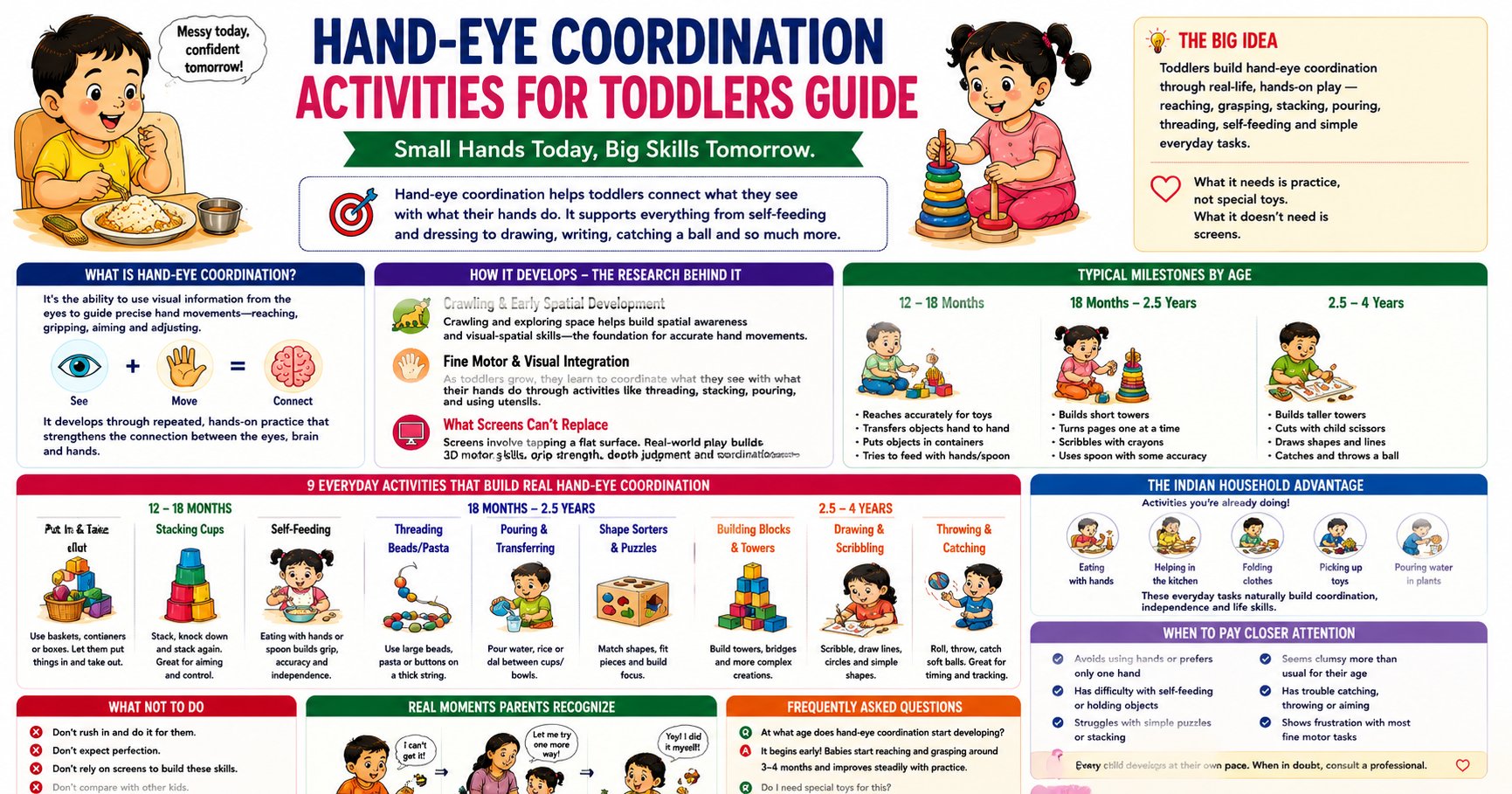
Hand-eye coordination — the ability to use visual information to guide precise hand movement — develops steadily through toddlerhood via hands-on, physical activity: threading, stacking, throwing, pouring, self-feeding, and simple household tasks. It doesn’t require special toys or classes; most of the genuinely useful activities are things many Indian households already do, from eating rice with hands to helping roll dough in the kitchen. What it does need is repeated, hands-on practice — something a screen, however colourful, can’t substitute for.
There’s a moment that happens in almost every household with a toddler around the eighteen-month mark: a fistful of rice, aimed vaguely in the direction of a mouth, ends up mostly on the cheek, the tray, and occasionally the family dog. It’s messy, it’s slow, and it’s incredibly tempting to just pick up the spoon and feed the child yourself to get through dinner in under forty-five minutes. It turns out that messy fistful of rice is doing something genuinely useful — it’s one of dozens of small, ordinary moments where a toddler’s brain is learning to connect what the eyes see with what the hand does, a skill that eventually shows up in everything from catching a ball to holding a pencil.
This article looks at what hand-eye coordination actually is, how it develops, typical milestones by age, and specific everyday activities — many of which are probably already part of your household routine — that build this skill without needing a single new toy.
Hand-eye coordination refers to the brain’s ability to take in visual information through the eyes and use it to guide precise, controlled movement of the hands — reaching for the right spot, adjusting grip based on an object’s size, timing a catch based on how fast a ball is moving toward you. It’s a genuinely foundational skill: it underlies self-feeding, dressing, drawing, writing, and eventually sports and most everyday physical tasks. It develops through the combined maturing of visual processing, fine motor control, and the neural pathways that connect the two — which is why it can’t really be taught directly through instruction; it develops through repeated, hands-on physical practice.
It might seem unrelated, but crawling plays a real, documented role here. Research on infant motor development has found that the experience of crawling — and more broadly, independently moving through space — measurably supports the development of spatial awareness and visual-spatial skills that later feed into refined hand-eye coordination. Babies who get plenty of floor time to crawl and explore are building the spatial groundwork that later shows up in tasks like reaching accurately or catching a ball.
As toddlers move past infancy, hand-eye coordination becomes increasingly tied to fine motor skill — the precise, small-muscle movements of the hands and fingers. Occupational therapy research describes this as the integration of visual processing and motor control: a toddler doesn’t just need functioning eyes and functioning hands, they need the neural pathways connecting the two to develop through repeated practice at tasks that require both — threading, stacking, pouring, and using utensils among them.
This is worth stating plainly, since it’s an increasingly common substitute for hands-on play time. A screen — however engaging or “educational” the app claims to be — asks a toddler’s eyes to track and respond to something, but it doesn’t require the physical, three-dimensional motor practice (grasping, adjusting grip, aiming, releasing) that actually builds hand-eye coordination. Tapping a flat screen is a fundamentally different motor task than picking up a bead, aiming it at a string, and threading it through. Time spent on genuinely hands-on manipulation of real objects isn’t easily substituted by screen-based activity, however visually engaging that activity is.
| Age | What’s typically emerging | What this looks like |
|---|---|---|
| 12–18 months | Simple stacking, dropping objects into containers, early spoon attempts | Stacking two to three blocks, putting a ball into a box, scooping with a spoon (messily) |
| 18 months–2 years | Improved grasp and release control, simple throwing | Throwing a ball a short distance (without much aim yet), turning pages, scribbling with a fist grip |
| 2–3 years | Better aim and timing, more controlled tool use | Attempting to catch a large, softly thrown ball, stringing large beads, using a spoon with less mess |
| 3–4 years | Refined precision, early tool-based tasks | Cutting with safety scissors along a line, threading smaller beads, catching a ball two-handed with reasonable success |
These are general patterns, not strict deadlines — the range of typical development here is wide, and a few months of variation in either direction is common and usually not a concern.
A lot of families spend money on “developmental” toys without realizing several ordinary Indian household and cultural practices are already doing genuinely useful hand-eye coordination work.
None of this means store-bought puzzles or lacing kits are unnecessary — they’re genuinely useful too — but it’s worth recognizing that a lot of valuable practice is likely already happening in your home without a specific “activity” label attached to it.
Most variation in hand-eye coordination development is completely typical, and skill differences between children of the same age are normal. It’s worth mentioning to your pediatrician — not urgently, just as a conversation — if you notice:
None of these points are meant to suggest a diagnosis — coordination difficulties in young children have a wide range of causes and outcomes, and a pediatrician or, if recommended, an occupational therapist is the right person to properly assess a specific concern rather than trying to judge it from a checklist online.
You might spend an entire meal watching your toddler miss their mouth more than they hit it and feel the urge to just take over with the spoon — and it’s worth reminding yourself that the aiming attempt itself, however messy, is the actual skill-building happening in that moment.
Or you might hand your toddler a few large marigolds to “help” with a garland before a family puja, expecting mostly chaos, and notice them genuinely concentrating on getting the flower onto the thread — a small, unplanned moment of real coordination practice.
Or you might watch a two-year-old attempt to catch a ball and simply hold their arms out a beat too late, again and again, and wonder if something’s wrong — when in fact that timing gap is exactly what’s expected at this age, and it closes gradually with repeated, low-pressure practice, not correction.
It develops steadily throughout the toddler years, roughly ages 1 to 4, building on earlier infant milestones like reaching and grasping. Simple stacking and dropping emerge around 12–18 months, with more refined skills like catching and threading small beads developing by ages 3–4.
Most toddlers begin attempting to catch a large, softly thrown ball with reasonable success somewhere between 2 and 3 years old, with accuracy and two-handed control improving noticeably by age 3–4. Wide individual variation here is normal.
Screen-based activities involve visual tracking but not the physical, three-dimensional motor practice (grasping, aiming, releasing real objects) that builds hand-eye coordination. Time spent on hands-on manipulation of real objects generally isn’t replaced by screen-based activity, however visually engaging.
Research links the experience of crawling and independent movement through space to the development of spatial awareness and visual-spatial skills, which later support more refined hand-eye coordination tasks.
Yes — it requires continuous visual-motor coordination (judging portion, guiding food to the mouth, adjusting grip), making it a genuine, repeated coordination-building practice, not just a cultural or convenience choice.
Yes, particularly with larger, easier-to-manage beads for younger toddlers, progressing to smaller beads as coordination improves. It directly practices the visual-targeting-plus-hand-control skill central to hand-eye coordination.
Persistent, significant difficulty with age-typical tasks (like an inability to attempt catching even a large ball by age 3), a strong one-sided hand preference well before typical, or regression in a previously mastered skill are worth mentioning to a pediatrician — though a wide range of typical development exists.
Yes — manipulating, rolling, and shaping playdough builds fine motor control and hand strength that support coordination, alongside offering a low-pressure, tactile activity toddlers generally enjoy.
Everyday activities already available at home work well — self-feeding, kitchen helping tasks (pouring, mixing), ball rolling and catching, and traditional practices like helping thread flowers or draw simple rangoli patterns all build genuine coordination skill.
Occasional clumsiness and a wide range of coordination skill among same-age toddlers is typical. It’s worth a conversation with your pediatrician if the difficulty is persistent, significant, or paired with other developmental concerns, rather than something to diagnose from comparison alone.
None of this requires a shopping trip. A fistful of rice at dinner, a few marigolds handed over before a puja, a ball rolled back and forth on the living room floor — these ordinary moments are doing real, measurable developmental work, whether or not anyone in the room thinks of them as an “activity.” The mess, the missed catches, the wonky rangoli dots are not signs of a child falling behind; they’re what the actual skill-building looks like while it’s still in progress.


















Great post, good job.