Physical Address
304 North Cardinal St.
Dorchester Center, MA 02124
Physical Address
304 North Cardinal St.
Dorchester Center, MA 02124

There’s a particular kind of silence in a delivery room when the doctor says “it’s twins” instead of “it’s a boy” or “it’s a girl.” Sunita remembers it exactly — the pause, then her husband laughing out loud from sheer shock, then the nurse asking, almost casually, “Naam soch rakha hai dono ka?” Have you thought of names for both?
They hadn’t. Nobody ever really does — most parents-to-be prepare one name, maybe a backup, and suddenly there were two tiny faces waiting for two names that needed to belong together the way the babies themselves already did.
That’s the real challenge with twin names, and it’s different from naming a single child. A twin name isn’t just a name — it’s half of a pair. It has to stand on its own for a lifetime, and it also has to sit next to its sibling’s name on birthday cards, school rosters, and wedding invitations for decades to come. Get it right, and the names carry a quiet story every time someone says them together. Get it wrong, and you end up with two names that just happen to rhyme, with nothing underneath.
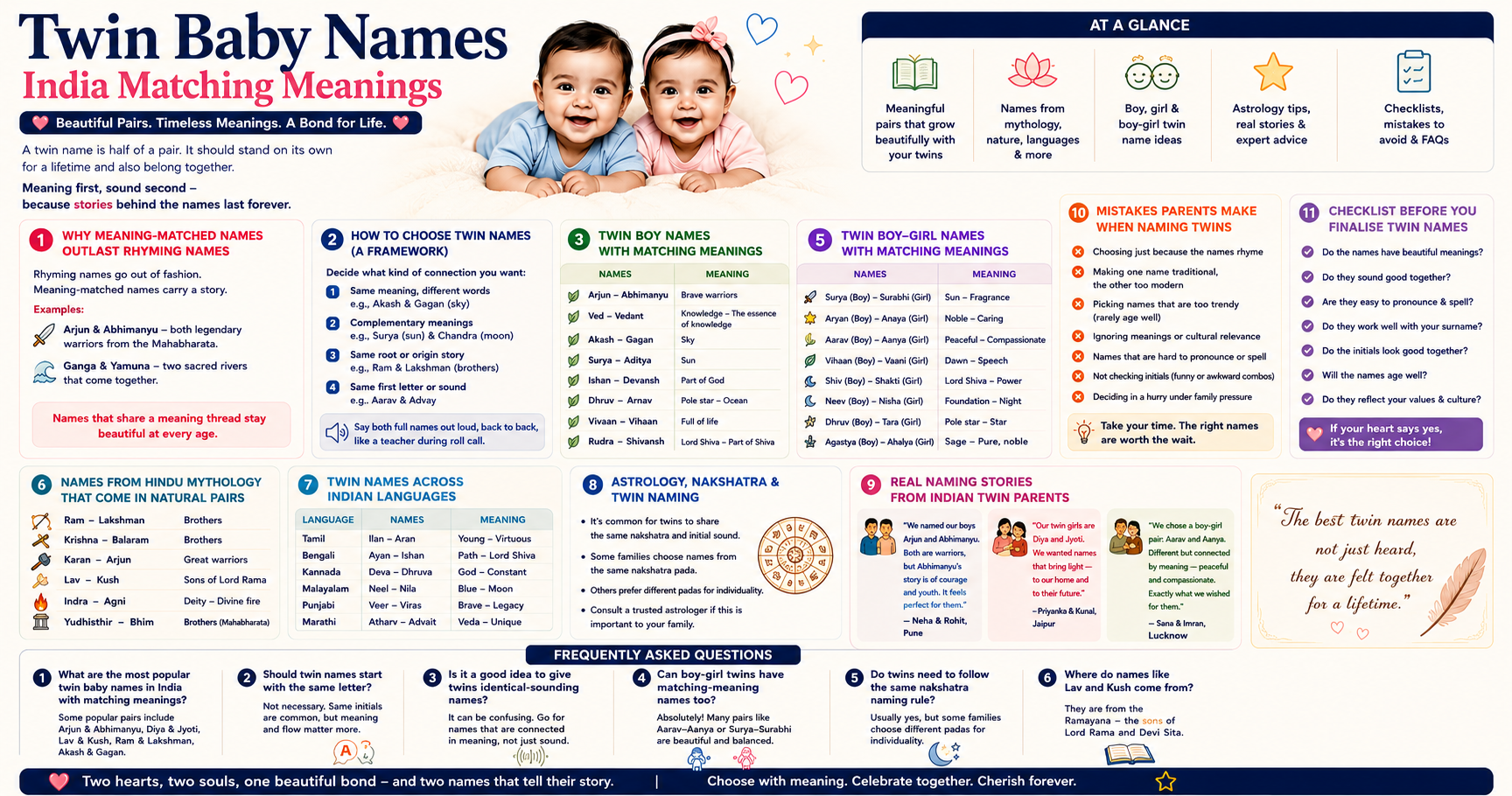
This guide is built around meaning first, sound second — because rhyming names (Rohan-Sohan, Priya-Riya) go out of fashion fast, but names that share a meaning thread — sun and moon, day and night, two rivers, two forms of the same goddess — stay beautiful at every age, from nursery to retirement.
Walk through any Indian school and you’ll find twins named Rohit-Mohit, Kiran-Kirti, Aditi-Priti — names chosen because they sound good together. There’s nothing wrong with that instinct. But rhyming names have a shelf life. They’re adorable on a nursery door and slightly awkward on a resume, a wedding card, or a LinkedIn profile at 35.
Meaning-matched names age differently. Consider Arjun and Abhimanyu — both warriors from the Mahabharata, uncle and nephew, both known for skill and courage. Or Ganga and Yamuna — two sacred rivers that, according to legend, actually meet. These pairs don’t rely on rhyme; they rely on relationship. The names tell a small story every single time someone says them side by side, whether the twins are five or fifty-five.
That’s the philosophy behind every pairing in this guide.
Before jumping into names, it helps to decide what kind of connection you want between your twins’ names. Most Indian parents land on one of these four approaches, often without realising it:
Approaches 1–3 tend to age best. Approach 4 is fine if it’s what genuinely resonates with your family, but it’s worth knowing it’s the most common choice — and therefore the least unique.
A quick gut-check before finalising: say both full names out loud, back to back, the way a teacher would during roll call. If they trip on the tongue or sound like a rhyme scheme rather than two real names, it’s worth reconsidering.
| Twin 1 | Meaning | Twin 2 | Meaning |
|---|---|---|---|
| Surya | Sun | Chandra | Moon |
| Agni | Fire | Vayu | Wind |
| Akash | Sky | Prithvi | Earth |
| Veer | Brave | Dheer | Courageous, patient |
| Ravi | Sun | Shashi | Moon |
| Arjun | Bright, white, warrior | Abhimanyu | One with great valour |
| Dev | God-like | Devansh | Part of god |
| Aryan | Noble | Uttam | Best, excellent |
| Nakul | Skilled | Sahadev | Wise and devoted |
| Ishaan | Direction/Sun | Vihaan | Dawn |
| Kabir | Great | Rehan | Fragrant, sweet-scented |
| Yash | Fame | Kirti | Glory (also used as girl’s name) |
| Aarav | Peaceful | Advik | Unique |
| Rudra | Fierce form of Shiva | Shiv | Auspicious |
| Om | Sacred sound | Aum | Same root, alternate spelling |
| Ganesh | Lord of beginnings | Skanda | Lord of war — Shiva’s two sons |
| Lav | Son of Rama | Kush | Son of Rama — twin sons of Ram and Sita |
| Ram | Pleasing, one who is charming | Lakshman | One with auspicious signs |
| Twin 1 | Meaning | Twin 2 | Meaning |
|---|---|---|---|
| Ganga | Sacred river | Yamuna | Sacred river |
| Usha | Dawn | Sandhya | Dusk/evening |
| Tara | Star | Chandni | Moonlight |
| Diya | Lamp | Jyoti | Light |
| Kiran | Ray of light | Kirti | Fame/glory |
| Riya | Singer, graceful | Priya | Beloved |
| Aditi | Boundless, mother of gods | Anantya | Endless |
| Vidya | Knowledge | Buddhi | Wisdom |
| Shraddha | Faith | Bhakti | Devotion |
| Kali | A form of Devi | Durga | A form of Devi — two forms of the same goddess |
| Lakshmi | Goddess of wealth | Saraswati | Goddess of knowledge |
| Falguni | Born in Falgun month | Chaitra | Born in Chaitra month — Hindu calendar pair |
| Nisha | Night | Divya | Divine, light |
| Meera | Devotee, prosperous | Radha | Beloved of Krishna |
| Pari | Fairy | Rani | Queen |
| Anaya | Caring | Aanya | Limitless — softer sound-and-meaning pair |
Boy-girl twins get less attention in most naming guides, but they’re common — and the meaning-matching approach works beautifully here, often better than with same-gender twins.
| Boy | Meaning | Girl | Meaning |
|---|---|---|---|
| Krishna | Dark, all-attractive | Radha | Beloved of Krishna |
| Shiv | Auspicious | Shakti | Divine power — a classic paired duality |
| Surya | Sun | Usha | Dawn (daughter of the sun in mythology) |
| Ram | Charming | Sita | Furrow, earth’s daughter — the epic’s central pair |
| Vayu | Wind | Vayushree | Grace of the wind |
| Aakash | Sky | Prithvi (girl usage) | Earth |
| Arjun | Warrior, bright | Draupadi/Panchali | Daughter of Panchal, wife of the Pandavas |
| Dev | Divine | Devi | Goddess |
| Chandra | Moon | Chandrika | Moonlight |
| Megh | Cloud | Meghna | River formed by clouds/rain |
| Kabir | Great | Kavya | Poetry, creative |
| Ansh | Part of | Anshika | A small part, feminine of Ansh |
Some of the most powerful twin name choices aren’t invented pairings at all — they’re names that were already twins, or near-twins, in mythology itself:
Choosing a mythological pair does more than sound nice — it hands your children a story they can grow into. Every school project on “the meaning of your name” becomes a little easier when the answer is a story instead of just a definition.
Most twin naming guides default entirely to Sanskrit and Hindi. India has far more to offer.
Tamil: Kaveri (river) and Ponni (another name for the Kaveri, meaning “golden”) — a beautiful same-river pairing for girls. For boys, Karthik and Vel both connect to Lord Murugan.
Bengali: Aakash (sky) and Prithibi (earth, Bengali pronunciation) work as a boy-girl pair; Ganga and Jamuna carry the same river-pair meaning in Bengali phonetics.
Marathi: Suraj (sun) and Chandra (moon) are used exactly as in Hindi, but Marathi families often pair Aai-inspired names like Sai and Om for a spiritually matched set.
Telugu: Chandana (sandalwood) and Kasturi (musk) — two fragrances, a lovely pairing for girls with a sensory rather than celestial theme.
Punjabi: Simran (meditation/remembrance) and Kirat (hard work/devotion) — both rooted in Sikh values, a strong values-matched pair rather than a mythology-matched one.
Malayalam: Amal (pure) and Nirmal (clean/pure) — near-synonyms, popular for Kerala twin boys.
If your family has strong regional or linguistic roots, it’s worth choosing names from that language rather than defaulting to Sanskrit just because it’s the most commonly covered online — a name in your own mother tongue often carries more warmth for grandparents and extended family than a “trendier” pan-Indian option.
A large number of Indian families still consult a priest or astrologer for the rashi (moon sign) and nakshatra (birth star) before finalising a name, especially the first letter. With twins, this creates a specific complication: twins born minutes apart can sometimes fall under different nakshatras, which technically means the “correct” first letter could be different for each child.
Families generally handle this one of three ways:
There’s no universally “correct” choice here — it depends on how much weight your family places on astrological naming traditions versus the symbolic bond between the twins themselves. If this matters to your family, it’s worth raising with your priest or astrologer specifically as a twin-naming question, since the guidance can differ from single-child naming.
Ananya and Ishaan, Pune — “We didn’t plan matching names at all. We’d shortlisted Ananya for a girl for months before we even knew we were having twins. When the scan showed a boy and girl, my husband said ‘Ishaan’ out loud in the car and it just clicked — dawn and uniqueness, morning and light. We didn’t design it, but it fit.”
Lav and Kush, Lucknow — “My mother-in-law didn’t even ask us what we wanted to name the boys. The moment she heard ‘twin boys,’ she said ‘Lav-Kush hi rakhna hai’ and honestly, we agreed instantly. Some names choose themselves.”
Kaveri and Ponni, Chennai — “I’m from a Kaveri delta family, three generations near the river. Naming my daughters after the river and its own other name felt like giving them something that was already ours before they were even born.”
Veer and Dheer, Jaipur — “We wanted strength in both names but didn’t want them to sound identical. Veer is the obvious brave; Dheer is the quieter kind of courage, the patience kind. As they’ve grown, it’s genuinely suited their personalities — one loud, one calm.”
These aren’t just testimonials — they’re a reminder that the “best” twin name pairing is rarely the most searched one. It’s the one that means something to your specific family’s story.
Surya-Chandra (sun-moon), Ganga-Yamuna (sacred rivers), and Lav-Kush (the mythological twin sons of Ram and Sita) remain among the most chosen pairings across Indian families.
Not necessarily. Same-letter names are a popular aesthetic choice but aren’t required — meaning-matched pairs (Surya and Chandra, Diya and Jyoti) often carry more depth than same-initial pairs.
Generally not recommended. Names that sound too similar (Isha/Ishaa) can cause confusion in school records, mail, and daily life. A shared meaning with distinct sounds tends to work better long-term.
Yes — pairs like Shiv-Shakti, Krishna-Radha, and Dev-Devi work specifically well for boy-girl twins because many mythological and conceptual pairs are already gendered as one masculine and one feminine form.
Not always. Twins can technically fall under different nakshatras depending on exact birth time, so families often either follow astrology individually for each child or choose meaning-based names instead. It’s worth discussing directly with your family astrologer if this tradition matters to you.
From the Ramayana — Lav and Kush were the twin sons of Lord Ram and Sita, raised by sage Valmiki, making this one of the most culturally rooted twin-naming choices in India.
Names and meanings in this guide draw on commonly referenced Sanskrit, Hindi, and regional-language sources; meanings can vary slightly by region, dialect, and transliteration. It’s always worth confirming a name’s meaning and pronunciation with a knowledgeable family member or priest before finalising.