Physical Address
304 North Cardinal St.
Dorchester Center, MA 02124
Physical Address
304 North Cardinal St.
Dorchester Center, MA 02124

The pandit arrived at 6 PM, exactly as promised, carrying a cloth bag with a panchang so old its edges had gone soft as fabric. Meera’s mother-in-law had been waiting by the door since five — not out of impatience, but because in her family, you didn’t call the naamkaran ceremony “scheduling a function.” You called it “bacche ka naam nikalwana” — literally, “getting the child’s name out” — as if the name already existed somewhere, in the stars the baby was born under, and the priest’s only job was to find it.
He asked for the exact time of birth. Meera gave it — 3:47 AM, she remembered it precisely because the nurse had announced it like a small miracle. He opened the panchang, traced a finger down a column of Sanskrit syllables, and said one word: “Uttara Phalguni.” Then he looked up and smiled. “Naam ‘Pa’ se shuru hoga.” The name will start with “Pa.”
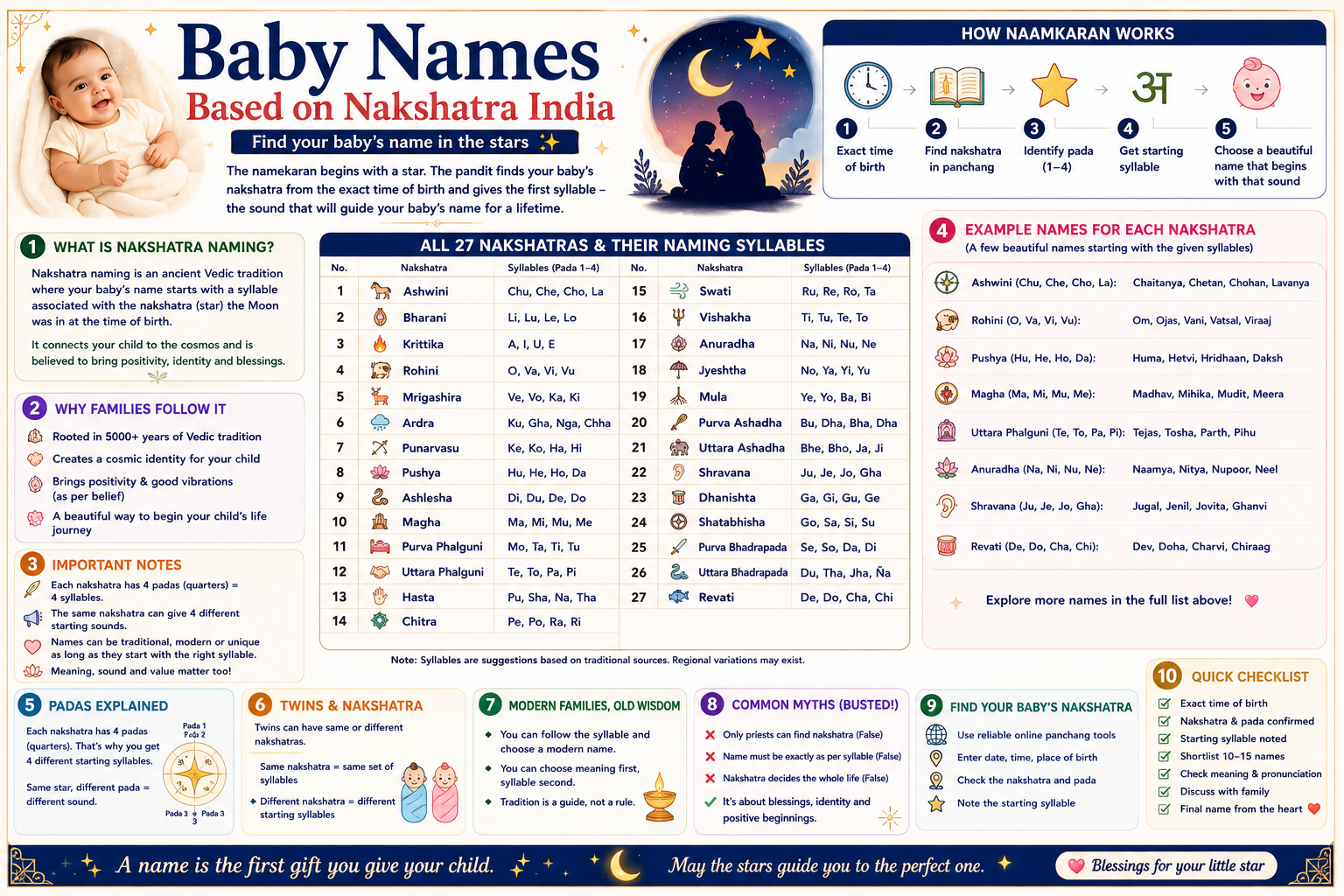
That’s the whole idea behind nakshatra-based naming, and it’s one of the oldest continuous naming traditions in the world — older than horoscope apps, older than baby-name websites, older even than most of the temples that still practice it. This guide walks through what nakshatra naming actually means, all 27 nakshatras and their naming syllables, how the tradition is practiced (and adapted) by Indian families today, and real names you can choose from for each birth star.
A nakshatra is one of 27 constellations, or “lunar mansions,” that the moon travels through over roughly 27–28 days. In Vedic astrology, the nakshatra your baby is born under — specifically, where the moon was positioned at the exact moment of birth — is considered deeply tied to that child’s personality, life path, and, in this tradition, the very first sound of their name.
Each nakshatra is divided into four padas (quarters), and each pada corresponds to a specific syllable or set of syllables considered auspicious to start the child’s name with. This isn’t randomly assigned — it comes from centuries-old astrological texts and is still calculated the same way today, usually by a priest or astrologer working from a panchang (a Hindu astrological almanac) or, increasingly, from software that does the same calculation instantly.
The underlying belief is that a name beginning with the “correct” syllable aligns the child with the vibrational and planetary energy of their birth star — giving them, in a sense, a head start in harmony with the universe they were born into. Whether or not you personally hold that belief, it remains one of the most widely practiced naming customs across Hindu families in India, spanning every region and language.
The traditional naamkaran process happens in a specific sequence:
Importantly, the syllable is a starting point, not a rigid rule. Families have historically taken enormous creative liberty within that one constraint — which is exactly why, across India, you’ll meet dozens of people whose names all start with the same sound but sound nothing alike.
This is the reference table most families actually want — the one the pandit is working from when he opens that panchang. Note: minor variations exist between regional traditions and different panchang systems, so treat this as a well-established general guide rather than the single universal authority; if precision matters to your family, cross-check with your own family priest or astrologer.
| # | Nakshatra | Ruling Planet | Naming Syllables |
|---|---|---|---|
| 1 | Ashwini | Ketu | Chu, Che, Cho, La |
| 2 | Bharani | Venus | Li, Lu, Le, Lo |
| 3 | Krittika | Sun | A, I, U, E |
| 4 | Rohini | Moon | O, Va, Vi, Vu |
| 5 | Mrigashira | Mars | Ve, Vo, Ka, Ki |
| 6 | Ardra | Rahu | Ku, Gha, Nga, Chha |
| 7 | Punarvasu | Jupiter | Ke, Ko, Ha, Hi |
| 8 | Pushya | Saturn | Hu, He, Ho, Da |
| 9 | Ashlesha | Mercury | Di, Du, De, Do |
| 10 | Magha | Ketu | Ma, Mi, Mu, Me |
| 11 | Purva Phalguni | Venus | Mo, Ta, Ti, Tu |
| 12 | Uttara Phalguni | Sun | Te, To, Pa, Pi |
| 13 | Hasta | Moon | Pu, Sha, Na, Tha |
| 14 | Chitra | Mars | Pe, Po, Ra, Ri |
| 15 | Swati | Rahu | Ru, Re, Ro, Ta |
| 16 | Vishakha | Jupiter | Ti, Tu, Te, To |
| 17 | Anuradha | Saturn | Na, Ni, Nu, Ne |
| 18 | Jyeshtha | Mercury | No, Ya, Yi, Yu |
| 19 | Mula | Ketu | Ye, Yo, Ba, Bi |
| 20 | Purva Ashadha | Venus | Bu, Dha, Bha, Dha |
| 21 | Uttara Ashadha | Sun | Bhe, Bho, Ja, Ji |
| 22 | Shravana | Moon | Ju, Je, Jo, Gha |
| 23 | Dhanishta | Mars | Ga, Gi, Gu, Ge |
| 24 | Shatabhisha | Rahu | Go, Sa, Si, Su |
| 25 | Purva Bhadrapada | Jupiter | Se, So, Da, Di |
| 26 | Uttara Bhadrapada | Saturn | Du, Tha, Jha, Ña |
| 27 | Revati | Mercury | De, Do, Cha, Chi |
Boys: Chetan, Chirag, Lalit, Lokesh Girls: Chetna, Cheshta, Lalita, Lavanya
Boys: Lokendra, Luv, Leelesh Girls: Lipika, Leela, Lovina, Lohita
Boys: Arjun, Ishaan, Uday, Eshan Girls: Aditi, Isha, Uma, Esha
Boys: Om, Vansh, Vivaan, Vivek Girls: Om (unisex), Vanya, Vidhi, Vinaya
Boys: Vedant, Karan, Kabir, Kishore Girls: Veda, Kavya, Kiara, Kimaya
Boys: Kunal, Kush, Ghanshyam Girls: Kusum, Kunjal
Boys: Keshav, Kohinoor (rare), Harsh, Hitesh Girls: Ketki, Hina, Hiral, Harshita
Boys: Hemant, Hemal, Dev, Darsh Girls: Hema, Heer, Darshana, Damini
Boys: Divit, Dushyant, Devansh, Dony Girls: Diya, Divya, Devika, Dolly
Boys: Manav, Mihir, Mukesh, Meet Girls: Manya, Mira, Muskan, Meera
Boys: Mohan, Tanmay, Tushar Girls: Mohini, Tanvi, Tisha
Boys: Tejas, Tanay, Parth, Pihu (unisex) Girls: Teesha, Tanya, Pari, Pihu
Boys: Puneet, Shaurya, Naman, Tharun Girls: Puja, Shanaya, Navya, Tharini
Boys: Prem (Pe-rooted variants), Rahul, Rishabh Girls: Priya, Preeti, Riya, Rishika
Boys: Rudra, Rehan, Rohan, Tarun Girls: Ruhi, Reva, Rohini, Tara
Boys: Tiwari (surname-linked), Tushit, Tejveer, Tony Girls: Tishya, Tulika, Tejal
Boys: Naman, Nikhil, Nutan, Neel Girls: Naina, Nishtha, Nutan, Neha
Boys: Nolan (modern crossover), Yash, Yuvraj Girls: Yashvi, Yamini, Yuvika
Boys: Yogesh, Bharat, Bimal Girls: Yogita, Bani, Bindiya
Boys: Bhuvan, Dhairya, Bhavesh Girls: Bhumi, Dhara, Bhavya
Boys: Bhoomi (unisex), Jatin, Jivan Girls: Bhoomika, Jaya, Jia
Boys: Jugal, Jeevan, Joginder Girls: Juhi, Jyoti, Jovita
Boys: Ganesh, Girish, Gaurav Girls: Gauri, Gitika, Gunjan
Boys: Govind, Sameer, Siddharth, Suresh Girls: Gopika, Sanya, Simran, Sujata
Boys: Sethu, Somesh, Daksh, Divit Girls: Seema, Sona, Daksha, Diksha
Boys: Dushyant, Thakur (surname-linked), Jhaanvi (unisex spelling) Girls: Durga, Jhanvi, Thara
Boys: Devansh, Dominic (crossover), Chaitanya, Chirag Girls: Devi, Dolly, Chandini, Chitra
This is where a lot of first-time parents get confused. If two children are both born under Rohini nakshatra, why does one end up “O” and the other “Vi”? The answer is padas.
Each nakshatra spans roughly 13°20′ of the zodiac and is divided into four padas of 3°20′ each. The specific pada your baby falls into — determined by the exact minute of birth, not just the day — is what narrows the naming syllable down from four options to one. This is precisely why astrologers ask for birth time down to the minute rather than a rough window; a baby born at 3:40 AM and one born at 4:10 AM on the same day, under the same nakshatra, can easily land in different padas and receive completely different naming syllables.
This is also why two siblings, or even twins, can be told to use different starting sounds despite being born hours (or minutes) apart — which brings us to the twin-specific question most parents actually search for.
Twins are usually born minutes apart, but minutes are exactly the margin that pada calculations run on. It’s entirely possible — common, even — for twins to fall into two different padas, or even two different nakshatras altogether, resulting in two different “correct” starting syllables.
Families generally handle this in one of three ways:
There’s no single “correct” path here; it genuinely depends on how central nakshatra tradition is to your family. If it matters to you, it’s worth raising directly with your family priest as a twin-specific question, since standard single-child guidance doesn’t always translate cleanly.
Across urban India today, nakshatra naming tends to show up in one of three ways in real families:
Full traditional approach — the naamkaran ceremony is performed, a priest calculates the nakshatra and pada, and the family selects the baby’s official first name strictly from the suggested syllable, often used specifically on legal documents and for religious ceremonies throughout life.
Hybrid approach — increasingly common in dual-income, multilingual urban households. The child gets a “school name” chosen freely by the parents (often for sound, meaning, or global pronunciation ease) and a separate nakshatra-based name used at home or during religious functions — essentially two names serving two purposes.
Symbolic approach — some modern parents skip the formal calculation but still want the emotional connection to the tradition, choosing a name that starts with a sound they associate with a nakshatra they find meaningful (often their own birth star, or one linked to a beloved grandparent), without a formal astrological consultation.
None of these is more “correct” than another — the tradition itself has always flexed to fit the family practicing it. What matters is that the choice feels intentional to you, rather than an obligation performed without understanding why.
Meera, Jaipur — “My mother-in-law wouldn’t let us name the baby before the pandit came. I was a little frustrated at first, honestly — we’d already been calling her ‘Pari’ in our heads for weeks. Turns out her nakshatra syllable was ‘Pa,’ so we kept Pari after all. Felt like it was meant to be, even though I know that’s probably just a nice coincidence.”
Arvind, Bengaluru — “We’re a tech family, not particularly religious, but my wife wanted at least the nakshatra syllable respected even if we skipped the full ceremony. We used an astrology app instead of calling a priest — took two minutes, gave us the same kind of answer my grandfather would have gotten from a pandit sixty years ago. Named our son Tejas.”
Fathima and Ramesh, interfaith family, Hyderabad — “We blended traditions for our daughter. I’m Muslim, my husband is Hindu. We didn’t do a formal naamkaran, but we did check her nakshatra out of respect for his family, and it happened to align beautifully with a name we both already loved — Ayesha starts with a sound close enough to what was suggested that everyone was happy.”
Kavita, joint family, Lucknow — “Honestly, the nakshatra naming process solved a fight before it started. Three generations in one house, everyone had an opinion on the baby’s name — but once the pandit gave us the syllable, it narrowed the options and somehow made the whole family agree faster than I expected.”
If a family priest isn’t easily accessible, or you simply prefer a modern route, here’s what’s needed either way:
Either route gets you to the same starting point: one syllable, and a world of names to choose from within it.
It’s a traditional Hindu naming practice where the baby’s first name — or its first syllable — is chosen based on the nakshatra (lunar constellation) and pada (quarter) the moon occupied at the exact moment of birth.
There are 27 nakshatras, each divided into four padas, giving 108 possible starting syllables in total across the full system — one for each of the four padas within each of the 27 nakshatras.
Not strictly — many Vedic astrology apps and websites calculate nakshatra and pada instantly from birth date, time, and place. A priest is traditional but not mandatory, especially for families taking a hybrid approach.
Yes, and it’s fairly common. Because padas are calculated down to the minute, twins born even a few minutes apart can fall into different padas or nakshatras, resulting in different suggested starting syllables.
No — they’re related but separate systems. Nakshatra naming uses 27 lunar mansions with 108 syllable options; rashi naming uses the 12 moon signs with a different, broader syllable table. Some families use one system, some use both.
Many modern families handle this by using the nakshatra syllable for a ceremonial or middle name and choosing their preferred name freely for daily/legal use — there’s no rule requiring the syllable to dictate the entire name.
Nakshatra and naming syllable information in this guide reflects commonly referenced Vedic astrology traditions; regional panchang systems can vary slightly. For a naming decision your family considers significant, it’s worth confirming details with a knowledgeable priest or astrologer using your baby’s exact birth details.