Physical Address
304 North Cardinal St.
Dorchester Center, MA 02124
Physical Address
304 North Cardinal St.
Dorchester Center, MA 02124

At a wedding in Bengaluru two years ago, Radhika found herself at a table with five other mothers, all comparing notes on their children’s names the way people usually compare notes on schools or paediatricians. There was a Bengali mother whose son had two entirely different names — one on his birth certificate, one that only his grandmother ever used. A Tamil mother whose daughter’s name included her own father’s first name folded into it, a detail Radhika had never noticed before despite having Tamil colleagues for a decade. A Punjabi mother whose son’s name had been chosen, in full, from the first line of a random reading of the Guru Granth Sahib. A Malayali mother explained that her daughter’s official name and “call name” weren’t even related to each other. And Radhika, Marathi, realised her own son’s name had followed a nakshatra syllable rule she’d simply assumed was universal across India — until that lunch, when she learned that two of the women at the table had never heard of it at all.
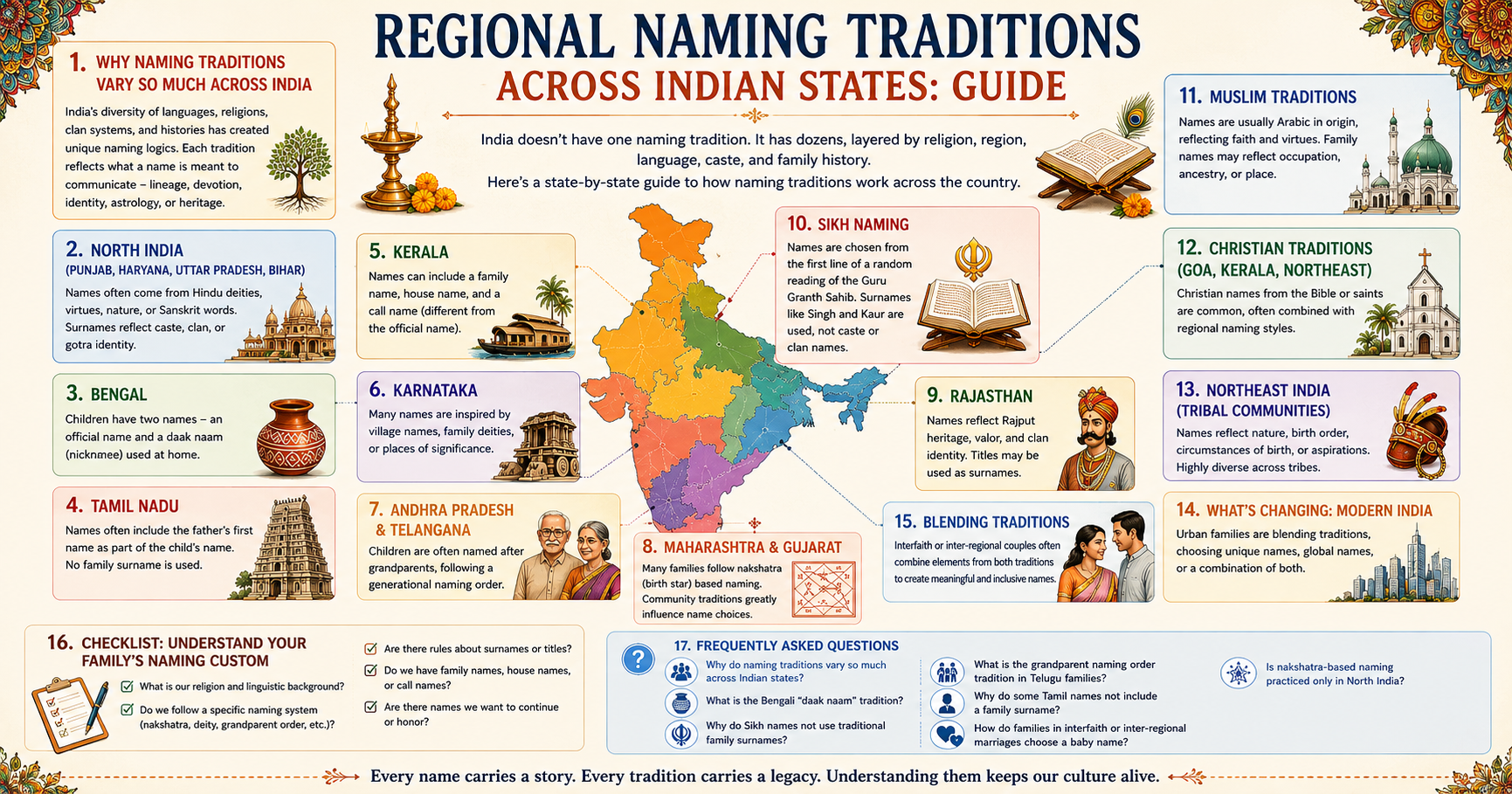
That conversation stuck with her, and it’s the honest starting point for this article too: India doesn’t have one naming tradition. It has dozens, layered by religion, region, language, caste, and family history, and most Indian parents only ever really know their own — until, like Radhika, a wedding table conversation reveals how much variety sits just next door.
This guide walks through how naming actually works, state by state and community by community, across the country — not as a dry anthropological list, but as a way of understanding the logic, love, and history behind each tradition.
India’s naming diversity isn’t accidental — it reflects the country’s genuinely distinct linguistic regions, its multiple major religions each with their own naming theology, historical caste and clan structures that used naming to signal lineage, and centuries of relatively separate regional development before modern transportation and media began blending customs together.
What’s remarkable is how functional each system still is today — a Tamil name isn’t just aesthetically different from a Punjabi one; it’s built on an entirely different logic about what a name is supposed to communicate: lineage, in one case; astrological alignment, in another; religious devotion, in a third; clan identity, in a fourth. Understanding these systems means understanding a small but genuine piece of how different Indian communities think about identity itself.
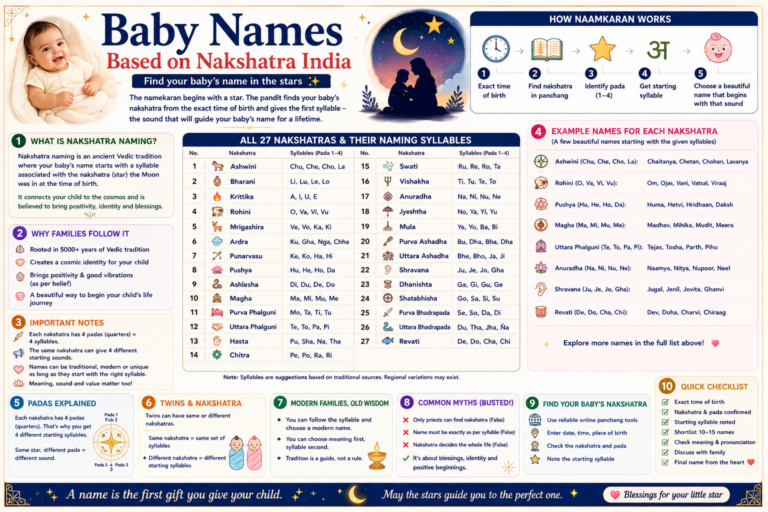
Hindu naming in the Hindi belt generally follows the nakshatra-based naamkaran tradition widely practiced across North India — the child’s name, or its first syllable, determined by the moon’s position at birth, calculated by a family priest using a panchang. This is the system most commonly assumed to be “the” Indian naming tradition by people unfamiliar with regional variation, largely because North Indian Hindi-belt customs dominate a lot of mainstream Indian media and popular culture.
Middle names and surnames in this region often reflect caste or community identity directly — surnames like Sharma, Yadav, Gupta, Singh, or Verma frequently signal specific caste or community backgrounds, a naming layer that carries real social weight in ways that purely first-name traditions elsewhere in India sometimes don’t.
Bihar and Eastern UP often retain a distinctly strong “ghar ka naam” (home name) versus “school ka naam” (formal name) split — a child might be called something entirely different, often an affectionate diminutive, within the family for years, with the formal name reserved for documents and schooling, a pattern that echoes (though with different specifics) similar practices found in Bengal.
Punjab (non-Sikh Hindu families) generally follow similar nakshatra-based patterns to the broader Hindi belt, though with some distinctly Punjabi name endings and sounds — “-preet,” “-jot,” “-veer” — that carry across both Hindu and Sikh Punjabi families regardless of religious naming system differences.
Bengali naming culture is one of the most distinctive in India, built around a formal-informal split that goes deeper than in most other regions.
The “daak naam” (call name) and “bhalo naam” (good/formal name) system means nearly every Bengali child grows up with two genuinely separate names — a daak naam used exclusively within family and close friends (often simple, affectionate, sometimes not even a “real” word — Bublu, Tumpa, Mishti), and a bhalo naam used for school, official documents, and formal introductions, chosen with far more deliberate meaning and often literary or scriptural weight.
The daak naam is often chosen first, sometimes even before birth, by a grandparent or close family member, purely on affection rather than formal ritual — while the bhalo naam frequently involves more consideration, sometimes consulting an astrologer, sometimes drawing from Bengali literature (Tagore’s work is a particularly common naming source), sometimes reflecting a family’s intellectual or cultural aspirations for the child.
Many Bengalis go their entire adult lives being known by their daak naam within family circles even when their professional and legal identity is built entirely around their bhalo naam — a duality that often surprises people from naming traditions without this formal split, and one that Bengali families themselves often don’t think to explain, simply assuming it’s universal.
Tamil naming conventions differ structurally from most of North India in a way that trips up a lot of official paperwork outside Tamil Nadu.
Traditional Tamil names often don’t use family surnames in the North Indian sense. Instead, many Tamil individuals use their father’s first name (or, in some traditional structures, the village/place of origin) as an initial before their own given name — resulting in name structures very different from the “first name + family surname” pattern common elsewhere, and a common source of confusion on forms designed around that assumption.
Traditional Tamil Brahmin naming frequently follows specific religious or astrological guidance, sometimes drawing directly from family deity names or specific nakshatra-linked Tamil naming conventions distinct from the North Indian syllable table, reflecting Tamil Nadu’s own long-standing astrological and religious naming scholarship.
Modern Tamil urban families, particularly in cities like Chennai, increasingly adopt a more standardised “given name + family name” format for practical reasons (passport applications, international travel, school records), even while understanding and using the traditional father’s-initial structure within the family and community context — a genuine example of tradition and modern administrative practicality coexisting side by side rather than one simply replacing the other.
Kerala’s naming structure adds yet another distinct layer, particularly strong in Hindu Malayali and Syrian Christian communities.
The “veedu peru” (house name) tradition — many Kerala families historically identify strongly with their ancestral house/family name, which sometimes appears alongside or before the individual’s given name, reflecting a specific joint-family compound or ancestral property that carries real social and historical weight within the community, especially in Nair and certain other traditional Kerala communities.
A separate “call name” distinct from the formal name is common in many Malayali families, similar in spirit (though not identical in structure) to the Bengali daak naam tradition — a warmer, more casual name used at home, sometimes bearing little resemblance to the formal given name used elsewhere.
Kerala’s exceptionally high literacy rate and strong Malayalam literary tradition has also historically influenced naming — many Malayali names draw specifically from Malayalam literature, mythology, and, in Christian Malayali families, biblical names adapted with distinctly Malayalam pronunciation and spelling conventions unique to the region.
Kula devata (family deity) naming is a particularly strong tradition in many Karnataka Hindu families — children are sometimes named directly after the specific deity worshipped by that family lineage for generations, a practice tying the individual name directly to inherited religious identity rather than to the child’s own birth circumstances (like a nakshatra) at all.
Village or place-name inclusion, similar in spirit to Tamil Nadu’s structure, appears in some traditional Kannadiga naming, particularly in older generations or in specific communities where the ancestral village name is considered an important marker of identity and lineage, though this has become less common in urban, younger-generation naming.
Vachana and Lingayat naming traditions, specific to Karnataka’s significant Lingayat community, sometimes follow distinct naming customs tied to the community’s own devotional and philosophical literary tradition, separate from broader Hindu nakshatra-based practices used elsewhere in the state.
A distinctive and widely followed custom in Telugu-speaking families: the firstborn son is often named after the paternal grandfather, and the firstborn daughter after the paternal grandmother, with subsequent children sometimes named after maternal grandparents — a structured generational naming order that carries real weight in many Telugu families, sometimes creating gentle family tension if parents wish to choose a name outside this expected order.
This tradition means a family’s name choices are often significantly less “free” than in naming systems built purely around personal preference or astrology — the family elder’s name essentially pre-determines a significant portion of the child’s own name before the child is even born, a system some younger, more urban Telugu parents are increasingly renegotiating with their own parents, often landing on a compromise (using the grandparent’s name as a middle name, while choosing a preferred first name freely).
Nakshatra-based naming is also practiced alongside this generational-order custom in many Telugu families, sometimes creating a layered naming process — the “which grandparent” question settled by family custom, and the specific name variant or additional name chosen within nakshatra-appropriate sound guidelines.
Marathi naming generally follows nakshatra-based conventions similar to the broader North and Central Indian pattern, with some distinctly Marathi name endings (“-esh,” “-ita,” “-a” for many feminine names) and a strong tradition of naming children after Maharashtra’s rich saint-poet and historical literary and political tradition (names honouring figures like Shivaji, various saint-poets, and regional cultural icons remain consistently popular).
Gujarati naming often incorporates specific community customs — Gujarat’s diverse religious and community landscape (Jain, Vaishnav Hindu, Patel/Patidar community customs, among others) means naming conventions can vary meaningfully even within the state, with some communities following strict nakshatra guidance and others prioritising family/community-specific naming patterns tied to their particular religious sect or caste community’s own traditions.
Middle names reflecting father’s first name, similar in structural logic (though not identical execution) to some South Indian patterns, also appear in certain traditional Gujarati and Maharashtrian naming formats, particularly on older official documents and in more traditional families, even as younger urban families increasingly move toward simpler two-part given-name-plus-surname structures.
Rajput naming traditions carry particularly strong clan and lineage significance — surnames and titles (Singh, various specific clan names tied to historic Rajput ruling houses) function as significant identity markers connected to centuries of documented family and clan history, distinct from the more religiously-driven naming logic found in many other Indian naming systems.
Royal and historical naming influence remains genuinely present in Rajasthani naming today — names honouring historical Rajput figures, forts, and regional heroes remain popular specifically within Rajasthan in ways not always mirrored elsewhere in India, reflecting the state’s particularly strong regional historical identity and pride.
Rural and traditional Rajasthani communities often maintain strict nakshatra-based first-syllable naming alongside these clan and historical influences, meaning a single child’s full name in a traditional Rajasthani Rajput family can carry multiple layers simultaneously — an astrologically appropriate given name, a clan-linked surname, and sometimes an honorific title, each communicating a different piece of identity.
Sikh naming follows one of India’s most distinctive and spiritually structured naming systems, genuinely different in method from every Hindu regional tradition covered above.
The Vaak/Hukamnama naming process: the Guru Granth Sahib (Sikhism’s central religious text) is opened at random, typically at the gurudwara, and the first letter of the first word on the resulting page becomes the required starting letter for the child’s name — a process called taking the “Vaak” or “Hukamnama,” considered a form of direct divine guidance for the naming decision, structurally similar in spirit to nakshatra naming’s “correct starting syllable” concept but rooted in entirely separate religious practice and text.
Universal surnames: Singh and Kaur. Regardless of family clan or regional background, Sikh naming tradition adds “Singh” (meaning lion) to boys’ names and “Kaur” (meaning princess/lioness) to girls’ names — a deliberate historical practice instituted to eliminate caste distinction from surnames entirely, since caste-linked surnames were traditionally used across much of India to signal social hierarchy, and Sikhism’s founding principles specifically reject caste distinction.
This means two Sikh individuals with completely unrelated family backgrounds can share the exact same full name (a common first name plus Singh or Kaur) without being related at all — a structural feature of the naming system itself, not a coincidence, and one that occasionally causes identification confusion in formal, non-Sikh-community contexts unfamiliar with the tradition.
Muslim naming customs in India draw from Islamic naming principles, with meaningful regional and linguistic variation across the country’s diverse Muslim communities.
Aqiqah naming ceremony, typically performed on the child’s 7th day, often combined with a ritual head-shaving and charitable donation, during which the name is formally announced — names are frequently chosen from Arabic-origin words carrying specific meaning (attributes of Allah, names of prophets, historically significant figures in Islamic history) considered auspicious and meaningful.
Regional linguistic influence remains strong even within Islamic naming conventions — Indian Muslim naming in Kashmir, Kerala (Mappila community), Hyderabad (with its distinct Deccani cultural influence), and Bengal (Bengali Muslim naming) each carry distinct regional pronunciation, spelling conventions, and sometimes locally specific name popularity, even while drawing from broadly similar core Islamic naming principles.
“Bin” and “Binti” or regional equivalents (meaning “son of” and “daughter of”) appear in some traditional naming formats, indicating direct paternal lineage explicitly within the name structure itself, though contemporary Indian Muslim families increasingly use simpler given-name-plus-family-surname formats for everyday and official use, similar to broader modern Indian naming simplification trends across religious communities.
Indian Christian naming reflects the country’s genuinely varied Christian communities, each shaped by different historical missionary influence and regional culture.
Goan Catholic naming often reflects strong Portuguese colonial historical influence — biblical and saint names in Portuguese-influenced spelling and pronunciation remain common, alongside distinctly Goan surnames reflecting this same colonial history, creating a naming culture visibly different from Christian naming conventions elsewhere in India.
Syrian Christian (Kerala) naming blends biblical naming traditions with strong Malayalam linguistic and cultural influence, often incorporating family/house name traditions similar to broader Kerala Hindu naming customs described earlier — reflecting shared regional culture across Kerala’s different religious communities despite differing religious naming theology.
Northeast Indian Christian naming (particularly strong in Nagaland, Mizoram, and Meghalaya, given the large Christian populations in these states) often blends biblical names with tribal naming conventions and specific local-language naming customs, resulting in genuinely distinctive naming patterns not closely mirroring Christian naming traditions found elsewhere in India.
India’s Northeast states carry naming traditions genuinely distinct from the broader Indian naming systems described above, rooted in specific tribal and community customs with far less overlap with mainland Hindu, Muslim, or Sikh naming logic.
Naga naming traditions vary significantly by specific tribe (Angami, Ao, Sumi, and others each carry distinct customs), often incorporating birth order, day of birth, or specific clan naming conventions rather than astrological or purely religious naming logic dominant elsewhere in India.
Khasi naming (Meghalaya) follows a notably matrilineal structure — children traditionally take their mother’s clan name rather than the father’s, a structurally significant difference from the patrilineal surname systems dominant across most of the rest of India, reflecting Khasi society’s broader matrilineal social structure.
Mizo naming often incorporates meaningful Mizo-language given names chosen for their meaning within Mizo culture and Christian biblical influence combined, reflecting the strong Christian presence in Mizoram alongside distinct local linguistic and cultural naming preference.
Assamese naming, while sharing some broader Eastern Indian naming patterns, carries its own distinct Assamese-language naming conventions and community-specific customs, particularly among Assam’s various indigenous and tribal communities alongside the broader Assamese Hindu population.
Across virtually every regional tradition described above, several consistent shifts are visible in modern, particularly urban, Indian naming today:
Shorter, simpler formal names are increasingly common, partly driven by international travel and passport/visa administrative convenience, which favours simpler, more globally pronounceable name structures over longer traditional multi-part names.
Gender-neutral and unisex names are gaining popularity across regional traditions, a notable shift from historically strongly gender-coded naming conventions in most Indian regional systems.
Cross-regional and interfaith naming blending is increasingly common, particularly in metro cities, as inter-community and interfaith marriages become more common and families deliberately choose names that draw meaningfully from both parents’ traditions rather than defaulting entirely to one.
Reduced strict adherence to nakshatra/astrological syllable rules among some urban, less traditionally religious families, though the practice remains very much alive and actively followed by a large proportion of Indian families across virtually every region and religious community covered in this guide.
Traditional naming ceremonies persisting even as name choices modernise — many families maintain the ceremonial and religious naming rituals (naamkaran, aqiqah, Vaak) even while choosing names that reflect more contemporary, sometimes globally-influenced preferences within whatever the ritual’s specific constraints (a starting syllable, a religious meaning requirement) happen to be.
For families navigating two different naming traditions — increasingly common in modern India — a few approaches tend to work well in practice:
Honour one tradition’s ceremonial structure, while drawing the actual name from both. For example, following a Hindu naamkaran ceremony’s ritual structure while choosing a name meaningful to both parents’ cultural backgrounds, rather than treating the ceremony and the name choice as inseparably linked to only one tradition.
Give the child two names, deliberately, similar in spirit to the Bengali daak naam/bhalo naam structure — one name reflecting each parent’s background, used in different contexts, rather than forcing a single compromise name that fully satisfies neither tradition.
Have an honest conversation with both sets of grandparents early, since naming tends to carry deep emotional weight for grandparents specifically, and surprises late in the process (after a name is already chosen) tend to create more friction than an early, respectful conversation about blending both traditions intentionally.
Research the actual meaning and pronunciation across both languages/traditions before finalising, since a name that works beautifully in one linguistic tradition can occasionally carry an unfortunate meaning or difficult pronunciation in the other — worth checking with knowledgeable family members from both sides before settling on a final choice.
India’s naming diversity reflects genuinely distinct regional languages, multiple major religions each with their own naming theology, historical caste and clan structures, and centuries of relatively separate regional cultural development before naming customs began blending in the modern era.
It’s the practice of giving a child two names — a “daak naam” (call name) used affectionately within family and close friends, and a “bhalo naam” (formal/good name) used for school, documents, and formal introduction, a genuinely distinctive structural feature of Bengali naming culture.
Sikh naming tradition deliberately adds “Singh” for boys and “Kaur” for girls to every name, regardless of family background, as a historical practice specifically intended to eliminate caste distinction from surnames, reflecting Sikhism’s founding rejection of caste hierarchy.
Many Telugu-speaking families in Andhra Pradesh and Telangana traditionally name the firstborn son after the paternal grandfather and the firstborn daughter after the paternal grandmother, a structured generational naming custom that carries real weight in many families.
Traditional Tamil naming often uses the father’s first name (or historically, a village/place name) as an initial before the individual’s given name, rather than a fixed family surname passed down generationally in the North Indian sense.
Common approaches include following one tradition’s ceremonial ritual while choosing a name meaningful to both backgrounds, giving the child two names reflecting each parent’s tradition, and having early, honest conversations with both sets of grandparents to blend both traditions intentionally rather than defaulting to one.
No — while strongly associated with North Indian Hindi-belt tradition, nakshatra-based naming (with regional variations) is also widely practiced in Maharashtra, Gujarat, Rajasthan, Telugu-speaking states, and parts of South India, often alongside other regional naming customs specific to those areas.
This guide describes commonly observed regional and community naming traditions across India; specific practices vary significantly by individual family, sub-community, and generation, and not every family within a given region or religion follows every custom described here. For guidance specific to your own family’s tradition, elders and family priests remain the most reliable source.