Physical Address
304 North Cardinal St.
Dorchester Center, MA 02124
Physical Address
304 North Cardinal St.
Dorchester Center, MA 02124

Somewhere between the first “aaa-ooo” and the first birthday, almost every Indian parent starts the same quiet worry: “Sab bacche toh bol rahe hain, mera kyun nahi bol raha?” The neighbour’s daughter was saying full sentences at 18 months. The cousin’s son said “Mumma” at nine months. And your own baby? Still babbling, still pointing, still communicating in a language only you seem to understand.
Here’s the truth that doesn’t get said enough: the range of “normal” for baby talking is wide, and comparing one baby to another is almost never useful. What matters is whether your baby is moving through recognisable stages, not whether they hit a specific word count by a specific date.
This guide walks through exactly when babies typically start talking, what’s normal variation versus what’s a genuine red flag, and — because parenting advice from the West often skips this — what speech delay evaluation and therapy actually look like in India, including realistic costs and where to start.
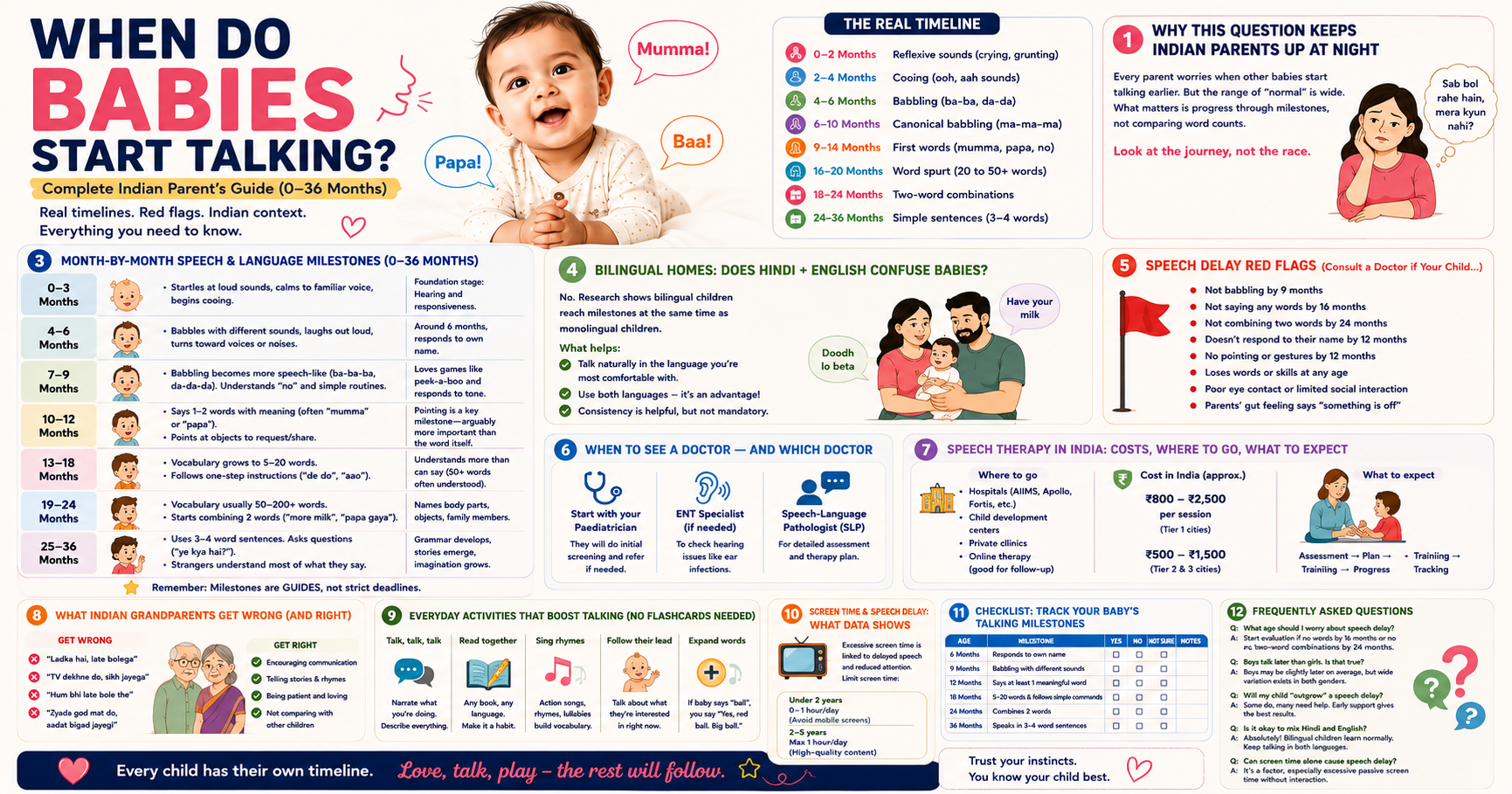
Language development happens in overlapping stages, not a straight line:
Most babies say their first recognisable word somewhere between 9 and 14 months, but plenty of perfectly healthy babies say their first word closer to 16 months. What paediatricians actually watch for isn’t the exact month of the first word — it’s whether pre-verbal communication is developing: babbling with intonation, pointing, eye contact, responding to their name, and understanding more than they can say.
Baby startles at loud sounds, calms to a familiar voice, and begins cooing. This is the foundation stage — hearing and responsiveness matter more than sound production.
Baby babbles with different sounds, laughs out loud, and turns toward voices or noises. Around 6 months, babies typically respond to their own name.
Babbling becomes more speech-like, with strings like “ba-ba-ba” or “da-da-da.” Baby understands “no” and simple routines like waving bye-bye.
Many babies say one or two words with meaning (often “mumma” or “papa,” though not always attached correctly at first). Pointing at objects to request or share interest is a key milestone here — arguably more important than the word itself.
Vocabulary usually grows to somewhere between 5 and 20 words. Baby follows simple one-step instructions (“de do,” “aao”) without gestures. Understanding runs well ahead of speaking — a baby who says only three words but clearly understands 50 is doing fine.
This is often the “word spurt” window. Two-word phrases begin (“more chahiye,” “papa office”). By 24 months, most toddlers have 50+ words and are combining them.
Sentences of 3–4 words become common. Strangers should be able to understand roughly 50–75% of what the child says by age 3. Grammar is still messy and that’s expected.
Important note on this timeline: these ranges reflect commonly cited developmental milestones used by paediatricians and speech-language professionals; they are general benchmarks, not a diagnostic tool. A baby who is a few weeks or even a couple of months “behind” one milestone while ahead on another is usually within normal variation.
This is one of the most common worries in Indian households, especially where a baby hears Hindi from grandparents, English from parents, and maybe a third regional language from domestic help or extended family.
Short answer: no, exposure to multiple languages does not cause speech delay. Bilingual and multilingual babies sometimes show a slightly smaller vocabulary in each individual language early on, but their total vocabulary across both languages is typically comparable to monolingual peers. Mixing words from two languages in one sentence (“mujhe milk chahiye”) is completely normal at this stage and is not a sign of confusion — it’s called code-mixing and most multilingual toddlers grow out of it naturally.
What actually matters more than the number of languages is consistency and quality of interaction — is the baby getting real back-and-forth conversation, or mostly passive exposure through TV or people talking around them rather than to them?
Most late talking resolves on its own. But certain signs are worth flagging to a paediatrician rather than waiting it out, because early intervention makes a measurable difference in outcomes.
By 6 months:
By 9 months:
By 12 months:
By 15–16 months:
By 18 months:
By 24 months:
At any age — regardless of milestone:
A useful rule paediatricians often use: regression is more concerning than delay. A child who is simply slow to start talking but keeps gaining skills is different from a child who had words and lost them — the second scenario always warrants prompt evaluation.
If two or more red flags apply, or if your gut says something feels off even without a textbook red flag, don’t wait for the next scheduled vaccination visit. Trust that instinct — parents notice subtle things long before checklists catch them.
Where to start in the Indian healthcare system:
You do not need a diagnosis in hand to start therapy — many SLPs in India will begin working with a child based on an initial evaluation while a fuller diagnostic workup (if needed) continues in parallel.
This is the part most global parenting content skips entirely, and it’s often what Indian parents actually need to plan for.
Typical costs (approximate, varies significantly by city and clinic):
What a typical program looks like: most children start with 1–2 sessions per week, with a re-evaluation every 8–12 weeks to track progress. Many Indian SLPs also train parents to do short daily practice at home, which meaningfully speeds up progress and reduces the total number of paid sessions needed over time.
Insurance note: speech therapy for developmental delay is not consistently covered under most Indian health insurance policies, though some newer family floater plans are beginning to include limited coverage — it’s worth checking your specific policy rather than assuming either way.
Finding a qualified SLP: look for professionals registered with the Rehabilitation Council of India (RCI) — this is the body that certifies speech-language pathologists in India, and checking RCI registration is a simple way to avoid unqualified practitioners in a largely unregulated private market.
“Ladko mein der se baat hoti hai” (boys talk late) is probably the single most repeated line in Indian households facing a late talker. There’s a kernel of truth in it — research does show boys, on average, reach some early language milestones slightly later than girls — but “slightly later on average” is not the same as “wait and don’t worry,” especially if red flags are present.
Other common but unhelpful advice worth gently pushing back on:
What grandparents often get right: pushing for more real conversation, less “baby talk,” and more time talking to the child directly instead of over their head — that instinct lines up well with what speech-language research actually recommends.
Indian paediatric guidance, in line with international recommendations, generally advises no screen time for children under 18–24 months except video calling with family, and limited, co-viewed screen time after that. The concern isn’t that screens are inherently harmful in small doses — it’s that screen time typically replaces the live back-and-forth interaction that actually builds language, and that background TV reduces the number of words spoken in a room even when a child isn’t actively watching.
If screens are already part of your routine, the most useful change isn’t guilt — it’s shifting toward co-viewing (watching together and talking about what’s happening) rather than solo viewing, and protecting mealtimes and playtime as fully screen-free
Q1. Is it normal for a baby to say nothing until 18 months? It’s on the later end but can still fall within normal range if the baby understands language well, uses gestures, and is otherwise developing typically. It’s worth a paediatrician check-in rather than a wait-and-watch on its own.
Q2. Do bilingual babies talk later than monolingual babies? Not meaningfully, when total vocabulary across both languages is counted. Mixing languages in one sentence is normal, not a delay sign.
Q3. My baby understands everything but says very few words — should I worry? This is actually a reassuring pattern. Strong understanding (receptive language) with slower speaking (expressive language) is common and often catches up on its own, though it’s still worth mentioning at a checkup.
Q4. Are boys really slower to talk than girls? On average, slightly, in some early milestones — but the difference is small and shouldn’t be used to explain away genuine red flags.
Q5. How much does a full speech evaluation cost in India? Typically ₹1,500–₹5,000 privately, often free or low-cost through government or AIIMS-affiliated hospital departments, with longer wait times.
Q6. Can too much screen time actually cause speech delay? It’s more accurate to say screen time displaces the interaction that builds speech, rather than screens directly causing delay. Reducing screen time and increasing conversation almost always helps regardless of the underlying cause.
Q7. What’s the single biggest red flag parents miss? Regression — losing words or skills the child previously had — is more concerning than simply being “late,” and it’s the one sign that should never be watched-and-waited on.
This article is for general information and does not replace professional medical or speech-language evaluation. If you have concerns about your child’s development, please consult a paediatrician or a Rehabilitation Council of India (RCI)-registered speech-language pathologist.