Physical Address
304 North Cardinal St.
Dorchester Center, MA 02124
Physical Address
304 North Cardinal St.
Dorchester Center, MA 02124

Dropping your child off at daycare every morning takes a certain kind of trust. You hand over your most important person to someone else for eight or nine hours and go live your life, trying not to check your phone every twenty minutes.
Most days, that trust holds. But then something shifts.
Your normally cheerful toddler becomes clingy. Your easy-going three-year-old starts having meltdowns at 5 p.m. Your baby comes home fussy and exhausted, not like tired-from-playing exhausted, but quiet and small in a way that unsettles you.
You start wondering: Is my child unhappy at daycare? Or is this just what kids do?
That question matters more than most parenting sites give it credit for. Because here is the truth — the signs your child is unhappy at daycare can look almost identical to normal adjustment symptoms. And knowing the difference could protect your child.
This guide is the most thorough, parent-first breakdown of daycare unhappiness signs available. You will learn which behaviors are normal for the adjustment period, which are genuine warning signs that need attention, and which are serious red flags that require immediate action. You will also get a clear, step-by-step plan for what to do in each case.
Before we get into the signs your child is unhappy at daycare, you need to understand one thing: a certain amount of distress at the start of daycare is completely normal and developmentally healthy.
Children are hardwired to prefer their primary caregivers. Crying at drop-off, clinging, fussing, even mild tantrums in the first few weeks — these are signs of healthy attachment, not signs that the daycare is failing your child or that your child is unhappy at daycare in a meaningful way.
So how long is the adjustment period supposed to last?
Education and development specialists say it varies widely by child. Some children settle in within just a few days. Others need several weeks to feel fully comfortable in a new environment. The general guideline most childcare professionals use is four to six weeks for most children to complete the primary adjustment phase.
The key word is progress. Normal adjustment looks like gradual improvement — fewer tears this week than last week, a bit more willingness to engage by week three, coming home with at least one story about their day by week four. It is not a straight line. There will be good days and setback days. But the overall direction should be forward.
When the overall direction is not forward — when things are not improving or are actively getting worse after six weeks — that is when you start looking more carefully at the signs your child is unhappy at daycare.
There is also a second category of concern that has nothing to do with adjustment: children who were previously settled at daycare and then suddenly show signs of distress. If your child has attended the same center happily for months and then starts showing the behaviors listed below, the adjustment explanation does not apply. Something has changed, and it is worth finding out what.
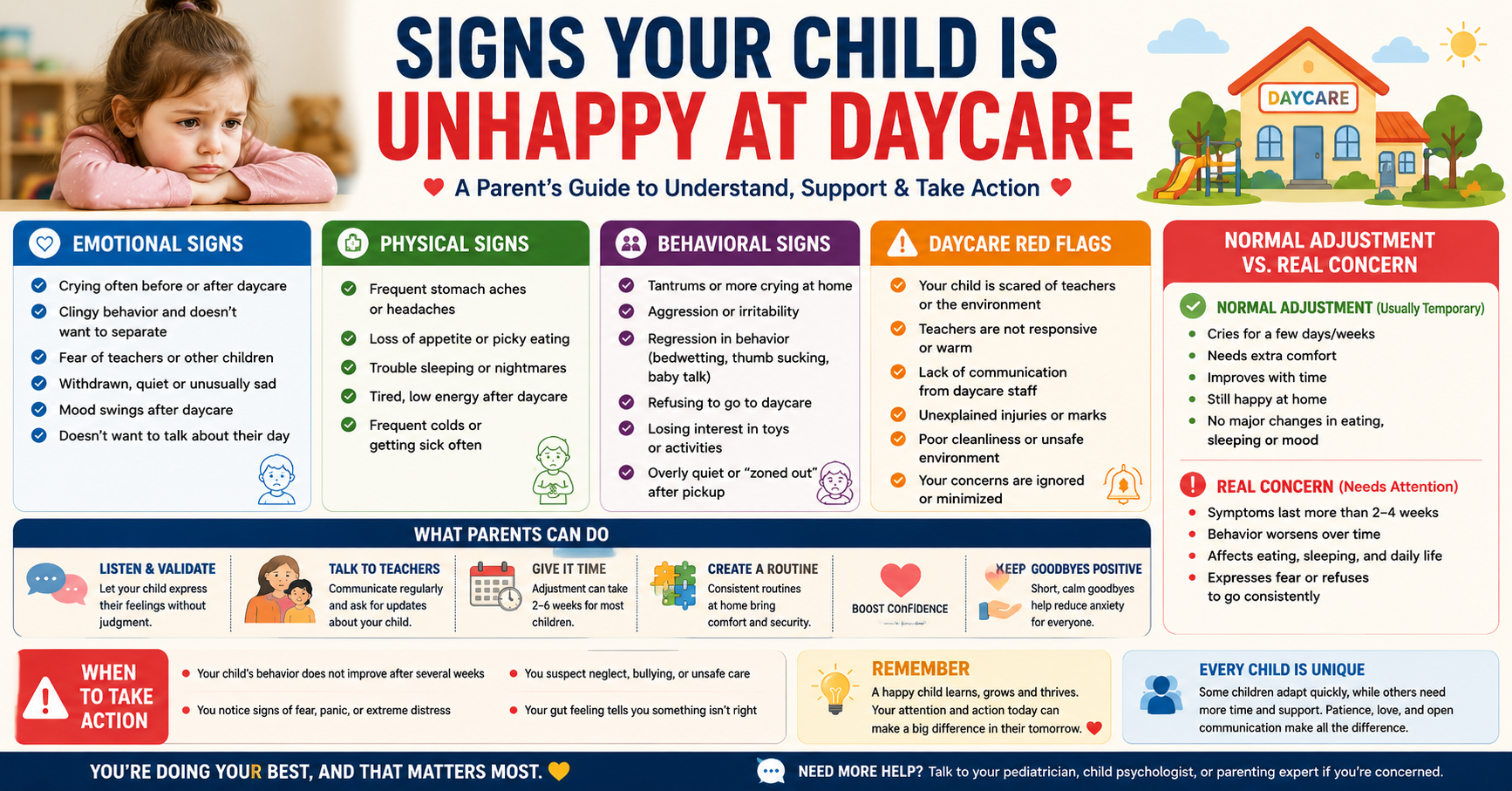
These fifteen signs are organized by category so you can quickly identify which area of your child’s behavior has changed. Not every sign in isolation is cause for panic. But when you see two, three, or four of them appearing together — or when any one of them is severe or sudden — pay close attention.
Some crying at drop-off is normal, especially in the first month. But if your child is still sobbing every single morning after six to eight weeks of attendance, that persistence is one of the clearest signs your child is unhappy at daycare.
The difference between adjustment tears and unhappy tears is this: adjustment tears typically get shorter and less intense over time. Unhappy tears stay the same or get worse. Your child may start crying before you even reach the parking lot, crying because they recognize where they are going.
Note: it is also possible for a child to be genuinely unhappy but not cry — because some children internalize distress instead of expressing it outwardly. The absence of tears does not automatically mean everything is fine.
This one stops parents in their tracks. You have a happy, curious, communicative child. Then daycare begins. And that child seems to disappear.
When a normally happy and energetic child suddenly becomes withdrawn, sullen, irritable, or emotionally flat after starting childcare, that personality shift is a significant sign your child is unhappy at daycare. This is not the usual tired-after-a-busy-day behavior. It is a deeper, more consistent change in who your child seems to be.
Trust your knowledge of your child. You know them better than any teacher or director does. If something feels off in a way that you cannot explain away, take it seriously.
A spike in aggressive behavior — hitting, biting, throwing things, screaming fits — after starting daycare can be a sign of stress that your child does not have the vocabulary to express any other way.
Some increase in assertive behavior is normal as toddlers learn to navigate group settings. But if the aggression is significant, uncharacteristic for your child, or specifically triggered by anything related to daycare — getting ready in the morning, hearing the word daycare, driving past the building — it is one of the signs your child is unhappy at daycare that deserves investigation.
If your child was relatively independent and is now refusing to let you out of sight, has separation anxiety at places they were previously fine — like dropping at grandma’s house, the park, anywhere other than home — that generalized anxiety often points to a sense of insecurity that began at daycare.
Children who feel unsafe in one environment sometimes become anxious about all separations because their trust in “I will be okay when my parent leaves” has been shaken. Persistent and worsening clinginess well past the adjustment window is one of the common signs your child is unhappy at daycare.
Regression means a child starts doing something they had already stopped doing, or stops doing something they had already learned. Common regression signs include:
Regression is how children respond to stress when they lack other coping tools. It is their way of going back to something that felt safe. While regression can happen for many reasons — a new sibling, a move, illness — when it lines up with starting or continuing at a particular daycare, it is worth paying attention to.
Children eat well when they feel comfortable and safe. When they are anxious or unhappy, appetite is one of the first things affected.
If your child is consistently coming home and devouring food as if they have not eaten all day, or if the daycare is regularly returning their lunch box uneaten, that is a physical sign your child is unhappy at daycare. It may mean they are too distressed to eat during the day, or that the mealtime environment itself is stressful.
Ask the daycare directly: how much did my child eat today? Good centers track this. If they do not know — or the answer is consistently very little — follow up.
Sleep is where children process the day. When something at daycare is causing stress, children often carry it into the night.
Watch for:
These sleep disruptions are among the physical signs your child is unhappy at daycare, and they are especially telling when they correlate specifically with daycare days versus non-daycare days. If your child sleeps fine on weekends and wakes up frightened on Sunday nights — the night before daycare — that pattern speaks clearly.
“My tummy hurts.” “I don’t feel good.” “My head hurts.”
Children who are emotionally distressed often experience real physical symptoms. The connection between anxiety and gastrointestinal distress is well documented — children actually do get stomach aches from stress. The pattern to watch for is complaints that appear specifically on daycare mornings, improve on daycare-free days, and have no identifiable medical cause.
This is not to say you should dismiss physical complaints. Always check for medical causes first. But if the doctor finds nothing and the pattern keeps pointing to daycare mornings, that is one of the subtler signs your child is unhappy at daycare that is easy to miss.
Unexplained bruises, marks, or skin irritation that no one told you about are a separate category of concern. Coming home in the same wet or soiled clothes they were in at drop-off, or visibly unkempt in ways the center did not mention, points to a supervision or care quality issue.
If your child is frequently coming home without the diaper changes they need, without food, or with unexplained physical marks — these are serious physical signs your child is unhappy at daycare and may indicate neglect. Read the previous post in this series on daycare incident reports if you find unexplained injuries.
Most children, even shy ones, have something to say about their day. They mention a friend, a toy they played with, something they ate. When a child consistently shuts down, gives one-word answers, or actively changes the subject whenever daycare comes up — that deliberate silence is a sign.
It does not necessarily mean something terrible is happening. Some children are private about negative experiences. But when a child who used to share suddenly goes quiet specifically about the place they spend most of their waking hours, you listen to that silence.
Try open-ended questions on neutral ground — in the bath, at dinner, before bed. Not “did you have a good day?” but “tell me something that happened today.” Or “who did you sit next to at lunch?” Low-pressure, specific, and conversational.
Happy children at daycare talk about the people there. They mention the teacher by name. They come home excited to tell you about a friend they played with. They repeat something funny a caregiver said.
If after several weeks your child cannot — or will not — name a single person they like, play with, or talk to at daycare, that social disconnection is one of the signs your child is unhappy at daycare. Children thrive on connection. The absence of any positive relationships at a place they spend this much time tells you something important.
This one is direct and serious. If your child says things like:
Take it at face value. Young children do not have the social sophistication to fabricate grievances against caregivers. They may lack exact words, but when a child expresses specific fear of a specific person or area of the daycare — that is a sign your child is unhappy at daycare that you must investigate without delay.
Ask follow-up questions gently. Do not put words in their mouth. Write down exactly what they said, when they said it, and the context. This documentation matters if you need to escalate later.
Watch how your child plays. Children process their experiences through play. If your child is repeatedly acting out scenarios that involve being hurt, yelled at, shut in a room, or harmed by a caregiver figure — even with toys and dolls — that is their way of telling you something they cannot say in words.
This is especially true for children under age four, who use imaginative play as their primary language for emotional processing. A child who replays a caregiver being rough, or a scenario where another child hurts them while no adult helps — that play is communication.
There is a difference between not wanting to say goodbye to a parent, and not wanting to enter the building itself. Most children who are happy at daycare will resist the goodbye but walk in willingly once inside. A child who is genuinely unhappy at daycare may plant their feet, grab the door frame, physically refuse to go inside, or go limp — every single day, long after adjustment should be complete.
Combined with any of the other signs listed here, physical refusal to enter is one of the clearer physical demonstrations that something is wrong in that environment for your child.
Most parents expect their child to be happy when picked up. But here is something that surprises many parents: some children cry when the parent arrives, not because they are happy to see them, but because the reunion triggers the release of all the distress they held in all day.
Alternatively, some children at genuinely troubled daycares come out at pickup looking flat, vacant, or emotionally dulled. They are not sleepy-tired. They are emotionally depleted in a way that feels different. If your gut tells you something is off in how your child looks at pickup — that your child seems like someone who has been managing something difficult all day — trust that instinct.
This is the comparison that almost no parenting site provides. Use this every time you are unsure.
| Behavior | Normal Adjustment | Genuine Concern |
|---|---|---|
| Crying at drop-off | First 2–4 weeks, improves over time | 6+ weeks, same intensity or worse |
| Clinginess | First few weeks, fades gradually | Worsens over time, generalizes to other places |
| Sleep disruption | Brief, first few weeks | Persistent, especially on daycare nights |
| Not eating | First few days of starting | Ongoing, consistently uneaten lunches |
| Regression | Brief, mild, improves with reassurance | Significant, worsening, or accompanied by fear |
| Quiet after pickup | Tired from active day | Emotionally flat, won’t engage, flinches |
| Not naming friends | First 2–3 weeks of adjustment | After 6+ weeks, still no positive relationships |
| Physical complaints | Occasional, no pattern | Every daycare morning, improves on days off |
| Mood changes | Adjusting to new routine | Personality shift, not recognizing your child |
There is one level beyond “unhappy at daycare.” It is the level where unhappiness may indicate something is actively wrong — neglect, abuse, or a genuinely unsafe environment.
These are not signs to monitor. These are signs to act on immediately.
Act the same day if you notice:
If you see these signs, document immediately. Photograph. Write everything down. Seek a pediatric evaluation if there are physical signs. Contact your state’s childcare licensing authority to file a report. You do not need to be certain. You need to report what you observe and let an investigator determine what is happening.
The Childhelp National Child Abuse Hotline (1-800-422-4453) is available 24 hours a day if you need guidance on next steps.
Seeing signs your child is unhappy at daycare does not automatically mean you need to pull them out or call an attorney. It means you follow a process. Here is the right sequence.
Step 1: Observe Without Reacting Immediately
Keep a one-week mental note or written log of specific behaviors, when they occur, and what was happening immediately before. Pattern recognition matters more than any single incident.
Step 2: Talk to Your Child in Low-Pressure Moments
Not at drop-off. Not right at pickup when everyone is in transition. Choose bath time, a walk, or bedtime. Use open-ended questions. “Tell me something that happened at school today.” “What do you do when you feel sad there?” Write down exact quotes. Children’s words matter.
Step 3: Do an Unannounced Visit
Most licensed daycares are required by law to allow parents to visit during operating hours without notice. Arrive at a random midday time. Observe how your child is interacting. Watch how staff responds to children. Look at the physical environment. What you see in ten minutes when they are not expecting you tells you more than a scheduled tour.
Step 4: Request a Meeting With the Director
Bring specific observations — not accusations. “I have noticed my daughter has not been eating her lunch and is waking up at night. I would like to understand what her day looks like.” Come with specific questions written down. A good center will take your concerns seriously and follow up with concrete responses.
Step 5: Request a Temporary Schedule Adjustment
Sometimes reducing hours or days temporarily helps a struggling child while you gather more information. Discuss this with the director. Watch whether a lighter schedule changes your child’s behavior at home.
Step 6: Check the Daycare’s Inspection Records
Every licensed daycare has a licensing file with your state. Most states publish inspection reports and violations online. Search “[your state] childcare licensing lookup” to find your center’s record. Patterns of safety violations or supervision deficiencies are important context for what your child may be experiencing.
Step 7: Trust Your Decision
If after these steps you still feel that your child is genuinely unhappy at daycare and the center is not making it better — you are allowed to leave. You are the parent. You do not need permission, justification, or a dramatic incident to decide that a particular environment is not right for your child. Some daycares are simply a poor fit. That is a legitimate reason to find another one.
Because it is just as important to recognize things are going well, here are the signs that your child is genuinely thriving at daycare:
These are the signs of a child who is comfortable, safe, and growing. When you see them consistently, breathe. The daycare is doing right by your child.
One reason parents stay silent too long is fear of creating conflict. They do not want to be “that parent.” They worry the staff will take it out on the child. Here is what actually works.
Lead with observation, not accusation. “I’ve noticed” is a different conversation opener than “I think you’re.” It invites collaboration instead of defensiveness.
Ask questions before drawing conclusions. “Can you walk me through what her day looks like when she seems off?” opens the door. “Why isn’t anyone watching her?” closes it.
Put your concerns in writing. An email to the director creates a paper trail, gives the center a chance to respond thoughtfully, and creates a record of whether they follow up. This is not threatening — it is professional.
Gauge the response. A good center responds to parental concerns with genuine engagement, specific answers, and follow-through. A center that gets defensive, dismisses your observations, or gives vague reassurances without action is showing you how it operates.
If after raising your concerns the daycare becomes less communicative or you feel your child’s treatment has changed — those reactions are themselves data about whether this is a safe and trustworthy environment.
The main difference between adjustment and genuine unhappiness is the direction things are moving. Normal adjustment gradually improves over four to six weeks — less crying, more settling, growing engagement with the environment. Genuine unhappiness either stays the same or gets worse over time, often paired with behavioral changes at home like sleep problems, regression, or personality shifts. If your child has been at daycare for more than six weeks and is showing multiple signs listed in this guide, their distress goes beyond normal adjustment.
Most children complete the primary adjustment phase within four to six weeks. Education specialists note that individual differences are significant — some children settle in a few days, while others need several weeks. The key marker is progress, not perfection. By weeks five or six, most children who are in a genuinely good-fit environment show meaningful improvement, even if drop-offs are still sometimes difficult.
Not necessarily. Crying at drop-off is common even in children who are ultimately happy at daycare, especially in the early weeks. The question is whether the crying is improving over time and whether your child appears genuinely engaged and content during the day. If the daycare confirms your child settles quickly after you leave, is eating and napping normally, and interacts well with caregivers and peers, the drop-off tears may be purely about the goodbye — not about what comes after. If the center cannot confirm your child is okay during the day, or if you are seeing the other signs of daycare unhappiness at home, that is a different situation.
Signs of daycare neglect include: coming home hungry despite being there all day, unchanged diapers or clothes, unexplained physical marks, developmental regression, a child who seems fearful or withdrawn in ways that are out of character, and caregivers who do not know basic things about your child’s day. Neglect differs from abuse in that it is often about what is not happening — not enough supervision, not enough attention, not enough basic care — but its effects on a child are equally damaging.
Signs that may indicate daycare abuse include: specific, consistent fear of a particular staff member; sexual knowledge or behaviors inappropriate for the child’s age; unexplained physical injuries inconsistent with the given explanation; severe regression; and play that recreates violent or frightening scenarios involving caregiver figures. If you observe these signs, seek a pediatric evaluation and contact your state childcare licensing authority immediately. You can also reach the Childhelp National Child Abuse Hotline at 1-800-422-4453.
Toddlers cannot tell you directly, but they communicate through behavior. Watch for frequent hunger at pickup, unchanged diapers, persistent diaper rash indicating infrequent changes, weight not progressing appropriately, a child who seems emotionally flat or disengaged during the day, and caregivers who cannot describe what your child did during the day. Drop by unannounced and observe. Ask specifically about how often your child’s diaper was changed, what they ate, and whether they napped. Consistent gaps in basic care are signs of neglect.
Consider changing daycares when: the director is consistently dismissive of your concerns; you have raised specific issues and seen no follow-through; your child’s distress is not improving after a genuine adjustment period; you observe the serious red flags listed in this guide; you find licensing violations or inspection failures in the center’s public record; or your instinct as a parent persistently tells you something is wrong even when you cannot articulate what. You do not need a dramatic incident to leave. A poor fit — even without any abuse or neglect — is a valid reason to find a better environment for your child.
Occasional setbacks and hard mornings are normal throughout the daycare years, not just at the start. But sustained daily crying for months without any improvement is not within the normal adjustment range. At that point, it is worth a more thorough evaluation: Is this particular environment right for this particular child? Is the child-to-caregiver ratio low enough that your child is getting enough individual attention? Is there something specific about the environment, the routine, or a relationship that is not working? The goal of daycare is not for your child to endure it. It should be a place where they learn, grow, and — on most days — genuinely feel good.
Watching your child struggle and not being sure why is one of the hardest things about parenthood. You cannot be there to see it for yourself. You are relying on your child’s signals, your gut, and whatever the daycare tells you.
Here is what you need to remember:
You are not being paranoid for paying attention. You are not being “that parent” for asking questions. You are not overreacting for trusting your instincts when your child’s behavior changes.
The signs your child is unhappy at daycare are not always obvious. Sometimes they are subtle and slow-building. Sometimes they look just enough like “adjustment” that you keep waiting for things to get better. But you know your child. You know what they look like when something is wrong.
Use this guide. Document what you see. Ask questions. Drop by unannounced. And if the answer you get does not satisfy you — if the daycare you are trusting with your child cannot give you confidence that they are safe, cared for, and okay — you are allowed to find one that can.