Physical Address
304 North Cardinal St.
Dorchester Center, MA 02124
Physical Address
304 North Cardinal St.
Dorchester Center, MA 02124

You walk into daycare at 5:30 p.m., arms full, brain still half at the office. Your child’s teacher waves you over and hands you a piece of paper.
“We had a small incident today. Can you sign here?”
Your stomach drops.
Daycare incident report.
In that moment, most parents do one of two things. They panic and wonder if something terrible happened. Or they sign quickly without really reading it, trusting that “small” means nothing serious.
Both responses can get you into trouble.
The truth is, a daycare incident report is one of the most important pieces of paper your child’s care center will ever hand you — and almost no one teaches parents how to actually read one. Most of the content out there on this topic is written for daycare directors, not for moms and dads standing at the pickup door with a racing heart.
This guide is written entirely for you, the parent.
By the time you finish reading, you will know exactly what a daycare incident report is, what must be in it by law, how to spot red flags that actually warrant concern, and what steps to take if something feels wrong. You will also know when to stay calm — because most of the time, a report is a sign that the daycare is doing its job correctly.
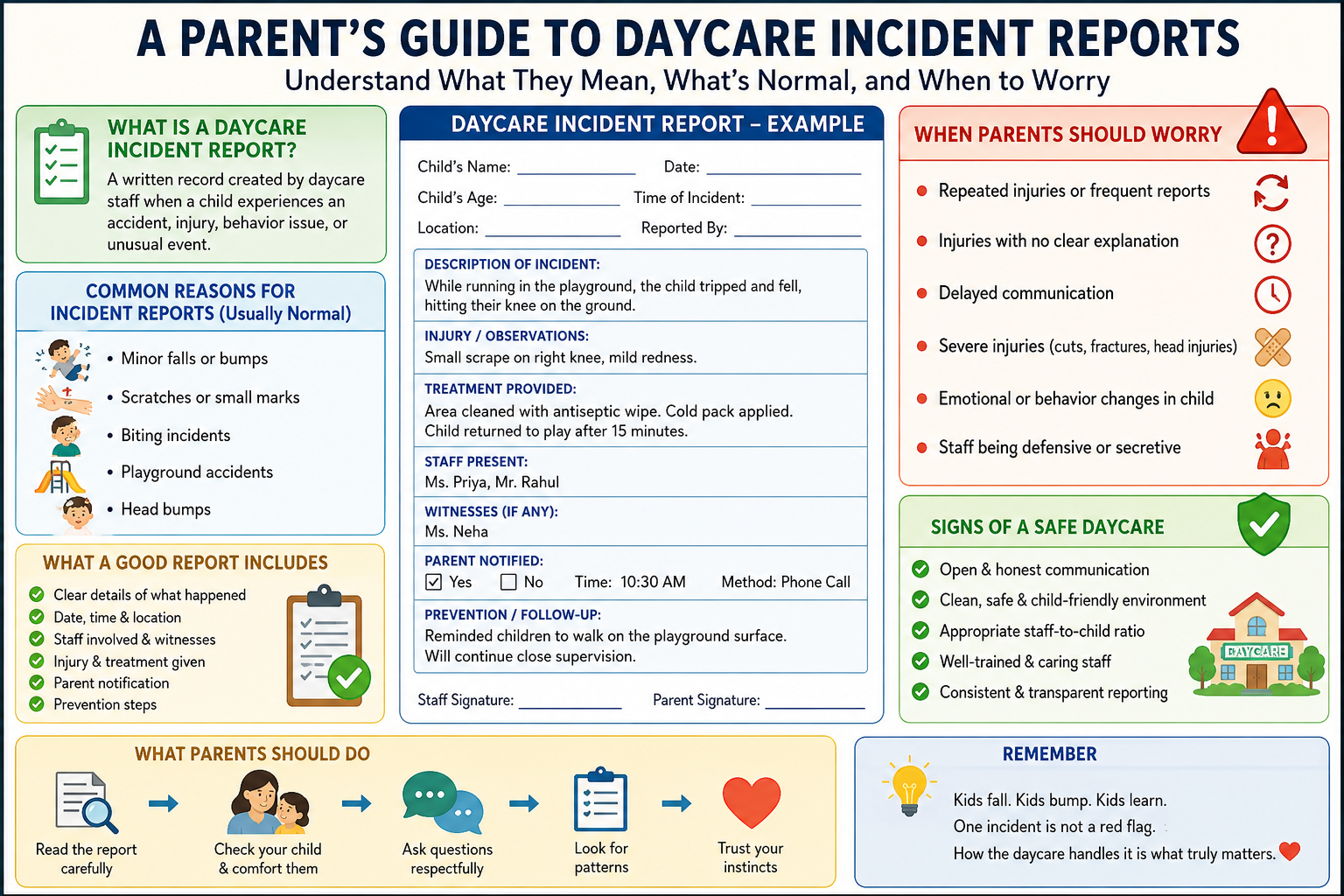
A daycare incident report is a formal written document that records any accident, injury, illness, behavioral event, or unexpected situation involving your child while they are at the childcare center.
Think of it as a written record of a moment in time. It captures what happened, where it happened, who was involved, what care was given, and how you — the parent — were notified.
A childcare incident report is required in most U.S. states any time a child needs to stop their normal activity to receive first aid or medical care. But good daycares use them even for minor events, because documentation builds trust and protects everyone — including your child.
Here is the important mindset shift most parents need:
A daycare that hands you an incident report is doing the right thing. A daycare that never gives you one — even when your child comes home with a bruise or a bump — is the one you should worry about.
Good documentation is a sign of a responsible, transparent facility. The absence of documentation is a red flag.
According to the U.S. Consumer Product Safety Commission, an average of over 190,000 playground equipment-related injuries required emergency room visits each year between 2021 and 2023. Falls are the number one cause of injuries in young children in care settings. In an environment where kids are running, climbing, pushing, and learning — incidents happen. What matters is that the center catches them, reports them, and tells you.
A daycare accident report should be filed any time one of these situations occurs:
Most states require the report to be completed on the same day the incident occurs. Some states allow up to 24 hours for incidents involving emergency transport. The key word is same day — fresh, accurate, and timely.
This is the section most parenting sites completely skip. They tell you a report is important. They do not tell you what to actually look for when you hold one in your hand.
Here is what every proper daycare incident report must contain. Use this as your personal checklist every single time.
Good reports use specific language. A proper childcare incident report says: “Child fell while running on the outdoor play surface at 10:12 a.m. Small abrasion noted on left knee. Skin not broken. Child cried for approximately two minutes.”
A poor report says: “Child fell outside. Knee was scraped.”
The difference matters — especially months later if questions arise.
This section is critical. If there is a significant gap between when the incident occurred and when you were called, that gap needs an explanation.
You have the right to note disagreements on the form before signing. You can write “Received and reviewed — questions pending” if you have concerns.
Always get your own copy. Never hand back the only copy.
Every daycare injury report is not created equal. The emotional instinct of “something happened to my child” can cause parents to either overreact to routine events or, just as dangerously, underreact to genuinely concerning ones.
Here is a practical way to think about the level of concern a report warrants.
These are normal childhood mishaps in an active environment. Getting a daycare accident report for these events is simply proof the center is documenting properly.
What to do: Read it carefully, ask one or two clarifying questions if needed, sign it, keep your copy, and watch your child at home. Most kids bounce back fast.
These situations are not emergencies but deserve your attention and a follow-up.
What to do: Request a time to speak directly with the room teacher and the director. Bring your copy. Ask specific questions calmly and write down the answers. A good daycare will appreciate the engagement.
These situations require you to act, document independently, and potentially contact licensing authorities.
What to do: Seek medical attention first. Document the injury yourself — take photos with a timestamp. Write your own account of everything you were told and when. Then contact your state’s childcare licensing agency to file a report.
This is the section that exists nowhere else — specifically written for parents who have received a daycare incident report and something in their gut is telling them the story is not complete.
These nine red flags are drawn from real patterns that parents, licensing officials, and childcare injury attorneys see repeatedly.
Look at two times on the report: when the incident occurred, and when you were notified. In most states, serious injuries require immediate notification. Minor injuries require same-day notification.
If your child had a head injury at 9:30 a.m. and no one called until 4:45 p.m. pickup, that is not a coincidence. It may mean the staff did not recognize the severity, violated protocol, or was hoping the incident would go unnoticed.
Compare these two descriptions:
“Child was playing and got hurt.” — Protecting the facility
“Child was running on the blacktop near the east fence and fell at 2:15 p.m., landing on both hands and left knee. No equipment involved. Staff member Jones was supervising from the bench approximately 10 feet away.” — Proper documentation
Vague language in a childcare incident report is not just poor writing. It can be a deliberate way of obscuring what actually happened and who was responsible.
You receive the written report. The teacher tells you something slightly different verbally. And then when you ask your child casually — “What happened today?” — they tell you something different again.
Inconsistency across those three accounts is a serious red flag. In particular, if the report blames the child’s own clumsiness but your child says another child pushed them, or a staff member was rough with them — that discrepancy must be investigated.
This one requires you to trust your eyes. A “small tumble on the carpet” that produces a bruise the size of your palm on your child’s back is not consistent. A “bump against the table” that leaves a mark shaped like fingers is not consistent.
If the physical injury does not make sense with the written explanation, document what you see and seek medical attention. A doctor can sometimes identify whether an injury pattern is consistent with the claimed cause.
Every daycare incident report should list the name of at least one staff member who witnessed or responded to the event. If the report contains phrases like “no one saw it happen” or the witness section is blank — especially for an injury that required first aid — that is a supervision failure.
It may also indicate the staff member was not present in an appropriate supervisory position when the injury occurred.
One incident is normal. Two over a month is worth watching. Three or more involving your specific child in a short window — or a pattern of multiple incidents involving different children in the same room — signals a systemic problem.
That problem could be understaffing, an unsafe physical environment, inadequate staff training, or poor supervision practices. Ask for a meeting. Ask what has changed. Ask what the child-to-staff ratio is in that room.
This is your right. In virtually every U.S. state, parents are legally entitled to receive a copy of any daycare incident report involving their child. Some states additionally require that parents receive the report on the same day.
If a staff member tells you the report is “internal only,” “for our files,” or asks you to sign it before you can read it — do not comply. Ask again in writing via email. If they still refuse, contact your state childcare licensing agency.
There is no ambiguity here. If your child comes home with a visible bruise, burn, welt, or cut that you did not know about — and no one mentioned it, and no daycare accident report exists — that is not an oversight.
That is either a failure of supervision (they did not notice the injury happened) or a failure of honesty (they knew and chose not to tell you). Neither is acceptable.
This one is not on the report. It is in your child’s behavior. If your child suddenly resists going to daycare, cries more than usual at drop-off, shows regression in potty training or sleep, or becomes withdrawn and quiet in ways that feel different — pay attention.
Combine behavioral changes with any inconsistencies in an incident report, and you have reason to investigate further. Children who lack words will often communicate distress through behavior long before they can explain what happened to them.
Getting a daycare injury report does not automatically mean you need to pull your child from care. What it means is that you need to follow a clear, calm process every single time. Here is the exact sequence.
Step 1: Read It Right There, Before You Sign
Do not sign at the door while managing your bag and your toddler. Ask for two minutes to read it properly. Most teachers will understand. If they seem impatient, that itself tells you something.
Read every section. Check the timeline. Check who is listed as a witness. Check what prevention steps are promised.
Step 2: Ask Clarifying Questions on the Spot
Simple questions are completely appropriate: “Where exactly were they when this happened?” “Which staff member was supervising?” “What time did you call me?” Write the answers down on your phone or a notepad. Not because you’re building a case — because memory fades.
Step 3: Talk to Your Child (Age-Appropriately)
Later, not right at pickup. Let them settle. Then ask open-ended questions: “Tell me about your day today.” “Did anything hurt today?” “What was the most surprising thing that happened?” Let them lead. Do not say “your teacher said you fell — is that what happened?” That plants the answer.
Step 4: Look at the Injury Yourself
Examine the actual physical injury. Does its size, shape, and location match the written description? Take a photo if anything feels inconsistent. Timestamp it.
Step 5: Keep Your Copy Filed
Put that report somewhere safe. If you ever need to file a complaint, take legal action, or simply track a pattern, having the originals matters.
Step 6: Follow Up with the Director if Needed
If any of the yellow or red flags from the previous section are present, request a formal meeting with the director — not just the teacher. Come prepared with your copy of the report and your specific questions written out.
Step 7: Contact Licensing if Something is Wrong
Every U.S. state has a childcare licensing division. A simple Google search for “[your state] childcare licensing complaint” will find the right agency. Filing a report does not automatically close the daycare. It triggers an investigation. You can file anonymously. You have every right to do it.
When you are looking for a daycare — or evaluating the one your child already attends — the way they handle daycare incident reports is one of the most revealing things you can observe.
Ask these questions during a tour or at enrollment:
A facility that answers confidently and transparently is a green flag. A facility that gets defensive, vague, or dismissive of these questions is not.
Good incident reporting does not mean more bad things happen at a daycare. It means they are honest about the fact that kids get bumps, and they take their documentation responsibilities seriously.
Centers that train their staff well in communication — not just childcare techniques — see measurable reductions in parent concerns and conflicts. A daycare accident report delivered clearly and promptly, with empathy and a specific explanation, builds trust. The same event handled with vagueness and deflection destroys it.
Most parents do not know that they have legal rights in this area. Here is what you should know.
You have the right to receive a copy. In the vast majority of states, childcare facilities are legally required to give parents a copy of any daycare incident report involving their child on the same day it occurs or within 24 hours.
You have the right to read it before signing. Your signature acknowledges receipt — not agreement. You can add notes or disagreements before signing.
You have the right to request past reports. If you are concerned about a pattern, you can ask the center for copies of all incident reports involving your child going back to enrollment. Most states require these to be retained for one to three years.
You have the right to file a licensing complaint. If the daycare repeatedly fails to report incidents, gives you incomplete reports, refuses copies, or you have reason to believe your child was harmed without disclosure — you can and should file a complaint with your state licensing authority.
You do not need a lawyer to do any of this. Contact the licensing agency first. They have investigators. The process is free.
Print this out or save it to your phone. Use it every single time.
The Basics
The Incident Description
The Response
Parent Notification
Prevention
Signatures
Your Own Checks
A proper daycare incident report must include the child’s full name, exact date and time of the incident, precise location within the facility, a factual description of what happened, injury details, the first aid or care provided, the name of the staff member who witnessed it, the time and method of parent notification, prevention steps, and signatures from staff, the director, and the parent. Any report missing these elements is incomplete.
Not automatically, no. Receiving a childcare incident report for a minor scrape, bump, or toddler conflict is actually a sign the daycare is doing its job — documenting properly and communicating openly. Worry is warranted if the report is vague, the timing does not add up, the story is inconsistent, your child seems frightened, or you find injuries that were not reported.
Yes, in most U.S. states. Childcare licensing laws in the majority of states require daycares to complete a daycare incident report and provide parents with a copy on the same day the incident occurs, or within 24 hours in cases involving emergency transport. Check your specific state’s childcare licensing requirements for the exact rules that apply in your area.
First, ask directly and in writing — email or text creates a paper trail. If the daycare still refuses, contact your state’s childcare licensing agency to file a complaint. Repeated failure to provide incident documentation is a licensing violation in most states and may indicate the facility is hiding unsafe conditions or events.
There is no universal number, but frequency matters. One report over several months for an active child is entirely normal. Two or three reports involving similar incidents in a short window — or multiple reports about different children in the same room — suggests a pattern that warrants a direct conversation with the director. Ask specifically: what has changed to address this?
The biggest red flags in a daycare incident report include: vague or blame-shifting language, a significant delay between incident time and parent notification, inconsistency between the written account and what your child says, injuries that do not match the described cause, missing witness information, no listed prevention steps, and — most critically — receiving no report at all despite finding an injury on your child.
You can choose not to sign, but it is usually more useful to sign with notes. Your signature means “I received and reviewed this document” — it does not mean you agree with everything written. You can write “Received — questions pending” or note a specific disagreement before you sign. Always keep your copy.
Take a photo of the injury immediately with a timestamp. Then contact the daycare in writing — text or email — asking specifically: “I noticed [describe injury] on my child today. Can you tell me what happened and where the incident report is?” Document the response. If no adequate explanation is given and no report is produced, contact your state childcare licensing authority.
childcare licensing complaint” online. Every state has a licensing agency that handles complaints about licensed care facilities. You can typically file online, by phone, or by mail. Most agencies allow anonymous complaints. A complaint triggers an investigation — it does not automatically close or penalize the facility, but it creates an official record.
echnically, these terms refer to the same document in most childcare contexts. A daycare accident report is often used to describe reports involving physical injuries or accidents specifically. A daycare incident report is a broader term that covers injuries, illnesses, behavioral events, supervision lapses, and any other significant event. In practice, most facilities use these terms interchangeably.
You do not need to be suspicious of every piece of paper a daycare hands you. Most daycare incident reports are exactly what they look like — honest records of ordinary accidents in a setting where active, curious children bump into things, fall off things, and occasionally collide with each other.
But your instincts exist for a reason. When something does not feel right — when the story shifts, when the report is incomplete, when your child’s body tells you a different story than the paper does — trust that feeling enough to ask questions.
The best daycares in the world welcome those questions. They have nothing to hide. Their documentation is detailed because they are proud of how they responded. Their staff can walk you through the timeline from memory because they were present and paying attention.
A transparent daycare with complete incident reports is not a scary daycare. It’s a safe one.
Use this guide every time you receive a daycare incident report. Share it with other parents in your network. And if you ever find yourself staring at a piece of paper that does not add up — you now know exactly what to do.
Your child cannot advocate for themselves yet. That is your job. And you are now equipped to do it.