India is one of the most naturally multilingual countries in the world, with most families navigating at least two or three languages in daily life — a regional mother tongue, Hindi or another link language, and English, often layered together within a single household or even a single conversation. Yet despite this natural multilingual environment, many Indian parents worry whether raising a child across multiple languages will cause confusion, delay speech development, or dilute fluency in any one language.
Raising Bilingual Multilingual Kids in India
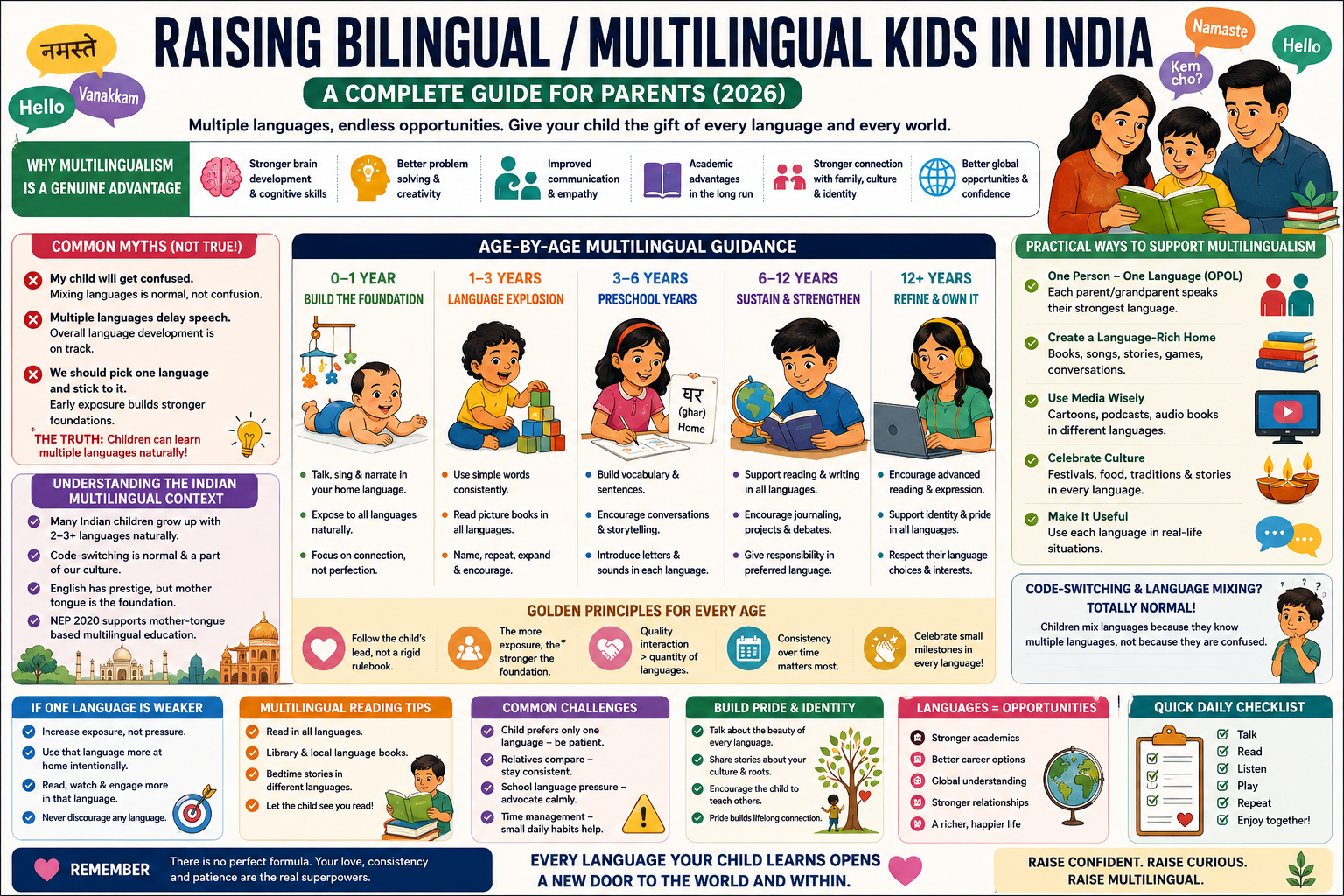
The reassuring reality, backed by decades of language development research, is that multilingual exposure from early childhood is not only safe but genuinely advantageous for most children. This guide covers practical, India-specific strategies for raising confidently multilingual kids — from infancy through the school years — along with troubleshooting common challenges and addressing persistent myths that cause unnecessary parental worry.
1. Why Multilingualism Is a Genuine Advantage
Extensive language development research has consistently found that multilingual children generally show enhanced cognitive flexibility, stronger executive function skills (including attention control and problem-solving), and often greater metalinguistic awareness — meaning an intuitive understanding of how language itself works, which can support learning additional languages later.
Beyond cognitive benefits, multilingualism in the Indian context carries significant cultural and familial value — the ability to communicate fluently with grandparents, extended family, and community members in a regional language preserves connection, cultural transmission, and a sense of belonging that purely English-medium upbringing can sometimes dilute over generations.
Rather than viewing multiple languages as competing for limited “space” in a child’s developing brain, current understanding treats language acquisition capacity in early childhood as remarkably expansive — children are neurologically well-equipped to absorb multiple language systems simultaneously, particularly when exposure begins early and continues consistently.
2. Common Myths That Cause Unnecessary Worry
Before diving into practical strategies, it’s worth directly addressing the anxieties that often hold parents back from confidently raising multilingual children:
“My child will get confused.” Research doesn’t support this — multilingual children do sometimes mix languages temporarily (discussed in detail in Section 11), but this reflects normal language development, not confusion or delayed understanding.
“Multiple languages will delay speech.” While some multilingual children show slightly different developmental timelines in each individual language compared to monolingual peers, overall communicative competence (combining all languages) typically develops on a comparable timeline, and any individual-language differences generally even out over time.
“We should pick one language and focus on it properly.” This approach, while understandable, often means missing a genuinely valuable early window for building strong multilingual foundations that become considerably harder to build later, particularly for languages without strong school or community reinforcement.
3. Understanding the Indian Multilingual Context
India’s linguistic landscape is genuinely distinctive globally, which shapes how multilingual parenting typically unfolds here compared to other multilingual contexts:
- Many families already operate multilingually without deliberate strategy — a regional language at home, Hindi in broader community interaction, and English in school and professional contexts — meaning many Indian children are naturally exposed to multiple languages regardless of explicit parental planning
- Code-switching within single conversations is culturally normal and widely practiced by adults themselves, providing children with natural modeling of fluid multilingual communication
- Regional language prestige varies significantly by context, with English often carrying strong social and economic prestige that can inadvertently deprioritize regional language transmission if parents aren’t intentional about it
- The National Education Policy (NEP) 2020 explicitly emphasizes mother-tongue and multilingual education in the foundational years, reflecting a policy-level recognition of multilingualism’s developmental value
4. Multilingual Development: What’s Actually Normal
Understanding typical multilingual development patterns helps parents distinguish normal variation from genuine concern:
- A “silent period” is common in some multilingual children, particularly when a language is introduced later (such as starting English-medium school after primarily speaking a home language) — this represents active listening and processing, not lack of progress
- Uneven proficiency across languages is entirely typical — a child might have stronger vocabulary in one language for certain topics (school-related concepts in the school language, home-related concepts in the home language) based simply on where they encounter that vocabulary most
- Temporary preference for one language over others, sometimes shifting over time based on which language is currently getting more exposure or social reinforcement, is a normal, fluid part of multilingual development
- Combined vocabulary generally matches or exceeds monolingual peers when measured across all languages together, even if any single language shows a smaller vocabulary count compared to a monolingual child focused on just that language
5. Building a Language Strategy for Your Family
While many families navigate multilingualism organically, having an intentional strategy—even a loose one—tends to support stronger outcomes for languages that don’t have strong external reinforcement:
- Identify your family’s language priorities — which languages matter most for family connection, cultural identity, practical communication, and future opportunity
- Consider a “one parent, one language” approach if each parent has a different native language, though this isn’t the only effective strategy and many successful multilingual families use other approaches
- Consider a “minority language at home” approach, particularly valuable if a regional or heritage language lacks strong external reinforcement outside the home (such as no local school or extensive community support in that language)
- Build in consistent contexts for each language — perhaps a specific language for bedtime stories, another for weekend extended family calls — providing natural, low-pressure structure without requiring rigid rules
- Revisit and adjust your strategy periodically, since family circumstances, school choices, and children’s individual responses often shift over time
6. Age 0–1: Early Multilingual Exposure
Early infancy is a valuable window for building foundational familiarity with multiple language sounds and rhythms, even before meaningful language production begins:
- Speak to your baby in whichever language feels most natural and comfortable to you, since babies benefit most from rich, engaged interaction, regardless of which specific language that occurs in
- Don’t worry about “mixing” languages at this stage — infants are absorbing sound patterns, rhythm, and interactive cues broadly, not yet distinguishing languages in the way older children or adults do
- Expose your baby to multiple caregivers speaking different languages naturally, if this reflects your family’s actual context (grandparents, for instance, speaking a regional language)
- Sing songs and rhymes in multiple languages, which supports early phonological awareness across each language system
7. Age 1–3: The Toddler Language Explosion
Toddlerhood is a period of rapid vocabulary growth, making consistent multilingual exposure during this stage particularly valuable:
- Continue consistent language exposure across whichever languages are part of your family’s strategy, recognizing that toddlers can and do build vocabulary in multiple languages simultaneously
- Expect uneven vocabulary distribution across languages based on context — this is normal and not a sign of one language “winning” over another in any concerning sense
- Respond supportively to code-mixing (using words from multiple languages within a single sentence), which is a normal developmental stage, not a sign of confusion (more on this in Section 11)
- Increase regional language and heritage language exposure specifically during this window if that language lacks strong external reinforcement, since early childhood offers a particularly effective foundation-building period
8. Age 3–6: Preschool and Early School Years
School entry often introduces a formal language of instruction, which can shift the balance of language exposure if not actively managed:
- Recognize that school language exposure often increases significantly during this stage, potentially outpacing home language exposure if not intentionally balanced
- Actively protect home/heritage language time, particularly if the school’s medium of instruction differs from your family’s home language, since this is a common point where heritage language proficiency can begin quietly declining without deliberate effort
- Introduce simple literacy exposure in multiple languages where relevant — even basic exposure to script and simple words in a heritage language builds foundational familiarity, even if formal literacy instruction is happening primarily in the school language
- Continue extended family interaction in the heritage or regional language as a natural, low-pressure reinforcement mechanism
As academic demands increase, sustaining multilingual proficiency requires more intentional effort, particularly for languages without institutional support:
- Consider formal language classes or tutoring for a heritage language if it isn’t part of your child’s school curriculum, particularly valuable for building literacy alongside conversational fluency
- Introduce age-appropriate reading material in multiple languages, which supports both literacy and vocabulary depth beyond conversational usage
- Maintain consistent heritage language use in specific contexts (extended family communication, cultural or religious practices) to sustain practical relevance and motivation
- Watch for early signs of declining heritage language confidence or willingness to use it, and address proactively through increased positive, low-pressure exposure rather than correction-heavy approaches that can create reluctance
10. Balancing English, Hindi, and Regional Mother Tongue
For many Indian families, the specific balance between English, Hindi (or another link language), and a regional mother tongue is a central practical consideration:
- Recognize that English often receives disproportionate emphasis due to its academic and professional prestige, which can unintentionally deprioritize regional language transmission if parents aren’t deliberate about protecting it
- Consider your long-term family goals — is maintaining strong regional language fluency primarily about grandparent/extended family connection, cultural identity, regional literature access, or all of these — since this shapes how much deliberate effort to invest
- Use Hindi (or another link language) contextually where it naturally fits your family and regional context, without needing to treat it as equally weighted to English and your specific mother tongue if it’s not a core family priority
- Avoid an either/or mentality — strong English proficiency and strong regional language proficiency aren’t inherently in competition when both receive reasonably consistent exposure over time
11. Handling Code-Switching and Language Mixing
Code-switching — mixing words or phrases from multiple languages within a single sentence or conversation — is one of the most misunderstood aspects of multilingual development:
- Understand that code-switching is normal and often sophisticated, not a sign of confusion — even highly fluent multilingual adults code-switch regularly and fluidly, often reflecting nuanced linguistic choices rather than gaps in ability
- Avoid excessive correction of code-mixing in young children, which can create self-consciousness or reluctance to communicate rather than genuinely improving language separation
- Model consistent language use yourself in specific contexts if you want to encourage more distinct language separation over time, since children often naturally increase language separation as they mature and become more aware of their conversational partners’ language preferences
- Recognize that code-switching frequency often naturally decreases as children get older and develop stronger awareness of audience-appropriate language use, without requiring heavy-handed intervention
12. What If One Language Is Weaker Than the Others?
It’s common, and not necessarily concerning, for one language to lag behind others at any given point:
- Identify the likely cause — is it simply receiving less exposure currently (e.g., a heritage language with limited use since starting English-medium school), or is there a broader developmental concern affecting all languages equally?
- Increase exposure and motivation for the weaker language through enjoyable, low-pressure means — media, books, extended family interaction, rather than formal drilling, which can create resistance
- Avoid comparing your child’s proficiency in any single language directly to monolingual peers in that same language, since combined multilingual vocabulary and overall communicative competence is the more relevant comparison
- Consult a speech-language professional if you notice concerns affecting communication broadly across all languages, not just one — this distinction matters, since single-language lag alone is not typically a developmental red flag
13. Multilingual Reading and Literacy Development
Building literacy across multiple languages, particularly those using different scripts, requires some specific consideration:
- Introduce reading in each language gradually, recognizing that literacy development timelines may differ slightly across languages, particularly if scripts differ significantly (such as Devanagari alongside Roman script for English)
- Seek out children’s books in regional languages specifically, which are increasingly available through Indian publishers focused on vernacular children’s literature
- Don’t worry if literacy develops at different paces across languages — oral fluency and literacy are related but distinct skills, and a child can be strongly orally fluent in a heritage language while developing literacy more gradually, particularly without formal school instruction in that language
- Use audiobooks and read-aloud sessions in heritage languages as an accessible way to build vocabulary and comprehension even before independent literacy develops fully
14. School Choice and Its Impact on Multilingualism
School language of instruction significantly shapes your child’s overall multilingual development, making this an important consideration in broader school choice decisions:
- Recognize that most schools in India, regardless of board (CBSE, ICSE, or State), operate primarily in English or occasionally Hindi, meaning your home is often the primary reinforcement mechanism for a regional heritage language, particularly if it differs from the school’s medium
- Some schools offer strong second/third language instruction as part of their curriculum — worth investigating specifically if formal literacy in a heritage language is a family priority
- NEP 2020’s emphasis on mother-tongue-based foundational education means some schools, particularly newer or government-affiliated ones, are increasingly incorporating regional language instruction in early years — worth asking about directly when evaluating school options
- Whichever school language balance you choose, deliberately compensate at home for any languages that receive less institutional support, since school exposure alone is rarely sufficient to sustain strong heritage language proficiency without home reinforcement
Joint family living, common in many Indian households, often provides a natural, built-in multilingual advantage worth actively leveraging:
- Encourage grandparents and extended family to communicate in their most natural, comfortable language with children, rather than switching to English out of concern about confusing the child — this natural exposure is genuinely valuable, not something to minimize
- Use family gatherings and traditions as organic language reinforcement opportunities, particularly for languages that might otherwise receive limited exposure in a child’s daily school-and-peer environment
- Recognize potential differing family opinions about language priority (some family members may prioritize English fluency above all else, while others deeply value regional language transmission) and have calm, collaborative conversations about your family’s specific language goals
16. Common Challenges and Practical Troubleshooting
Challenge: My child responds in English even when spoken to in our regional language. This is common, particularly once school and peer exposure increases English usage significantly. Continued consistent input in the regional language, even without matching output initially, still builds comprehension and passive proficiency, which often supports later active use, particularly if reinforced through motivating contexts like extended family relationships.
Challenge: My child seems embarrassed to speak our heritage language in front of friends. This often reflects social dynamics and peer language norms rather than genuine reluctance around the language itself. Building positive heritage language associations through enjoyable family contexts, rather than pressuring performance in front of peers, tends to help more than direct confrontation of the embarrassment.
Challenge: We moved and no longer have regular exposure to our heritage language community. Consider video calls with extended family specifically in the heritage language, heritage language media (shows, music, books), or connecting with other families sharing the same heritage language locally or online for maintained exposure.
17. Building Pride and Identity Around Multiple Languages
Beyond pure linguistic proficiency, fostering genuine pride and positive identity around multilingualism supports sustained motivation:
- Frame multilingualism as a genuine strength and skill, not a burden or complication, in how you discuss it with your child
- Celebrate multilingual moments naturally — praising a well-executed translation for a family member, or simply acknowledging the value of being able to connect across different family and community contexts
- Share family and cultural stories connected to each language, building emotional and identity-based motivation beyond pure practical utility
- Avoid comparing your child’s proficiency negatively to more monolingual-focused peers, reinforcing instead the distinct value of their multilingual capability
18. Common Myths About Multilingual Kids, Addressed
Myth: Multilingual children are always “late talkers.” Reality: While individual language milestones can show minor variation, overall communicative development across all languages combined generally proceeds on a typical timeline for multilingual children.
Myth: You should only speak the “important” language (usually English) at home to give your child an advantage. Reality: Strong home language foundations, even in a regional or heritage language, generally support rather than hinder later English acquisition, particularly given research on cross-linguistic transfer of skills like phonological awareness and vocabulary-building strategies.
Myth: Code-mixing means my child hasn’t mastered either language properly. Reality: Code-switching is a normal, often sophisticated linguistic behavior seen even in highly fluent multilingual adults, not evidence of incomplete mastery of individual languages.
Myth: It’s too late to introduce a heritage language if we haven’t been consistent so far. Reality: While early, consistent exposure offers real advantages, children (and even adults) can meaningfully build proficiency in an additional language at various life stages — it’s genuinely worth starting or increasing heritage language exposure at any point, not just in the earliest years.
19. A Practical Weekly Language Exposure Framework
Daily: Consistent conversational use of your family’s core languages in natural, low-pressure contexts (mealtimes, play, bedtime routines)
Weekly: Dedicated heritage/regional language reinforcement activities — extended family calls, specific media (shows, music) in that language, or a heritage language book
Monthly: Cultural or community engagement opportunities specifically connected to heritage language contexts, where accessible (community events, religious or cultural gatherings, heritage language classes if enrolled)
Ongoing: Ambient exposure through household language choices, extended family interaction patterns, and modeling positive attitudes toward all family languages consistently
This is a flexible framework, not a rigid schedule — the goal is consistent, positive exposure across your family’s chosen languages, adapted to your specific circumstances.
20. Frequently Asked Questions
Will raising my child multilingual delay their speech development?
Overall communicative development across all languages combined generally proceeds on a typical timeline. Any individual-language differences compared to monolingual peers are usually temporary and tend to even out over time.
Should I worry if my toddler mixes words from different languages in the same sentence?
No, this is a completely normal part of multilingual development, not a sign of confusion. Most children naturally increase language separation as they mature and become more aware of their listener’s language preferences.
My spouse and I speak different native languages — how should we approach this at home?
A “one parent, one language” approach works well for many families in this situation, though it’s not the only effective strategy. What matters most is consistent, rich exposure to each language rather than a single “correct” method.
Is it worth continuing our regional language at home if our child’s school is entirely English-medium?
Yes — school exposure alone is rarely sufficient to sustain strong heritage language proficiency, making consistent home reinforcement particularly important precisely because the school isn’t providing that support.
How do I know if my child’s language development needs professional evaluation versus just normal multilingual variation?
The key distinction is whether difficulties appear broadly across all languages (a potential concern worth discussing with a speech-language professional) versus being specific to one particular language while others develop typically (generally normal variation related to differing exposure levels).
Can starting a heritage language later in childhood still be effective?
Yes, while early consistent exposure offers real advantages, meaningful progress is achievable at various ages with consistent, motivated effort — it’s genuinely worth starting or increasing heritage language exposure even if earlier years weren’t as consistent as you might have wanted.
21. Final Checklist for Multilingual Families
- Identify your family’s specific language priorities and goals
- Choose a rough strategy (one parent-one language, minority-language-at-home, or a natural mixed approach) that fits your family
- Ensure consistent exposure to any language not reinforced by school or broader community
- Avoid excessive correction of normal code-switching in young children
- Seek out books and media in regional/heritage languages specifically
- Leverage joint family and extended family relationships as natural language reinforcement
- Build positive identity and pride around multilingualism, not just proficiency
- Watch for developmental concerns that affect all languages broadly, rather than single-language variation alone
- Revisit and adjust your family’s language strategy periodically as circumstances change
This article is intended for general informational purposes to help parents navigate multilingual parenting in India. Every family’s specific language context and goals are different — adapt these suggestions to fit your household, and consult a speech-language professional for any developmental concerns affecting your child’s communication broadly across all languages.
Read Also