Physical Address
304 North Cardinal St.
Dorchester Center, MA 02124
Physical Address
304 North Cardinal St.
Dorchester Center, MA 02124

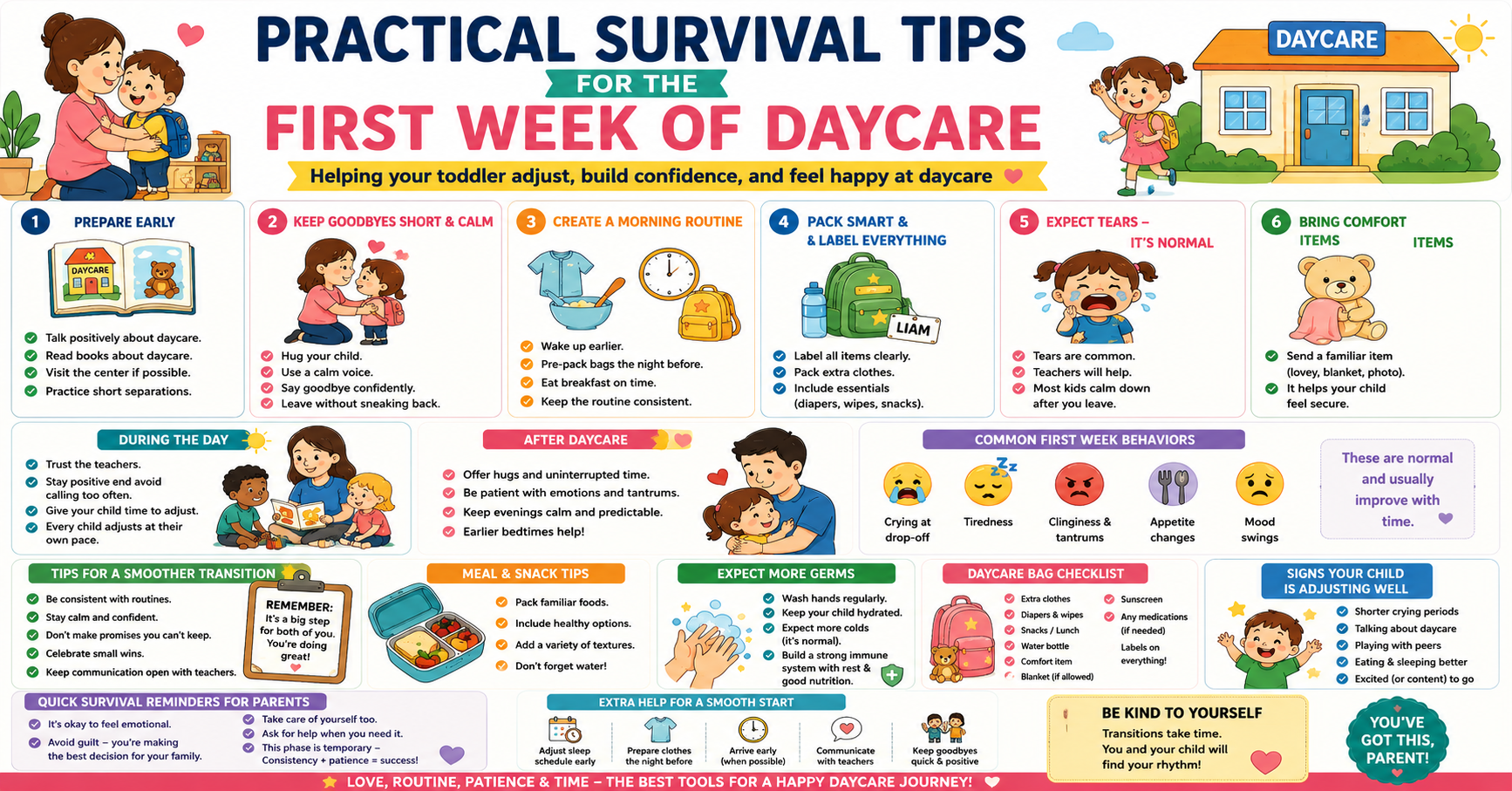
Nobody warns you about what the first week of daycare actually feels like. The pamphlets from the daycare centre talk about settling periods and key workers. Your mum friends tell you it gets easier. But in that moment when you are standing at the daycare door, your child clinging to your leg and crying, your heart doing something it has never done before — all of that advice goes completely out of your head.
The truth is that survival tips for the first week of daycare are not just for your child. They are for you too. Because while your toddler is adjusting to a new environment, new faces, and a new routine, you are sitting at work — or at home — watching the clock and wondering whether they are okay. You are fielding that tight feeling in your chest every morning at drop-off. You are second-guessing every decision you made to get to this point.
This guide gives you real, practical survival tips for the first week of daycare — things that actually help, explained clearly and honestly. Not vague reassurances. Not a list of things to buy. Real strategies that help children settle, help parents cope, and make the whole transition smoother for everyone in the family.
Whether your child is six months old, one year old, or two and a half, whether you are going back to work or making a change in childcare arrangements, and whether you are nervous, relieved, guilty, or all three at once — this is for you.
Before we get into the survival tips for the first week of daycare, it helps to understand why this transition is so genuinely difficult. Not just for children, but for the whole family.
For a baby or toddler, starting daycare is one of the biggest changes they have ever faced. Everything is new at once — the room, the smells, the sounds, the faces, the toys, the food, the routine. Most young children have spent their entire lives in the company of their primary caregivers. Suddenly, those people are gone, and they are expected to eat, sleep, and play in a completely unfamiliar environment with people they have never met before.
Young children do not have the cognitive ability to understand ‘you will be back at three o’clock’. They do not have the language to express what they are feeling. What they do have is a very healthy attachment to the people who have always kept them safe — which is exactly why separation anxiety at daycare drop-off is completely normal. It is not a sign that something is wrong. It is a sign that your child has a secure attachment. Which is actually a very good thing, even when it does not feel like it.
The first week of daycare survival tips that work best are the ones that account for this reality. They meet children where they are developmentally, rather than expecting them to simply adapt without support.
Parents going through the first week of daycare often describe a very specific emotional cocktail. There is guilt — the feeling that leaving your child with someone else is somehow failing them. There is grief — a real and underacknowledged sadness about the end of the season you have been in. There is anxiety — the constant background noise of wondering whether your child is okay when you are not there. And sometimes, underneath all of that, there is relief — and then guilt about the relief.
All of these feelings are normal. All of them are valid. The first week of daycare is genuinely one of the emotionally harder experiences of early parenthood, and it deserves to be treated seriously. The survival tips in this guide include practical strategies for managing your own emotions, not just your child’s behaviour.
Here is something that often helps parents during the first week of daycare: understanding what the staff are actually doing on their end. Good daycare workers are trained specifically in supporting children through transitions. They know that the first week is hard. They have a plan. They are watching your child carefully, noting what soothes them, what distracts them, what makes them laugh, and what makes things worse. They are going to send you updates if you ask for them. They want this transition to go well just as much as you do.
Trusting the process and trusting the people you have chosen to care for your child is itself one of the most powerful survival tips for the first week of daycare. That trust is very hard to manufacture, but it starts with choosing the right daycare in the first place and building a genuine relationship with your child’s key worker.
The best survival tips for the first week of daycare actually start before the first week. What you do in the days and weeks leading up to starting can make an enormous difference to how the first week goes.
Most good daycare centres offer settling-in sessions before a child’s official start date. These are short visits where you and your child come to the daycare together. They give your child a chance to explore the environment, meet the key worker, and begin building familiarity — all while you are still present.
Many parents rush through these sessions or skip them entirely because they are difficult to arrange around work schedules. This is understandable, but if there is any way to do them, do them. Children who have had proper settling-in sessions before starting typically settle faster once they do start. Even one or two proper visits where your child begins to feel safe in the environment can make a real difference to how the first week goes.
During settling-in sessions, let your child lead. Do not push them to play or interact. Just be present and calm, and let them explore at their own pace. Your calm signals to them that this place is safe.
In the week or two before starting, begin mentioning daycare naturally at home. Keep it simple, positive, and honest. You might say things like ‘Soon you are going to a new place called daycare. There will be toys there and some new friends. And I will always come back and get you.’
Read books about starting daycare. There are several excellent ones aimed at toddlers and young children that show daycare as a fun, safe, friendly place. Stories are one of the most effective tools for preparing children for new experiences because they process information through narrative.
Avoid over-preparing or over-explaining. With very young children, too much talk about a future event can build anxiety rather than reduce it. A few simple, calm mentions are enough.
One of the most underrated first week of daycare survival tips is simply getting the logistics sorted before the chaos begins. The first week of daycare is emotionally demanding enough without also scrambling for spare clothes, trying to remember to label everything, and figuring out the morning routine at the same time.
In the week before your child starts, do the following. Label absolutely everything — clothes, bottles, bags, dummies, cups. Pack the daycare bag and check you have everything on the centre’s checklist. Do a trial run of the morning routine, including the journey to daycare, so you know exactly how long it takes. Set your alarm fifteen minutes earlier than you think you need to. Have backup plans for sick days — especially because the first week of daycare often comes with a first daycare illness.
If your child has a comfort object — a favourite stuffed animal, a small blanket, a particular toy — make sure it is ready to go to daycare with them. Familiar objects carry the smell and feel of home. They are hugely reassuring for young children in a new environment.
If your child does not have a strong attachment to a particular object, consider introducing one a few weeks before starting. A small soft toy or a piece of fabric that has been slept with a few times can begin to take on comforting properties. Some parents put a piece of their own worn clothing — a t-shirt, for example — in the bag so the child has the parent’s familiar smell nearby.
The first day is often the hardest. Here is how to navigate it.
One of the most practical survival tips for the first week of daycare is to plan your first drop-off carefully. You want enough time to settle your child in without rushing — but not so much time that you are hovering for an extended period.
Give yourself about ten to fifteen minutes for drop-off. Arrive, help your child get settled with a toy or activity, say a warm and confident goodbye, and then leave. This sounds simple. It is not. But it is genuinely the right approach.
The reason a long, drawn-out drop-off does not help is that it prolongs your child’s anticipation of the goodbye. Children often find the actual separation easier than the waiting-for-separation. Once you leave, most children settle faster than you would believe. The daycare staff see this every day.
This is one of the single most effective survival tips for the first week of daycare, and it is supported by child development research. A consistent goodbye ritual gives your child something predictable to hold on to during the most uncertain moment of their day.
Your goodbye ritual can be anything — a special hug, a particular phrase, a little song, three kisses on the forehead. What matters is not what it is, but that it is always the same. After a few days, your child begins to anticipate it. The ritual signals that yes, you are leaving — but also that this is a safe, known thing that always happens in the same way. Predictability is enormously comforting to young children.
Keep the goodbye warm, confident, and brief. Say ‘I love you. I will come back after your afternoon snack. Have a great day.’ Then go. Do not linger. Do not say ‘Are you going to be okay?’ — because this communicates uncertainty. Go confidently, even if you are not feeling it.
Pro tip: Never sneak out without saying goodbye, even if it feels like it would be easier. Research consistently shows that children whose parents leave without warning have more anxiety at drop-off over time, not less. Always say a proper goodbye.
After you walk away from that daycare door — especially in the first week — you may need a few minutes. This is completely okay and completely normal. Sit in your car for a moment if you need to. Breathe. Text a friend. Have your coffee somewhere quiet before starting your day.
Most daycare centres will allow you to phone and check in during the morning, especially in the first week. Use this sparingly — once a check-in call per morning is fine. Most of the time, the staff will tell you your child is fine, because they are. Children are remarkably adaptable, especially when the environment is warm and caring.
Give yourself permission to feel whatever you feel. Sad, relieved, guilty, proud, all of the above. The first week of daycare drop-off is a rite of passage for parents, and the feelings that come with it are real and valid.
The first week of daycare does not follow a single script. Every child is different. But there are some general patterns that most families experience, and knowing what to expect helps enormously.
Day one and two of daycare are usually very full-on. Children may be clingy at drop-off, or they may go in surprisingly easily — only to fall apart on day two once the novelty wears off. Both reactions are normal. Some children are fine on day one because everything is new and stimulating. Then on day two, the reality of the routine kicks in and the crying starts.
This is not a sign that things are getting worse. It is a sign that your child is beginning to understand what is happening. That understanding is actually part of settling in, even though it is hard to watch.
On day one, keep the rest of the day low-key. Your child is going to be emotionally and physically exhausted by the end of their first day of daycare. Do not plan any activities for the afternoon. When you pick them up, keep the tone warm but calm. Ask simple open questions — ‘Did you do anything fun today?’ rather than ‘Were you okay? Were you upset? Did you miss me?’ Follow their lead. Some children need to talk about it immediately. Others need half an hour of quiet and a snack before they are ready to engage.
Many parents report that days three and four of the first week of daycare are the hardest. The initial novelty has worn off for the child. The parent has had a couple of exhausting early mornings and emotionally draining drop-offs. Everyone is tired. Separation anxiety at drop-off may be at its peak.
This is normal. It has a name in early childhood circles — the ‘week two wall’, though it often happens partway through week one. It does not mean your child is not settling. It means they are processing. The survival tip for this stage is simply to keep going. Keep the routine consistent. Keep the goodbye brief and warm. Keep evenings calm and low pressure.
This is also the point where parents most often start to question their decision. ‘Is this the right daycare? Is my child too young? Should I have chosen differently?’ In most cases, these doubts are a product of exhaustion and emotion rather than genuine evidence that something is wrong. If you have real concerns about how your child is being cared for, raise them with the daycare directly. But if you are just exhausted and sad, that is different — and valid — and it does get better.
Most families notice something shift by day five of the first week of daycare. It might be small — a moment where your child walked into the daycare without looking back for the first time. Or they mentioned the name of another child at home. Or they stopped crying at drop-off a minute sooner than usual. These are huge milestones even though they look tiny.
Day five is the day most parents begin to believe that things genuinely will get better. And they do. The second week of daycare is almost always easier than the first. By the end of the first month, most children are settled into a routine that feels normal and safe. By the end of three months, the daycare is simply part of life.
Separation anxiety is perhaps the topic parents search for most when looking for survival tips for the first week of daycare. It is important to understand both sides of it.
Separation anxiety is developmentally normal and expected in children from around six months through to approximately three years of age. It peaks between fourteen and eighteen months. This means that for many children starting daycare, separation anxiety is at its biological height.
When a child cries at daycare drop-off, they are not being manipulative. They are not ‘putting it on’. They are expressing a genuine emotional response to separation from the person they love most. This is a sign of healthy attachment, not a problem to be fixed.
The daycare staff know how to support children through this. Most children stop crying within minutes of a parent leaving — sometimes within seconds. The goodbye is the hard part, not the day. This is true even when a child has been crying at drop-off for several weeks. Once the parent is out of sight, the child very often redirects remarkably quickly.
If your child’s separation anxiety seems extreme, prolonged beyond the first month, or is impacting their eating or sleeping at daycare, speak to the key worker and to your GP or health visitor. In most cases, however, separation anxiety at daycare is part of normal development and does not require intervention beyond consistency and warmth.
Parent separation anxiety is real and it does not get talked about nearly enough. Many parents feel an almost physical anxiety after dropping their child at daycare — particularly in the first week. This is a normal physiological response to separation from your child. Your brain is wired to want to know your child is safe. Leaving them in a new place with new people activates the same protective instincts that have kept children safe for thousands of years.
The most helpful survival tips for first week of daycare parent anxiety are these. Set a rule for yourself about how often you will check in with the daycare by phone — once in the morning is fine. Ask the daycare to send you a brief update or photo during the day if they can. Keep yourself busy — being occupied is genuinely the most effective way to manage the anxiety of the waiting. And talk to other parents who have been through it. The solidarity of knowing that almost every parent has sat in a car crying after a drop-off is genuinely comforting.
Beyond the emotional side, there are plenty of practical survival tips for the first week of daycare that make everyday life just a little more manageable.
The morning of a first week of daycare is not the time to be figuring out the routine. If you can, practise the morning routine — including waking time, breakfast, getting dressed, and the journey to daycare — at least once or twice before the first day. Know exactly how long everything takes. Add ten minutes. Then add five more.
Rushed, stressful mornings make drop-offs harder for everyone. A child who has been rushed and stressed before arriving at daycare is more likely to struggle at drop-off. A parent who has been rushing and stressed is less able to give a calm, confident goodbye. The morning routine sets the tone for the whole drop-off experience.
This sounds too simple to be a genuine survival tip for the first week of daycare. But the number of parents who have arrived at daycare without the bottles, without spare clothes, or with an unlabelled bag that causes confusion for the staff is enormous.
Pack the daycare bag the night before, every night. Check the daycare’s daily sheet for anything they need for the next day. Make sure every item is labelled. Have the bag by the door. This removes one source of morning stress entirely.
If you have not yet discovered the black hole that is daycare lost property, you will. Labels are non-negotiable. Clothes, socks, shoes, bottles, cups, dummies, bags — everything needs to be labelled with your child’s first name and ideally a second name or initial. Use iron-on labels, stick-on labels, or a laundry marker. Some parents use both.
Small items like socks and hats are the most commonly lost. Some parents choose to send their child to daycare only in clothes they would not mind losing, especially in the early weeks. This removes the added heartache of a favourite outfit going missing.
One of the survival tips for the first week of daycare that nobody talks about enough is this: your child is very likely to get sick in their first two to four weeks at daycare. This is not a reflection of the daycare’s hygiene standards. It is simply the reality of a baby or toddler being exposed to a wide variety of new germs for the first time.
Prepare for this now, before it happens. Have a plan for what you will do when your child cannot go to daycare because of illness. Know the daycare’s illness policy — most centres require children to be symptom-free for 24 to 48 hours before returning after a stomach bug or fever. Have a backup childcare option if you can. Keep your employer informed that the first month of daycare often comes with unexpected absences.
Managing your own expectations around this is also important. First week of daycare illness is so common that many parents consider it part of the experience. The upside is that children who go through this early exposure generally have stronger immune systems in the long run. But it is exhausting and stressful in the moment, and it is worth being prepared.
Most parents think a lot about the drop-off routine and forget entirely about the pick-up routine. But how you greet your child at the end of the day matters enormously. Your child has been through a lot. They have held themselves together for several hours. When they see you, they are likely to release all the emotion they have been managing.
This can look like crying when they see you, even if the staff tell you they were fine all day. It can look like clinginess, grumpiness, or even brief rejection of you as they process their feelings. All of this is normal. It has a name — ‘afterschool restraint collapse’ or ‘after-care emotional release’. It is your child trusting you enough to let go.
Keep the pick-up warm and low-key. Bring a small snack in the car. Do not overwhelm them with questions. Allow them to decompress. Some children want to talk immediately. Others need thirty minutes of quiet before they are ready to engage. Follow their lead and you will both do better.
During the first week of daycare, evenings at home matter more than usual. Your child has spent the day in a stimulating, busy environment managing a lot of new experiences. They come home tired, emotionally full, and in need of calm.
Keep the first week’s evenings as simple and predictable as possible. Normal dinner, normal bath, normal bedtime routine — ideally at the same time as usual. Avoid extra outings, extra visitors, or changes to the routine. Predictability at home balances the unpredictability of the new daycare environment.
Some children sleep more than usual in the first week of daycare. Others sleep less well because they are overstimulated. Both are normal. Early bedtimes during this week are your friend.
This might be the most important practical survival tip for the first week of daycare on this entire list. Be as kind to yourself as you would be to a close friend going through the same thing.
You are making a huge transition too. You are leaving your child in the care of others, possibly for the first time. You are managing a new morning routine on top of everything else in your life. You are probably not sleeping as well as usual. You may be going back to work at the same time, which brings its own enormous emotional load.
This is hard. It is allowed to be hard. It gets easier. It genuinely does. The families on the other side of the first month of daycare — the ones whose children now run in happily without looking back — all had a first week that felt exactly like yours does now.
One of the most anxious thoughts parents have during the first week of daycare is wondering whether things are actually going well. Here are the signs to look for.
If you notice any of the second set of signs, speak to your key worker and your GP. In most cases, these signs resolve with time and additional support. In a small number of cases, they indicate that a particular child needs a different settling strategy or a different type of childcare arrangement.
Almost every article about survival tips for the first week of daycare focuses on what to do for your child. This section is about something else entirely.
At some point during the first week of daycare — or possibly the second, or the third — you are going to have a moment of absolute certainty that you have done the wrong thing. That your child is suffering. That you are a terrible parent. That other people are raising your baby while you are somewhere else. That the relationship you have built over months or years is being damaged.
This moment will feel completely real and completely true. It is not.
Starting daycare does not damage the bond between a parent and child. Research is very clear on this. Secure attachment is not broken by hours of separation. Children can form strong bonds with daycare workers without replacing or reducing their bond with their parents. The hours spent together at home matter enormously. The warmth, the routine, the bedtime stories, the weekend mornings — these are the substance of your relationship with your child, and they are not going anywhere.
The guilt that comes with the first week of daycare is one of the most common experiences in modern parenthood. It does not mean you are doing something wrong. It means you love your child. That is not the same thing.
Most children take between two and six weeks to fully settle into daycare. Some children settle in the first week. Others take longer, especially if they are older, have strong separation anxiety, or are particularly sensitive by temperament. The first week of daycare is typically the hardest. By the end of the first month, most children have a recognisable routine and are more comfortable. By three months, daycare usually feels completely normal to both child and parent.
Yes, crying at daycare drop-off is completely normal, especially in the first week and first month of daycare. Young children cry at drop-off because they love you and miss you — not because something is wrong. Most children stop crying within minutes of a parent leaving, even if they cry every morning. The best approach is a consistent, warm goodbye ritual. If your child is still crying daily after six to eight weeks with no signs of improvement, talk to the key worker about additional settling strategies.
For the first week of daycare, pack at least two full changes of clothes per day, labelled with your child’s name. Pack any bottles, cups, or feeding equipment the daycare requires. Include a comfort object if your child has one. Pack nappies and wipes if the centre does not provide them. Bring any medication with written instructions if your child takes any. Include a family photo if you would like your child to have a familiar face nearby. Check the daycare’s specific list as requirements vary between centres.
It is fine to call once in the morning during the first week of daycare, especially on the first few days. Most centres are happy to give you a quick update. Avoid calling multiple times a day, as this can make it harder for you to relax into the separation. Many modern daycare centres offer photo updates or brief message updates through an app, which many parents find much easier than phone calls. Ask your centre what they offer.
There is no single right age to start daycare. Children can start successfully at any age from a few months old onwards. The key factors are the quality of the daycare environment, the warmth and consistency of the key worker, how well the daycare meets your child’s individual needs, and the quality of your preparation for the transition. That said, many child development experts suggest that children who start daycare after their first birthday may settle more quickly because their communication skills are developing rapidly. However, many babies start from three to six months and settle beautifully.
This is very common and has a name among early childhood educators — the ‘day three dip’. On day one, the novelty of the new environment is stimulating enough that some children do not react strongly to separation. By day two or three, the novelty has worn off and your child understands that this is a pattern — you leave and they stay. The day three dip is actually a sign that your child is processing what is happening, which is a normal and necessary part of settling. Keep the routine consistent and it will pass.
Absolutely. Comfort objects — whether a stuffed toy, a small blanket, or a soft item from home — are genuinely helpful for young children settling into daycare. They carry the smell and feel of home and provide real comfort in a new environment. Most good daycare centres actively encourage comfort objects, especially for babies and toddlers. Just make sure the object is labelled with your child’s name and that you are comfortable with it going to daycare, as small items can occasionally get lost.
For very young babies starting daycare, the most important factors are the key worker relationship and routine consistency. Visit during settling-in sessions so your baby begins to associate the key worker with your presence. Share your baby’s routine in detail — feeding times, nap schedules, soothing preferences, favourite songs. Bring a piece of your worn clothing so your baby has your familiar smell nearby. Ask the key worker to follow your baby’s home routine as closely as possible in the first weeks. Consistency between home and daycare is especially important for pre-verbal babies who rely entirely on routine and familiar sensory cues.
Keep it simple, honest, and positive. Say something like ‘You are going to a new place called daycare. There will be toys and children there, and kind people who will look after you. And I will always come back to get you.’ Repeat this consistently in the days before starting. Read books about starting daycare together. If possible, visit the daycare with your toddler before the first day so the environment is not completely unfamiliar. Avoid projecting your own anxiety in these conversations — children are very sensitive to the emotional tone behind words, not just the words themselves.
Seek additional support if your child has shown no improvement in settling after four to six weeks of consistent attendance. Other warning signs worth discussing with a professional include consistent refusal to eat or drink at daycare, prolonged withdrawal with no engagement, significant regression in skills such as toilet training or sleep that persists beyond the first few weeks, or your own gut feeling that something specific is not right about the environment or the care. Trust your instincts as a parent. If something feels wrong, investigate it — even if everyone else tells you it is fine.
If there is one thing to take from all of these survival tips for the first week of daycare, it is this: the first week is hard and it is temporary. Both of those things are true at the same time.
Your child will settle. It may take a week. It may take a month. But they will get there. They will start to know the names of the other children. They will have a favourite toy in the daycare room. They will tell you about something funny that happened there. They will run in one morning and not look back — and you will stand at the door for a moment with a mix of relief and a tiny thread of something that almost feels like loss, because that is what parenting is.
You will also get through it. The morning drop-off will get easier. The drive home will stop feeling so heavy. You will stop checking your phone every twenty minutes. You will find your new normal.
The survival tips for the first week of daycare in this guide are not magic. They will not make the first week painless. But they will make it manageable. And manageable, right now, is enough.
Take it one morning at a time.