Physical Address
304 North Cardinal St.
Dorchester Center, MA 02124
Physical Address
304 North Cardinal St.
Dorchester Center, MA 02124

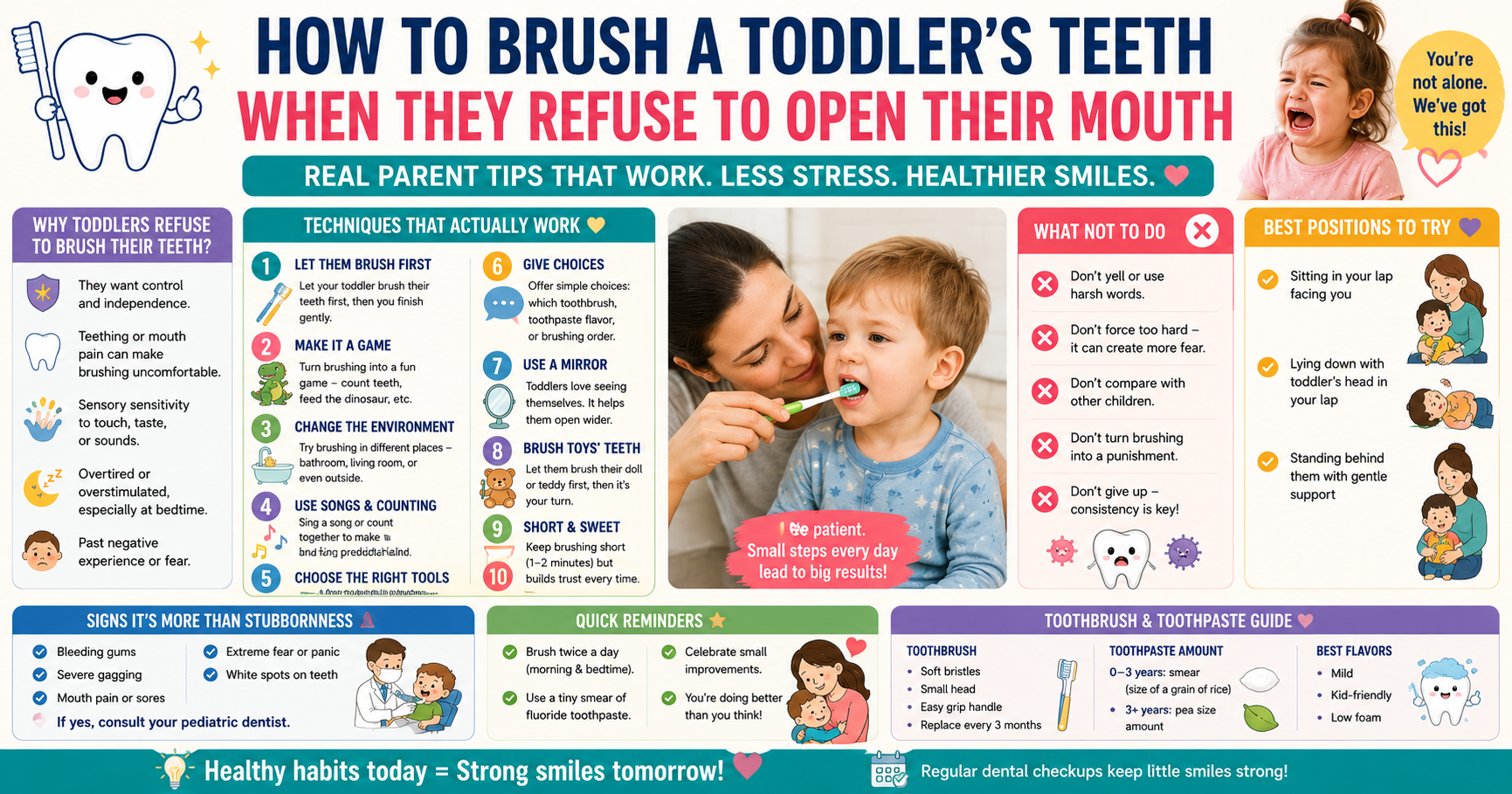
It is 7:45 p.m. You have the toothbrush loaded and ready. Your toddler sees it, clamps their jaw shut like a tiny vault, turns their head, and either bursts into tears or goes completely rigid.
You have been here before. Maybe every night this week.
This is one of the most common frustrations in toddler parenting — and one of the least helpfully covered by the internet. Most articles about how to brush toddler teeth when they refuse tell you to “make it fun” and “sing a song.” And while those tips have merit, they do not help you when you are already ten minutes into bedtime and your child has not opened their mouth once.
This guide goes further. It covers why toddlers refuse in the first place (there are real reasons, and knowing them changes your approach), the exact physical techniques that work when your toddler clamping their mouth shut is a nightly occurrence, 14 strategies ranked from gentlest to most structured, a special section for children with sensory sensitivities, and clear guidance on when to stop trying to handle this alone and bring in a pediatric dentist.
The goal here is clean teeth with less war.
Before the strategies, you need to know what is at stake — because the nights when it feels easiest to just give up are the nights your child needs you to push through.
According to the American Academy of Pediatric Dentistry, childhood tooth decay is four times more common than early childhood obesity, five times more common than childhood asthma, and twenty times more common than diabetes. Nearly one in five US children under the age of five has experienced dental caries. The CDC reports that tooth decay in children leads to pain, infections, difficulty eating, and impaired ability to speak, play, and learn.
Here is the part parents are not told clearly enough: baby teeth matter. The common belief that “they’re just baby teeth, they fall out anyway” is one of the most damaging pieces of misinformation in parenting. Baby teeth hold space for permanent teeth. Cavities in baby teeth cause real pain. Untreated early cavities can lead to infections serious enough to require hospitalization. Pediatric dentists have reported seeing children as young as two and three hospitalized for facial infections that were entirely preventable with routine brushing.
This is not about being a perfect parent. It is about understanding that brushing toddler teeth is a health essential — the same category as car seats, safe sleep, and vaccines. It is non-negotiable. The question is not whether to do it, but how to make it work.
Understanding why your toddler refuses helps you choose the right strategy instead of cycling through tactics randomly. The resistance to tooth brushing in children aged one to three is usually due to a combination of the following causes.
Toddlers between the ages of one and three are in a phase of strong independence-seeking. Saying “no” is how they explore boundaries and assert their growing sense of self. When a toddler refuses teeth brushing, it is often less about the toothbrush and more about feeling that something is being done to them without their input. This is developmentally normal and temporary — but it requires strategies that give back a sense of control.
For children with heightened sensory responses, the act of brushing involves multiple simultaneous triggers: the texture of the bristles, the pressure on gums and teeth, the foam and flavor of toothpaste, and the sensation of a foreign object moving in their mouth. For these children — and they are not rare — brushing genuinely feels overwhelming, not just uncomfortable. This is not defiance. It is their nervous system saying this input is too much.
If a child has ever been brushed in a way that felt rough, if they gagged on toothpaste, or if a brushing session escalated into a distressing struggle, they may carry that association forward. Children remember. Once the connection between “toothbrush” and “bad experience” is made, resistance is their self-protective response.
Active teething makes gums tender and inflamed. When a toddler’s mouth is already sore, the pressure of a toothbrush directly on an erupting tooth or swollen gum is genuinely painful. A child who was cooperative with brushing and suddenly refuses may be teething — not choosing to be difficult.
Most adult toothpastes are strongly mint-flavored — a taste most children under five actively dislike and some find burning or unpleasant. If your toddler is refusing with particular intensity right at the moment the toothbrush enters their mouth, the toothpaste could be the trigger rather than the brushing itself.
Bedtime brushing happens at the end of the day when a toddler is at their lowest regulation capacity. Tiredness does not create cooperation. If brushing regularly escalates at night but morning brushing is more manageable, fatigue is a major factor.
Knowing the reason behind the resistance does not excuse skipping brushing. But it tells you which category of strategy to try first.
Before the fourteen strategies, you need to know about the lap position — because this is the physical technique that changes everything for parents dealing with a toddler clamping their mouth shut and twisting away.
The knee-to-knee approach is one of the most recommended positions when a child is especially resistant. Here is exactly how to do it:
Solo version (one parent): Sit on the floor with your legs stretched out in front of you. Have your toddler lie down with their head in your lap, feet pointing away from you. This gives you a clear view of the entire mouth from above, controls head movement naturally, and keeps your toddler’s body calm and positioned rather than twisted away.
Two-parent version (knee-to-knee): Sit facing another adult with knees almost touching. The child sits on one adult’s lap facing that adult. Then the child reclines back onto the second adult’s lap — head in the second adult’s lap, feet on the first adult’s lap. The second adult does the brushing while the first adult distracts and comforts.
Why it works: Lying back naturally opens the mouth slightly. The parent has better visibility, better control of the brush angle, and can see all tooth surfaces clearly. The child’s body position is secure without feeling pinned. Using a clean index finger to gently pull the cheek away from the teeth on the side you are brushing gives clearer access and better control — keeping the finger on the outside of the teeth so you do not get bitten.
For very young children — under 18 months — this position is often the most practical approach regardless of cooperation level. For older toddlers who resist more actively, combine this position with the distraction and engagement strategies below.
These strategies are organized roughly from engagement-first approaches (for mild to moderate resistance) through to structured non-negotiable techniques (for full refusal). Work your way through them — and remember, what works one week may need rotating with something else the next.
The key to working with a toddler’s need for control is offering limited choices that all lead to the same result: clean teeth. You are not asking whether brushing happens — you are asking how.
Try: “Do you want to brush the top teeth first or the bottom teeth first?” “Do you want to hold the toothbrush or should I?” “Do you want to stand on the step stool or sit on the counter?” “Batman toothbrush or the dinosaur one tonight?”
Every option in the choice set results in teeth getting brushed. Your toddler feels the power of the decision. You get access to the mouth. This strategy alone solves a significant portion of control-based resistance.
Children under six do not have the fine motor coordination to brush their own teeth effectively. Clinical guidelines confirm that parent involvement is essential for children under six. But handing your toddler the brush first — letting them “brush” for thirty seconds or however long they want — satisfies the “I do it myself” developmental drive before you step in to do the actual cleaning.
Frame it clearly: “Your turn first, then my turn.” Then follow through. Do not let their turn substitute for yours. Let them do their bit, praise them warmly, then take the brush and finish the job.
Children are powerful mimics. When they see parents brushing their own teeth enthusiastically — opening wide, making the motions obvious and visible — they internalize it as something the family simply does. It is not something being done to them. It is something everyone does together.
Stand at the sink, stand side by side at the mirror, and brush your teeth simultaneously. Make it a performance. Comment on your own brushing: “Getting all those back teeth! Big open mouth for the molars!” Your toddler’s natural imitation drive kicks in.
This approach is particularly powerful for toddlers who resist because brushing feels like something imposed on them rather than a normal family activity.
Toddlers have no abstract concept of “two minutes.” What they do understand is a definite beginning and end. A song, a timer shaped like a fun character, or a specific short video running on a tablet gives the session defined boundaries — and that structure reduces anxiety because the child can see when it is over.
The American Dental Association has a Tooth Brushing Songs Playlist available online. Apps with two-minute brushing timers featuring cartoon characters are highly effective for this age group. You can also use any song you know your child loves, as long as it runs approximately two minutes. The same song every night turns the song itself into a signal that brushing time starts — and crucially, ends — at a predictable point.
Give your toddler a second toothbrush and get them to brush their favorite toy’s teeth at the same time you are brushing theirs. This works on multiple levels simultaneously: it distracts, it engages their natural play instinct, it models the brushing motion in a way they control, and it makes brushing feel reciprocal rather than one-directional.
“Your turn to brush Teddy’s teeth while I brush yours!” Many a parent has gotten a full two-minute brush in while their toddler was completely absorbed in cleaning a stuffed bear’s nonexistent molars.
Rotate which toy needs brushing. The novelty sustains engagement.
Turn the tables completely. Let your toddler examine your mouth before you check theirs. Hand them a flashlight or a pretend mirror. Let them count your teeth. Ask them if you have any “sugar bugs” hiding. Then make it your turn — now they are the dentist checking you, and suddenly what was a source of resistance becomes something they performed on you first.
This role reversal reduces the feeling of vulnerability. When a child has done something to you first, having it done to them feels much less threatening.
If the refusal is most intense at the moment the brush enters the mouth, the toothpaste is a top suspect. Most children actively dislike mint flavor. Bubblegum, strawberry, watermelon, fruit punch, and even unflavored toothpaste options exist for children. The most important thing is that the toothpaste contains fluoride at a concentration of at least 1000ppm — the flavor is secondary.
For children under three years old, the AAPD guidelines are clear: use a smear of fluoride toothpaste about the size of a grain of rice. For children three to six, use a pea-sized amount. If your child dislikes all flavored toothpastes, just the act of brushing with water still removes food and disrupts plaque — use water and introduce a new toothpaste flavor attempt separately from bedtime when there is less emotional charge around it.
For children who have a strong sensory reaction to the texture of standard toothbrush bristles, a silicone finger brush or a toothbrush with ultra-soft silicone bristles can be a gentler entry point. The softer texture reduces the sensory input significantly while still allowing you to clean the tooth surfaces.
If hypersensitivity is the issue, an index finger wrapped in gauze also works as an alternative for a toothbrush, alleviating the bristle texture concern entirely. It is not the ideal long-term solution, but it keeps brushing happening while you work toward transitioning to a standard brush.
Electric toothbrushes with pressure sensors and small brush heads can also work counterintuitively well for sensory-sensitive children — the consistent vibration provides predictable input that some children regulate to more easily than the variable pressure of manual brushing.
For children who are having a severe reaction to brushing — gagging, panic, extreme distress — fighting through it every night is not the right answer. The distress builds the negative association and makes future brushing harder, not easier.
Instead, an American Dental Association specialist recommends starting with just a ten-second brush and increasing gradually up to two minutes as the child can tolerate the brush. Begin with simply touching the brush to the lips. Then the front teeth only. Then add one more section of teeth every few days.
This graduated desensitization approach takes longer to build up to a full brush but creates a positive association rather than a traumatic one that keeps the battle going indefinitely.
Changing the location of brushing removes the established negative associations of “the sink where the toothbrush battle happens.” Many parents find that offering brushing in the bathtub — where a toddler is already relaxed, playing, and in a different mental mode — dramatically reduces resistance.
It does not need to be permanent. Once the habit is established and the association is broken, you can gradually return to the bathroom sink if that matters to you. But during a period of high resistance, environment change is a legitimate and useful tool.
Toddlers find bodily functions fascinating. Spitting, rinsing, and the whole production of brushing can be made into a performance that children want to participate in.
Make exaggerated faces brushing your teeth. Spit dramatically. Say “ahhh” and open wide for the mirror. Let them see it is silly and physical and a bit gross in a fun way. The moment brushing becomes something they want to observe and copy rather than something being imposed on them, resistance drops.
Sticker charts are effective for toddler teeth brushing when used correctly. The distinction is important: a sticker chart acknowledges the behavior after it happens, building a positive association over time. A bribe offers something in exchange for cooperation and teaches the child to hold out for the reward.
After brushing — not instead of brushing — say: “You did it! Time to pick your sticker.” The sticker goes on the chart. Over time, the brushing session is framed as something that leads to a moment of celebration and recognition, not something that has to be endured.
Small rewards after completing a chart — an extra story, choosing the weekend breakfast, a new bath toy — sustain motivation. Avoid sugary treats as rewards for brushing teeth. The irony defeats the purpose.
Your emotional energy is one of the most powerful variables in the brushing session. A parent who approaches brushing with visible dread, frustration, or tension transmits that energy directly to their toddler — and toddlers mirror emotional states more than they mirror instructions.
Before you even pick up the toothbrush, check your own state. Take a breath. Then narrate the session like a cheerful sportscaster: “Now we’re getting the left side — those big back teeth! Found a hiding crumb! Getting the bottom teeth — big wide open! Almost done — last ten seconds!” Keeping your voice light and the commentary upbeat keeps the session from feeling heavy or confrontational.
This is harder than it sounds at 7:30 p.m. after a full day. But it genuinely changes the dynamic.
For children who have learned through inconsistency that enough resistance will result in no brushing, the most important strategy is the most simple: brushing happens every time, no exceptions.
One of the most effective strategies is consistency. If brushing is optional one night and enforced the next, the child receives mixed messages. Children thrive on predictability. When brushing is as non-negotiable as getting dressed or going to sleep — when there is no possibility of opting out, only ways of making it more comfortable — most children eventually stop fighting because the fight leads nowhere.
This does not mean physical force or holding a child down routinely. But it does mean: brushing happens every morning and every night, using whatever position and technique is most comfortable, with as much warmth and playfulness as you can manage. Think of it the same as a diaper change — even if the baby is being fussy, it still needs to get done.
Some children resist brushing not because of the developmental autonomy phase but because their sensory processing system makes the experience genuinely distressing. If your child gags, cries hard, physically shakes, or becomes extremely anxious every single time — and these responses are not improving over weeks of trying different strategies — sensory processing differences may be at play.
Children with sensory sensitivities may find the texture of the bristles, the taste of the toothpaste, or even the sound of brushing to be distressing. Signs that this might be a sensory issue rather than typical toddler defiance include:
If this sounds familiar, consider:
Step one: Switch to a silicone toothbrush or finger brush and unflavored toothpaste. Remove as many sensory triggers as possible simultaneously.
Step two: Work with a graduated desensitization program starting from ten seconds.
Step three: Consult your pediatric dentist. Pediatric dentists are trained to handle behavior and can offer in-office demonstrations and desensitization that carry weight because they come from a different adult. Some dental offices offer happy visits — exploratory appointments with no procedures — that reduce fear and build familiarity.
Step four: If sensory aversions are broad and significantly impacting daily life, ask for a referral to an occupational therapist. OTs specialize in sensory integration and can give you a structured desensitization protocol that goes well beyond toothbrushing. Working alongside an occupational therapist or school therapist alongside your pediatric dentist is the recommended path for persistent sensory-based resistance.
Once you have the cooperation — even partial cooperation — here is exactly what the brush needs to do according to the AAPD and American Dental Association guidelines.
Position: Lap position as described above, or standing behind your child at the mirror.
Toothbrush: Small-headed, soft-bristled toothbrush designed specifically for infants or toddlers.
Toothpaste amount: For children under three — a smear the size of a grain of rice. For children three to six — a pea-sized amount only. Because the amounts are so small, there is no need for rinsing or spitting in children under two.
Technique:
Frequency: Twice daily. Once in the morning, once before bed. The bedtime brush is the more critical of the two — saliva production slows during sleep, meaning the mouth is less able to naturally clear bacteria overnight.
Parents should continue brushing for their child until approximately age six to seven, when fine motor coordination is developed enough for effective independent brushing. You do not need to do everything yourself — letting your child brush first, then you finish, is the recommended two-stage approach for toddlers.
If you have tried multiple strategies over several weeks and your toddler’s refusal is not improving — or if brushing sessions are consistently escalating into genuine distress for the entire household — it is time to bring in professional support.
The American Academy of Pediatric Dentistry recommends a child’s first dental visit when the first tooth appears, or no later than their first birthday. If your child has not yet had a dental visit and they are refusing brushing at home, this is the moment to book one.
Contact a pediatric dentist if your child:
A pediatric dentist can examine your child’s mouth to rule out pain as a driver of the resistance. They can demonstrate brushing directly to your child — a message from a different trusted adult that carries different weight than the same words from a parent. They can offer a personalized strategy based on your child’s specific temperament and sensory profile. And they can assess whether there are any early cavities forming that need attention regardless of brushing cooperation.
The first dental visit does not need to be scary. Good pediatric dental offices offer child-friendly environments, let children explore before any work is done, and focus on creating positive first experiences rather than doing procedures. The earlier you start, the more normal dental care becomes — which pays dividends for your child’s comfort for the next twenty years.
Wipe gums with a clean, damp cloth after feedings. This removes milk residue and introduces the sensation of mouth cleaning before the first tooth appears, which makes the later transition to brushing much smoother.
Switch to a soft-bristled infant toothbrush. Use a rice-grain smear of fluoride toothpaste. Brush gently twice daily. Use the lap position. This is also the time for the first dental visit — within six months of the first tooth appearing.
Resistance often begins here as autonomy-seeking kicks in. Introduce the “your turn first” approach. Use the stuffed animal technique. Keep sessions very short and positive. Consistency matters most at this stage.
Full toddler autonomy phase — this is peak refusal for most families. The lap position, song timers, distraction, and choice-offering strategies are your primary tools. If sensory reactions seem severe, consult your dentist now rather than waiting.
Children can begin to understand simple explanations of “sugar bugs.” They can stand at the sink. Let them participate meaningfully — holding the toothbrush, choosing the toothpaste flavor, picking the brushing song. Continue parent-assisted brushing for all critical surfaces. The child’s own brushing is practice, not the primary cleaning.
Children begin wanting to brush independently. Let them. Then follow up on anything they missed. Use a two-stage approach every session. Most children this age can begin to spit toothpaste rather than swallow it — though the small amounts recommended mean swallowing is not dangerous.
Use the lap position — have your toddler lie back with their head in your lap so you are looking down into their mouth rather than approaching from the front. This natural position opens the mouth slightly and gives you better access and control. Combine with distraction — have them hold a stuffed animal to brush, play a song, or use a finger brush if bristles cause resistance. Give limited choices about the process so they feel some control. And be consistent: the session happens every time, even if it is brief.
Holding a child down in a way that is frightening and distressing every night is not recommended — it builds a strong negative association that makes future brushing harder. However, brushing is a health necessity that must happen. The lap position provides physical security without being physically threatening. Short, calm, consistent brushing using the position and distraction strategies above is the appropriate standard. If a session is distressing, keep it short rather than abandoning it, and use the experience to learn which element caused the most resistance so you can change it next time.
First, check whether the refusal has a pattern — is it always at the same time of night, with a specific toothpaste, with a specific approach? Pattern recognition points to the solution. Then rotate through the strategy categories: choice-offering for control-based resistance, toothbrush or toothpaste change for sensory resistance, timing change for tiredness-based resistance. If nothing improves over several weeks, book a pediatric dental appointment. The dentist may find a pain or sensitivity issue that is driving the refusal, or can help with behavior-based strategies tailored to your child.
At two, the most effective opening strategies are song-based distraction (open wide on the chorus), the stuffed animal technique (they open to show you Teddy’s teeth), gentle cheek opening using a clean finger from outside the mouth, and the lap position which naturally causes the mouth to open slightly. Playing “look for sugar bugs” with a small flashlight also motivates opening. Let them open for you on their terms rather than prying — work with the developmental drive to participate rather than against it.
Use a soft-bristled infant toothbrush with a small head and a rice-grain smear of fluoride toothpaste. Have the child lie in your lap with their head stable and mouth accessible. Brush gently in small circular motions along all tooth surfaces and the gumline. Two seconds per tooth is the general guideline for very young children. Keep the experience calm, upbeat, and brief. Do not worry about perfect technique — the goal at this stage is building familiarity and ensuring basic plaque removal. The first dental visit should happen around this age.
Toddlers most commonly resist brushing because of one or more of these reasons: the desire for autonomy and control (brushing feels imposed on them), sensory overload from bristle texture, toothpaste flavor, or oral pressure, teething pain that makes gum contact uncomfortable, a previous negative brushing experience that created a fearful association, or simple tiredness at the end of the day. Identifying which reason resonates most with your child’s pattern helps you choose the right strategy rather than cycling through tactics that do not match the underlying cause.
Two minutes is the recommendation from the American Dental Association for effective plaque removal. For very young children or highly resistant toddlers, building up to two minutes gradually is appropriate. Even a thirty-second to one-minute brush, done consistently twice daily, provides meaningful protection during the early stages of building the habit. Two minutes at consistent twice-daily brushing is the target to work toward over time.
Seek a pediatric dentist if: the refusal involves consistent gagging, panic, or extreme distress suggesting pain or sensory processing differences; if resistance is not improving at all despite months of consistent effort; if you notice visible changes to the teeth like discoloration, white spots near the gumline, or bad breath; or if your child has never had a dental visit. Also seek help if a previously cooperative child suddenly becomes very resistant — this change can indicate tooth pain requiring treatment.
Here is what every pediatric dental professional agrees on: toddler tooth brushing resistance is temporary, but establishing good oral hygiene habits is permanent.
The children who grow up brushing twice a day without drama are not the ones whose parents won every battle with perfect technique. They are the ones whose parents stayed consistent, stayed warm, and stayed patient through the phase without making brushing a source of nightly trauma.
Celebrate small wins out loud. Not performance celebrations, but genuine ones: “You opened so wide for the back teeth tonight. I noticed that.” Focus on the health benefit in simple terms: “Strong teeth help us eat all the crunchy things you love.” Make brushing as routine and unremarkable as putting on pajamas or washing hands — something that simply happens, not something that is up for negotiation.
The phase of toddler won’t brush teeth is temporary. The habit you build in these years is not. Most children outgrow this resistance phase within a few weeks or months when parents stay consistent and patient. What you are doing now — even on the hard nights — is building the foundation for your child’s oral health for the next twenty years.
That is worth ten minutes of patience.