Physical Address
304 North Cardinal St.
Dorchester Center, MA 02124
Physical Address
304 North Cardinal St.
Dorchester Center, MA 02124

Somewhere around month four or five, almost every Indian parent hits the same 3 AM thought: “Is there a better way to do this?” You’ve read an Instagram reel about “sleep training,” maybe a friend abroad swears by the Ferber method, and you wonder if it could work for you too. Then you look around your own house — a grandparent down the hall, a baby who’s used to being rocked by three different people, a one-bedroom flat with no space for a separate nursery — and the question changes shape entirely: not “which sleep training method is best,” but “does any of this even apply to a house like mine?”
This is the real, under-discussed divide in Indian parenting: almost everything written about baby sleep training assumes a nuclear family, a separate nursery, and a household where the parents are the only two adults making decisions about the baby’s night. That’s not how most Indian households work. A large majority of Indian families co-sleep, and in joint families, the baby’s sleep is rarely a two-person decision — it involves grandparents, sometimes in-laws, sometimes an older sibling sharing the room.
This guide is built specifically for that reality. We’ll look at how joint family and nuclear family setups genuinely differ when it comes to baby sleep, which sleep training approaches actually translate to an Indian joint household, how to navigate family pressure without a full-blown conflict, and how to keep co-sleeping safe if that’s the path your family chooses instead. There’s no single “correct” household structure here — only what’s realistic, safe, and sustainable for your specific home.
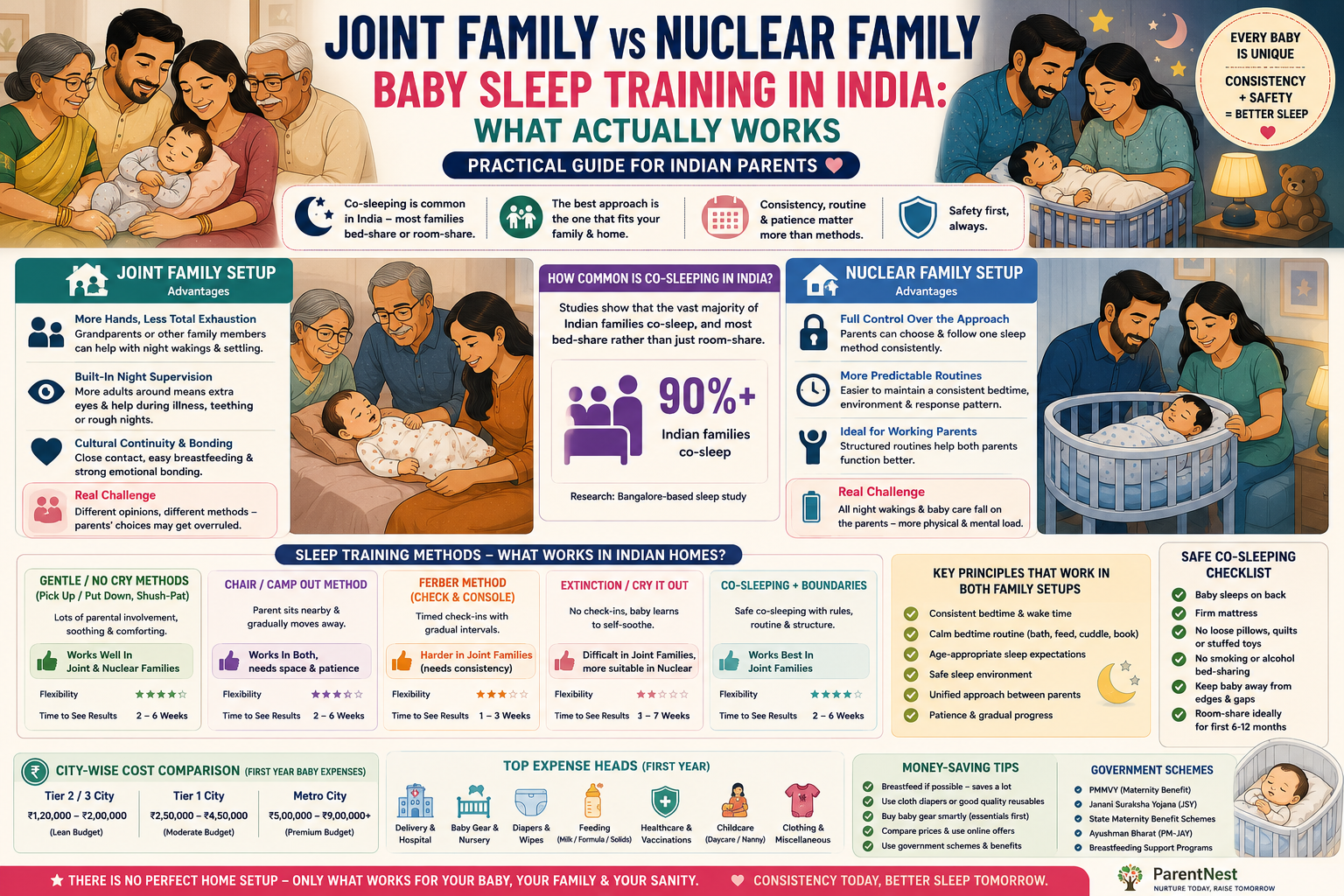
Before comparing family structures, it helps to see the actual scale of the norm. Indian sleep research has found that co-sleeping is the overwhelming default rather than the exception — one widely cited Bangalore-based study found that the vast majority of families co-sleep, and most of those families bed-share (baby sleeping in the same bed as a parent) rather than simply room-share.
This matters because most popular sleep training content — books, YouTube videos, parenting influencers — was written with a Western, nuclear-family, separate-nursery context in mind. It assumes a crib in its own room, one or two caregivers, and a household where “cry it out for five minutes” doesn’t wake up three other family members. None of that maps cleanly onto a joint family flat in Lucknow or a two-bedroom apartment in Pune with grandparents living in.
That doesn’t mean sleep training “doesn’t work” in India — it means the approach has to be adapted to the household, not copied from a book written for a different one.
Before treating joint family living as an obstacle to good sleep, it’s worth naming what it actually gets right.
In a joint family, a fussy baby at 2 AM doesn’t always have to be the parents’ problem alone. A grandparent taking the baby for a slow walk around the house, or a mother-in-law stepping in during a rough teething night, is a genuine, practical form of relief that a nuclear family — especially one without nearby extended family — simply doesn’t have access to. Many parents in joint households report they never needed to buy or use a baby swing or sleep-training program, because there were consistently two to four sets of hands to settle the baby when things got difficult.
Because multiple adults are physically present and often awake or lightly sleeping nearby, joint family co-sleeping arrangements can mean an extra layer of eyes on the baby overnight — useful during illness, teething, or the newborn stage when frequent checks matter.
For many Indian families, sleeping close to the baby isn’t a “problem to solve” — it’s simply how care and closeness have always been expressed. Frequent night feeds are easier to manage for breastfeeding mothers when the baby is within arm’s reach, and many pediatricians in India actively support this as compatible with healthy infant development, not in opposition to it.
The flip side is one every joint-family parent will recognize: when four adults have four different opinions about how the baby should sleep, whose lap they should sleep on, and whether “crying a little” is ever acceptable, the parents’ preferences can get quietly overruled — even when they’re the ones losing the most sleep.
A nuclear family — just the two parents, sometimes with paid help — has the freedom to choose and consistently apply one sleep approach without needing anyone else’s buy-in. If you decide on room-sharing with a bedside bassinet and a wind-down routine at 8 PM, there’s no one else to convince.
Consistency is one of the most important ingredients in any sleep approach, gentle or structured. It’s simply easier to keep a consistent bedtime routine, room temperature, and response pattern when only two adults are handling the baby, compared to a house where the baby might be handled differently by whoever happens to be free that night.
The obvious cost is exhaustion. Without extra hands, both parents absorb every night waking, every rough patch, and every “off” night directly — which is a major reason working parents, particularly mothers who need to return to office within months, often actively seek out structured sleep training in nuclear households, simply to protect their own functioning.
“Sleep training” isn’t one method — it’s a spectrum, from fully gentle to fully structured. Here’s how the common approaches map onto Indian joint-family and nuclear-family realities.
The baby sleeps in the same room as a parent, but on their own firm, separate surface — a bedside bassinet or crib. This is the approach most Indian pediatricians and international safety bodies favor, since a shared room appears to meaningfully reduce the risk of sudden infant death syndrome (SIDS) compared to a baby sleeping entirely alone, while keeping the sleep surface itself safe.
In a joint family: Works well if the couple has their own room; can be harder in a one-room shared setup, where a compromise position (bassinet on the parents’ side, away from other family members’ sleeping area) may be needed. In a nuclear family: Usually the easiest structure to implement from birth.
A parent sits in a chair beside the crib as the baby falls asleep, gradually moving the chair further from the crib over successive nights until the parent is out of the room. This is far less disruptive — and far less likely to cause a household conflict — than a full cry-it-out approach.
In a joint family: One of the more realistic options, since it doesn’t involve extended crying that might alarm or worry grandparents in an adjoining room. In a nuclear family: Effective, though it takes patience over multiple nights.
Instead of a defined “method,” this approach slowly shifts sleep associations — for example, gradually reducing rocking-to-sleep in favor of patting, then just voice, then just presence — over one to two weeks rather than a single hard transition.
In a joint family: Often the best starting point, since it requires everyone in the house to make small, low-conflict changes rather than one dramatic one. In a nuclear family: Works well but takes longer than structured methods; ideal for parents uncomfortable with any crying.
Involves letting the baby self-settle for defined, gradually increasing intervals with brief parental check-ins. Indian sleep research is clear that where this approach is chosen deliberately and appropriately, it is not associated with long-term emotional harm — but it is also the method most likely to cause real friction in a joint household, since crying (even brief, monitored crying) can be distressing for other family members to hear, and often triggers immediate intervention from a well-meaning grandparent.
In a joint family: Usually the hardest to implement without a prior, explicit conversation with everyone in the house — attempting it without buy-in almost always leads to someone stepping in mid-attempt, which can make things harder for the baby, not easier. In a nuclear family: More straightforward to apply consistently, since there’s no third party to unintentionally interrupt the process.
If an older child shares the room with the baby during the early nights of a new approach, three realistic options exist: temporarily moving the older child to sleep with a grandparent or in the parents’ room for the first several nights; using the gentler chair method specifically to minimize noise; or accepting that gradual, no-cry changes may simply take longer in a shared-room household — which is a reasonable trade-off, not a failure.
This is often the hardest part of sleep training in an Indian joint family — not the method itself, but the family conversation around it.
Rather than framing the conversation as “your way is wrong,” it helps to lead with what everyone already agrees on: everyone wants the baby to be calm, well-rested, and healthy. Framing a new approach as “I want to try something that might help all of us get more rest” tends to land better than “we’re doing it differently now.”
Sharing that sleep training, when done appropriately, is not linked to long-term emotional harm — and is associated with better sleep for the whole household — can help reframe the conversation from tradition-versus-modernity into a shared, practical goal.
Many joint families are doing something genuinely valuable that’s easy to overlook in the sleep-training conversation: consistent, safe co-sleeping practices, established night-feeding rhythms, and a support system nuclear families often lack entirely. Naming this explicitly — rather than treating the whole household approach as something to be replaced — tends to lower defensiveness considerably.
Rather than announcing a permanent change, framing a new approach as a one-week trial — with a clear check-in afterward — is far easier for extended family to accept than an open-ended shift, and gives everyone, including the parents, room to change course if it isn’t working.
For many Indian households, the realistic and preferred choice will be to continue co-sleeping rather than sleep train — and that is a legitimate choice, not a compromise. If that’s the path your family takes, a few non-negotiable safety basics apply regardless of family structure:
The goal in a co-sleeping household isn’t to eliminate the practice — it’s to make sure every adult involved is applying the same basic safety rules consistently, every night, regardless of who is on duty.
Rather than asking “which is better, joint family or nuclear family sleep training,” a more useful question is: what does my specific household actually make possible? Use this quick framework:
No — sleep training is a choice, not a requirement. Many joint families manage well with shared caregiving and consistent co-sleeping practices instead. It becomes worth considering mainly when a specific problem — exhaustion, inconsistent handling by different caregivers, or a return to work — makes the current approach unsustainable for the parents.
Lead with shared goals rather than correction, share evidence that appropriate sleep training isn’t linked to long-term harm, acknowledge what the joint family is already doing well, and propose a short, time-bound trial rather than a permanent change.
Yes, when done with consistent safety basics — back sleeping, a firm surface, no heavy bedding near the baby’s face, and every caregiver in the house following the same rules. The specific setup (room-sharing versus bed-sharing) matters more for safety than the family structure itself.
Gentle, gradual approaches — the chair method or slow sleep-shaping over one to two weeks — tend to cause the least household friction, since they don’t involve extended crying that might prompt a well-meaning family member to intervene mid-attempt.
Indian and international sleep research consistently finds that appropriately implemented sleep training is not associated with long-term emotional harm, and is linked to better sleep outcomes for the whole family, not just the baby.
There is no universally “correct” family structure for baby sleep in India — a joint family and a nuclear family each come with real, distinct advantages and real, distinct trade-offs, and the right approach is the one that matches the hands, space, and agreements you actually have at home, not the one a book or influencer assumes you have. Whether your household ends up sleep training gently, co-sleeping safely, or landing somewhere in between, the two things that matter most are consistency among everyone involved and the same basic safety rules applied every single night, no matter whose turn it is to settle the baby.
Looking for more on getting your baby’s sleep on track? Check out our Baby Sleep Calculator and Wake Window Calculator to build an age-appropriate schedule that fits your household.