Physical Address
304 North Cardinal St.
Dorchester Center, MA 02124
Physical Address
304 North Cardinal St.
Dorchester Center, MA 02124

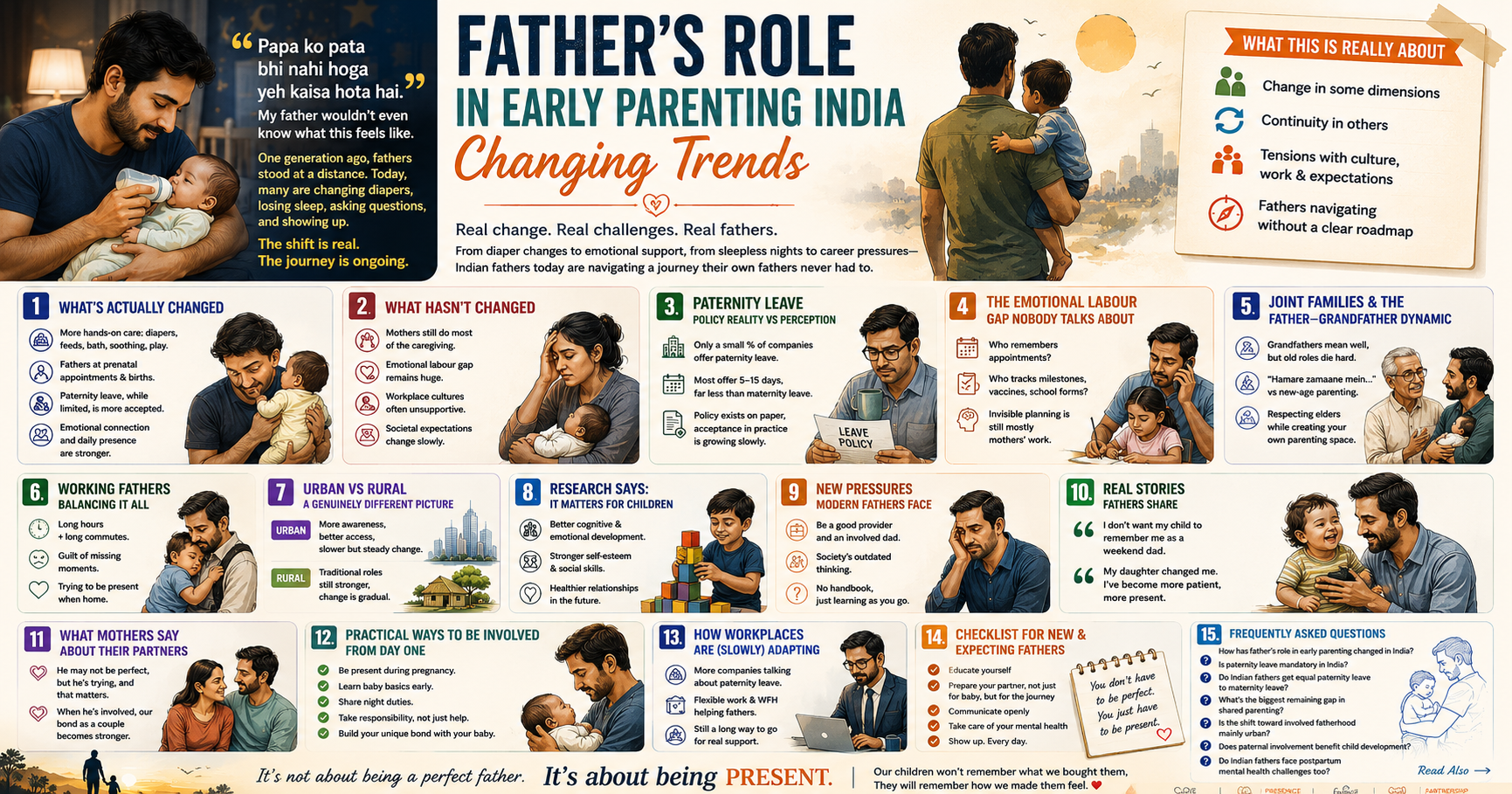
Vikram’s own father visited exactly twice during the hospital stay when Vikram was born — once to see the baby, once to bring his wife home. He never changed a single diaper in Vikram’s first year, not because he didn’t love his son, but because it genuinely never occurred to him, or to anyone around him, that it was his job. Thirty-two years later, Vikram found himself at 3 AM standing over a bassinet doing a diaper change he’d done maybe two hundred times by then, his own daughter eleven days old, and he remembers thinking, almost involuntarily, “Papa ko pata bhi nahi hoga yeh kaisa hota hai.” My father wouldn’t even know what this feels like.
It wasn’t a resentful thought. Vikram describes it, now, as more of a quiet marker — proof of how much the actual, daily texture of early fatherhood has shifted in one generation in urban India, even while so much of the surrounding culture, the extended family expectations, the workplace policies, the unspoken assumptions about “who does what,” has moved far more slowly, or not at all.
This is the real story of Indian fatherhood right now — not a clean, triumphant “modern fathers do everything now” narrative, and not the opposite “nothing has really changed” cynicism either. It’s messier and more interesting than either: genuine, visible change in some dimensions, deep continuity in others, and a specific set of tensions — with employers, with grandparents, with cultural scripts about masculinity — that today’s Indian fathers are navigating largely without a clear roadmap, because their own fathers mostly didn’t have to.
The shift in Indian fatherhood is real, and it shows up in concrete, observable ways rather than just sentiment or marketing language:
Hands-on infant care participation has genuinely increased, particularly in urban, dual-income, nuclear-family households. Diaper changes, night feeds (via expressed milk or formula), soothing a crying baby, bathing — tasks that were almost universally considered exclusively maternal or domestic-help territory a generation ago are now commonly, though not universally, shared.
Fathers are increasingly present at prenatal appointments and childbirth itself. A generation ago, it was common, even in urban families, for fathers to wait outside the delivery room entirely, sometimes not present in the hospital at all during labour. Today, particularly in private urban hospitals, father presence during labour and delivery has become far more normalised and, in many hospitals, actively encouraged.
Paternity leave, while still limited compared to global standards, is now a genuine workplace conversation in urban corporate India — something that essentially didn’t exist as a formal policy conversation for most Indian companies even fifteen years ago.
Fathers are more visibly involved in early developmental engagement — reading to infants, structured play, attending paediatrician visits — activities historically coded as almost entirely maternal in Indian parenting culture, now increasingly treated as a shared or even specifically paternal responsibility in many urban households.
Social and media narratives have shifted meaningfully. Advertising, parenting content, and public conversation increasingly depict and normalise hands-on fatherhood in a way that would have been unusual, even mildly mocked, in mainstream Indian media a generation ago.
It’s important, and more honest, to name what remains largely unchanged, because an uncritical “fathers do everything now” narrative doesn’t match most families’ lived reality.
The default parent for logistics and mental load remains overwhelmingly mothers, even in households where fathers are genuinely hands-on with hands-on tasks. Remembering vaccination schedules, tracking developmental milestones, managing the household’s broader coordination around the baby — this “invisible” cognitive and organisational labour remains disproportionately maternal in the large majority of Indian households, even progressive ones.
Career sacrifice around childcare remains heavily gendered. Career pauses, reduced work hours, or turning down opportunities specifically due to childcare responsibilities remain overwhelmingly more common among mothers than fathers, even in dual-income urban families where both partners describe themselves as equally committed parents.
Extended family and social expectation still assumes maternal primacy in most contexts — a father taking equal or greater responsibility for a young child, particularly in more traditional or non-metro settings, can still draw genuine surprise, occasional gentle mockery, or unsolicited advice from relatives in a way mothers doing the identical tasks simply don’t experience.
Formal workplace support remains genuinely limited, particularly for non-corporate, informal sector, or smaller-company employment, which together constitute the large majority of Indian employment — meaning the visible shift in urban corporate fatherhood doesn’t reflect most Indian fathers’ actual working conditions or available leave.
Night-time and physically demanding infant care still skews maternal in most households, even progressive urban ones, particularly around breastfeeding logistics, which naturally tether a significant portion of night care to the mother regardless of how willing or available the father is.
This is one of the most searched, and most misunderstood, aspects of the changing-fatherhood conversation.
Central government employees are entitled to 15 days of paternity leave under central civil service rules — a genuine, long-standing formal entitlement, though limited compared to many other countries’ policies.
Private sector paternity leave has no uniform mandatory national policy in India comparable to maternity leave’s legal framework under the Maternity Benefit Act — meaning private sector paternity leave, where it exists, is entirely at individual company discretion rather than legal requirement, resulting in enormous variation across employers, from generous multi-week policies at some larger, progressive companies to zero formal leave at many others.
Larger, particularly multinational and tech-sector companies have increasingly introduced formal paternity leave policies, sometimes ranging from 2 to 6 weeks or more, reflecting global parent-company standards and competitive talent-retention considerations rather than any Indian legal requirement.
Smaller companies, traditional family businesses, and the informal sector — which together employ the vast majority of Indian workers — typically offer minimal to no formal paternity leave, meaning the father’s actual time with a newborn in these settings often depends entirely on individual employer goodwill, accumulated personal/casual leave, or informal arrangement rather than any structured entitlement.
There’s a meaningful gap between policy existence and actual uptake even where paternity leave exists on paper — some fathers report workplace cultural pressure (explicit or implicit) discouraging full use of available paternity leave, reflecting persistent professional norms that don’t yet fully accommodate genuinely equal caregiving expectations for men.
Beyond visible tasks (diaper changes, feeding, bathing), a less discussed but significant gap remains around what’s often called “emotional” or “cognitive” labour — the planning, anticipating, worrying, and coordinating that keeps a household and a baby’s needs running smoothly.
Remembering appointments, tracking developmental milestones, anticipating needs before they become urgent (noticing supplies running low, recognising early signs something might be off) — this category of parenting work remains disproportionately maternal in most Indian households, even ones where fathers are genuinely, actively hands-on with physical tasks.
This gap is often invisible even to the couples experiencing it, precisely because it doesn’t show up as a discrete, countable task the way a diaper change does — many fathers who consider themselves highly involved genuinely don’t recognise how much of this planning and anticipating work their partner is doing largely unremarked, simply because it doesn’t look like “work” in the way physical caregiving tasks visibly do.
Naming this gap explicitly, as a couple, is one of the more useful conversations Indian couples navigating early parenthood can have — not as an accusation, but as an honest inventory of what each partner is actually carrying, since mismatched perception of “who does how much” is a genuinely common source of quiet resentment in otherwise happy, well-functioning new-parent relationships.
Multi-generational households add a specific layer to how Indian fatherhood is changing, since a father’s own hands-on involvement often plays out directly alongside his own father’s — and his mother’s, and mother-in-law’s — very different generational assumptions.
Grandfathers are often the least surprised by the shift, in practice, once it’s actually happening in front of them — many Indian fathers report their own fathers becoming genuinely warm, engaged, hands-on grandfathers, even after having been relatively hands-off fathers themselves, a pattern several fathers describe as a kind of generational “second chance” at closeness that grandfathers seem to actively embrace once grandchildren, rather than their own children, are involved.
Mothers-in-law’s reactions to hands-on sons tend to be more mixed, ranging from genuine pride and active encouragement to occasional, usually good-natured, teasing (“mard aadmi diaper badal raha hai”) that can nonetheless carry real social friction for some fathers navigating this in front of extended family regularly.
Joint family settings can either significantly support or significantly constrain a father’s hands-on involvement, depending heavily on the specific family’s dynamics — in some joint families, additional adult hands genuinely free up a father to be more present and less exhausted; in others, established gendered task expectations within the household mean a father’s attempts at hands-on involvement can be gently but persistently redirected back toward “his” traditionally expected roles.
Younger fathers in joint families increasingly report having explicit, sometimes difficult, conversations with parents and in-laws about wanting a different, more involved role than the one their own father modelled — a conversation that didn’t typically need to happen a generation ago, precisely because the expected role wasn’t really in question then.
Indian corporate and professional culture still largely assumes an “always available” employee — a norm that historically applied unevenly by gender, with mothers more often expected to (and sometimes pressured to) scale back visible ambition around childcare responsibilities, while fathers’ career trajectories were rarely expected to be affected by fatherhood at all.
Fathers actively trying to be more hands-on today often report a genuine, largely unaddressed tension: wanting to leave early for a bath-and-bedtime routine, or take time for a paediatrician visit, in workplace cultures that don’t yet have clear, normalised scripts for fathers doing this the way maternal caregiving needs are (however imperfectly) accommodated.
Some fathers report actively concealing or downplaying caregiving-related time off or schedule adjustments, specifically because they perceive (sometimes accurately, sometimes based on assumption) that being visibly identified as a highly hands-on father could be read, in some traditional workplace cultures, as reduced professional seriousness or ambition — a genuinely different professional risk calculation than what an equally hands-on mother would generally face, though for very different, historically rooted reasons.
Remote and hybrid work arrangements, which expanded significantly in India post-2020, have had a genuinely meaningful, if uneven, positive effect on many fathers’ ability to be present for daily caregiving moments (a feeding, a nap-time routine) that a fully in-office schedule would have made largely inaccessible.
Much of the “changing Indian fatherhood” narrative reflects urban, educated, often dual-income household experience specifically — it would be inaccurate to characterise this as a uniform national shift; rural and smaller-town family structures, work patterns, and cultural expectations around gendered caregiving roles remain, in many regions, considerably closer to previous generational norms.
Economic necessity, rather than shifting gender philosophy, sometimes drives hands-on rural fatherhood — in agricultural or informal-sector households where both parents’ labour is economically essential and childcare help isn’t readily available or affordable, fathers may become genuinely hands-on out of practical necessity, a different underlying driver than the more deliberate, values-driven shift often described in urban professional contexts.
Migration patterns also shape this picture significantly — many rural and semi-urban fathers work in distant cities for extended periods, seeing their young children only periodically, a completely different fatherhood experience from the “changing hands-on urban father” narrative that dominates most mainstream discussion of this topic, and one that arguably represents a larger share of Indian fathers’ actual lived experience than the urban narrative suggests.
It’s worth being explicit that this article, like most available research and discussion on the topic, skews toward describing urban, middle-class, and upper-middle-class experience specifically — a limitation worth naming honestly rather than implying a more universal national shift than the evidence actually supports.
Broader developmental research, largely though not exclusively from international studies, generally links active paternal involvement in early childhood with a range of positive outcomes — including language development, emotional regulation, and social skills — though most of this research reflects Western study populations, and India-specific longitudinal research on this specific question remains comparatively limited.
What does seem to translate meaningfully across cultural contexts, based on available research, is the general principle that consistent, responsive caregiving from multiple attached adults — rather than the specific gender identity of the caregiver — is what most directly benefits early childhood development, suggesting the quality and consistency of paternal involvement likely matters more than treating “father involvement” as an undifferentiated single variable.
Maternal mental health also appears to benefit meaningfully from genuinely shared caregiving responsibility, based on broader research into postpartum wellbeing — the emotional and logistical relief of a genuinely equal partner in early caregiving is repeatedly identified as a significant protective factor against postpartum depression and burnout, an indirect but important reason involved fatherhood matters beyond its direct effect on the child.
It’s worth treating claims in this specific area with appropriate humility — much of the confident-sounding “engaged fathers produce X specific outcome” content circulating online overstates the certainty of the underlying research, particularly regarding India-specific contexts where dedicated study remains limited.
Alongside genuine positive change, today’s Indian fathers navigate several pressures their own fathers largely didn’t face, worth naming honestly rather than presenting only the positive side of the shift.
The expectation to be both a strong financial provider (the traditional expectation) and a hands-on, emotionally present caregiver (the newer expectation), often without a corresponding reduction in either expectation to make room for the other — creating a genuinely demanding dual standard many fathers describe feeling privately overwhelmed by.
Comparison pressure via social media, similar in structure to the comparison pressure widely discussed for mothers — images and narratives of exceptionally involved, seemingly effortlessly present fathers online can create a private sense of inadequacy for fathers navigating the genuine exhaustion and imperfection of actual early parenthood.
Uncertainty around role models, since many of today’s fathers explicitly describe not having a close personal model for the kind of hands-on fatherhood they’re attempting — meaning a lot of navigation happens through trial, error, and peer conversation with similarly-aged fathers, rather than intergenerational guidance from their own fathers, who mostly didn’t do this specific version of the role.
Mental health and emotional support resources specifically for fathers remain significantly underdeveloped in India compared to the (still limited, but comparatively more developed) postpartum support conversation around mothers — paternal postpartum adjustment, including genuine paternal postpartum depression (a recognised, if less discussed, phenomenon), receives markedly less cultural attention, screening, or resource development in India currently.
Vikram, Mumbai — “My father genuinely didn’t know how to hold a newborn safely when my daughter was born — he told me so, honestly, a little sheepishly. I had to teach him. That felt strange at first, teaching my own father something, but it also told me everything about how different this generation’s starting point actually is.”
Aditya, Bangalore — “I took the full paternity leave my company offered — four weeks — and I was genuinely one of only two men in my entire office who’d ever taken it fully rather than cutting it short. My manager was supportive, but I could tell some colleagues found it a little unusual. Nobody said anything negative directly. It was more in the raised eyebrows.”
Farhan, joint family, Lucknow — “My father-in-law was more surprised than anyone when I started doing night feeds regularly. But my own father-in-law being a grandfather now is honestly wonderful to watch — he’s more affectionate and hands-on with my son than I remember him ever being with my wife growing up. Something about being a grandfather unlocked a different version of him.”
Rohit, Chennai, informal sector worker — “Nobody talks about fathers like me in these ‘changing fatherhood’ conversations. I don’t have paternity leave. I took two unpaid days when my son was born because that’s what my employer could manage, and I was back at work. I’m as hands-on as I can be in the hours I have, but the conversation about ‘modern involved fathers’ mostly isn’t really about people in my situation.”
To keep this honest rather than one-sided, it’s worth including how mothers themselves describe the shift, since perception gaps between partners are a genuinely common theme.
Many mothers report genuine appreciation for meaningfully increased hands-on involvement compared to what they observed in their own parents’ generation, while also noting the emotional/cognitive labour gap described in Section 4 remains real and under-acknowledged even by otherwise very involved partners.
Several mothers specifically describe the “he helps when asked, but doesn’t anticipate” pattern as the most common remaining gap — a father who will do virtually any task requested, and does it well, but who doesn’t independently track, anticipate, or initiate caregiving needs the way the mother does by default, a distinction several mothers describe as more exhausting than the raw task-hours themselves.
Some mothers in joint families specifically describe extended family dynamics, rather than their own partner’s willingness, as the actual constraint on more equal caregiving — an involved father sometimes redirected, gently but persistently, back toward “his” traditional role by well-meaning grandparents, more than by his own preference.
A growing, though still limited, number of Indian companies — particularly larger multinationals and tech-sector employers — have introduced formal paternity leave policies ranging from a couple of weeks to, in some progressive cases, several months, often explicitly framed around talent retention and competitive positioning in the broader employment market rather than purely values-driven policy design.
Flexible and hybrid work arrangements, which expanded substantially in Indian corporate culture from 2020 onward, have had a meaningful secondary effect on father involvement, even where not explicitly designed as a parenting-support policy — enabling presence for daily caregiving moments that a strict in-office schedule would have prevented.
Workplace culture change generally lags formal policy change, meaning even companies with generous paternity leave on paper sometimes retain informal cultural norms (manager expectations, peer perception) that discourage full utilisation — a gap several fathers specifically flagged in Section 10’s stories.
Government policy conversation around expanding formal paternity leave entitlements has occurred periodically in India, though no comprehensive national private-sector mandate comparable to the Maternity Benefit Act currently exists — this remains an area of ongoing policy discussion rather than settled law, worth checking current status if it’s specifically relevant to your own employment situation.
Hands-on infant caregiving — diaper changes, feeding, bathing, active presence at birth and prenatal appointments — has genuinely increased, particularly in urban, dual-income households, though the “invisible” mental and organisational labour of parenting remains disproportionately maternal in most families.
Only for central government employees, who are entitled to 15 days under central civil service rules. Private sector paternity leave has no uniform legal mandate and varies entirely by individual employer policy.
No — maternity leave is legally mandated at 26 weeks for eligible employees under the Maternity Benefit Act, while paternity leave has no comparable national legal requirement in the private sector, resulting in enormous variation across employers.
Many mothers and researchers point to the “emotional” or cognitive labour of parenting — anticipating needs, tracking milestones and appointments, coordinating logistics — as the most persistent gap, even in households where fathers are genuinely hands-on with physical caregiving tasks.
Largely, yes — most available research and discussion reflects urban, educated, dual-income household experience specifically; rural and smaller-town caregiving patterns, shaped by different economic and cultural factors, often look considerably different.
Available research, largely from international studies given limited India-specific longitudinal data, generally links consistent, responsive caregiving from multiple attached adults with positive developmental outcomes — suggesting quality and consistency of involvement matter more than treating father involvement as a single undifferentiated factor.
Yes — paternal postpartum depression and adjustment difficulty is a recognised phenomenon, though it receives markedly less cultural attention, screening, and resource development in India currently compared to (already limited) maternal postpartum mental health support.
This article reflects commonly observed trends and available research on Indian fatherhood, which skews toward urban, educated, and dual-income household experience specifically; individual family circumstances vary considerably. For specific workplace leave entitlements, always verify current policy directly with your employer or relevant government source.