Physical Address
304 North Cardinal St.
Dorchester Center, MA 02124
Physical Address
304 North Cardinal St.
Dorchester Center, MA 02124

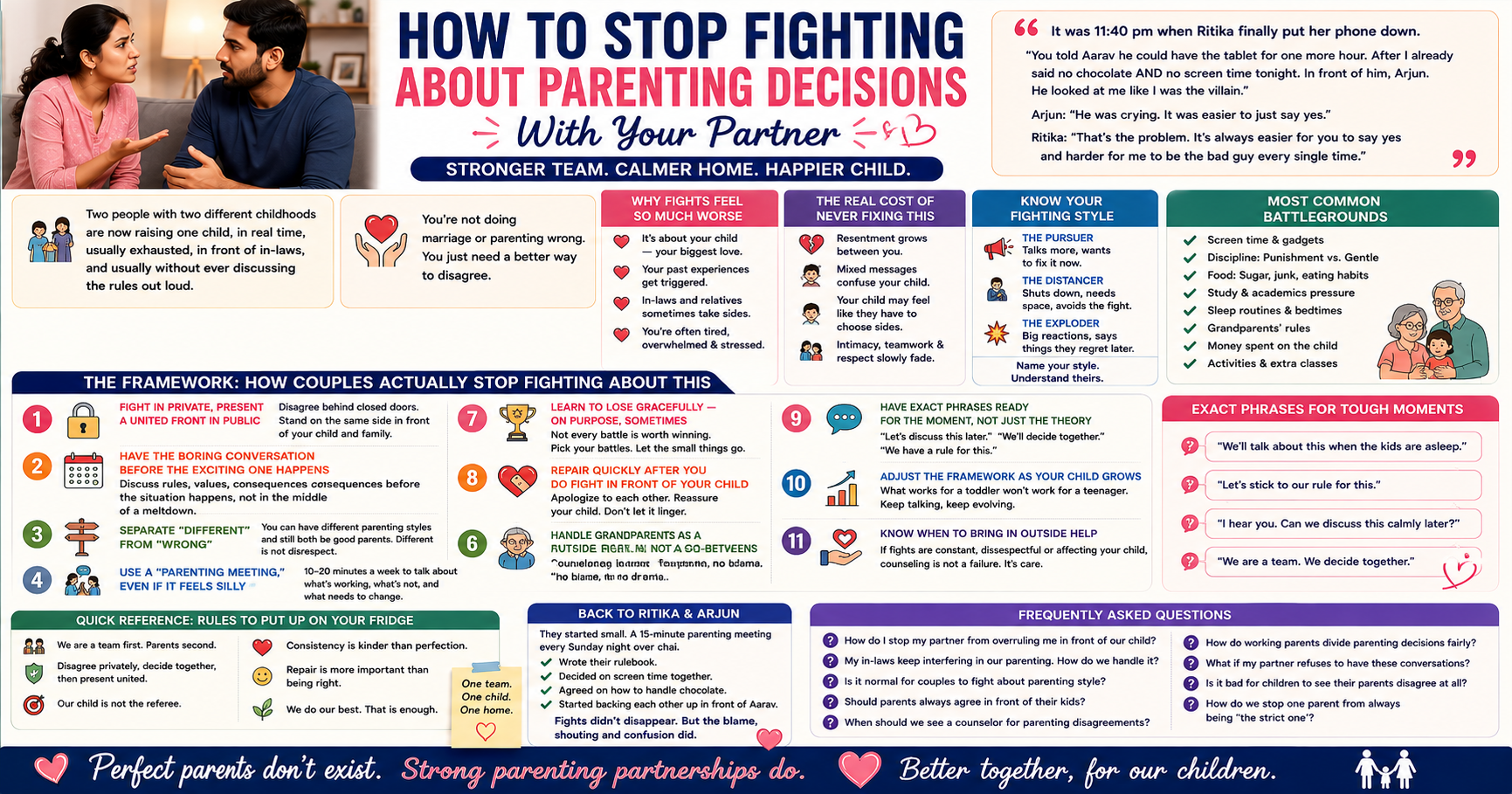
It was 11:40 pm when Ritika finally put her phone down and looked at Arjun across the bed like he was a stranger.
“You told Aarav he could have the tablet for one more hour. After I already said no chocolate AND no screen time tonight. In front of him, Arjun. He looked at me like I was the villain.”
Arjun didn’t even look up from his laptop. “He was crying. It was easier to just say yes.”
“That’s the problem. It’s always easier for you to say yes and harder for me to be the bad guy every single time.”
If you’ve had a version of this exact fight — maybe not about a tablet, maybe about spanking, or sugar, or which grandmother’s rules apply this weekend — you’re not doing marriage or parenting wrong. You’re doing something incredibly common that nobody warns you about before you have kids: two people with two different childhoods are now trying to raise one child, in real time, usually exhausted, usually in front of an audience of in-laws, and usually without ever having actually discussed the rules out loud.
This is the story of how couples like Ritika and Arjun stop fighting about parenting — not by agreeing on everything, because you never will, but by changing how the disagreement happens. Grab a chai, because this one’s long, and honestly, if you’re reading this at midnight after your own version of that fight, I wrote it for you.
Before we get into the “how,” it helps to understand the “why.” Because parenting arguments hit differently than a fight about whose turn it is to load the dishwasher.
You’re not actually fighting about the tablet. You’re fighting about whose childhood gets to be the template. Ritika grew up in a home where “no” meant no, full stop, because her father was strict and her mother backed him up in front of the kids even when she disagreed privately — they’d sort it out later, behind closed doors. Arjun grew up as the youngest of three, doted on, and the rule in his house was whoever was around in the moment made the call. Neither of them is wrong. They’re both just running the only operating system they know.
There’s no referee. At work, there’s a manager, a process, an HR policy. At home, when you and your partner disagree about discipline, there’s nobody to appeal to except each other — and increasingly, in Indian households, a sasu-maa or nanaji who’s happy to cast the deciding vote whether you asked for it or not.
The stakes feel infinite. A fight about the dishwasher affects tonight. A fight about “are we too strict” or “are we raising a spoiled child” feels like it’s deciding who your kid becomes in twenty years. That’s a lot of pressure to put on a 11:40 pm hallway conversation.
You’re both running on empty. Sleep-deprived parents fight more, full stop. There’s a reason the classic new-parent argument happens between 9 pm and midnight — that’s when the day’s patience reserves are at zero and the next feed or wake-up is looming.
Once you see the fight for what it actually is — two exhausted people defending their own upbringing while genuinely trying to do right by their child — it gets a lot easier to stop treating your partner like the opposition.
There’s also a quieter reason these fights sting more than they should: nobody prepares you for this specific kind of disagreement before you’re in it. Before marriage, you’ve likely discussed money, where you’ll live, maybe even how many kids you want. Very few couples sit down before their first child arrives and actually talk through how they’ll discipline, how much screen time feels reasonable, or what happens when their own parents disagree with a decision they’ve made together. You find out you disagree in real time, usually at the worst possible moment, which makes it feel personal and sudden when really it’s just the first time the topic ever came up.
A lot of couples let parenting disagreements slide because “it’s not that serious” or “we’ll figure it out.” Here’s what actually happens if you don’t:
Kids learn to play you against each other. By age four, most children have figured out that if Papa says no, Mummy might say yes if you ask sweetly enough, or vice versa. This isn’t manipulation in the sinister sense — it’s just intelligence. But it teaches a child that rules are negotiable based on who they ask, which makes every single boundary in the house harder to hold.
Resentment builds silently. The parent who’s always “the strict one” starts to feel like the family enforcer while the other parent gets to be the fun one. Over years, that imbalance turns into real relationship resentment that often has nothing to do with parenting anymore.
Undermining in front of the child damages both parents’ authority — not just one. When one parent overrules the other in the moment, the child doesn’t just lose respect for the parent who got overruled. Child psychologists who study family systems consistently find that visible parental conflict, more than the specific rule itself, is what unsettles children — kids read tension long before they understand the argument.
It spills into everything else. Couples rarely fight about only parenting. A pattern of unresolved parenting conflict tends to bleed into finances, intimacy, and general goodwill, because every unresolved disagreement is evidence, in the moment of the next one, that “we can’t seem to get on the same page about anything.”
There’s a physical cost too, one couples rarely connect back to the actual argument. Chronic, unresolved tension at home — even the low-grade kind that never turns into a shouting match — keeps both partners in a mild, near-constant state of alert. Sleep gets worse, patience with the child (not just each other) gets shorter, and small annoyances that would normally roll off you start landing harder. Couples often describe feeling “on edge” for weeks without connecting it to the fact that the tablet argument from three Tuesdays ago never actually got resolved, just paused.
The good news: none of this is permanent. It’s a pattern, and patterns can be interrupted.
Here’s something most parenting advice skips entirely: not all couples fight the same way, and the fix that works for one pattern can actually make another pattern worse. Before you try any of the steps ahead, it helps to recognize which of these you and your partner default to.
The Escalator + Escalator pair. Both partners raise their voice, both dig in, and a disagreement about bedtime turns into a full argument within two minutes. If this is you, the priority isn’t better arguments — it’s learning to pause before either of you speaks, because for this pairing, the content of the disagreement almost never matters as much as the tone it started in.
The Avoider + Escalator pair. One partner wants to talk it through immediately; the other shuts down, goes quiet, or leaves the room. This is exhausting for both people — the escalator feels ignored, the avoider feels cornered. If this is your pattern, the fix usually isn’t forcing the conversation in the heat of the moment at all. It’s agreeing in advance on a phrase like “I need twenty minutes and then I promise we’ll talk,” so the avoider gets space without the escalator feeling stonewalled.
The Appeaser + Appeaser pair. Neither partner wants to “start a fight,” so disagreements get swallowed for weeks until they leak out sideways — as sarcasm, as passive digs, as suddenly bringing up something from three months ago during an unrelated conversation. If this is you, the scheduled “parenting meeting” in Step 4 below matters more than almost anything else here, because it forces a conversation that would otherwise never happen on its own.
The Silent Scorekeeper. One partner appears calm on the surface but is quietly tallying every time they “gave in” — I let the tablet thing go last week, so this week he owes me one. This one is sneaky because it doesn’t look like fighting at all, until the scorecard tips over and comes out all at once, usually over something small and unrelated.
Most couples are a blend, and the blend often shifts depending on how tired you both are. Naming your pattern out loud to each other — even just saying “I think I’m an avoider and you’re an escalator, no wonder this keeps happening” — tends to defuse a surprising amount of tension on its own, because it turns “you’re overreacting” or “you never talk to me” into a shared, almost funny observation about how you’re both wired, rather than a character flaw in either of you.
Before the framework, let’s name the actual fights, because “communicate better” is useless advice if you don’t know what you’re miscommunicating about. In most Indian households, the recurring flashpoints tend to be:
Notice something? Almost none of these are really about the child. They’re about values, upbringing, money anxiety, and who gets to be right. Which is exactly why “just talk it through” doesn’t work unless you change how you talk it through.
It’s also worth naming that some of these battlegrounds carry more weight in India specifically than the generic “parenting advice” you’ll find written for a Western audience acknowledges. A couple living with or near in-laws doesn’t have the option of simply “setting a boundary” the way a nuclear family three time zones away from grandparents does — the grandparent is in the next room, at the dinner table, or picking your child up from school. Academic pressure in many Indian cities starts earlier and runs hotter than what most global parenting content assumes, which is why “just let kids be kids” advice often falls flat for parents genuinely worried about competitive school admissions. And the expectation that a mother “naturally” handles the bulk of caregiving, even in dual-income households, remains stubbornly common enough that it deserves to be named directly rather than danced around — because a lot of “we keep fighting about parenting” is, underneath, actually “we keep fighting about who does the invisible work of parenting.”
I’m going to walk you through this the way I’d explain it to a friend over chai, not as a clinical checklist. Take what’s useful, ignore what isn’t — every marriage is different.
This is the single biggest shift, and it’s also the hardest, because it requires doing something deeply unnatural in the heat of the moment: staying quiet.
Here’s the rule: if your partner has just made a parenting call — right or wrong — in front of your child, you do not overrule them on the spot. Not because they’re always right, but because a child watching two parents contradict each other learns that rules are unstable, and that’s more damaging than one imperfect decision.
Instead, you say something neutral like “let’s talk about this later” or you simply let it go for that moment. Then, later — not at 11:40 pm when you’re both drained, ideally the next morning over chai — you have the real conversation. “Hey, when Aarav asked for the tablet last night, I’d already said no earlier. Can we agree on what happens when that comes up?”
This isn’t about one partner losing every private argument to “win” in public. It’s about separating the two questions — what should the rule be and how do we enforce it in the moment — so they don’t collide in front of your child.
Most parenting fights are actually failures of planning, not failures of love. You didn’t fight about the tablet because you disagree on principle — you fought because you’d never actually sat down and decided the screen time rule before your child asked for it at the worst possible moment.
Set aside twenty minutes — genuinely, put it on a to-do list if you have to — to go through the predictable flashpoints before they become 9 pm emergencies:
You won’t think of everything in one sitting. That’s fine. The goal isn’t a perfect rulebook — it’s building the habit of deciding things together, calmly, before you’re both standing in a kitchen at bedtime with a screaming toddler between you.
A lot of couples treat any parenting style that isn’t their own as a mistake to be corrected rather than a valid alternative. Ritika’s instinct is structure and consistency. Arjun’s instinct is warmth and flexibility. Neither is a parenting flaw — both are real, useful traits a child benefits from having in the house.
Try reframing your internal script from “my partner is bad at this” to “my partner has a different strength than me, and our child gets both.” This one mental shift takes the moral charge out of the disagreement. You’re no longer debating who’s the better parent. You’re negotiating how two good instincts combine into one household rule.
This sounds very corporate for something as intimate as raising your child, but couples who do this consistently report it works because it takes the decision out of the emotionally loaded moment. Once a week, or once every two weeks, sit down — even for fifteen minutes — and go through:
Couples who treat this like a standing appointment, the same way you’d protect a work meeting, tend to fight far less in the moment — because the disagreement already happened in a calm, scheduled space instead of an ambush.
This sounds excessive until you try it. A shared note on your phone, split by category — food, screens, discipline, bedtime, money — with two or three lines under each about what you’ve agreed. It doesn’t need to be formal. It just needs to exist somewhere other than two separate memories, because human memory is unreliable, especially the sleep-deprived kind.
The written rulebook does something subtle but powerful: it turns “you never agreed to that” into “let’s check what we wrote down,” which takes the ego out of the disagreement. You’re not accusing your partner of lying or forgetting on purpose. You’re both just checking a shared source of truth.
This is the flashpoint unique to a lot of Indian households, and it deserves its own section, because “my mother-in-law overrides us” is one of the most common parenting complaints there is.
The mistake most couples make is letting the parent who’s related to the grandparent handle it alone. If it’s Arjun’s mother, Arjun is expected to “manage” her, and Ritika either stays silent and resentful or steps in directly and creates in-law tension. Both approaches tend to fail.
What works better: decide the rule together, privately, first. Then whichever partner is the biological child of that grandparent delivers the message, but frames it as “we’ve decided,” not “she wants.” “Amma, hum dono ne decide kiya hai ki abhi Aarav ko chocolate nahi denge, doctor ne mana kiya hai” lands very differently than “Ritika doesn’t want him to have it.” One is a united parenting decision. The other invites the grandmother to see you as the obstacle and your spouse as the reasonable one to appeal to instead.
This matters even more in joint family homes where grandparents aren’t occasional visitors but daily presences with their own long-standing relationship with your child. In those homes, it helps to pick your battles even more deliberately than Step 7 already suggests — reserve direct pushback for things that genuinely matter (safety, health, a value you feel strongly about) and let smaller stylistic differences go, because a running low-grade war with a live-in grandparent exhausts everyone in the house, not just the two of you. Some couples find it useful to occasionally involve the grandparent in the “boring conversation” from Step 2 itself, rather than only informing them after the fact — not because they get a vote, but because a grandparent who feels consulted tends to override far less than one who feels dictated to.
Not every parenting disagreement is worth winning. Genuinely ask yourself: does this affect my child’s safety, values, or wellbeing in a meaningful way — or is this just about what I personally would have done? If your partner wants to let your child wear mismatched socks to school, or eat cereal for dinner once, that’s not a hill worth a cold war over.
Save the real negotiating energy for things that matter: safety, honesty, respect, core values. Letting your partner “win” the small stuff isn’t losing — it’s depositing goodwill into an account you’ll need later, for the arguments that actually count.
You will, eventually, still argue in front of your kid. Everyone does, no matter how good the system. What matters more than avoiding it entirely is what happens next. Children don’t need parents who never disagree — they need to see that disagreements get resolved.
A simple, sincere repair works: “Sorry beta, Mumma aur Papa thoda argue kar rahe the, but we’re okay now, we love each other and we love you.” This does something research on family conflict consistently supports — it’s not the disagreement itself that unsettles children, it’s disagreement that never gets visibly resolved.
Knowing the theory is one thing. Actually having the words ready when your partner has just said something you disagree with, in front of your child, in the middle of a public meltdown, is another thing entirely. A few scripts that couples who’ve gotten good at this actually use:
Scripts feel awkward the first few times. They stop feeling awkward once you’ve used them under real pressure and noticed they actually work.
The fights you have over a two-year-old’s tantrum are not the fights you’ll have over a fourteen-year-old’s phone or a seven-year-old’s homework pressure. Couples who assume the “rules” they set when their child was a toddler will simply carry forward often get blindsided later, because the flashpoints change even when the underlying disagreement — how strict versus how flexible to be — often stays exactly the same.
With toddlers, most conflict is about immediate behavior: tantrums, food, sleep, screen time. With school-age children, it shifts toward academic pressure, extracurricular scheduling, and how much independence to allow. With teenagers, it becomes about privacy, phones, curfews, and trust. The specific step-by-step framework above still applies at every stage — private disagreement, public alignment, scheduled check-ins, written agreements — but revisit your “rulebook” at least once a year, or whenever your child moves into a new stage, rather than assuming decisions made when they were three still make sense when they’re thirteen.
If the same fight has repeated for months with no movement, if one partner has started keeping score, or if the conflict has stopped being about parenting and started being about contempt for each other, that’s the point to consider a couples counselor — not as a last resort for broken marriages, but as a practical tool the same way you’d hire a financial planner for money you can’t figure out alone. There’s no shame in it, and in most cases it takes far fewer sessions than couples expect to unstick a recurring pattern.
Three months after that midnight fight, Ritika and Arjun aren’t a different couple. They still disagree — Arjun still wants to say yes more than Ritika would like, Ritika is still the one enforcing bedtime most nights. But two things changed.
First, they started a fifteen-minute Sunday check-in, usually while Aarav naps, going through what came up that week. Second, they agreed on one hard rule: no overruling each other in front of Aarav, full stop, even if it means privately disagreeing later. The tablet fight still happens sometimes. But now it happens on Sunday, calmly, over chai, instead of at 11:40 pm in a dark hallway.
“We’re never going to agree on everything,” Ritika told me. “But now when we disagree, it feels like we’re on the same team trying to solve a puzzle, not on opposite sides of a fight.”
Arjun’s version of the same change is smaller, but it’s the one that stuck with me more: “I used to think agreeing with Ritika in the moment meant I’d lost. Now I just think of it as — we already decided this together, I’m just the one saying it out loud right now. Next time it’ll be her turn.”
That’s really the whole goal. Not agreement. Alignment. Not one parent always winning and the other always folding, but two people who’ve built enough of a shared system that the disagreement itself stops feeling like a threat to the marriage — it’s just Tuesday’s puzzle to solve together, over chai, before bedtime gets complicated again.
Address it privately, not in the moment. Say something like, “When you say yes right after I’ve said no, it undermines both of us — can we agree that whoever says something first, we both stick to it, and talk about it later if we disagree?” Bring it up when you’re both calm, not right after it happens.
Decide the rule together first, privately, then have the biological child of that grandparent deliver it as a joint decision — “we’ve decided,” not “my wife wants.” This keeps you as a united front instead of putting one partner in the position of villain.
Extremely normal. Different upbringings, different instincts, and constant exhaustion make this one of the most common sources of marital conflict for new and experienced parents alike. What matters is not whether you disagree, but whether you have a healthy process for resolving it.
or the specific moment — yes, avoid contradicting each other out loud in front of the child. But that doesn’t mean pretending to agree forever. Have the real conversation privately and adjust the rule going forward.
If the same disagreement has repeated for several months without resolution, if either partner has started keeping score or feeling contempt, or if the fights have stopped being about the child and started being about each other, a couples counselor is a practical next step, not a sign of failure.
Most couples find it easier to divide by domain rather than by time — one parent might own health and school decisions, the other owns activities and discipline follow-through — with both partners still weighing in on anything major. A weekly check-in keeps this from drifting into one parent doing all the invisible mental load.
Start smaller than a full “parenting meeting” — a single specific question after a calm moment works better than announcing a new system. “Can we quickly agree on the tablet rule before this weekend?” is easier for a reluctant partner to say yes to than “we need to talk about how we communicate.” If they consistently refuse even small, specific conversations over time, that’s often a sign of a broader communication issue in the marriage worth raising with a counselor, rather than a parenting-specific problem alone.
No — and this is one of the most common misconceptions. Children who never see disagreement modeled and resolved can struggle later to handle conflict themselves. What matters is that disagreements are handled respectfully and visibly resolved, not that they never happen. A calm “we see this differently, and here’s what we’ve decided” is a healthy thing for a child to witness.
Rotate enforcement rather than letting roles calcify — if one partner has been the one saying no to screens all week, let the other partner take that role for a stretch, even if their instinct is different. This prevents one parent from being permanently cast as the villain and the other as permanently “fun,” which over time damages both the marriage and the child’s respect for whichever parent is left holding the boundary alone.
If you’re reading this because you had your own version of the 11:40 pm hallway fight last night — you’re not failing at marriage, and you’re definitely not failing at parenting. You just haven’t built the system yet. Most couples don’t, until something forces them to. Consider this the nudge. Have the boring conversation this weekend, before the exciting one happens again tonight.
And if it doesn’t go perfectly the first time — if the “parenting meeting” feels awkward, or one of you forgets and undermines the other in front of your child anyway next week — that’s not proof the framework doesn’t work. It’s proof you’re two humans learning a new habit under pressure, which is exactly what this always was. Give it a few genuine tries before deciding it isn’t for you. Most couples don’t feel the shift after one conversation — they feel it a few months in, the way Ritika and Arjun did, when they notice the fight that used to happen at midnight is now happening calmly on a Sunday instead, and somehow that alone makes it feel like less of a fight at all.
This article offers general relationship and parenting communication guidance based on common patterns observed by family counselors and child development researchers. It isn’t a substitute for professional counseling — if conflict in your relationship feels persistent, distressing, or is affecting your child’s wellbeing, consider speaking with a licensed marriage or family therapist.