Physical Address
304 North Cardinal St.
Dorchester Center, MA 02124
Physical Address
304 North Cardinal St.
Dorchester Center, MA 02124

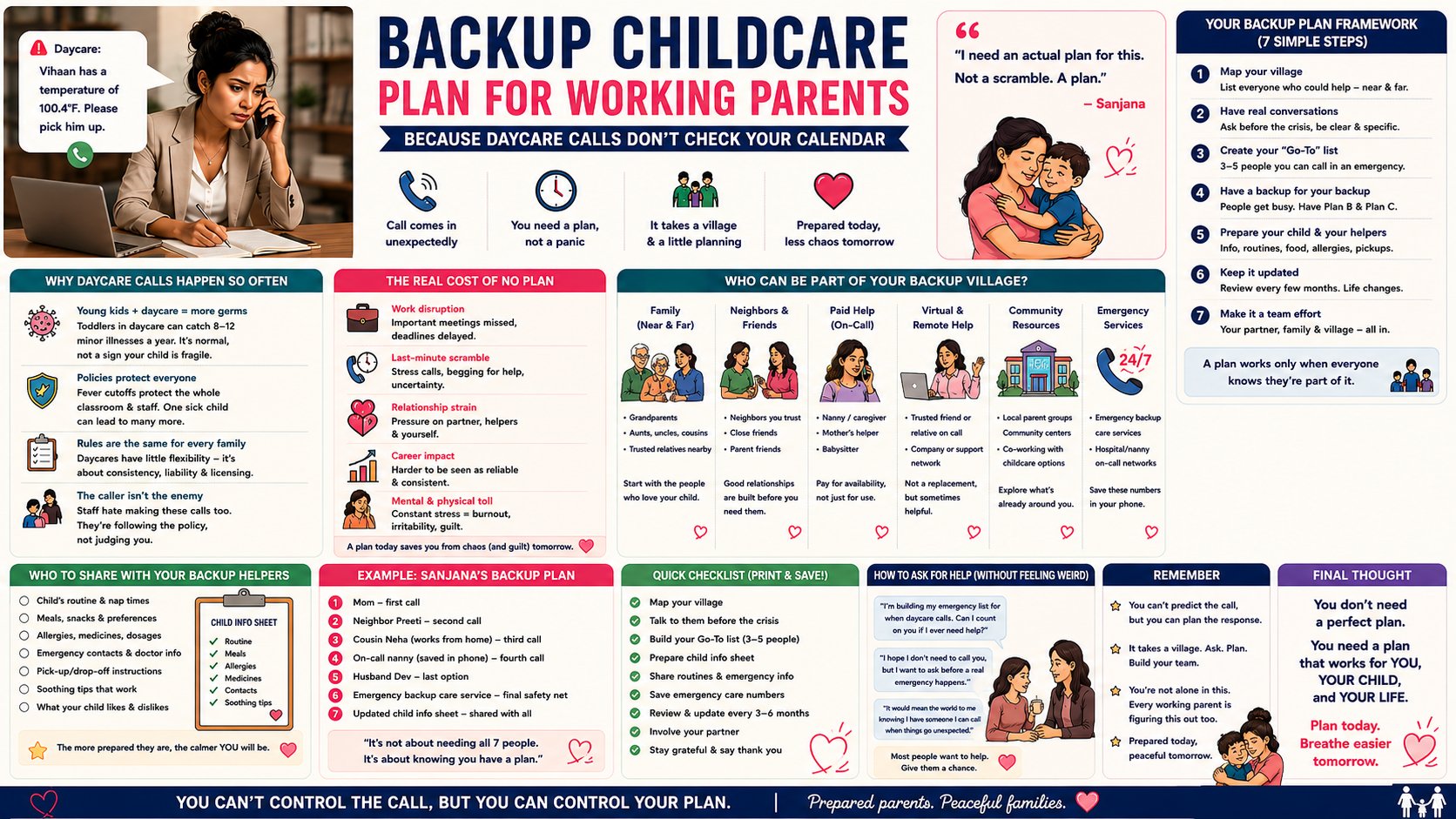
Sanjana was three minutes into presenting quarterly numbers to her entire team when her phone lit up on the desk beside her laptop. Daycare. Again.
She didn’t even need to answer to know what it was — the third call in two weeks. Her son Vihaan had a temperature of 100.4°F, the daycare’s cutoff was 100°F, and “policy is policy, ma’am, we can’t keep him here.” She excused herself from her own meeting, mouthed “sorry, emergency” to eight confused faces on a video call, and spent the next forty minutes on the phone trying to figure out who — anyone — could pick Vihaan up in the next hour, because she had a client call at 2 pm that simply could not move.
Her husband Dev was two hours away at a client site. Her mother, who usually helped, had gone to her sister’s for the week. The one number she hadn’t tried yet was her neighbor Preeti, whom she’d spoken to maybe four times, mostly about the building’s water supply schedule. She called anyway, out of options, feeling embarrassed even as she dialed. Preeti said yes without hesitation, and Sanjana sat in her car afterward — child successfully collected, meeting rescheduled, deadline somehow still met — and thought, not for the first time, “I need an actual plan for this. Not a scramble. A plan.”
If you’ve ever sat exactly where Sanjana sat — phone in one hand, calendar in the other, running through a mental list of people who might, possibly, maybe be free in the next ninety minutes — this article is the plan you’ve been meaning to build for months but never quite got around to, because who has time to plan for chaos when you’re busy living through it. Let’s fix that today, before the next call comes in.
Before building the fix, it helps to understand why this keeps happening, because a lot of parents privately (or not so privately) suspect their daycare is being overly strict. Usually, it isn’t.
Young children are still building their immune systems, and daycare accelerates that process — loudly. A child in daycare is exposed to a much wider range of common viruses than a child cared for at home, especially in the first year or two of enrollment. Pediatricians commonly note that daycare-attending toddlers can catch 8 to 12 minor illnesses a year, compared to roughly half that for children cared for primarily at home, simply because of the sheer number of other children and shared surfaces involved. This isn’t a sign your child is unusually fragile — it’s closer to a universal daycare experience, and it does taper off noticeably by the time a child starts school.
Daycare exclusion policies exist for a real, if sometimes inconvenient, reason. A 100°F cutoff might feel arbitrary when your child is otherwise playing happily, but the policy exists to protect an entire room of children and staff from communicable illness spreading through a facility that can’t isolate one child from twenty others the way a home can. From the daycare’s side, one uncontained fever can mean ten sick children — and ten more phone calls to ten more working parents — within days.
Most centers have very little flexibility to interpret the rule case by case, because doing so opens them up to liability and inconsistency across staff and shifts. The person calling you generally isn’t making a judgment call about your child specifically — they’re following a policy that was likely set at a corporate or ownership level, sometimes for insurance or licensing reasons that have nothing to do with how mild your child’s symptoms actually look in the moment.
The person calling you is often just as constrained by the policy as you are frustrated by it. Daycare staff who make these calls frequently mention finding them uncomfortable too — they know the parent on the other end is likely mid-workday, and they’re rarely calling out of an abundance of caution just to be difficult. Keeping this in mind during the call itself, even briefly, tends to make the conversation shorter and less adversarial than treating the staff member as an obstacle to negotiate past.
None of this makes the calls less disruptive to your workday. But understanding that this is a structural, ongoing feature of daycare — not a one-off crisis you’ll eventually outgrow — is exactly why a backup plan matters more than trying to white-knuckle through each call as a surprise.
There’s also a quieter, less talked-about layer to why these calls feel so destabilizing: they arrive with zero warning and demand an answer within minutes, at the exact moment you’re usually deep into something else that also demands your full attention. Unlike most parenting logistics — a school event you know about weeks ahead, a doctor’s appointment you scheduled yourself — a daycare sickness call is one of the few genuinely unpredictable interruptions in an otherwise plannable week. That unpredictability is precisely what a backup plan is designed to neutralize: you can’t predict when the call comes, but you can absolutely predict what happens in the ninety seconds after it does.
Most parents don’t build a backup childcare plan until after the third or fourth panicked scramble, the same way most people don’t buy insurance until after the thing they should have insured against already happened once. Here’s what the absence of a plan actually costs, beyond the obvious stress of the moment:
Your professional reputation takes a quiet hit you may not even notice. Repeatedly stepping out of meetings, missing deadlines, or being visibly unreachable during work hours — even for entirely legitimate reasons — accumulates in how colleagues and managers perceive your reliability, whether that’s fair or not. A backup plan doesn’t just solve the childcare problem; it protects the version of you that shows up prepared at work, too.
One parent usually absorbs almost all of the burden by default, not by agreement. In many households, especially where one partner’s job is seen as more “flexible” or lower-stakes (often, though not always, the mother’s), that parent becomes the automatic answer to “who handles this” without either partner consciously deciding it should work that way. Over months and years, this quietly reshapes career trajectories, promotion timelines, and resentment levels in ways couples rarely trace back to their actual root cause: the lack of a shared, planned system.
The financial cost compounds silently. Unplanned leave, last-minute paid help, or a rushed decision to hire a backup nanny at premium emergency rates all cost more than the same arrangements set up calmly in advance. Families who plan ahead for backup care routinely spend less over a year than families who solve each crisis individually at whatever rate is available in the moment.
This is worth internalizing precisely because the upfront cost of a paid backup layer can feel unnecessary when you haven’t needed it yet. It’s the same psychological hurdle as any insurance-like expense — paying for something on the chance you’ll need it feels wasteful right up until the month you actually do, at which point it feels like the best money you’ve spent all year.
The child’s experience of being sick gets worse too, not just the parents’. A sick toddler shuttled between an unfamiliar last-minute babysitter, a rushed pickup, and a parent who’s visibly stressed picks up on all of it, even if they can’t articulate why the day feels chaotic. A pre-arranged backup plan, with a known caregiver and a predictable routine, tends to make sick days calmer for the child too — which, in turn, often means faster, easier recovery.
There’s also an emotional cost that rarely gets named directly: the low-grade guilt that builds every time you have to choose, in real time, between your child and your job during that call. Even when you make the “right” choice by any reasonable measure, the scramble itself — the apologetic messages, the rescheduled meeting, the sense of having let someone down on both sides — leaves a residue that accumulates over months. A backup plan doesn’t just solve logistics; it removes a good portion of that guilt, because the decision was already made calmly in advance, not negotiated under pressure while your child waits, unwell, in a daycare office.
This isn’t a single backup option — it’s a layered system, because no single solution covers every scenario. A good backup plan usually has three to four layers, so that when your first option falls through (and eventually, it will), you’re not back to square one.
Sit down — not during a crisis, but on an ordinary weekend — and make an actual list of every person who could plausibly help on a few hours’ notice. This is less obvious than it sounds, because most parents only think of the “official” people (grandparents, spouse) and forget the wider circle that’s genuinely available in a pinch:
For each person, note two things: how much advance notice they realistically need, and what their actual availability looks like on weekdays. A grandparent who’s thrilled to help but lives ninety minutes away by train needs a very different call time than a neighbor two doors down. Knowing this in advance means you’re not mentally sorting through availability while also on hold with your child’s pediatrician.
Relying entirely on goodwill — family, neighbors, favors — eventually runs out, usually at the worst possible time. A paid backup layer removes the awkwardness of asking and the risk of nobody being free.
Options worth setting up in advance, before you need them:
The key difference between this layer and Layer 1 is that it doesn’t rely on someone’s schedule happening to be free out of kindness — it’s a standing, paid arrangement you can activate the same way you’d book a cab.
Most parents only discover what their employer will actually allow during the crisis itself, which is the worst possible time to negotiate. Have this conversation proactively, ideally when you’re not currently asking for anything:
This conversation feels uncomfortable to initiate, especially in workplace cultures where asking for flexibility can feel like admitting you’re not fully committed. But having the policy clarified in advance means that when the call comes, you’re executing a known plan rather than having an anxious, improvised negotiation with your manager in real time.
It also helps to reframe this conversation, internally, as a normal operational request rather than a personal favor. Organizations that genuinely want to retain skilled employees with young children have usually already thought about this, even if it isn’t advertised prominently — asking about it isn’t revealing a weakness in your commitment, it’s using a resource your employer likely already intends for exactly this situation. If your workplace genuinely has no flexibility and no willingness to discuss it, that itself is useful information worth knowing well before a crisis forces the issue, since it changes how much weight the other layers of your plan need to carry.
This is the layer most couples skip, and it’s arguably the most important one. Sit down together and actually decide, in advance, how sick-day calls will be split — not “whoever’s less busy,” which in practice almost always defaults to the same parent, but something closer to a genuine rotation or domain split.
Some approaches that work well in practice: alternating weeks where one parent is the “designated first call” regardless of what’s on their calendar that day; splitting by which parent’s job has more built-in flexibility on a given day rather than by gender-based default; or agreeing that whoever has the less time-critical meeting that specific day takes point, decided the night before by briefly comparing calendars.
Whatever you choose, write it down somewhere both of you can see — a shared note, a family calendar entry, anything more durable than a verbal agreement made once and never revisited. Couples who explicitly plan this division report far less resentment than couples where one partner has simply, silently, become “the sick-day parent” over time without either of them consciously deciding that’s how it would work.
If you’re managing this without a co-parent to split the load with, Layer 4 obviously looks different, but that makes Layers 1, 2, and 3 carry proportionally more weight — worth building out more deliberately rather than less. A wider, more redundant network of on-call contacts matters more when there’s no automatic second adult to fall back on, so it’s worth investing extra effort in Layer 1’s list and making sure Layer 2’s paid backup option is genuinely reliable rather than a rarely-tested afterthought. It’s also worth being more assertive, not less, in the Layer 3 employer conversation — a single parent’s flexibility needs are just as legitimate as a two-parent household’s, even though the conversation can feel harder to initiate alone. Many single parents find that leaning more heavily on a paid, professional backup option reduces the emotional load of repeatedly asking the same few people for help.
If you have more than one child, particularly if they’re in different programs or age groups, the plan needs to account for the very real possibility of two sick-day calls arriving close together, or one child needing pickup while the other still needs to be dropped off or collected on the normal schedule. Build slightly more redundancy into Layer 1 and Layer 2 than you think you need, and consider whether your paid backup option can realistically handle two children at once if that scenario arises, since not every sitter or agency service is set up for it.
Part of what makes daycare-call sick days so stressful is that they’re also disorganized — you’re improvising the actual care, not just the logistics of who provides it. A small amount of advance preparation smooths this considerably:
Set aside a modest, specific fund — even a small monthly amount — earmarked purely for backup childcare costs: an emergency sitter’s premium rate, a cab for a grandparent who needs to travel across the city, a day of missed daycare fees plus a day of paid backup care on top. Treating this as a planned line item rather than an unexpected expense each time removes one more layer of stress from an already stressful morning, and it means you’re not making a financial trade-off decision (Do I really need help today, or can I just push through?) at the exact moment you’re least equipped to think clearly about money.
If grandparents or other family members are part of your backup network, the difference between “please help, I don’t know what to do” (asked in a panic) and “we’ve built you into our plan for these situations, here’s roughly how often this might come up and what it would look like” (discussed calmly in advance) is significant. The second approach lets family members mentally and practically prepare — arranging their own schedules, knowing what to expect — rather than being surprised into an obligation each time, which over months can quietly strain even a close, willing relationship.
If your family lives with you or nearby in a joint family setup, this conversation is easier logistically but still worth having explicitly rather than assuming: confirm who’s actually available on which days, rather than assuming “someone’s always home” translates into “someone’s always able and willing to take over toddler care with no notice.”
This last point matters more than it might seem. A grandparent who’s technically home all day may also be managing their own health appointments, household responsibilities, or simply prefers a heads-up rather than an unplanned full day of active toddler care. Assuming availability without confirming it can quietly strain a relationship over time, even with family members who genuinely want to help — the difference between “of course, always” and “yes, but let’s actually talk about which days work” is often the difference between a sustainable arrangement and one that eventually causes quiet resentment on both sides.
A backup plan built when your child was eighteen months old and attending daycare five days a week looks different once they’re three and in a different program, or once a grandparent who used to help has taken on new commitments, or once your own job has changed. Revisit the plan every three to four months — a fifteen-minute conversation with your partner is usually enough — to confirm your Layer 1 contacts are still realistically available, your Layer 2 paid backup is still active and reachable, and your Layer 4 division of labor still reflects how things are actually playing out, not how you agreed it would work six months ago before circumstances shifted.
Even with a full plan in place, the moment of the call itself can feel disorienting. A few phrases worth having ready, mentally rehearsed, so you’re not improvising tone along with logistics:
Having these ready doesn’t make the day stress-free, but it does compress the decision-making from twenty scattered minutes down to two or three calm ones. Over time, most parents find that these scripts stop feeling scripted at all — they become second nature, the same way you don’t consciously think through how to answer a routine work email anymore. The first few times you use them, they might feel stiff or overly rehearsed. By the fifth or sixth call, they’re just how you talk about it, calm and matter-of-fact, which is exactly the tone that makes the whole day easier for everyone involved, including your child.
Three months after the day Preeti bailed her out, Sanjana has an actual system now, and it looks nothing like that frantic afternoon. Her mother-in-law, who lives across the city, is Layer 1’s first call on Tuesdays and Thursdays, when she’s reliably free. Preeti — now genuinely a friend, not just an emergency contact — is Layer 1’s backup for any other day, in exchange for Sanjana doing the same for her. A backup sitter from a local care app is saved in her phone as Layer 2, used exactly twice so far, both times without drama. She and Dev alternate “first call” weeks, marked plainly on their shared calendar, and her manager knows, proactively, that daycare calls happen and that Sanjana will be reachable by phone even when she has to step away.
The calls from daycare haven’t stopped — Vihaan still catches everything going around his classroom, probably will for another year or two. But the forty minutes of panic Sanjana used to spend each time have shrunk down to about four minutes: check the calendar, send one message, confirm the plan, get back to work. “It’s still annoying,” she told me, “but it’s not a crisis anymore. It’s just a Tuesday.”
It wasn’t an instant fix, either. The first month of having “a plan” still involved some awkward moments — her mother-in-law once assumed a Tuesday call meant something more serious than a mild cold and arrived visibly worried, which meant an extra ten minutes of reassurance before anyone could actually get to work. Preeti, in the early weeks, wasn’t always sure whether a “can you help” text meant right now or later that afternoon, until they agreed on a simple shorthand — “urgent” versus “whenever works” — that removed the ambiguity entirely. None of this made the plan a failure; it just meant the plan, like most systems, needed a few small adjustments once it met reality.
That’s really the whole shift a backup plan creates. Not fewer sick days — daycare illness is simply part of the deal for the next year or two — but the difference between every single call feeling like an emergency and most of them feeling like a known, manageable inconvenience you’ve already planned for.
None of these layers need to be perfect from day one — most parents build two or three to start, then add the rest over the following weeks as gaps become obvious. The goal isn’t a flawless system on the first try; it’s simply having more than zero plan in place before the next call comes in, since even a partial plan beats the scramble Sanjana went through that first time.
Most centers follow a fixed temperature or symptom threshold set by their licensing body or management, often around 100°F, that staff have very little discretion to override, regardless of how mild the illness looks in person. This protects the wider group of children from exposure, even when it feels frustratingly strict for a single mild case.
Several city-specific and national apps now specialize in vetted, background-checked short-notice childcare, alongside more traditional options like a nearby home daycare or a part-time nanny kept specifically as a backup contact. The key is establishing the relationship — meeting the sitter, sharing basic information about your child — before an emergency, not during one.
Couples who split this well tend to decide it explicitly in advance — an alternating weekly “first call” system, or a domain split based on whose job has more built-in flexibility on a given day — rather than letting it default informally to whichever parent has historically absorbed it. Writing the agreement down somewhere visible helps it stick.
Yes, and ideally before it becomes a recurring issue rather than after a manager has already noticed a pattern. A proactive, calm conversation about the reality of daycare-age parenting tends to build more goodwill than repeated last-minute scrambles or apologies.
It varies widely, but many pediatricians note that daycare-attending toddlers can experience 8 to 12 minor illnesses in their first year or two of enrollment, tapering off noticeably as their immune systems build up exposure. This is a normal, temporary phase of daycare attendance rather than a sign of anything unusual with your child, and most families find the frequency drops sharply by the time their child is closer to school age.
For many working parents, yes — the cost of an occasionally-used, reliable backup option is usually far lower than the combined cost of missed work, rushed emergency-rate help, and the accumulated stress of having no standing plan. Think of it the way you’d think of any insurance: the value is in having it available, not in how often you use it.
This is exactly why the layered approach matters more than any single option, however reliable it seems — if Layer 1’s family contact is unavailable, Layer 2’s paid backup exists specifically so you’re never fully without an option. It’s worth periodically testing that Layer 2 option even when you don’t strictly need it, so you know it actually works before the day you’re relying on it under pressure.
Most pediatricians don’t recommend keeping a healthy child home purely as a precaution, since regular attendance is part of how a young immune system builds resilience over time, and it can also disrupt a child’s routine and social development unnecessarily. The backup plan approach — accepting that illness will happen and preparing for it — tends to work better long-term than trying to avoid daycare illness exposure altogether
If your phone has become something you flinch at during work hours because it might be daycare calling again, you’re not overreacting, and you’re not managing this badly. You’re navigating a genuinely disruptive, genuinely universal stage of working parenthood that almost nobody prepares you for in advance. The fix isn’t willing yourself to handle each call better — it’s building the layered system above once, calmly, on an ordinary weekend, so that the next call is a known process instead of a fresh crisis. Sanjana didn’t stop getting calls from daycare. She just stopped needing forty minutes and a small miracle from her neighbor every time one came in.
Building this plan takes maybe an hour of actual sitting-down time, split across a weekend and a couple of short conversations — with your partner, with a potential backup contact, maybe with your manager. That’s a small investment against months, sometimes years, of daycare-age parenting ahead. Most parents who build it say the same thing afterward: they wish they’d done it after the first call instead of the fourth.
This article offers general childcare planning and logistics guidance based on common patterns among working parents. It isn’t medical advice — for questions about your child’s specific symptoms, fever thresholds, medication dosing, or when an illness needs urgent care, please consult your pediatrician directly.