Physical Address
304 North Cardinal St.
Dorchester Center, MA 02124
Physical Address
304 North Cardinal St.
Dorchester Center, MA 02124

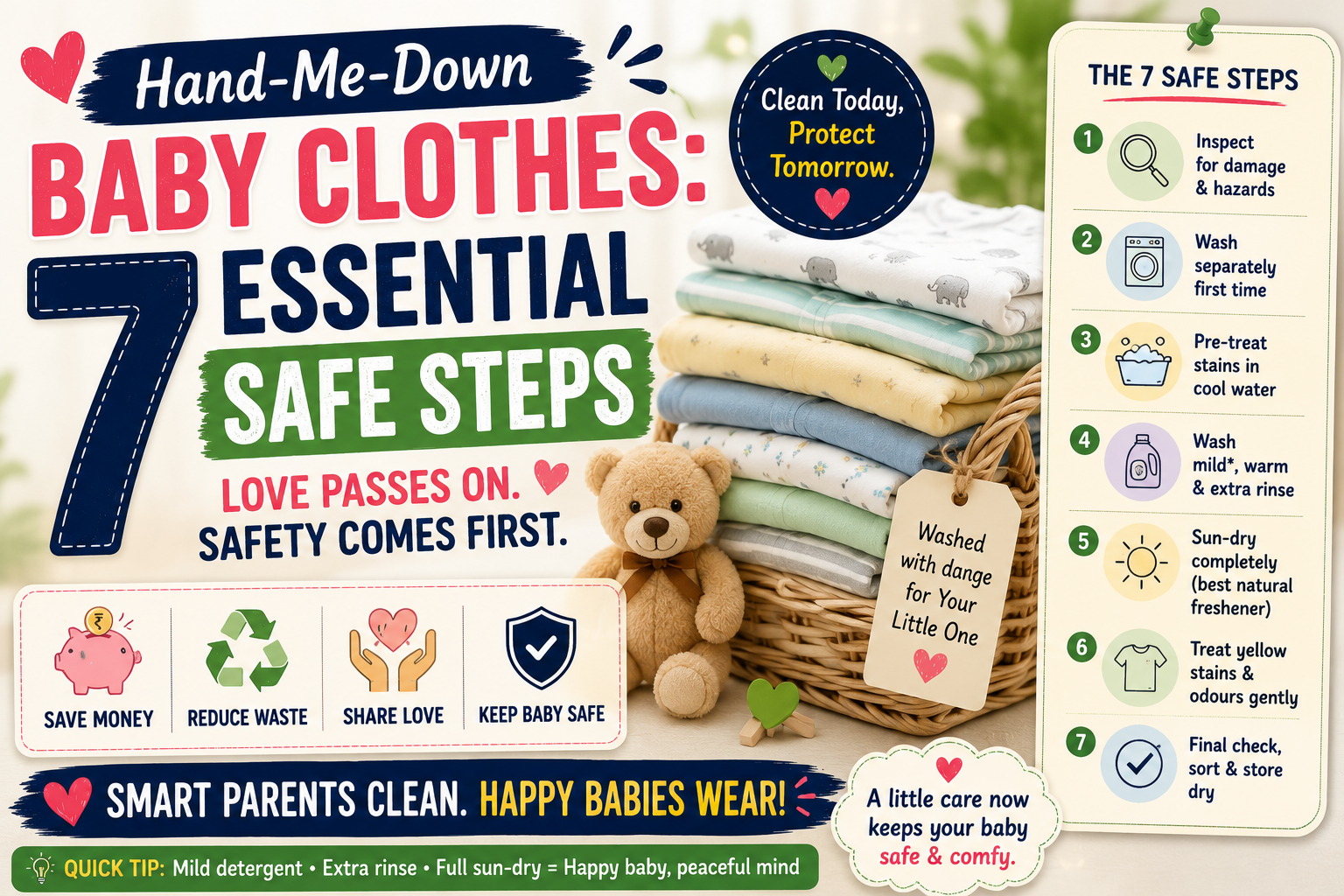
A free bag of baby clothes can be the best gift you ever get, or the reason your baby wakes up with a red, itchy neck. The difference is seven simple steps, and one of them is the step almost every parent skips.
Keep reading. I will tell you which step it is, and why it matters more than the hot water, the sun and the detergent put together.
Farah was sitting on her bedroom floor in Hyderabad, holding her nose.
Her cousin had just left, with a big smile and an even bigger plastic bag. “Arre, yeh sab Zaid ke kapde hain. Bilkul achhe condition mein. Tumhare baby ke kaam aayenge.” It was a lovely gesture. The baby was due in six weeks, and the bag looked like a small treasure chest.
But when Farah opened it, the smell hit her. It was not dirty, exactly. It was a stale, closed-cupboard smell, the kind that sits in a bag for a year. Some of the tops had yellow marks near the collar. A few had tiny brown dots that she could not name. One vest had a button hanging by a single thread.
She did what many of us do. She froze.
Part of her wanted to throw everything in the dustbin and buy new. Another part of her felt guilty about wasting good clothes, and about hurting her cousin’s feelings. A third part wanted to dump it all into the machine, with her husband’s shirts, and hope for the best.
She called her neighbour, an aunty who had raised three children and was known on the whole lane for her soft, spotless baby clothes. The aunty listened, laughed, and said, “Beta, ghabrao mat. Pehle dekho, phir alag dhoo, phir dhoop mein sukhao. Order yaad rakhna.”
Order yaad rakhna. Remember the order.
Within a week, Farah had washed, sorted and sun-dried every piece. The yellow marks faded. The musty smell was gone. Three pieces with loose buttons and stretched elastic were set aside, and the rest, nearly thirty soft cotton pieces, went into the baby’s cupboard. And because of that one big bag, she did not need to buy half the clothes she had planned.
That is what this article is about. If you are looking for how to clean and reuse hand-me-down baby clothes safely, I will give you a clear, calm, 7-step routine, an easy way to deal with yellow stains and musty smells, a system for sharing clothes between siblings, and a short list of things that are better not to reuse. No fear. No wasted money. Just the order, as the aunty said.
Quick note: I am a parent and content writer, not a doctor. This article shares general hygiene and laundry guidance. If your baby has sensitive skin, eczema, allergies, or any skin infection in the family, please talk to your pediatrician before using second-hand clothes.
To reuse hand-me-down baby clothes safely, inspect each piece for damage and hazards, keep them separate from other laundry for the first wash, pre-treat stains in cool water, wash with a mild detergent at the hottest temperature the label allows with an extra rinse, dry fully in the sun, treat yellow stains gently, and check every piece before storing or wearing.
Here are the 7 steps at a glance:
| Step | What to do | Why it matters |
|---|---|---|
| 1 | Sort and inspect for damage and hazards | Safety first, before any water touches the cloth |
| 2 | Keep them separate for the first wash | The step most parents skip. It protects your other laundry and your baby |
| 3 | Pre-treat stains in cool water | Heat can set milk, formula and spit-up stains |
| 4 | Wash with mild detergent, warm or hot as the label allows, plus an extra rinse | Cleans deeply, removes residue |
| 5 | Sun-dry fully, then iron if the label allows | Natural freshening, helps remove damp and germs |
| 6 | Treat yellow stains and odours gently | Fixes the common leftover problems without harsh chemicals |
| 7 | Final check, sort by size and store dry | Catches missed problems, and keeps the clothes ready |
Now let me explain each step, one by one, in the order the aunty taught Farah.
Let me begin with the good news. Baby clothes are one of the most reusable things in the world. Babies outgrow clothes long before they wear them out. A soft cotton vest that has been washed many times is often softer and gentler on the skin than a brand-new one, because the finishing chemicals and stiffness have already washed away.
Using hand-me-downs also:
But hand-me-downs also come with a few things to watch:
The point is not to be afraid. The point is to follow a simple routine every time, so you can enjoy the good side without worry.
Before we get to the steps, here is a short list of things I would think twice about. Some are about safety. Some are about hygiene. When in doubt, ask your pediatrician, or choose to pass them on.
A good rule: if you would hesitate to put it on your baby, trust that instinct. There will always be more clothes. Your baby’s comfort and safety come first.
Now, the heart of the article. Follow these steps, in this order, every time you get a new bag of clothes.
This is where you decide what is worth washing at all. It takes about ten minutes, and it saves a lot of effort.
What to do:
A small tip: smell the clothes in a bag, one by one. A musty smell is usually from storage. A sour or sharp smell may mean old milk or urine. Neither is a reason to panic, but note which pieces smell stronger, so you can treat them first.
What this saves you: time and effort, because you only wash what is worth using.
This is the step I promised you, and the one most families miss. Do not wash hand-me-downs with your other laundry for the first time.
Why does this matter? Because you do not know what is on the clothes. There may be old stains, storage smells, dust, mould spores, or other residue. If you wash them together with your adult clothes, or even with your baby’s other clothes, you may spread these to clean items. And if you wash them with a bigger load, the water and detergent are spread thin, and may not clean as well.
What to do:
If you use a shared family machine, you can run the hand-me-down load first, when the drum is clean, or do a short empty rinse afterwards. (See our guide on washing baby clothes separately from adult clothes for more.)
What this saves you: the cleaning of every other piece in the house, and the worry that something was passed on.
This is the step that decides whether yellow marks fade or stay forever.
Most baby stains are protein stains from milk, formula, spit-up, poop and food. Heat can set these stains into the fabric, like cooking an egg. So the first rinse should be cool or lukewarm, never hot.
What to do:
What to avoid at this stage:
What this saves you: most of the stains you would otherwise think were permanent.
Now comes the main wash. This is where the clothes get truly clean, and where leftover residue goes away.
Detergent:
Temperature:
Load size and cycle:
Rinse:
Hand wash tips:
What this saves you: a lot of worry. A good wash removes most of the dirt, residue and germs from clothes that were worn before.
If there is one free, natural helper in Indian homes, it is the sun. Dhoop is a gentle sanitiser, a freshener and a stain fader, all in one.
How to use the sun well:
On cloudy, rainy or foggy days:
Ironing:
What this saves you: the “stuffy cupboard” smell, and any hidden dampness.
Sometimes, after a good wash, a few problems remain. The most common are yellow stains and a leftover musty smell. Here is how to handle them without harsh chemicals.
Yellow stains on hand-me-downs usually come from:
The good news is that many yellow stains are not permanent.
Try these in order, and stop when the stain fades.
1. Sunlight (the easiest). Wet the stained spot with a little water, lay the cloth flat in direct sun, and let it dry. Wet it again after an hour or so, and repeat. The sun’s UV rays have a natural bleaching effect on cotton, and poop and milk stains often fade a lot. Turn coloured items inside out, or protect the colours, because sun can fade dyes.
2. A longer cool soak. Soak the item in cool water with a little mild detergent for a few hours. Rinse, wash and dry in the sun again.
3. A baby-safe stain remover or an oxygen-based laundry booster, as per the label. Some families use a gentle, oxygen-based product made for laundry, mixed in water as the pack says. Check that it is suitable for baby clothes and for the fabric colour, test a small hidden spot first, and rinse very well. If you are unsure, skip this step or ask your pediatrician.
4. Repeat, with patience. Old stains can take two or three rounds. Do not rush with strong chemicals.
What to avoid:
A small thought: a faded yellow shadow on an old, soft cotton vest is not a sign of dirt. If the cloth is clean, soft and safe, a little discolouration does not matter to the baby. You can wear stained pieces under other clothes, or use them for home wear.
1. Wash again with an extra rinse. Many musty smells come from storage, and a good wash removes them. 2. Sun-dry. Sun is excellent for removing stale smells. 3. Soak in a cool water wash with a little mild detergent, then rinse and sun-dry. 4. Air the clothes. Hang them in a breezy, shaded place for a few hours. 5. Check for spots. If you see black, green or grey spots that do not come out, the item has mould. I would not use it on a baby.
If a very strong smell remains after two washes, it is probably best to let the garment go. Not every piece needs to be saved.
Some clothes come from cupboards where mothballs, naphthalene or strong air fresheners were used. These smells can be hard to remove, and strong chemical smells are not good near a baby.
You have washed, dried and treated the clothes. Now, one last check, and then you are done.
The final check, piece by piece:
Sort by size and season:
Store properly:
What this saves you: surprises later. A final check catches problems before they reach your baby.
| Problem | What to try | When to let it go |
|---|---|---|
| Musty smell | Extra rinse, sun-dry, a cool soak | If it stays strong after two washes |
| Yellow marks (milk, spit-up) | Cool soak, sun on a wet stain, repeat | If it does not matter for comfort, wear as home wear |
| Brown dots | Check if they are mould or old food. Wash, sun-dry | If they look black or green, or do not wash out |
| Stiff, rough fabric | Wash with an extra rinse, dry in sun and softly fold | If still rough on the skin |
| Faded or dull colour | This is normal with age | Not a safety issue |
| Loose button | Sew tight with strong thread, or replace with a snap | If you cannot fix it securely |
| Stretched elastic | Replace the elastic, or skip | If it does not hold |
| Strong mothball or perfume smell | Wash two or three times, air in shade | If it stays |
| Colour bleeding | Wash separately in cool water, and keep dark colours away | If it keeps bleeding on the first few washes |
| Pilling or thin fabric | Use for home wear | If it is very thin or torn |
There is a lot of fear around the word “sanitize,” especially for second-hand baby clothes. Let me explain simply.
For most hand-me-downs from a healthy household, a proper wash with a mild detergent, at the hottest suitable temperature, with an extra rinse, followed by sun-drying and ironing, is enough. You do not need to boil, bleach or soak everything in strong disinfectants.
When to be a little more careful:
Please avoid:
(Our article on washing baby clothes separately from adult clothes goes into this in more detail, and our cloth diaper guide explains how to wash heavily soiled items.)
One of the best parts of hand-me-downs is passing clothes from one child to the next. If you have an older child and a younger one, or a baby you plan to have later, here is how to make it easy.
Soft yellow, green, white, grey, mustard and cream clothes can be used for any child. This makes it easy to reuse the same pieces, whoever comes next.
The best time to remove stains is right after the baby outgrows the clothes. Stains left for months turn yellow and harden. Wash each piece, treat the stains, dry fully, and store.
Use labelled bags, such as “6-9M, winter,” so you can pull out the right bag when the next baby arrives. Plan for the season the next baby will be in, not just the size.
Write a small list in your phone or planner of what is in each bag, like “8 tops, 6 pyjamas, 2 sweaters.” This helps you know what you will need to buy.
Elastic and snaps age. Before your next baby uses a stored garment, check them carefully.
It is lovely to keep one or two special outfits, like the going-home outfit or the first festival outfit, in a separate, acid-free or clean cotton wrapping, as keepsakes. They do not need to be part of the working wardrobe.
If a piece has been used by two or three children and is very thin or worn, retire it. Use it as a cleaning cloth or for home wear, not on the baby.
If there are several years between your children, stored clothes may need extra care. Open the bags once or twice a year to air them, check for damp or insects, and wash again before use.
Hand-me-downs are also about relationships. Here are some gentle ideas that work well in Indian families and friend circles.
When both sides are kind and honest, hand-me-downs become a lovely chain of care.
Here are the mistakes I see most often. I have made a few myself.
If you have just received a big bag, here is an easy week to get through it without stress.
You can do all of this in short bursts, while the baby sleeps.
Before washing:
Washing:
After washing:
Storing:
Go back to Farah, sitting on her bedroom floor with a big plastic bag, a stale smell and a tangle of feelings.
Here is what I would tell her. You do not have to throw it all away, and you do not have to wash it all together. Do it in order, as your neighbour aunty said. Look first. Keep it separate. Soak in cool water. Wash well. Dry in the sun. Treat the leftovers gently. And check every piece before it touches your baby. That is the whole secret, and the step most people skip is the one that keeps everything else clean.
So, if you are wondering how to clean and reuse hand-me-down baby clothes safely, remember the seven steps: inspect, separate, pre-treat, wash properly, sun-dry, treat stains and smells, and do a final check before storing. It takes a little time, but it can save a lot of money, and it gives a good, soft garment another happy life.
When your baby wears a clean, soft vest that has already kept another baby warm, you are not just saving rupees. You are joining a long chain of families who have looked after each other’s little ones. And that is a very good thing to be part of.
Inspect each piece for damage and hazards, keep the clothes separate for the first wash, pre-treat stains in cool water, wash with a mild detergent at the hottest temperature the label allows with an extra rinse, dry fully in the sun, treat yellow stains and smells gently, and do a final check before storing or wearing.
In most cases, yes, if they are in good condition and washed well. Check for loose buttons, strings, weak elastic, mould and strong smells. If your baby has eczema, allergies, or there was a skin infection in the previous wearer, ask your pediatrician first.
Usually a thorough wash with a mild detergent, at the hottest suitable temperature, with an extra rinse, followed by sun-drying and ironing, is enough. Strong disinfectants are rarely needed and can leave residue. Ask your pediatrician if you are unsure.
Yes, at least for the first wash. You do not know what is on the clothes, such as stains, mould spores or residue, and washing them separately protects your other laundry.
Use the hottest temperature the care label allows. Washing at about 60°C is often mentioned for plain cotton that can handle it. For delicates, woollens and printed items, follow the label.
Start with a cool soak and mild detergent, then lay the wet stain in direct sun and repeat. Avoid hot water on untreated milk and poop stains. If you use any stain remover, choose one suitable for baby clothes, test a small spot, and rinse very well. Do not mix cleaning products.
Often because of leftover milk, spit-up, food, body oils or detergent residue that slowly changes colour over time. Washing clothes thoroughly and treating stains before storing helps prevent it.
Wash again with an extra rinse, dry in direct sun, and air the clothes in a breezy shaded place. If black or green mould spots remain, or the smell persists after two washes, it is better not to use the garment.
Many parents avoid it. If you use it on white cotton, follow the label, rinse very well, and never mix it with vinegar or other cleaners. Oxygen-based boosters and sun are gentler options for most stains.
Pieces with neck cords or strings, loose buttons or decorations, broken elastic, mould, strong chemical smells, or severe wear. When in doubt, pass them on.
Wash and treat stains before storing, sort by size and season in labelled bags, keep a simple inventory, check elastic and snaps before reusing, and keep a few favourites as keepsakes. Gender-neutral colours make reuse easier.
Make sure they are fully dry, then store them in clean cotton bags or boxes, away from damp walls and the bathroom, and without mothballs. Check them every few months, especially after monsoon.
Yes. Your instinct matters. Use what you are comfortable with, pass on what you are not, and know that a good wash and a careful check make most hand-me-downs safe and lovely to use.