Physical Address
304 North Cardinal St.
Dorchester Center, MA 02124
Physical Address
304 North Cardinal St.
Dorchester Center, MA 02124

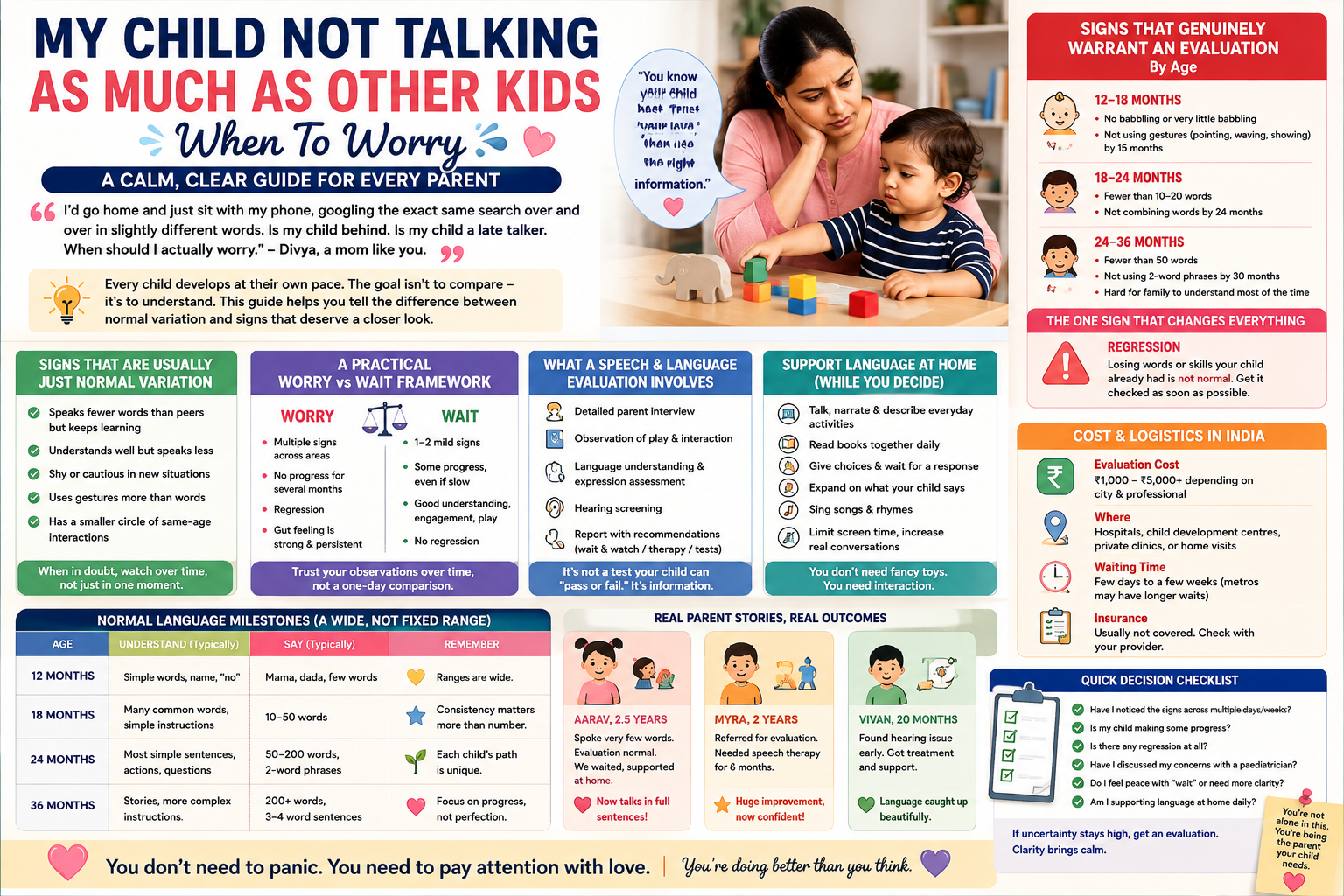
Divya counted. She didn’t mean to start counting, but somewhere around her son’s second birthday, she found herself doing it anyway — at the park, at a cousin’s birthday party, in the paediatrician’s waiting room, silently tallying how many words the other two-year-olds around her seemed to be using compared to her own son, who mostly pointed, grunted, and used exactly four words with any consistency: “mumma,” “no,” “ball,” and, inexplicably, “elephant.”
“I’d go home and just sit with my phone, googling the exact same search over and over in slightly different words,” she says now, a year on. “Is my child behind. Is my child a late talker. When should I actually worry. And every single article either terrified me completely or told me to relax with so little actual guidance that I didn’t feel any calmer at all.” What Divya needed, and what she eventually found only after several confusing weeks and one genuinely excellent paediatrician appointment, wasn’t reassurance or alarm — it was a clear, honest framework for telling the difference between the two.
This guide is that framework. It won’t tell you your child is definitely fine, and it won’t tell you to panic. It will walk you through exactly how to think about the comparison anxiety itself, what genuinely warrants a professional evaluation versus what’s ordinary variation, how the evaluation process actually works in India if you decide to pursue one, and how to hold both patience and appropriate vigilance at the same time — which, as it turns out, is entirely possible, even though it doesn’t always feel that way at 11 PM with a search bar open.
There’s a specific kind of parenting anxiety that comparison triggers — not the vague, general worry every parent carries, but a sharp, specific one, activated the moment you watch another child the same age produce a full sentence while your own child points at the same object silently. It’s almost impossible not to notice, and once noticed, almost impossible not to start quietly tracking.
Here’s the genuinely important thing to understand about that comparison: children’s individual language development is influenced by an enormous number of factors that have nothing to do with underlying ability or long-term outcome — birth order (later-born children sometimes talk later, partly because older siblings anticipate their needs and speak for them), temperament (naturally more observant, cautious children sometimes speak later than naturally more socially forward ones), bilingual or multilingual home environments, and simple individual variation that exists in every single developmental domain, not just language.
The child at the park saying full sentences at two and the child pointing silently at the same age can both be developing entirely typically — this isn’t a comforting platitude, it’s a genuinely accurate description of how wide the normal range for early language development actually is, which is exactly why comparison against any single other child is a poor tool for assessing your own child’s development, even though it’s almost impossible to resist doing.
By 12 months, most children have started using at least one or two words with consistent meaning, though a range extending to 15-16 months for a first meaningful word is still considered within typical variation by most paediatric and speech-language guidance.
By 18 months, vocabulary commonly ranges anywhere from roughly 10 to 50 words, an enormous range that reflects genuine, normal individual variation rather than a narrow band most children should fall precisely within.
By 24 months, many children have 50 or more words and are beginning to combine two words together, though children with meaningfully fewer words at this age, provided other developmental indicators (discussed in Section 4) are progressing normally, are often still within a range that resolves on its own with continued typical development.
By 30-36 months, most children are forming short sentences and are increasingly understood by people outside their immediate family, though clarity of speech (articulation) specifically often continues developing well past this age even in children whose overall language development is entirely on track.
The critical point underlying all of these ranges: they describe averages and common ranges, not strict deadlines. A child outside a specific range at a specific age is not automatically a child with a problem — it’s a signal, among several others, worth factoring into the fuller picture this guide walks through next.
Rather than fixating on word counts alone, a more genuinely useful framework asks four questions together:
1. Is your child’s understanding (receptive language) progressing normally, even if their spoken output (expressive language) lags? A child who follows instructions, responds to their name, and clearly understands far more than they say is in a meaningfully different, generally more reassuring position than a child whose understanding also seems limited.
2. Is your child communicating in other ways — pointing, gesturing, making eye contact, showing things to share interest, using sounds or babbling with clear intent — even without many actual words? Communication intent, expressed through any channel, matters more at this stage than the specific channel (spoken words) alone.
3. Is your child progressing, even slowly, rather than staying completely static or losing skills? Slow but steady progress over months is a fundamentally different pattern from a child who seems genuinely stuck at the same point for an extended period, or — the one sign that changes this entire calculation, covered fully in Section 6 — a child who is losing previously acquired skills.
4. Are there other developmental concerns alongside the language delay, such as social engagement, motor skills, or unusual repetitive behaviours, or does the delay appear isolated to language specifically? An isolated language delay with everything else progressing typically carries a different likely trajectory than a delay accompanied by broader developmental concerns.
A genuinely useful way to use this framework: if the answers lean toward “yes, understanding is fine, yes, they communicate in other ways, yes, they’re progressing, and no, nothing else seems concerning” — a period of watchful waiting, combined with the home strategies in Section 13 and a specific follow-up conversation at the next paediatric visit, is often entirely reasonable. If several answers lean the other way, an evaluation (Section 7) sooner rather than later is worth prioritising.
By 12 months: no babbling at all, no response to their own name, no gestures like pointing or waving.
By 15-16 months: no single words used with consistent meaning, no pointing to show interest in something.
By 18 months: fewer than roughly 10 words, not following simple one-step instructions without accompanying gestures.
By 24 months: fewer than roughly 50 words, no two-word combinations at all, limited or no imitation of words or sounds.
By 30-36 months: speech that remains largely unintelligible even to parents, no simple sentences forming, difficulty being understood by anyone outside the immediate family.
At any age, regardless of the specific milestone: loss of previously acquired words or social skills (covered fully in Section 6), limited or no eye contact, reduced interest in social interaction with caregivers or peers, or a strong parental instinct that something feels different — this last one deserves to be taken seriously in its own right, since parents consistently notice subtle patterns well before they can articulate them in checklist terms.
Understanding significantly more than they say — a child with a small spoken vocabulary who clearly understands complex instructions, follows conversations, and responds appropriately to questions is showing a very common, generally reassuring pattern of expressive language lagging behind receptive language.
Mixing languages in a bilingual or multilingual home — code-mixing (using words from two languages within the same sentence) is a normal feature of bilingual development, not a sign of confusion or delay.
Being a notably quiet or observant child in social settings generally, while communicating comfortably and typically within the family — temperament-driven quietness in unfamiliar settings is different from a genuine language delay present across all contexts.
Having an older sibling who talks “for” them frequently — in households where an older sibling anticipates and voices the younger child’s needs, the younger child sometimes has less practical need or opportunity to practice independent verbal communication, a situational factor rather than a developmental one.
A recent life change (a new sibling, a house move, starting daycare) causing a temporary, mild dip in talkativeness — situational stress can genuinely affect a young child’s verbal output temporarily, distinct from a persistent underlying delay.
Every section of this guide has been building toward this specific point, because it’s genuinely the single most important distinction in the entire “worry vs wait” decision.
A child who is behind on typical milestones, but steadily gaining new skills over time, is in a fundamentally different situation than a child who had skills and lost them. Losing previously acquired words, previously demonstrated social engagement, or previously shown interest in interaction is a pattern that should prompt a prompt evaluation, essentially regardless of how the rest of this guide’s framework otherwise applies.
This distinction matters because “late but progressing” has a broad range of generally reassuring possible explanations and outcomes, while “regression” specifically narrows the range of likely explanations toward things that genuinely warrant faster, more thorough professional attention.
If you’re reading this guide specifically because you’ve noticed regression rather than simple lateness, this is the one point in the article worth acting on immediately rather than continuing to weigh a wait-and-watch approach — contact your paediatrician promptly to discuss next steps, rather than treating this specific pattern with the same patience appropriate for ordinary developmental variation.
The starting point is almost always your paediatrician, who will typically conduct a basic developmental screening during a regular visit and, importantly, check for or refer for a hearing evaluation — undetected hearing issues are among the most common and most treatable underlying causes of an apparent speech delay, making this an essential early step rather than an optional add-on.
A hearing test (commonly BERA or OAE testing) rules out or identifies hearing-related causes definitively, and is generally recommended as one of the first specific evaluations pursued, particularly for a child with limited response to sound or a history of frequent ear infections.
A referral to a speech-language pathologist (SLP), or in some cases a developmental paediatrician, typically follows if the initial screening raises genuine concern — this evaluation usually involves structured observation of the child’s communication, play, and social interaction, along with a detailed history gathered directly from parents about the child’s developmental trajectory so far.
The evaluation process is not typically a single, definitive, one-time test with an instant conclusive answer — it’s more often an initial assessment that leads either to a specific therapy recommendation, a further diagnostic referral (for example, to rule in or out autism spectrum considerations, covered in Section 8), or a structured “monitor and reassess in X weeks” recommendation, depending on what the initial evaluation reveals.
Look specifically for professionals registered with the Rehabilitation Council of India (RCI) when seeking a speech-language pathologist, since this registration is the standard credential verification in an otherwise loosely regulated private therapy market in many Indian cities.
Hearing loss or hearing difficulty, even partial or intermittent (such as from recurring fluid buildup after ear infections), is one of the most common underlying, and often correctable, causes of an apparent speech delay — which is precisely why a hearing test is recommended early in the evaluation process rather than assumed unnecessary.
Autism spectrum considerations are sometimes raised during an evaluation, particularly when a language delay appears alongside other signs — limited eye contact, reduced interest in social interaction, unusual or repetitive behaviours, strong resistance to changes in routine. It’s important to understand that a speech delay alone, without these accompanying signs, is not itself diagnostic of autism, and it’s equally important not to dismiss a professional’s suggestion to screen for this specifically if other signs are present — early identification, where it applies, is consistently associated with better outcomes through earlier, targeted support.
Developmental language disorder (sometimes called specific language impairment) describes children with a persistent language difficulty that isn’t explained by hearing loss, autism, or other identifiable conditions — a distinct diagnostic category in its own right, generally addressed effectively through speech-language therapy.
Oral-motor difficulties (issues with the physical coordination of the mouth, tongue, and jaw needed for clear speech) can sometimes underlie speech delays specifically related to clarity/articulation rather than vocabulary or language understanding, and are assessed and addressed differently from broader language delays.
This section exists to inform, not to diagnose — only a qualified professional evaluation can determine which, if any, of these possibilities applies to your specific child, and it’s genuinely common for an evaluation to conclude none of these apply at all, with the child simply following a slower but entirely typical individual timeline.
Initial paediatric consultation and developmental screening is typically included within a standard paediatric visit cost, or a modest additional fee for a more extended developmental discussion, depending on your paediatrician’s specific practice.
Hearing tests (BERA/OAE) typically range from a few hundred to a few thousand rupees depending on the city and specific facility, and are increasingly available at general hospitals and dedicated ENT/audiology clinics in most sizeable Indian cities.
A full speech-language evaluation with a qualified SLP typically ranges roughly ₹1,500–₹5,000 as an initial assessment cost in most private settings, with significantly lower or subsidised costs often available through government or teaching hospital departments, though these may carry longer waiting periods.
If ongoing therapy is recommended, session costs vary considerably by city tier and setting, generally ranging from very low-cost or free at government/hospital-affiliated centres to ₹800–₹2,500 per session at private clinics in major metro cities, with online/tele-therapy sessions increasingly available as a somewhat lower-cost alternative, particularly useful where local specialist access is limited.
It’s worth beginning the evaluation process even before you’re fully certain you’ll pursue therapy — an initial assessment doesn’t commit you to a specific ongoing treatment path, and getting clear information early is almost always more useful than continuing to wait while uncertain, given that many of these evaluation steps (particularly the hearing test) are quick, low-cost, and genuinely informative regardless of the eventual outcome.
A “wait and watch” recommendation from a qualified professional is a genuine, evidence-based conclusion, not a dismissal of your concern — it typically means the evaluation found your child’s overall developmental pattern consistent with normal variation, without the specific red flags that would prompt an immediate therapy recommendation.
This recommendation usually comes with a specific plan, not an open-ended “just wait” — a defined follow-up timeline (commonly reassessment in 2-3 months), specific things to monitor for in the interim, and often some general home-based language-support strategies (Section 13) to continue during that watching period.
It’s entirely appropriate to seek a second opinion if a “wait and watch” recommendation doesn’t sit right with your own observation of your child, particularly if you’re the one spending the most time with them and have a strong, persistent instinct that something specific feels off — parental instinct, while not a diagnostic tool on its own, is a genuinely valuable input that experienced clinicians take seriously rather than dismiss.
Continuing genuine monitoring during a wait-and-watch period, rather than either anxiously over-tracking or completely setting the concern aside, tends to serve families best — noting general progress at the agreed follow-up interval, rather than daily comparison-driven tracking, which tends to increase parental anxiety without adding genuinely useful information between scheduled check-ins.
A therapy recommendation is not a permanent label or a definitive long-term prognosis — many children who begin speech-language therapy in toddlerhood make significant, sometimes complete, progress and no longer require ongoing therapy by school age, particularly with early intervention, which is consistently associated with better outcomes across the research on this topic.
Most programs begin with 1-2 sessions per week, often combined with specific home practice activities the SLP teaches parents to continue between sessions, with periodic reassessment (commonly every 8-12 weeks) to track progress and adjust the approach as needed.
Parent involvement in the therapy process meaningfully speeds progress in most cases — SLPs in India commonly train parents directly in specific interaction techniques to use during ordinary daily activities, which extends the practical impact of therapy well beyond the actual paid session time itself.
It’s worth approaching a therapy recommendation as active, hopeful problem-solving rather than a source of ongoing anxiety — starting the process is itself the single most useful action available once a genuine need has been identified, and the overwhelming majority of children who receive early speech-language support show meaningful improvement over time.
This specific family dynamic — a well-meaning grandparent or relative dismissing a genuine concern with “mera bhai bhi der se bola tha, dekho ab kitna bolta hai” (my brother also talked late, look how much he talks now) — is genuinely common and worth navigating thoughtfully rather than either dismissing the relative’s experience or abandoning your own instinct because of it.
Acknowledge the family history as genuinely useful context, not something to dismiss — a family pattern of late talking is worth actually mentioning to your paediatrician, since it can be relevant information, while still not being a substitute for an actual evaluation if other signs (Section 4) are present.
Frame the evaluation as information-gathering, not alarm — “We’re just getting it checked to be sure, not because we think something is definitely wrong” tends to land better with skeptical relatives than a conversation that feels like disagreement about whether concern is warranted at all.
Share the actual outcome once you have it, whether that’s a reassuring “wait and watch” or a therapy recommendation — relatives who were initially dismissive often become genuinely supportive once there’s a concrete professional conclusion to reference, rather than an ongoing, seemingly unresolved parental worry.
Trust your own observation over a relative’s anecdote, respectfully — one family member’s individual late-talking story, however true, is a single data point, not a substitute for your own child’s specific evaluation by someone who’s actually observed them directly.
Regardless of where you land on the worry-vs-wait spectrum, these strategies genuinely support language development and cost nothing beyond time and attention:
Divya, Pune — “We got the evaluation, hearing test came back perfect, SLP said he was understanding everything and just needed a bit more encouragement talking rather than being anticipated by us and his older cousin constantly. We changed how we responded to him at home, and within about three months the difference was genuinely dramatic. No therapy needed at all in the end, just a specific strategy shift.”
Farhan, Hyderabad — “Our son needed actual therapy — turned out to be a fairly significant expressive language delay. Eight months of consistent sessions later, he’s basically caught up to his peers. I’m honestly grateful we didn’t wait longer just because relatives kept saying he’d ‘talk when he’s ready.’ Earlier felt like it genuinely mattered.”
Priya, Chennai — “The hearing test found the actual issue — fluid buildup from repeated ear infections, muffling his hearing without us realising it at all. Once that was treated medically, his language caught up almost entirely on its own within a few months, no speech therapy needed. I would never have guessed hearing was the actual root cause.”
Kavita, joint family, Lucknow — “My mother-in-law was completely dismissive initially. Once we got the actual evaluation and could say clearly, ‘the specialist recommended twice-weekly therapy for six months,’ she became one of the most supportive people in the whole process — even started doing the home exercises with him herself during her afternoons with him.”
Focus less on comparison to other children and more on whether your child understands language well, communicates through gestures even without many words, and is steadily progressing rather than stuck or regressing — these factors matter more than word count alone.
Regression — losing previously acquired words or social skills — is the single sign that should prompt a prompt evaluation regardless of how the rest of your child’s development otherwise looks, distinct from simply being slower to reach typical milestones.
Yes, generally — hearing issues, including partial or intermittent hearing difficulty from ear infections, are among the most common and most treatable underlying causes of an apparent speech delay, and testing is quick, low-cost, and genuinely informative even when hearing turns out to be fine.
Not necessarily — a speech delay alone, without accompanying signs like limited eye contact, reduced social interest, or repetitive behaviours, is not itself diagnostic of autism spectrum considerations, though a professional evaluation is the appropriate way to assess this if other signs are present alongside the delay.
Typically ₹1,500–₹5,000 for an initial private assessment, with often free or low-cost options through government or teaching hospital departments, though these may involve longer waiting periods.
It’s entirely reasonable to seek a second opinion if a wait-and-watch recommendation doesn’t align with your own close observation of your child — parental instinct is a valuable input that experienced clinicians generally take seriously.
Yes — early speech-language intervention is consistently associated with meaningful progress, and many children who begin therapy in toddlerhood no longer need ongoing support by school age, particularly when therapy begins early rather than being delayed.
This article provides general information about early language development and does not replace professional medical or speech-language evaluation. If you have concerns about your child’s development, please consult your paediatrician or a Rehabilitation Council of India (RCI)-registered speech-language pathologist.