Physical Address
304 North Cardinal St.
Dorchester Center, MA 02124
Physical Address
304 North Cardinal St.
Dorchester Center, MA 02124


At 2 am, Meera was wide awake, bouncing her three-week-old daughter Anaya on her shoulder while her phone screen glowed with the same search she’d typed three nights in a row: “baby awake all night sleeps all day.”
Anaya had been an angel from 9 am to 6 pm — long, peaceful naps, easy feeds, the kind of baby who made Meera’s mother-in-law say “kitni achi bacchi hai, bilkul shaant.” But the moment the sun went down, Anaya turned into a different baby entirely. Wide eyes. Cooing. Wanting to be held, played with, walked around the house. Meera’s husband Kabir would find her at 3 am sitting on the living room floor with Anaya propped against her knees, both of them staring at each other in the dark, Anaya looking about as sleepy as someone who’d just had two cups of coffee.
“She’s got her days and nights mixed up,” Meera’s mother told her over a video call, in the tone of someone stating an obvious, ancient fact. “Every baby does this in the beginning. It’ll pass.” Which was true, technically, and also not remotely helpful to a woman who hadn’t slept more than ninety consecutive minutes in nine days.
If this is you right now — sitting in a dark room at some ungodly hour, wide-awake baby in your arms, wondering if you broke your child’s internal clock somehow — take a breath. You didn’t do anything wrong. This is one of the most common, most fixable, and most temporary problems in the entire newborn stage. It has a name, it has a reason, and more importantly, it has a fix that doesn’t take months. Grab whatever’s left of your chai — probably cold by now, that’s just how this stage goes — and let’s walk through it properly.
Before we fix anything, it helps to understand what’s actually happening inside your baby’s tiny, brand-new brain, because once you see the mechanism, the fix stops feeling like guesswork.
Babies are born with no circadian rhythm at all. The internal body clock that tells adults “it’s dark, time to feel sleepy” and “it’s bright, time to feel alert” doesn’t exist yet at birth. It has to develop over the first several weeks of life, and until it does, your baby genuinely cannot tell day from night on their own.
In the womb, night was actually the busy time. This is the part almost nobody explains, and it changes how you see the whole problem. Inside the womb, your baby was rocked to sleep all day by your movement — walking, working, moving around. At night, when you finally lay down and got still, your baby often woke up and became active, because the constant motion that had been lulling them to sleep all day suddenly stopped. Many babies are, quite literally, born already on a nocturnal schedule, and it takes time to flip that around.
Melatonin doesn’t kick in immediately. Melatonin, the hormone that signals “it’s nighttime, wind down,” crosses over from mother to baby during pregnancy but babies don’t start reliably producing their own until somewhere around 8 to 12 weeks of age. Until their own supply ramps up, there’s no strong internal signal telling their body that 2 am is different from 2 pm.
Newborn sleep isn’t organized into day/night blocks yet — it’s organized into short cycles. A newborn’s sleep is naturally chopped into 2-4 hour chunks around the clock, driven by hunger and an immature nervous system, not by daylight. Day-night confusion is really just this normal newborn pattern happening to land more heavily on the daytime side, so nights end up disproportionately wakeful.
It’s also worth knowing that not every baby experiences this to the same degree. Some newborns show only a mild version — slightly longer wakeful stretches at night, nothing dramatic — while others, like Anaya, seem to have their entire schedule flipped almost completely. There’s no version of “how bad” your baby’s day-night confusion is that predicts anything meaningful about their long-term sleep — a dramatic flip in week two is just as fixable as a mild one, it may simply take a few extra days of consistency to show results.
The reassuring part in all of this: day-night confusion isn’t a disorder, a parenting mistake, or a sign something is wrong with your baby. It’s a universal, temporary stage that almost every newborn passes through in some form, and it responds well to a handful of specific, consistent habits.
It also helps to understand why this feels so much harder than any tiredness you’ve experienced before. New-parent exhaustion isn’t just about total hours of sleep lost — it’s about the unpredictability and fragmentation of it. Getting four separate ninety-minute chunks of sleep scattered across a 24-hour period does something different to your brain than getting four uninterrupted hours in a row, even though the total is similar. Add in hormonal shifts if you’ve just given birth, the physical recovery your body is still doing, and the sheer novelty of caring for a newborn, and it makes sense that this particular stage of tiredness feels almost disorienting in a way ordinary tiredness never has before. You’re not imagining how hard this is. It genuinely is one of the harder stretches of early parenthood, and it genuinely does end.
This is the question every exhausted parent actually wants answered, so let’s not bury it. Most babies begin sorting out day from night somewhere between 6 and 8 weeks of age, with a noticeably longer nighttime sleep stretch typically emerging by 3 to 4 months as melatonin production matures and the circadian rhythm properly comes online. That doesn’t mean full nights of sleep — most babies still wake to feed at this stage — but it does mean the dramatic “wide awake and playful at 3 am” pattern tends to fade well before then, especially if you actively support the process rather than waiting it out passively.
The active steps below can meaningfully speed this up. Babies whose parents consistently reinforce the day-night difference from the early weeks tend to sort their internal clocks out faster than babies left to figure it out entirely on their own.
One of the most common sources of new-parent panic is not knowing which category a fussy, wakeful night actually falls into, so it’s worth pulling these apart before diving into the fix.
Day-night confusion looks like a baby who is genuinely calm, easy, and sleeps reasonably well during the day, but becomes alert, playful, or fussy specifically at night, without intense, inconsolable crying — more “wide awake and wants to engage” than “something is wrong.”
Colic, by contrast, typically involves predictable, intense crying bouts — often in the evening specifically, roughly the same time each day — that last well over an hour, with a baby who seems genuinely distressed rather than simply alert, and who’s difficult to soothe even with feeding, holding, or the usual comfort measures. Colic usually appears a few weeks after birth and tends to resolve on its own by around three to four months, but it’s a different mechanism from day-night confusion, even though the two can overlap and be mistaken for each other.
General newborn wakefulness is simply the short, frequent sleep cycles every newborn has around the clock — waking every 2 to 4 hours regardless of day or night, driven purely by hunger and an immature sleep architecture, without a strong day/night skew either way.
If your baby’s nighttime wakefulness comes with real, hard-to-soothe distress rather than alert playfulness, or follows a very predictable evening crying pattern, it’s worth mentioning colic specifically to your pediatrician, since the two conditions are addressed somewhat differently even though several of the calming strategies below help with both.
One more distinction worth knowing: some of what looks like day-night confusion in the very early days, particularly in the first one to two weeks, is simply the newness of everything — a baby who hasn’t yet settled into any recognizable pattern at all, day or night. True day-night confusion implies a baby who does have a fairly settled, calm daytime pattern and a distinctly different, more wakeful nighttime one. If your baby seems equally unsettled around the clock with no clear daytime calm at all, that’s less likely to be day-night confusion specifically and more likely simply the general adjustment every newborn goes through in the first couple of weeks — which the steps below still help with, but which may take a little longer to show a clear day/night contrast.
This is the single most important lever you have, and most exhausted new parents accidentally do the opposite. When your baby naps during the day, resist the urge to darken the room, close curtains, and tiptoe around in silence the way you would at night. Let normal daylight in. Keep the television or regular household sound at its normal volume. Let your baby nap in the living room, in the bassinet near you, wherever the ordinary noise and light of daytime life happens.
The goal is to teach your baby’s developing brain that daytime sleep, even long stretches of it, happens in a bright, sound-filled environment — so the contrast with nighttime becomes obvious and meaningful as early as possible.
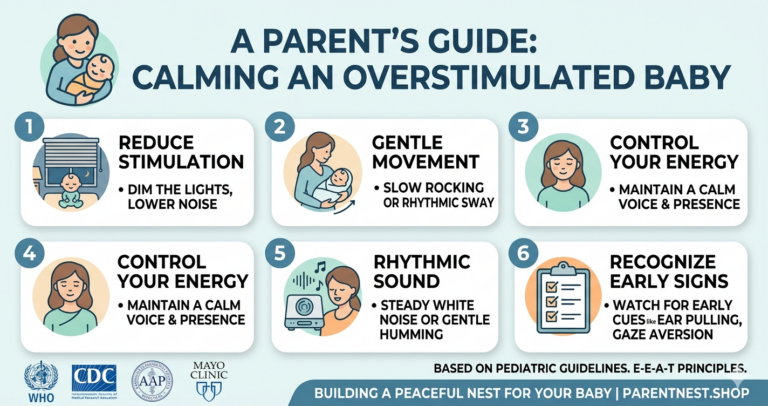
The flip side of Step 1. Once the sun goes down, especially for nighttime feeds and diaper changes, keep the lights low — a small nightlight or dim lamp rather than an overhead bulb. Keep your voice quiet and calm. Skip the playful talking, the singing, the eye contact and cooing that you’d naturally do during a daytime feed. This isn’t about ignoring your baby at night; it’s about making night feel unmistakably different from day, so their brain has something to latch onto.
Change diapers only when genuinely necessary at night — a soaked diaper, yes; a barely-damp one, probably not worth a full wake-up and light exposure. Every unnecessary light-on moment at 2 am is a small vote for “maybe this is daytime” in your baby’s still-forming internal clock.
Within the first hour of waking each morning, if you can manage it, take your baby near a bright window or, weather permitting, outside for a few minutes. Morning light exposure is one of the strongest known signals for setting a circadian rhythm in humans of any age, and newborns respond to it too. This doesn’t need to be elaborate — sitting by a sunny window while you have your own morning chai with your baby in your lap does the job.
Newborns need a lot of daytime sleep, and you shouldn’t panic over a solid daytime nap — but if a single daytime nap regularly stretches past 3 hours, especially in the early weeks, it’s worth gently waking your baby to feed and get some activity in before letting them drift back off. Long, undisturbed daytime naps are often exactly what’s stealing hours from the nighttime stretch, because a baby who slept for four hours at 2 pm simply isn’t going to be sleepy again by 9 pm.
A simple rule many parents use: wake your baby for a feed if a daytime nap crosses the 3-hour mark, but let nighttime sleep stretches run their natural course without interruption once the day-night pattern starts improving, since protecting nighttime sleep matters more once the rhythm begins to shift.
Day-night confusion gets an extra layer of complexity with twins, because you’re often managing two different internal clocks at once, and it’s common for one baby to sort out the day-night pattern noticeably faster than the other. Resist the urge to treat this as a competition or a sign that something’s different about one baby’s development — it’s simply normal variation. Where possible, try to keep both babies on the same daytime-bright, nighttime-dim environment even if their individual wake and feed times don’t line up perfectly, since a shared environment tends to help the slower-adjusting twin catch up faster than if the two are handled in completely separate rooms with different light and noise conditions.
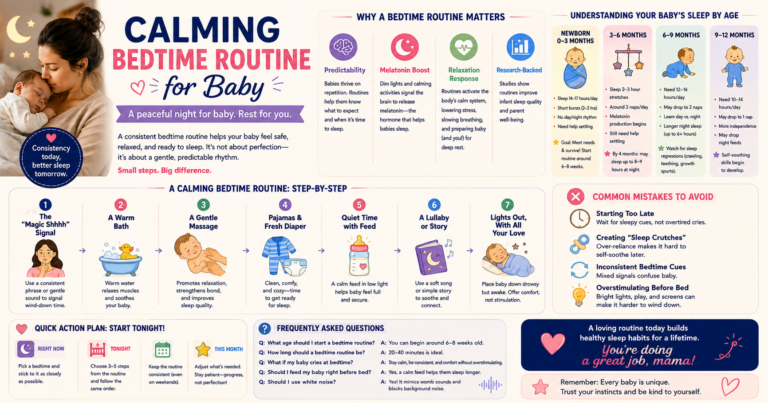
It feels almost silly to have a “bedtime routine” for a three-week-old, but babies pick up on repeated sequences far earlier than most parents expect. A simple, repeated pattern — dim the lights, a short massage or gentle bath, a specific lullaby, then into the sleep space — signals “this is the transition into the long nighttime stretch” long before your baby consciously understands why. Consistency matters more than elaborateness; five quiet, repeated minutes each night works better than an elaborate routine you can’t sustain.
A gentle white noise machine or app can help mask the everyday household sounds that might otherwise startle a lightly-sleeping newborn — a door closing, a sibling’s laughter, traffic outside. Keep the volume moderate (roughly the level of a running shower, not louder) and placed a reasonable distance from the crib rather than right beside your baby’s head. White noise used consistently at night, but not during the day, can also become one more subtle cue that reinforces the day-night distinction.
At 3 am on your ninth sleepless night, it genuinely feels like this has been happening forever and nothing is changing. A simple log — even just times jotted in your phone’s notes app — often reveals gradual progress you’re too tired to notice in the moment, and it also helps you and your partner spot which specific habit (a nap running too long, a too-bright 4 am diaper change) might be working against the reset. Three or four days of tracking is usually enough to see a pattern worth adjusting.
This is where day-night confusion becomes a family-coordination problem, not just a baby problem. If a grandmother, a nanny, or your partner is handling daytime naps while you sleep off a rough night, everyone needs to be doing the same thing — bright, active daytime naps and dim, quiet nighttime handling — or the reset gets undone by well-meaning inconsistency.
This is genuinely one of the more delicate conversations in a joint family home, because a well-meaning Dadi who’s raised three children herself often has a very confident, very different opinion about what a baby needs. “Usko andhere mein sula do, warna aankhein kharab ho jayengi” (put her to sleep in the dark, or her eyes will get weak) is a real thing many parents hear about daytime naps — well-intentioned, rooted in real generational experience, and exactly the opposite of what actually helps reset a newborn’s clock.
It’s worth remembering, too, that this generational disagreement usually comes from genuine love and hard-won experience raising children in a different era, not from a wish to undermine you. Many grandparents raised their own children without air conditioning, in smaller homes, at a time when a dim, quiet room genuinely was the only practical way to get any child to nap through a hot afternoon. Their advice made complete sense in that context. It simply hasn’t caught up with what’s now understood about infant circadian rhythm development, and gently updating the “why” behind a recommendation, rather than dismissing the recommendation itself as outdated, tends to go over far better in practice.
The way through this isn’t confrontation — it’s framing it as something the doctor recommended, or something you read applies specifically to the first few months. “Doctor ne bola hai ki din mein normal roshni mein sulana chahiye, isse raat ko jaldi sona seekh jaayegi” tends to land far better than “that’s an old wives’ tale,” because it respects the relationship while still protecting the plan you and your partner have agreed on.
There’s a specific stretch — often somewhere between 2 and 5 am — where day-night-confused babies are at their most alert and playful, almost as if their body has decided this is actually the best part of the day. This is the hardest window to get through calmly, because your baby genuinely seems happy and engaged, which makes the dim-lights, low-interaction approach from Step 2 feel almost cruel in the moment.
Hold the line anyway. Feed if it’s a feeding time, change the diaper only if needed, offer calm physical comfort if your baby is fussing — but resist the urge to chat, play, or turn on brighter lights just because your baby seems wide awake and ready to engage. This window is usually one of the first things to shorten once the other steps start taking effect, often within one to two weeks of consistent effort.
It helps to have a plan for this window before you’re actually in it, because decision-making at 3 am with almost no sleep in your system is genuinely difficult. Decide in advance, ideally with your partner, exactly what the 2-5 am routine looks like: which parent handles it, what lighting is allowed, whether feeding happens in the crib-adjacent chair or back in the bedroom, and what “just needed” means for a diaper change. Having this decided ahead of time, the same way you might plan for a fire drill, removes a huge amount of the friction and second-guessing that makes this specific window feel harder than it needs to.
No article about newborn sleep is complete without saying this plainly: day-night confusion is one of the hardest early parenting stages precisely because it targets your own sleep at the exact moment you have the least reserve to handle it. Split the night if you can — one parent handles the first stretch, the other takes over later, so at least one of you gets an unbroken block of sleep. If you’re breastfeeding and splitting isn’t straightforward, even having your partner handle diaper changes and settling after each night feed can meaningfully protect a bit more of your own sleep. This isn’t a side note — parents who are running on empty are far more likely to accidentally undo the daytime/nighttime contrast out of sheer exhaustion, so protecting your own rest is part of the fix, not separate from it.
If you have family around who wants to help, this is exactly the stage to accept it, even if it feels like giving something up. Letting a grandparent, sibling, or friend take an afternoon shift so you can nap in a dark, quiet room — genuinely darkened, unlike your baby’s naps — for two or three hours can meaningfully change how you feel for the following 24 hours. There’s sometimes a quiet pressure in Indian households for a new mother to appear like she’s managing everything herself, especially in front of visiting relatives, but accepting help during this specific window isn’t a failure of capability — it’s one of the more practical decisions you can make while your baby’s schedule is actively resetting.
Most fussy, wide-awake nights in the newborn stage are simply this normal, temporary pattern. But it’s worth knowing when to loop in your pediatrician rather than assuming it will resolve on its own:
If any of this resonates while you’re reading, please don’t sit on it the way many exhausted new parents do out of a sense that “everyone goes through this.” Bringing it up early, even if it turns out to be nothing, is always the right call.
None of these mean something is necessarily wrong — many have simple explanations — but they’re worth a conversation with your pediatrician rather than assuming more time alone will fix it.
It’s also worth saying that seeking reassurance from your pediatrician early doesn’t mean you’re overreacting or “that parent” who calls about everything. Most pediatricians would genuinely rather field a quick question about a sleep pattern that turns out to be completely normal than have a parent quietly worry for weeks about something easily explained. A short phone call or a message through your clinic’s app describing exactly what you’re seeing — how long the wakeful stretches last, whether feeding and weight gain seem on track, whether the crying (if any) responds to comfort — usually gets you a clear answer within a day, and often that answer is simply “this is normal day-night confusion, keep doing what you’re doing.”
While you’re adjusting light, noise, and routine, it’s worth keeping the basics of safe infant sleep in place throughout, since a tired household can sometimes let these slip: always place your baby on their back to sleep, use a firm sleep surface, and keep soft bedding, pillows, and toys out of the crib. These guidelines apply regardless of what time of day or night your baby is sleeping, and they matter more, not less, during an exhausting stretch like this one.
By the end of week two of consistently applying this — bright, noisy daytime naps, dim and boring nighttime feeds, morning sunlight by the window with her chai, and a firm but polite conversation with her mother-in-law about why the curtains stayed open during Anaya’s afternoon naps — Meera noticed something on a Tuesday night that she almost didn’t trust.
Anaya had fed at 1 am, gone back down within twenty minutes, and didn’t wake again until almost 5. It wasn’t a full night. It wasn’t even close to what Meera used to consider a full night, back before Anaya existed. But it was the longest stretch either of them had gotten in a month, and Meera lay there in the dark for a few extra minutes just to make sure it was real before allowing herself to fall back asleep, half-smiling.
“She’s figuring it out,” Kabir said the next morning, watching Anaya blink sleepily in the bright kitchen light while they had breakfast. “Took her long enough.” Which, from a man who’d spent two solid weeks pacing the living room floor at 3 am, was about as close to a victory speech as it got.
The improvement wasn’t a straight line, either, and it’s worth saying that plainly. There was a night about ten days in where Anaya was wide awake again from 1 to 4 am, seemingly out of nowhere, and Meera spent the whole stretch convinced they’d somehow undone all their progress. It turned out to be nothing more than a slightly longer daytime nap that had crept past the three-hour mark two days in a row without anyone noticing. One evening of tightening the nap length back up, and the pattern corrected itself within a night or two. Small backslides like that are normal and don’t mean the approach has stopped working — they’re usually just a small daytime habit quietly drifting and needing a light course correction.
It doesn’t happen overnight — the pun, unfortunately, is unavoidable — but it does happen. Give the steps above two to three consistent weeks, expect the 4 am window to be the last thing to fully resolve, and trust that the fog does lift, usually earlier than the exhausted version of you currently believes possible.
Most babies begin showing real improvement within 2 to 3 weeks of consistently applying a day-night reset routine, with the circadian rhythm more fully maturing by 3 to 4 months of age as melatonin production increases naturally.
This is classic day-night confusion — the baby’s circadian rhythm hasn’t developed yet, and in many cases the pattern is a holdover from the womb, where movement during the day lulled the baby to sleep while stillness at night made them more active. It typically resolves with consistent light and activity cues over several weeks.
No — this is one of the most common and most counterproductive instincts new parents have. Keeping daytime naps in normal light and sound actually helps a baby’s brain distinguish day from night faster, which speeds up the fix rather than slowing it down.
Yes, night feeding needs don’t disappear during a day-night reset — the goal isn’t to stop night feeds, it’s to keep them calm, dim, and low-stimulation so they don’t accidentally reinforce daytime-like alertness.
If there’s been no improvement at all after several weeks of consistent effort, or if it’s paired with feeding difficulties, poor weight gain, or signs of illness, it’s worth discussing with your pediatrician rather than continuing to wait it out alone.
Frame it around your pediatrician’s advice rather than as a disagreement with her experience — something like “doctor ne bola hai normal roshni mein sulana chahiye, isse raat mein jaldi sona seekh jaayegi” tends to be far more effective than directly contradicting a generational habit, since it respects her intentions while still protecting the routine you’re building.
Swaddling doesn’t directly fix the circadian rhythm issue, but it can help a baby settle more easily during nighttime feeds by limiting the startle reflex that often wakes newborns mid-sleep, which indirectly supports the calm, low-stimulation nighttime environment you’re trying to build. Always follow safe swaddling practices — arms can be swaddled but hips should have room to move, and swaddling should stop once a baby shows signs of rolling.
It’s uncommon for it to fully return once a baby’s circadian rhythm has matured, but travel across time zones, illness, or a major routine disruption can cause a temporary wobble that looks similar. The same core approach — bright, active days and dim, boring nights — usually helps re-establish the pattern quickly in these cases too.
Occasional exceptions won’t undo weeks of consistent effort, but making dark and silent the default daytime nap environment works against the reset you’re trying to build. If your baby seems to need it occasionally due to overtiredness or overstimulation, that’s fine — just return to the normal-light, normal-noise approach for the next nap rather than letting it become the new default.
If you’re reading this bleary-eyed at some impossible hour with a wide-awake baby on your chest, know that this specific stage, as brutal as it feels, has one of the clearest, most reliable fixes in all of newborn parenting. You’re not doing anything wrong, your baby isn’t broken, and in a few weeks this exact moment will be a story you tell — the way Meera tells it now, mostly laughing, about the three weeks her daughter thought 3 am was playtime.
It’s worth holding onto that image for the nights when it feels hardest to believe: somewhere, right now, there’s a parent exactly one year past where you are tonight, telling this same story to a friend who’s currently pacing their own dark living room, and laughing about it the way Meera does. That parent used to be exactly this tired, exactly this unsure it would ever change, and it changed anyway. Yours will too.
This article offers general newborn sleep guidance based on common patterns observed in infant sleep development and pediatric care. It isn’t a substitute for medical advice — if you have concerns about your baby’s feeding, weight gain, breathing, or overall wellbeing, or if you’re struggling to cope, please consult your pediatrician or a healthcare provider directly.