Physical Address
304 North Cardinal St.
Dorchester Center, MA 02124
Physical Address
304 North Cardinal St.
Dorchester Center, MA 02124

A few weeks before the baby came, my aunt showed up at the door with a small cloth bag. Inside were dry, brown, wrinkly things that looked a bit like old dates.
“Reetha,” she said. “This is what we used for you. No powder. No smell. Nothing.”
I smiled and thanked her. Then I put the bag in a drawer and went online, because I had questions. Was reetha really safe for a newborn? Did it clean milk stains? What about all those recipes with borax and essential oils that kept popping up? Everyone online said “natural” and “chemical-free”. Nobody said what could go wrong.
So I read. A lot. If you have searched for a homemade natural detergent for baby clothes safe recipe, you may be asking the same thing. I found out that there is a safe way to do it, but it looks quite different from the popular recipes. It is simpler, and it has clear limits. This guide shares that safe recipe, step by step, in plain words. It also tells you what to skip, and when a shop-bought detergent is the better choice. Get a cup of tea. The headings will help if you want to jump ahead.
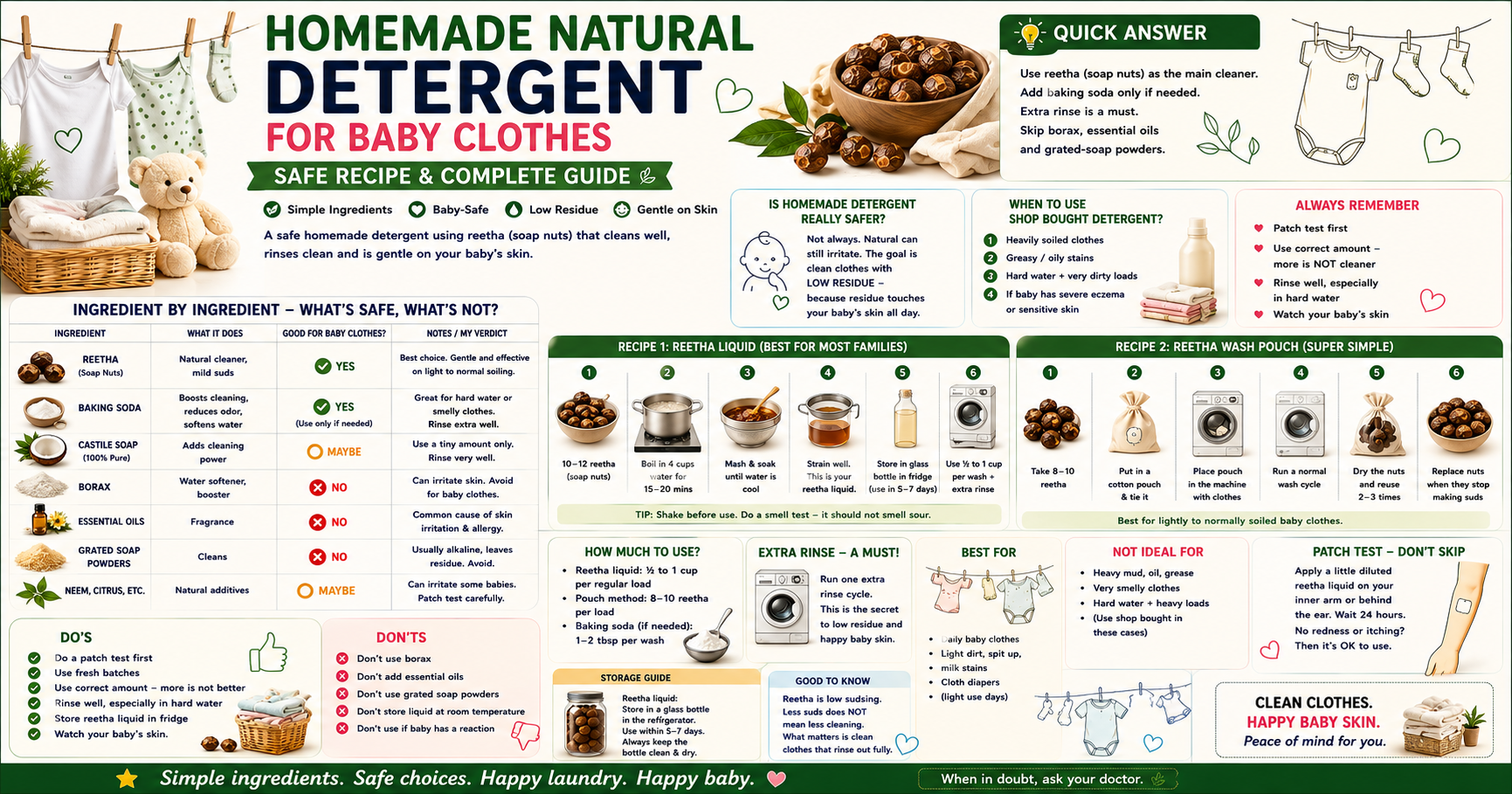
Quick answer: A safe homemade natural detergent for baby clothes is simple. Use reetha (soap nuts) as the cleaner, either boiled into a liquid or kept in a cotton pouch in the machine. Add baking soda only if your water is hard or clothes smell. Add a plain extra rinse. Skip borax, essential oils and grated-soap powders. Homemade works best on lightly soiled clothes. Patch test first, and ask your doctor if your baby has eczema.
Let me be honest before we start.
I did not test these recipes in a lab. I did not wash a hundred onesies. What I did was read many DIY recipes, safety notes about the ingredients, advice about skin and laundry, guidance from consumer testers, and a few Indian sources on using reetha. Then I kept only the parts that seemed safe, simple and sensible for baby clothes.
Three things to keep in mind:
Now, the big question.
Not always. And this is the part many websites skip.
People make their own detergent because they want to know what is in it. That is a good reason. But “homemade” and “natural” do not automatically mean “gentle”. Here is what I found.
| What people say | What is more accurate |
| “Natural means safe.” | Natural things can still irritate or cause allergies. Reetha, neem, citrus and essential oils all can, for some people. |
| “Chemical-free.” | Everything is made of chemicals. Water is a chemical. Baking soda is a chemical. The real question is which ones, and how much stays in the clothes. |
| “Homemade has no hidden ingredients.” | True, but you also have no tested formula, no preservative and no dosing guide. |
| “Soap is gentle.” | Traditional soap is alkaline, and skin is slightly acidic. Soap residue can irritate sensitive skin. |
| “Reetha cures eczema.” | Some sellers say this. There is no good proof, and you should not use it as a treatment. |
So the goal is not “homemade at any cost”. The goal is clothes that are clean and low in residue, because residue is what touches your baby’s skin all day.
Whether you buy it or make it, a good baby detergent follows four simple rules. I call them the Four Safe Rules.
Keep these four rules in your head. They explain every choice in the recipes below, and they explain why I left out so many popular ingredients.
Here is how the common DIY ingredients stack up for baby clothes. The last column is my verdict.
| Ingredient | What it does | Main concern for babies | Verdict |
| Reetha (soap nuts) | A natural cleaner. The shells release saponin, which lifts dirt. | Mild cleaner, weak on heavy soil. Can cause allergy in rare cases. Liquid spoils fast. | Use |
| Baking soda | Helps with smell. Can help soften hard water. | Weak as a stand-alone cleaner. | Use as a booster |
| White vinegar | Acidic rinse that helps remove residue and sour smell. | Don’t mix with baking soda at the same time. Never mix with bleach. | Use carefully |
| Washing soda | Strong alkaline booster and water softener. | High pH. Can irritate skin. Must not be inhaled. Leaves alkaline residue. | Skip for babies |
| Borax | Cleaning booster. | Can irritate skin. Safety groups advise leaving it out. | Skip |
| Castile or grated bar soap | True soap that cleans well. | Makes soap scum in hard water. Can leave residue and gray clothes. Can clog machines. | Skip, especially with hard water |
| Essential oils | Scent. | Fragrance allergy and irritation risk. | Skip |
| Dish soap | Strong cleaner that foams a lot. | Over-sudsing, weak rinse, skin irritation. | Skip |
You’ll notice that the “Use” list is short. That’s on purpose. Fewer ingredients means fewer things that can go wrong, and less residue on the cloth.
Reetha is the dried shell of the soapberry. It grows on trees in India and Nepal, and it has been used for washing hair, silver and clothes for a very long time.
The shell holds a natural cleaning agent called saponin. When the shell touches water, saponin comes out. It makes a soft, low foam that lifts oil and dirt from cloth. You will not see big, fluffy bubbles. That is normal. Less foam also means less to rinse out.
What reetha does well:
What reetha does not do well:
A word about allergy. Reetha is natural, but natural is not allergy-proof. One published case report describes a worker who developed a true allergy to soapnut raw material after handling ground product at work. That does not mean it is dangerous for your family. It does mean you should patch test, avoid breathing in dust when you crush shells, and stop if your baby gets a rash.
What to look for when you buy:
[IMAGE: close-up of deseeded reetha shells in a steel bowl]
Before the recipes, here is the whole idea in one line. I call it the 1-1-1 Baby Wash.
That’s it. One cleaner, one booster, one rinse. No long ingredient list, no scents, no guessing. Everything below fits into these three steps.
This is the classic homemade natural detergent. It makes about 3 cups. Make small batches, because the liquid has no preservative and does not last long.
What you need:
How to make it:
Safety while making it: Don’t boil it with a baby on your hip, and keep the pot and bottle out of reach of children. A bottle of brown liquid can look like tea or juice to a toddler. Label it clearly and store it up high.
How much to use:
These are starting points, not exact rules. Your reetha and your water will decide the right amount.
How long it lasts (be strict about this):
| Where you keep it | How long | Notes |
| Room temperature | Up to 2 days at most | Less in hot weather. Sources say anywhere from 2 days to 2 weeks, so I chose the cautious end. |
| Fridge | Up to 1 week | Keep it in a closed, clean glass bottle. |
| Freezer (ice cube trays) | A couple of months | Freeze in cubes, move to a bag and label the date. Two cubes is about 1/4 cup. |
Throw it away if: it smells sour or like fermenting food, looks cloudy or slimy, or has any mould on top. Don’t try to “rescue” it. Make a fresh batch. The pouch method below avoids this problem completely.
If you only try one thing from this guide, make it this. There is no cooking, no liquid to spoil and almost nothing to measure.
What you need:
How to use it:
For hand wash: soak a pouch in a bucket of warm water for 15 to 20 minutes, squeeze it a few times until the water looks lightly soapy, then wash the clothes in that water.
A few tips:
Several Indian sources suggest this pouch method, and so do many reetha sellers. It’s also very cheap per wash.
[IMAGE: muslin pouch with reetha shells inside a washing machine drum]
Baking soda gets a lot of hype, so let’s keep it real. Baking soda is not a detergent. It does not lift grease or food the way a cleaner does. But it has two useful jobs in baby laundry.
Job 1: smell. Baking soda helps cut sour milk and musty smells.
Job 2: hard water. If your water is hard, baking soda can act as a mild water softener. A laundry expert quoted by Consumer Reports said this may help.
How to use it:
Important: don’t use baking soda and vinegar in the same step. They cancel each other out. If you want both, use one, rinse, and then use the other.
White vinegar is acidic, and that is why it can help with sour smell and with soap or mineral residue. It is a rinse aid, not a cleaner.
How to use it:
Rules:
Here’s the honest bit. A homemade reetha wash has no enzymes. Enzymes are the helpers in many store detergents that break down milk and food. That means dried milk and spit-up stains are harder for a homemade wash.
The good news is that a lot of stain removal is about what you do first, not what you wash with. Use the same cold-water-first method from our spit-up stain guide:
For stains that have set, a few hours of sunlight on white cotton can help fade them. If a stain still will not shift, a fragrance-free store-bought enzyme detergent is a better tool for that one job. Using homemade for daily washes and a store detergent for tough stains is a sensible middle path.
Many parents search for a “chemical-free homemade detergent”. I get it. You want something simple and honest.
But “chemical-free” cannot be true. Reetha has saponin, which is a chemical. Baking soda is sodium bicarbonate. Vinegar is acetic acid. Even the water you use is a chemical, and tap water has minerals and sometimes chlorine in it.
A better goal is this: “few ingredients, low residue, no fragrance, and I know what each one does.” That is something you can actually achieve. And it matches the Four Safe Rules from earlier.
If you live in a hard water area, read this part twice.
Hard water has a lot of minerals, mainly calcium and magnesium. These minerals react with true soap (like castile or grated bar soap) and make a sticky, waxy film called soap scum. That film can make clothes stiff, grey and a bit smelly. Several sources say DIY soap-based recipes work poorly in hard water, and that is one big reason I left them out.
What about reetha? Reetha’s cleaning agent is saponin, not fatty-acid soap, so it does not behave in exactly the same way. But I could not find solid evidence either way about how it performs in very hard water. So please test it, and do not assume it will work.
A simple hard water test:
If your water is very hard:
I know, many recipes online tell you otherwise. Here is why I left these out.
| Skip this | Why |
| Borax | It can irritate skin. Some safety groups advise leaving it out of DIY laundry recipes. For baby clothes there is no good reason to take the risk. |
| Washing soda mixes | Washing soda is strongly alkaline and can irritate skin. It can leave alkaline residue, and you should never breathe in the powder. |
| Grated bar soap powders | They can make soap scum, especially in hard water. Consumer Reports notes that you cannot know the right dose, and some people report clogged front loaders. |
| Essential oils | Fragrance is a common irritant. Natural oils can still cause reactions in babies. |
| Dish soap | Too foamy, hard to rinse, and can irritate skin. |
| “Everything” blends | Salt, Epsom salt, oxygen cleaners, soda and soap all in one jar. More ingredients means more residue and more chances of a reaction. |
| Chlorine bleach with vinegar | This can release harmful gases. Never mix them. |
If a recipe says “safe for babies” and has borax, washing soda and essential oils in it, I would not use it on my baby’s clothes. Remember the Four Safe Rules.
Things will not always work on the first try. Here is a quick guide.
| What you notice | Likely cause | What to try |
| Clothes feel stiff | Residue from hard water or too much liquid | Rinse again in plain water. Cut the amount of liquid. Add 1/4 cup baking soda to the drum next time. |
| Clothes smell sour | Spoiled liquid, a damp pouch or a dirty drum | Throw away old liquid. Dry the pouch fully. Run a tub-clean cycle. Try a vinegar rinse. |
| Clothes look grey or dull | Residue or hard water minerals | Add an extra rinse. Try the vinegar rinse once. Dry whites in the sun. |
| Milk stains stay | No enzymes in reetha | Cold rinse first, then pre-treat. Use a store enzyme detergent for that stain only. |
| Brown marks on white cloth | Pulp or a strong batch of liquid | Strain twice. Use less liquid. Try the pouch method instead. |
| Baby has redness or rash | Possible irritation or allergy, or something else entirely | Stop using it, rinse clothes in plain water, and call your doctor. |
| Machine smells musty | Damp drum or gasket | Wipe the seal, leave the door open, run a monthly tub-clean cycle. |
If you try two fixes and nothing changes, switch back to a fragrance-free store detergent for a while. You can always try again later.
I’ve seen these in parenting groups again and again, and they are easy to avoid.
Even a simple, gentle recipe needs a careful start. Here is how I would roll it out.
Stop and call your doctor if: your baby gets a rash, redness, itching, blisters, or dry cracked skin, or if an existing eczema flares. Stop using the homemade wash and go back to what you used before while you check.
Be careful here. Cloth nappies, clothes after a stomach bug and anything with a lot of poop or vomit need a stronger clean than a mild reetha wash.
In my view, this is the one area where a good store detergent beats homemade, and there is no shame in using one.
A few small habits keep your homemade wash safe.
Good news: the pouch method works in most machines, including front loaders, because reetha makes very little foam. Here are my tips.
If your machine manual says anything about natural or soap-based products, follow it.
Reetha is usually cheap, and a pouch of shells can wash several loads. So yes, it can cost less per load than many baby detergents. But think about the full picture.
| Cost | Homemade (reetha) | Store-bought baby detergent |
| Money per load | Often low | Low to medium, depending on the brand and dose |
| Your time | More: soaking, boiling, straining, drying the pouch | Almost none |
| Waste | Spoiled liquid if you make too much | Very little |
| Stain power | Mild, no enzymes | Many include enzymes |
| Consistency | Varies with the reetha you buy | Same formula each time |
To compare properly, work out cost per wash for both: the price of the pack divided by the number of washes it gives. Our baby detergent comparison shows how. Don’t choose homemade only to save a few rupees if it adds stress or doesn’t get the clothes clean.
Homemade is a nice option, but it isn’t for everyone. I would pick a shop-bought, fragrance-free baby detergent if:
Choosing a store detergent doesn’t mean you failed at being natural. It means you picked the safest tool for the job. Our comparison of five Indian baby detergents can help you read the labels.
Here’s how this can fit into a real week.
Daily: Rinse any stains in cold water. Wash the day’s baby clothes with the reetha pouch on a gentle cycle at 30 to 40 degrees. Add an extra rinse. Dry in the sun.
Twice a week: Wash bibs and muslins in their own load, because they take the worst of the milk and food.
Weekly: Dry the pouch in the sun and check the shells. If they are grey and soft, replace them. Add 1/4 cup of baking soda if your water is hard or clothes smell flat.
Monthly: Run an empty tub-clean cycle. Check your supply of reetha and your jars.
Always: Keep one plain store detergent in the cupboard for tough stains or heavy loads.
A few months later, the little cloth bag came out of the drawer.
I used it for about six weeks. On most days it was lovely. The clothes smelled of nothing at all, which still feels strange and nice. The muslins came out soft. I felt calm about what was touching my baby’s skin.
But it wasn’t perfect. A set-in milk stain on a white vest would not shift, however long I soaked it. During a very hot week, a bottle of reetha liquid I had left out on the counter went sour in two days, and I poured it away with a sigh. And on the day of a stomach bug, I reached for a plain store detergent without thinking twice.
That’s when I understood what my aunt had really been telling me. She didn’t mean “reetha is magic”. She meant “keep it simple, keep it clean, rinse well”. The reetha was only the tool.
So here is my honest summary. A homemade natural detergent for baby clothes, with a safe recipe like this one, can be gentle and lovely, if you keep the recipe short, skip the scents and the strong boosters, make small batches, rinse twice and patch test. Use it for everyday clothes. Use something stronger when the job needs it. And be kind to yourself. Finding a homemade natural detergent for baby clothes safe recipe is really about asking the right questions, and you already are.
A homemade natural detergent for baby clothes can be safe if the recipe is very simple, fragrance-free and rinsed out fully. A reetha pouch with an extra rinse is a gentle choice for lightly soiled clothes. But newborn skin is delicate, so patch test first, and ask your paediatrician if your baby has eczema or sensitive skin.
For most families, reetha is a mild, traditional cleaner that works well for lightly soiled baby clothes. But natural does not mean allergy-proof. Patch test with one item, rinse twice, and stop if you see a rash. Do not use it as a treatment for eczema.
No. Baking soda helps with smell and can soften hard water, but it is not a real cleaner. Use it as a booster alongside reetha, about 1/4 cup per load, or as an odour soak. Don’t mix it with vinegar in the same step.
Not long. Use it within 2 days at room temperature and within 1 week in the fridge. For longer storage, freeze it in ice cube trays. Throw it away if it smells sour, looks cloudy or slimy, or shows mould. The no-cook pouch avoids this problem.
Soap-based recipes, such as castile or grated bar soap, often leave scum in hard water. Reetha works differently, but I found no clear proof of how well it works in very hard water. Test with a white muslin cloth, add 1/4 cup baking soda, and rinse extra well.
I would skip both. Borax can irritate skin, and some safety groups advise leaving it out. Essential oils add fragrance, which is a common cause of skin reactions. A simple recipe with few ingredients leaves less residue and fewer chances of irritation.
The reetha pouch method works in most machines, including front loaders, because it makes very little foam. Avoid grated-soap powders, which some people say clog front loaders. Add an extra rinse, clean the drum monthly, and check your manual.
Only partly. Reetha has no enzymes, so dried milk stains are harder. Rinse in cold water first, work a little reetha liquid into the stain, and dry in the sun. For set stains, a fragrance-free store detergent with enzymes may do better.
Choose a store detergent if your baby has eczema or very sensitive skin, if your newborn is only a few weeks old, if your water is very hard, or if you wash cloth nappies or heavily soiled clothes. Fragrance-free is the safest starting point.