
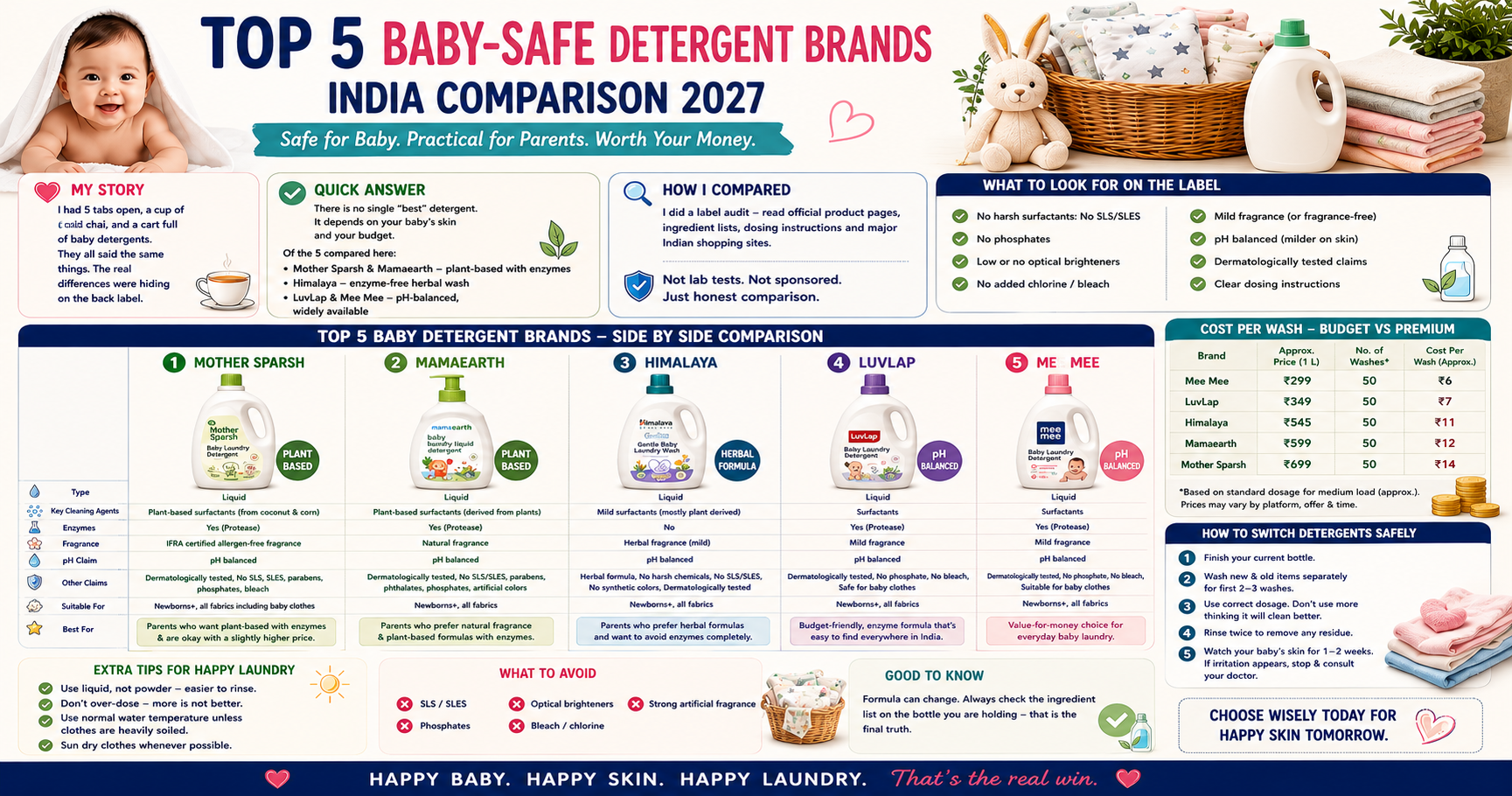
I had five browser tabs open, a cup of cold chai beside the laptop, and a shopping cart that kept growing. Six bottles of baby detergent. Every single one promised the same things: dermatologically tested, safe for your baby, plant-based, gentle, chemical-free.
And every one of them cost a different amount.
I remember sitting there thinking, they can’t all be the best. But they all say the same words. How do you choose between six products that describe themselves in nearly identical language?
Top 5 Baby-Safe Detergent Brands India Comparison:
That evening I stopped reading the front of the bottles and started reading the back, the small print, the ingredient lists, the dosing instructions. It turned out the real differences were hiding there. If you’ve been searching for a top 5 baby-safe detergent brands India comparison 2027 can trust, this is the guide I wish I’d had that night, and I’ll show you exactly how to read those labels yourself.
Here’s what we’ll cover: what the big claims on the front of the pack really mean, how five popular Indian baby detergents compare on ingredients, enzymes, fragrance and pH claims, how to work out the true cost per wash (budget versus premium), and how to switch detergents without upsetting your baby’s skin. Make a fresh cup of chai first. It’s a long read, and the headings are there so you can skip ahead.
Quick answer: There is no single “best” baby detergent in India, because the right pick depends on your baby’s skin and your budget. Of the five compared here, Mother Sparsh and Mamaearth are plant-based formulas with enzymes, Himalaya is an enzyme-free herbal wash, and LuvLap and Mee Mee are pH-balanced, widely available mass-market options. Whichever you choose, prefer a liquid, use the recommended dose (not more), rinse twice, and read the ingredient list on the pack you are holding.
Table of Contents
How I compared these five brands (and what I did not do)
Let me be upfront, because honesty matters more than a dramatic headline.
I did not run laboratory tests. I did not wash a hundred stained bibs under controlled conditions. What I did was a label audit: I read each brand’s official product page, the ingredient lists published there, the dosing directions, and the listings on the big Indian shopping sites, and I compared what each one claims and what it actually names on the label. I looked at things that matter for a baby’s laundry: the type of cleaning agents, whether enzymes are used, whether there’s fragrance, which common irritants are left out, what claims are made about pH and dermatological testing, and how much product you really use per wash.
I picked the five brands by a simple rule: they are easy to find across India, they are made specifically for baby laundry, and they come up most often when parents compare options. The five are Mother Sparsh, Mamaearth, LuvLap, Himalaya and Mee Mee. Other good names exist, and I mention several of them later.
Two honest limits to keep in mind:
- Brands change formulas. The ingredient list on your bottle is the final word, not this article and not the website.
- Marketing claims are not proof. When a brand says “dermatologically tested”, I report that it says so. I can’t verify the test.
With that said, let’s start with the part that confused me most.
Decoding the label: what “baby-safe” really means
Before comparing brands, you need a quick translation guide. The front of the bottle is advertising. Here is what the common phrases usually mean and what they don’t.
| Label claim | What it usually means | What it does not guarantee |
| Dermatologically tested | The product was tested on skin under a dermatologist’s supervision. | That your baby won’t react. It isn’t the same as “dermatologist approved” or “recommended”. |
| Hypoallergenic | Formulated to reduce the chance of allergic reactions. | That it is allergen-free. There is no single universal standard behind the word. |
| pH balanced | The brand adjusted the pH so it is milder. | A specific number. Most labels never print one. |
| Plant-based | Some ingredients come from plants, such as coconut-derived cleaning agents. | That every ingredient is natural or that it can’t irritate. |
| Chemical-free | Marketing shorthand for “free of certain ingredients we chose to leave out”. | Anything literal. Water is a chemical. So is neem extract. |
| Kills 99.9% germs | Lab test result against selected organisms. | That your laundry is sterile or that you need it. Most baby laundry only needs to be clean and well rinsed. |
| Free from SLS/SLES, phosphates, bleach | The product leaves these out. | That the product is safe for every baby. It’s a sensible precaution, not a certificate. |
The phrase I’d treat most carefully is “chemical-free”. Every detergent, including the gentlest plant-based one, is made of chemicals that clean fabric. What you want to know is which ones, and in what company.
pH neutral detergent: what it means and what it doesn’t
You’ll see “pH balanced” or “pH neutral” printed on many bottles. It sounds reassuring, so it’s worth a moment to understand it.
pH is a scale that tells you how acidic or alkaline something is. Healthy baby skin is slightly acidic. Skin-care brands often aim for products around pH 5.5; for example, Himalaya’s own baby wash page describes its product as pH 5.5. Most laundry detergents, by contrast, tend to be somewhat alkaline, because alkaline conditions help lift grease and dirt from fabric.
Here’s the catch. A detergent isn’t left on your baby’s skin the way a lotion is. It’s meant to rinse out. So the real question isn’t only “what is the pH of the bottle”. It’s “how much detergent stays in the fabric after rinsing, and what is it made of?” This is why pediatric skin advice usually leans on three habits: use fragrance-free or mild products, don’t overdose, and rinse thoroughly.
So when you see “pH balanced” on a pack, take it as a good sign that the brand has thought about mildness. But don’t treat it as a guarantee. Very few brands print the actual number, so a claim that can’t be checked is a claim that can’t separate one bottle from another.
Detergent ingredient list check: a six-point routine
This is the habit that changed how I shop. It takes about two minutes per bottle, and you only have to learn it once.
1. Find the cleaning agents (surfactants)
These are the ingredients doing the actual cleaning. On Indian baby detergent labels you’ll see names like “plant-based surfactants”, “cocamidopropyl betaine”, “alkyl glucoside” or “lauryl alcohol ethoxylate”. You don’t need to memorise them. Just notice what is listed first after water, because ingredients are normally listed in order of amount.
2. Look for SLS and SLES
Sodium lauryl sulfate and sodium laureth sulfate are common, effective cleaning agents. They can also irritate sensitive skin in some people. Many baby brands say “free from SLS/SLES” as a precaution. That’s a reasonable preference, but a “free from” claim doesn’t prove safety, and a product that contains SLES isn’t automatically unsafe. It’s one signal among several.
3. Check for enzymes
Enzymes such as protease (breaks down protein), amylase (starch) and lipase (fat) are very good at lifting milk and food stains. That’s why many baby detergents use them. A few sources suggest that, in rare cases, enzymes might bother very sensitive skin, which is why some families prefer enzyme-free (also called “non-bio”) formulas. Neither choice is wrong. It depends on your baby, and I cover it in its own section below.
4. Check the fragrance line
This one matters more than most parents realise. Fragrance is widely cited as one of the most common causes of detergent-related skin reactions. A bottle can be plant-based and still contain perfume. Look for words like “fragrance”, “perfume”, “parfum” or essential oils. “Allergen-free fragrance” or “IFRA certified” means the fragrance is made to follow industry safety limits, but it’s still fragrance. If your baby has sensitive skin or eczema, a fragrance-free option is the safer starting point.
5. Check the preservatives
Water-based liquids need preservatives. Some, like methylisothiazolinone and methylchloroisothiazolinone (often written MI and MCI), are known to cause contact allergy in some people. Brands that avoid them usually say so. If you see these names on a list, it doesn’t mean the product is dangerous, but it’s worth knowing for babies with reactive skin.
6. Check what’s left out
Look for the “free from” list: phosphates, bleach, optical brighteners (fluorescent whitening agents), synthetic dyes, parabens. Optical brighteners and dyes make clothes look whiter or nicer but do nothing for cleaning, so avoiding them on baby clothes is an easy decision.
Pro tip: Take a photo of the ingredient list on the pack, and save it in a folder. If your baby ever develops a rash, you’ll be able to show the exact list to the paediatrician or dermatologist instead of guessing from memory.
Top 5 baby-safe detergent brands India comparison 2027: the scorecard at a glance
Here are the five brands side by side. Everything in this table comes from the brands’ own pages and published listings as I checked them in October 2026, so treat it as a starting point and confirm on your pack.
| Brand | Type | Enzymes | Fragrance | pH claim | Dermatologically tested claim |
| Mother Sparsh Plant Powered | Plant-based liquid | Yes (bio-enzymes) | Yes (IFRA hypoallergenic perfume, eucalyptus oil) | Not prominent | Yes |
| Mamaearth Plant Based | Plant-based liquid | Yes | Yes (IFRA allergen-free fragrance) | Not prominent | Yes |
| LuvLap (pH Balanced line) | Mass-market liquid | Not highlighted | Mild scent, not clearly stated | Yes (pH balanced) | Yes |
| Himalaya Baby Laundry Wash | Herbal liquid | No (enzyme-free) | Herbal extracts, not clearly stated | Not prominent | Yes |
| Mee Mee Mild | Mass-market liquid | Yes (protease, amylase, lipase) | Mild fragrance (brand lists aloe and lemon) | Yes (pH balanced) | Yes |
Notice how little separates them on the “dermatologically tested” line. They all claim it. The real differences are enzymes, fragrance, and the “free from” lists. Let’s look at each one.
1. Mother Sparsh Plant Powered Baby Laundry Liquid
What the label says: Mother Sparsh describes this as a plant-powered liquid with bio-enzymes, aloe vera, neem and eucalyptus oil. Listings and the brand site say it is free from SLS/SLES, phosphate, parabens, bleach, optical brighteners and dyes, and that it uses an IFRA-certified allergen-free fragrance. It’s sold in sizes from a small travel pack to a 2.2 litre bottle.
What stands out in the ingredient list: The brand’s published list names aloe vera, neem extract, eucalyptus oil, perfume, a hypoallergenic IFRA perfume, a foam stabiliser, polyethylene glycol, cocamidopropyl betaine and lauryl alcohol ethoxylate. So it’s plant-powered in marketing terms, with a blend of plant extracts and conventional mild cleaning agents behind it. That’s normal for any liquid detergent, and a more honest way to describe it than “all natural”.
Best for: Parents who want a plant-based formula with enzymes for milk and food stains, and who are comfortable with a light natural scent. It also comes in several sizes, including refill packs.
Watch out for: The fragrance and eucalyptus oil. Essential oils are natural, but they can still be a trigger for some sensitive skin. If your baby is eczema-prone, this may not be your first choice.
What parents say: At the time I checked, the 2.2 litre bottle on Amazon.in showed an average of about 4.4 stars from more than five thousand ratings. Ratings move, so check again before buying.
My verdict: A well-known all-rounder with a strong track record and good stain-fighting claims, but not fragrance-free.
2. Mamaearth Plant Based Baby Laundry Liquid
What the label says: Mamaearth presents this as a dermatologically tested, plant-based liquid with bio-enzymes and neem extract. It states that it’s free from bleach, foam boosters, SLS/SLES, phosphates, optical brighteners, parabens and dyes, and it carries a Made Safe certification claim. It also says it’s suitable for newborn clothes.
What stands out in the ingredient list: The published list is short, which is a good thing. It reads roughly: water, plant-based surfactants, sodium citrate, citric acid, neem extract, enzymes and an IFRA-certified allergen-free fragrance. One listing also names a coconut fatty acid amide. A short list is easier to scan and easier to show a doctor.
How you use it: The dosing on retailer listings for hand washing is about 5 ml in 5 litres of water, which is a low dose compared with some others. Always confirm on your own pack.
Best for: Parents who value a short, transparent ingredient list and a third-party certification, and who want enzymes.
Watch out for: Like Mother Sparsh, it contains fragrance, even though it’s an allergen-free one. And “Made Safe” is a certification program that checks ingredients against its own list of concerns. It’s a useful signal, but it’s not a medical clearance for any individual baby.
My verdict: The easiest list of the five to read and understand, and a strong choice if enzymes suit your baby. Not for a fragrance-free routine.
3. LuvLap Baby Laundry Detergent
What the label says: LuvLap sells two different ranges, and this is the first thing to understand. The classic line is marketed as pH balanced, anti-bacterial, dermatologically tested, enriched with aloe vera and “safe for mommy’s hands and baby’s skin”. The second is a plant-based line with bio-enzymes, aloe vera and neem, free from SLS/SLES, phosphate and bleach. Both appear in many pack sizes.
What stands out: The listings for the classic line also mention a softening technology. That makes clothes feel softer, but it’s one more thing that has to rinse out, and softening agents are exactly what many dermatology tips advise sensitive-skin families to limit. If your baby’s skin is reactive, the plant-based range with the “free from” list may suit you better than the classic one.
Best for: Budget-conscious families who want a baby-specific detergent that’s easy to find, with a clear pH-balanced claim in the classic range.
Watch out for: Choosing the wrong version. The names are long and similar, so check whether the pack says “pH Balanced” or “Plant-Based” and then read the matching ingredient list.
What parents say: The 1 litre refill pack was ranked #2 in Amazon.in’s baby laundry detergent bestsellers when I looked, with an average of about 4.4 stars from over four thousand ratings.
My verdict: A popular, easy-to-buy option. Pick your range deliberately.
4. Himalaya Baby Laundry Wash (Gentle and Germ Free)
What the label says: Himalaya describes its wash as made with naturally derived cleansing agents and herbs. Neem, lemon, soapnut, rosemary and nagarmotha oil are named, and the brand states it is dermatologically tested, biodegradable and enzyme-free. It claims 99.9% germ protection based on in-vitro (lab dish) studies.
What stands out: This is the only one of the five that clearly says it contains no enzymes. An older brand page also lists it as free from phosphorus, parabens, SLS/SLES/ALS, synthetic colour, added bleach and silicates. It’s worth noting that two product names appear online, “Gentle Baby Laundry Wash” and “Germ Free Baby Laundry Wash”. They look like versions of the same range, so check the exact name on your bottle and the matching label.
How you use it: The directions say to pour about 20 ml in 10 litres of water for a 30-minute hand soak, and about 40 ml for a medium machine load. That’s a higher dose than some competitors, which affects cost per wash (more on that soon).
Best for: Parents who want to avoid enzymes, or who like the herbal, soapnut-based approach.
Watch out for: Without enzymes, tough protein stains (like spit-up) may need a longer pre-soak or a repeat wash. Herbal ingredients are natural, but “natural” isn’t a synonym for “never irritating”.
My verdict: The best-known enzyme-free option here, and a sensible choice for a family that wants a non-bio wash.
5. Mee Mee Mild Baby Liquid Laundry Detergent
What the label says: Mee Mee markets its liquid as pH balanced, dermatologically tested, hypoallergenic and anti-bacterial, with aloe and lemon extracts. It’s fortified with three enzymes: protease for protein, amylase for starch and lipase for fat. It comes in pack sizes from 300 ml to 1.5 litres, plus refill pouches.
What stands out in the ingredient list: On its own site, Mee Mee lists coconut and palm-based surfactants, a polyglucoside, soy amino acid, aloe vera juice extract and lemon extract, and says it is free from SLS, MI and MCI preservatives, LABSA/LAS, parabens, phthalates, phosphate, triclosan, bleach, fluorescent brighteners and synthetic colour.
A discrepancy worth knowing about: I also found an older retailer listing for a Mee Mee 300 ml pack that shows a different ingredient list, naming SLES and a methylchloroisothiazolinone preservative. That could be an older formula or a different pack, and I can’t tell which. It’s a perfect example of why you should read the label on the bottle you actually own, not the one on a website.
Best for: Parents who want the broadest enzyme set (protease, amylase and lipase) at a mass-market price, and who like pH-balanced claims.
Watch out for: Check the pack for the current ingredient list, especially if you want to avoid SLES or MI/MCI.
My verdict: Strong on paper for stain-fighting, but make sure your bottle matches the brand’s current list.
Other baby detergents worth a look
Five brands can’t cover a whole market. Here are some others that came up repeatedly while I was researching. I haven’t scored these in depth, so treat the list as a starting point for your own label check.
- Pigeon Baby Laundry Detergent: A well-known baby brand, with a powder version that makes germ-reduction claims. Check the format (powder or liquid) and the ingredient list.
- Chicco Baby Laundry Detergent: An international baby brand sold in India, described in reviews as free from phosphorus, optical brighteners and colourants.
- Moon and Mount Baby Laundry Liquid: Sold in large sizes (up to 5 litres), biodegradable and cruelty-free in its description. Some variants are scented.
- MYLO Baby Gentle Laundry: Listed as chemical and fragrance-free and pH balanced. If you want a fragrance-free starting point, it’s worth looking at the label closely.
- Windmill, The Moms Co., Healofy: Smaller natural-positioned brands often found on baby-care marketplaces.
Plant-based detergent in India: what to expect (and what to ignore)
“Plant-based” has become the most popular phrase in Indian baby care, and I understand why. It feels gentle, familiar and kind to the environment. Neem, aloe, soapnut and tulsi are all ingredients our grandmothers would recognise.
Here’s how I think about it. Plant-based usually means that the cleaning agents (surfactants) come from sources like coconut or palm oil, and that some herbal extracts are added. That’s a perfectly good approach. But three things are worth remembering.
First, plant-based doesn’t mean fragrance-free. Two of the five brands here include a fragrance, and one includes eucalyptus oil.
Second, plant-derived doesn’t mean mild by default. A cleaning agent from coconut is still a cleaning agent. What matters is the whole formula and how well it rinses.
Third, essential oils and herbal extracts are active ingredients. They’re lovely for many families, but they can be allergens for some. If your baby has any history of skin reactions, a simpler, fragrance-free formula is a better place to begin.
A good plant-based detergent is still worth buying. Just judge it by its list, not its leaf-green packaging.
Enzyme or enzyme-free? How to choose for your baby
This is the question I get asked most, so let me lay it out plainly.
Enzyme detergents use protease, amylase and lipase (or similar) to break down milk, food and fat. For babies, whose clothes mostly face milk, spit-up, puree and diaper accidents, enzymes are highly effective. Four of the five brands here (Mother Sparsh, Mamaearth, Mee Mee, and the plant-based LuvLap range) highlight them.
Enzyme-free (non-bio) detergents, like Himalaya, skip them. Some dermatology advice suggests starting with non-bio for babies with very sensitive or eczema-prone skin, since enzymes can occasionally irritate. The trade-off is that stains may need more pre-treatment.
My own rule of thumb:
- Typical baby, no skin problems: Either type is fine. Pick on ingredient list and fragrance.
- Sensitive or eczema-prone skin: Start with a fragrance-free formula, consider non-bio, rinse twice, and ask your paediatrician or dermatologist what they prefer.
- Stubborn stains: Use an enzyme detergent, with the cold-water-first method from our spit-up stain guide.
There is no universal winner. There’s only the one that suits your baby’s skin and your laundry situation.
Budget vs premium baby detergent: the real cost per wash
Price per bottle is a trap. A cheaper bottle with a high dose can cost more per wash than a pricier bottle with a low dose. Here’s how to work it out in 60 seconds.
Cost per wash = (price of the pack ÷ volume of the pack) × dose per wash
Let’s try it. Here are two real examples of dosing I found on published listings (confirm on your own pack): Himalaya suggests about 20 ml for a 10 litre hand soak, while a retailer listing for Mamaearth suggests about 5 ml for 5 litres, which is about 10 ml for 10 litres. That means the Mamaearth dose is roughly half.
To see how it plays out, imagine both cost ₹400 for a litre (a made-up price just for the sum). Himalaya’s 20 ml dose works out to ₹8 per 10 litre soak, and Mamaearth’s 10 ml dose works out to ₹4. Same shelf price, half the cost per wash. Reverse the doses, and the answer reverses too.
Prices also vary hugely by pack size. On two single listings I checked in October 2026, a 1.2 litre Mee Mee refill pack was listed at about ₹599, which is roughly ₹500 per litre, while a 2.2 litre Mother Sparsh bottle was listed from about ₹599, which is roughly ₹270 per litre. Prices change daily and differ by seller, so please check today’s price. But the lesson is solid: bigger packs and refill pouches usually cost far less per litre.
| Shopper type | Smart move |
| Budget-first | Buy the biggest refill pack of a brand that suits your baby’s skin, and decant into a small pump bottle. |
| Newborn stage, unsure | Buy the smallest pack of your top choice first. Test for a week before stocking up. |
| Sensitive skin | Pay a little more for a short, fragrance-free ingredient list. A rash costs more than a premium bottle. |
| Large family wash | Check the dose. If you’re washing everyone’s clothes, a baby detergent with a high dose gets expensive fast. |
Premium doesn’t automatically mean better, and budget doesn’t automatically mean worse. The label tells you more than the price tag.
How to switch detergents safely
Switching is where many parents make mistakes. A few simple habits can prevent most problems.
- Wash new clothes first. New baby clothes carry finishing agents from the factory. Wash them before the first wear, using your chosen detergent.
- Change one thing at a time. Don’t switch detergent, fabric softener and washing method in the same week. If a rash appears, you won’t know why.
- Patch test with one item. Wash one vest or muslin in the new detergent, rinse well, and let your baby wear it for a day. Watch for redness, dryness or fussiness.
- Use the right dose. More detergent doesn’t mean cleaner clothes. Excess leaves residue, which can irritate skin.
- Rinse twice. An extra rinse is the cheapest skin protection you can buy, especially if your water is hard.
- Skip fabric softener. Softeners deposit fragrance and residue on fibres. Baby clothes don’t need them.
- Keep the old bottle’s label. If you do see a reaction, it helps your doctor to compare ingredient lists.
If your baby develops a rash, persistent redness, or itching, talk to your paediatrician or a dermatologist. Don’t assume the detergent is the cause, and don’t assume it isn’t.
Dosing, water and rinsing: the three things that matter more than the brand
I’ve spent most of this article comparing brands. But if I’m being completely honest, how you wash matters at least as much as what you wash with.
Dose. Follow the pack. Himalaya’s directions suggest about 20 ml for a 10 litre soak, and others suggest less. Using double the recommended amount doesn’t double the cleaning. It doubles the residue.
Water. India has a lot of hard water, and hard water makes detergent work less efficiently and rinse less cleanly. If your clothes feel stiff or smell flat after drying, the cause could be leftover detergent. Use the full recommended dose, not less, add an extra rinse, and don’t pile the machine too full.
Rinse. The final rinse should run clear, with no foam. If you hand wash, rinse in at least two changes of fresh water. If you use a machine, add an extra rinse cycle.
Drying. Dry baby clothes fully, in sunlight or a well-ventilated spot. In the monsoon, a fan and spaced-out clothes help. Damp clothes can smell musty no matter how good your detergent is.
Five baby detergent myths I stopped believing
While I was reading labels, I kept bumping into the same handful of ideas, repeated everywhere from parenting groups to shop assistants. Here are the five I’d let go of.
Myth 1: A stronger smell means cleaner clothes. Fragrance is added for the nose, not for cleaning. Truly clean baby clothes smell of almost nothing, and a heavy scent can be a sign of more fragrance residue, not more cleanliness.
Myth 2: More foam means more cleaning. Foam is mostly a visual cue. Many modern detergents clean well with very little lather, and heavy foam is harder to rinse out.
Myth 3: Baby detergent is only for newborns. Many families keep using a mild detergent well beyond the first months, because skin stays delicate for a long time. Whether you move to a family detergent later is a personal call, ideally made with your paediatrician if your child has any skin history.
Myth 4: Natural means harmless. Neem, eucalyptus, citrus and soapnut are lovely, and each can still be an allergen for someone. Natural describes the source. It doesn’t describe the reaction.
Myth 5: If it worked for my friend’s baby, it will work for mine. Skin is personal. A bottle that is perfect for one child can sting another. That’s why the single-item patch test I described earlier is worth the extra week.
Letting go of these made shopping calmer. I stopped hunting for the “perfect” bottle and started looking for a reasonable one that I could read, measure and rinse properly.
So which one should you buy? A decision guide
If you’ve skipped to the end, this is the table to read.
| If this is you | Consider | Why |
| You want enzymes plus plant extracts, and don’t mind a light scent | Mother Sparsh or Mamaearth | Both highlight bio-enzymes and a “free from” list. Mamaearth’s list is shorter and easier to read. |
| You want the simplest ingredient list | Mamaearth | A short published list with a third-party certification claim. |
| You want to avoid enzymes | Himalaya | Clearly labelled enzyme-free with herbal cleansing agents. |
| You want a pH-balanced claim at a mass-market price | Mee Mee or LuvLap (classic range) | Both carry pH-balanced claims. Check the exact pack list. |
| You want the widest enzyme range for stains | Mee Mee | Protease, amylase and lipase listed together. |
| Your baby has eczema or very reactive skin | A fragrance-free formula, after talking to your doctor | Fragrance is one of the most common irritants. Several of these five contain fragrance. |
Whichever you choose, run the six-point ingredient check and rinse twice.
The label I almost trusted
I want to end with a small confession.
When I first started comparing detergents, I fell for the prettiest bottle. It had a soft green label, a drawing of a leaf, and the word “natural” in a lovely rounded font. I nearly paid extra for it before I turned it over and read the back.
The list was long. It included fragrance, a preservative I had to look up, and a foam booster. Nothing on it was dangerous, but none of it matched the story on the front.
That was the moment I realised the front of the pack is where a brand introduces itself, and the back is where it tells the truth. The five brands in this guide all have something good going for them. None is perfect for every baby. The right one is the one whose list you’ve read, whose dose you’ve followed, and whose rinse you’ve done twice.
That is the whole top 5 baby-safe detergent brands India comparison 2027 in one idea: read the back. So pick one. Read the back. Wash one vest first. And give yourself credit, because you’re asking the right questions, and that’s already half the job.
Frequently asked questions
Which is the best baby detergent in India in 2027?
There’s no single best. Mother Sparsh and Mamaearth suit parents who want plant-based formulas with enzymes, Himalaya suits those who prefer enzyme-free, and Mee Mee and LuvLap are widely available pH-balanced options. Choose by your baby’s skin, the ingredient list and the cost per wash.
Is “dermatologically tested” the same as “dermatologist approved”?
No. “Dermatologically tested” means the product was tested under a dermatologist’s supervision, but it doesn’t promise that your baby won’t react. “Dermatologist approved” or “recommended” is a stronger endorsement, and it should name the person or organisation. Treat both as helpful signals, not guarantees.
What does pH neutral detergent mean for baby clothes?
It means the brand has adjusted the formula to be milder. Baby skin is slightly acidic, and many laundry detergents are alkaline, so a balanced pH is a good sign. Few brands print an actual number, though, so rinsing well and using the right dose matter just as much.
Is a plant-based detergent safer for babies?
Not automatically. Plant-based usually means some ingredients come from plants, but the formula can still contain fragrance, essential oils or other irritants. Judge a plant-based detergent by its full ingredient list and by how well it rinses out.
Are enzymes in baby detergent safe?
Most families use enzyme detergents without problems, and they work well on milk and food stains. A few sources suggest they can bother very sensitive skin. If your baby has eczema or reactive skin, ask your paediatrician or dermatologist, and consider a fragrance-free, enzyme-free option.
How do I check a baby detergent’s ingredient list?
Look at the first ingredients after water (the cleaning agents), then check for enzymes, fragrance or perfume, and preservatives like MI or MCI. Finally, read the “free from” line for phosphates, bleach, optical brighteners and dyes. Take a photo of the list for reference.
How much baby detergent should I use?
Follow the dose on your pack. For example, Himalaya suggests about 20 ml for a 10 litre hand soak. Using more than recommended leaves residue in the fabric, which can irritate skin. If you’re unsure, use the lower end and add an extra rinse.
Is a cheaper baby detergent as good as a premium one?
It can be. Compare cost per wash (pack price divided by volume, multiplied by your dose), not price per bottle. A budget bottle with a high dose may cost more per wash than a pricier one with a low dose. Ingredients and rinsing matter more than price.
Can I wash baby clothes with regular family detergent?
Many families do once the baby is a few months old and shows no skin reactions. For newborns and sensitive skin, a mild, preferably fragrance-free baby detergent is the cautious choice. If your baby has eczema, ask your doctor before changing the routine.