
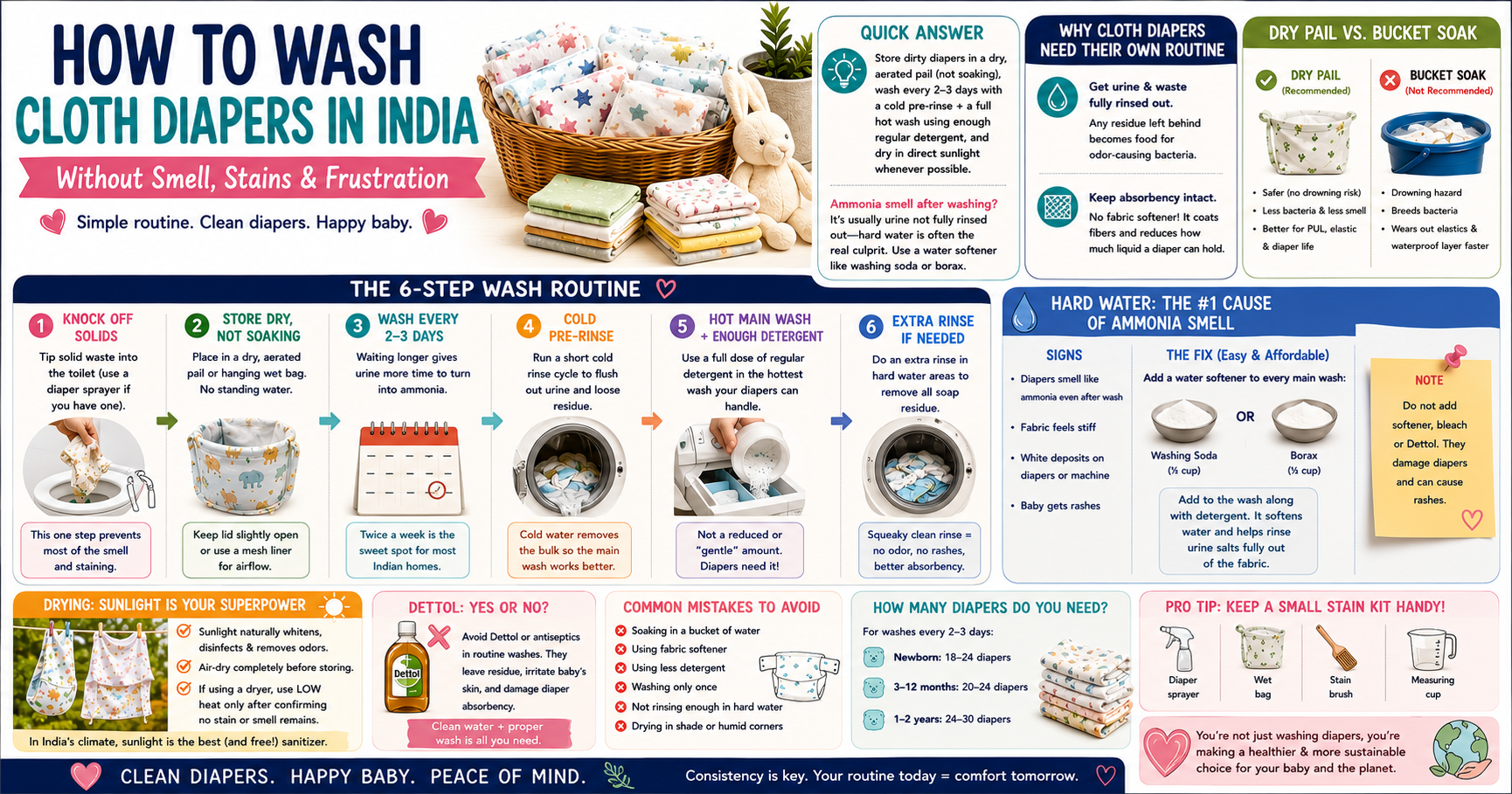
Quick answer: Store dirty diapers in a dry, aerated pail (not soaking in a bucket of water), wash every two to three days with a short cold pre-rinse followed by a full hot wash using enough regular detergent (not a softener, not a reduced “gentle” dose), and finish by drying in direct sunlight whenever possible. The ammonia smell that shows up even after washing almost always means urine isn’t being fully rinsed out, which in India is most often caused by hard water trapping residue in the fabric — a water softener like washing soda or borax added to the wash usually fixes this without needing anything imported or hard to find.
How To Wash Cloth Diapers India Without Smell
Somewhere around the second or third week of cloth diapering, most Indian parents hit the exact same wall: the diapers look clean, they smell completely fine folded in the drawer, and then the moment your baby wets one, a sharp, unmistakable ammonia smell hits you like you’ve opened a barn door. Your mother-in-law suggests soaking them longer in a bucket overnight, the way nappies were always washed. A friend swears by adding Dettol to every load. Someone in a parenting WhatsApp group recommends a product you’ve never seen in any shop near you. None of it is maliciously wrong advice, but a lot of it is outdated, and some of it actually makes the problem worse rather than better.
This article lays out a correct, step-by-step cloth diaper washing routine adapted specifically for Indian water, Indian washing machines (including the semi-automatic, manual-fill machines still common in many homes), and both traditional cotton langot and modern pocket or all-in-one cloth diapers — including honest, specific answers on the bucket-soak habit, the Dettol question, and why hard water is very likely the real reason behind that ammonia smell.
Table of Contents
Why cloth diapers need their own routine (not just a regular wash)
Cloth diapers are asked to absorb and hold urine and stool directly against a baby’s skin for hours at a stretch, which is a very different job from a shirt or a onesie. This means two things matter more here than for regular laundry: getting urine and waste fully rinsed out (any residue left behind becomes food for odor-causing bacteria) and keeping the fabric’s absorbency intact (which rules out fabric softener entirely, since softener residue coats fibers and reduces how much liquid a diaper can actually hold — see ParentNest’s guide on fabric softener safety for more on this specific mechanism). A regular wash cycle, built around getting clothes looking and smelling clean, isn’t automatically built around either of these two diaper-specific goals.
Dry pail vs. wet pail — and why the bucket-soak habit needs to go
This is worth addressing directly and early, since the “soak diapers in a bucket of water until wash day” habit is still extremely common in Indian households, often passed down from a generation that cloth-diapered with simple cotton langots and genuinely did soak them.
The dry pail method — storing soiled diapers in a dry, well-aerated pail or a hanging mesh or reusable liner bag, without standing water — is now the generally recommended approach, for a few specific reasons. A bucket of standing water is a real drowning hazard if a toddler or young child can reach it, which matters a great deal in a busy household with other children around. Standing water also breeds bacteria far more actively than a dry, aerated pail does, which can actually make the ammonia problem worse rather than better over the days between washes. And for modern cloth diapers with a waterproof PUL layer and elastic, prolonged soaking wears down these components considerably faster than dry storage followed by a proper wash.
If your household currently soaks diapers in a bucket, it’s worth switching: a simple dry pail (even a regular bin lined with a reusable, breathable wet bag) with the lid left slightly open or a mesh liner for airflow does the job more safely and often with less smell buildup between washes, not more.
The 6-step wash routine, step by step
- Knock off solids before storing. Tip solid waste into the toilet (a simple diaper sprayer attachment, if you have one, makes this faster) before placing the diaper in your dry pail — this single step prevents a meaningful amount of the smell and staining the rest of this routine has to deal with later.
- Store dry, not soaking. Place the diaper in a dry, aerated pail or hanging wet bag rather than a bucket of standing water, as covered above.
- Wash every two to three days. Waiting much longer than this gives urine more time to break down into ammonia-producing compounds before it even reaches the wash, making the whole load harder to fully clean.
- Run a cold pre-rinse first. A short, cold rinse cycle (or, if hand-washing, a thorough cold rinse under a tap) before the main wash flushes out the bulk of urine and loose residue, so the main wash isn’t trying to do all the work at once.
- Run a full, hot main wash with enough detergent. Use a proper, full dose of your regular detergent (not a reduced “gentle” amount) in as hot a wash as your diapers’ care label allows, with good agitation — a washing machine drum that’s too full to let diapers move freely doesn’t clean them properly, so don’t overload this particular load even if it feels wasteful to run a half-full machine.
- Dry thoroughly, ideally in direct sunlight. Complete drying before storage is essential — any lingering dampness gives bacteria more time to multiply before the diaper is even used again, and sunlight adds a genuine stain-fading and mild antibacterial benefit on top of simply drying the fabric.
Choosing a detergent (and what to avoid)
- Use a proper, full dose, not a “reduced for baby” amount. This is counterintuitive for parents used to being cautious with baby products, but under-dosing detergent is one of the most common causes of the ammonia smell this article is about — not enough detergent means not enough cleaning power to actually lift urine and waste out of the fabric.
- Avoid fabric softener entirely. As covered above and in more depth in ParentNest’s fabric softener guide, softener residue reduces absorbency, which directly undermines a cloth diaper’s actual job.
- A detergent with enzymes is generally fine and often recommended for breaking down the protein and waste residue cloth diapers deal with — this is one of the few laundry contexts where enzyme-heavy detergent is specifically an advantage rather than just a nice-to-have.
- Avoid heavily fragranced or optical-brightener-heavy detergents where possible, both for a baby’s skin sensitivity and because some brightening agents can interact oddly with certain diaper fabrics over repeated washes.
- Skip “natural” branded detergents that are low-sudsing or low-concentration unless you’re prepared to use noticeably more of them per wash — a mild, gentle-marketed detergent used at its suggested small dose is a common hidden cause of under-cleaning, even though the packaging suggests it’s the safer choice.
Why cloth diapers smell like ammonia, even after washing
Ammonia smell happens when bacteria break down urea, a compound present in urine, and it’s a near-universal sign that urine residue is being left behind in the fabric rather than fully rinsed and washed out. In practice, this almost always comes down to one or more of a short list of causes: hard water minerals trapping urine residue in the fabric (very common in India, covered in its own section below), too little detergent for the amount of soiling, too little water or agitation during the wash (an overstuffed machine drum, or a bucket wash with inadequate rinsing), or diapers sitting too long before washing, giving bacteria extra time to work before the laundry even starts. The fix is almost never a stronger-smelling detergent or an extra splash of perfume-based product — it’s identifying which of these specific causes applies to your routine and correcting that directly.
Hard water and cloth diapers — the real India-specific problem
This deserves its own section because it’s genuinely the most common underlying cause of persistent ammonia smell for cloth-diapering families across large parts of India, where groundwater and municipal supply often carry a meaningful mineral load. Hard water minerals (calcium and magnesium) bind with detergent and with urine residue in fabric, forming a buildup that traps odor-causing residue deep in the weave in a way that a normal wash, however thorough, has trouble fully reaching.
Signs this is likely your issue: diapers smell of ammonia specifically when wet, even right after a wash; you notice a general dullness or stiffness in diaper fabric over time; and dishes or other laundry in your home also show white mineral residue after washing.
The fix doesn’t require an imported product. A water softener added to both the pre-rinse and the main wash addresses this directly — washing soda (commonly sold as soda ash or “dhobi soda” in many Indian markets), borax (sold as “suhaga” in some pharmacies and hardware stores), or a store-bought water softening laundry additive all work on the same underlying principle, binding to the hardness minerals so they can’t bind to your diapers instead. Start with a modest amount (a few tablespoons per wash) and adjust based on results, since water hardness varies considerably even within the same city.
How to strip cloth diapers (only when you actually need to)
Stripping is a deeper reset wash, meant to remove detergent and mineral buildup that a normal wash routine hasn’t been fully addressing — it is not something that should be part of your regular, routine wash cycle, and doing it too often is genuinely harder on diaper fabric, elastics, and PUL than it needs to be.
A simple stripping method: wash clean, already-laundered diapers (not freshly soiled ones) in the hottest water your diapers’ care label allows, with a small amount of plain dish soap (just a few drops, since dish soap is a strong grease-cutter and too much can be excessive for the fabric) or a dedicated stripping agent if you have access to one, then run multiple additional hot rinse cycles until no more suds or bubbles appear in the rinse water. This indicates mineral and detergent buildup has finally been fully flushed out. Dry as usual afterward, ideally in sunlight.
Stripping should be treated as an occasional fix for a specific, persistent problem, not a regular habit — if you find yourself needing to strip diapers every few weeks, that’s a sign to adjust your everyday routine (detergent amount, water softener use, wash frequency) rather than a sign to keep stripping more often.
Sun drying — and what to do during monsoon
Sun drying is one of the most effective, completely free steps in this entire routine — sunlight genuinely helps fade staining and has a mild natural antibacterial effect on top of simply drying the fabric thoroughly, which matters enormously given how directly ammonia smell is tied to residual dampness and bacterial activity.
During monsoon, when consistent sun access isn’t realistic, a few adjustments help: use a fan or a covered, well-ventilated indoor drying area rather than letting diapers sit damp for extended periods, run an extra spin cycle if your machine allows it to remove as much water as possible before air-drying, and prioritize getting diapers fully dry over getting them dry quickly in the sun specifically — a slower, complete indoor dry beats a rushed, still-slightly-damp diaper that’s gone back into rotation too soon.
Washing different cloth diaper types: prefolds, flats, covers, and inserts
Most modern cloth diapering systems aren’t a single uniform product — they’re a combination of parts, and each benefits from slightly different handling within the same overall routine.
Prefolds and flats (simple, absorbent rectangular cloths, often cotton or bamboo, used with a separate waterproof cover) are among the most forgiving pieces in any cloth diaper system. They tolerate hot water, vigorous agitation, and even occasional boiling (for cotton versions specifically) better than almost any other component, since they contain no elastic or waterproof laminate to damage.
Waterproof covers (the outer layer that goes over a prefold or flat) are more delicate — they contain PUL or a similar waterproof laminate and should follow the same gentler, hot-but-not-boiling approach as full pocket or AIO diapers, with fabric softener avoided entirely, since softener residue can also affect a cover’s water-resistance over time, not just absorbency.
Absorbent inserts (used inside pocket diapers) generally wash and dry like prefolds in terms of fabric tolerance, but take considerably longer to dry fully than the diaper shell itself, particularly thicker bamboo or hemp inserts — it’s worth checking inserts specifically for complete dryness before storing, since a shell can look and feel dry while an insert tucked inside or dried alongside it is still slightly damp.
Snaps and hook-and-loop (velcro-style) closures both need a quick check during washing and before storage — residue can build up in the small grooves of snaps, and velcro-style closures should be fastened to themselves (laundry tabs) before washing to prevent them from snagging and damaging other diapers or fabric items in the same load.
Overnight diapers and heavily soiled loads
A diaper worn overnight holds considerably more urine than a daytime change, which means it needs a bit more attention within the same general routine rather than a completely different one.
- A quick rinse before placing an overnight diaper in the dry pail (rather than storing it fully saturated until wash day) reduces how much concentrated urine sits in the fabric for an extended period, which in turn reduces both staining and the ammonia-forming process described earlier.
- Heavily soiled or overnight-specific inserts may need a slightly longer or hotter wash cycle than lighter daytime diapers, within what the fabric’s care label allows, simply because there’s more residue to fully break down and rinse out.
- If you notice your overnight diapers specifically carry more ammonia smell than your daytime ones, that’s a normal pattern given the heavier soiling involved, and it’s worth treating this as confirmation that your general wash routine needs to be strong enough to handle the most-soiled items in your stash, not just the lightly-used ones.
Newborn-stage washing: meconium and tiny inserts
The newborn period brings a few specific adjustments worth knowing, since a newborn’s output is chemically and practically different from an older baby’s.
Meconium, the first days’ thick, tar-like stool, is oil-based and sticky rather than simply protein-based, and it benefits from the same dish-soap pre-treatment approach covered in ParentNest’s guide to natural poop stain removal, applied before the diaper goes through its regular wash cycle, rather than relying on the wash alone to lift it.
Newborn-sized inserts and diapers are often smaller and more tightly woven than toddler-sized ones, which can mean they take slightly longer to fully saturate during a wash and slightly longer to dry afterward — it’s worth checking these particularly carefully for complete dryness given how easy it is for a small, densely folded insert to feel dry on the outside while holding dampness in its folded center.
Building a diaper stash that makes washing easier
A wash routine is only as manageable as the stash behind it. Most families find a stash of around 18–24 diapers (more for a newborn changed very frequently, fewer for an older baby on a more predictable schedule) allows a comfortable two-to-three-day wash cycle without ever running critically low or needing an emergency extra wash mid-week. A stash that’s too small forces either more frequent, less efficient small washes, or occasionally reaching for disposables out of simple necessity, neither of which is a failure, just a sign the stash size and the wash routine aren’t quite matched to your actual daily usage yet.
Water and cost considerations in India
It’s worth acknowledging directly that cloth diapering in a water-conscious household is a genuine trade-off some Indian families weigh carefully, particularly in regions where water supply is limited or metered closely. A full, proper wash routine (pre-rinse plus main wash, run every two to three days for a stash of 18–24 diapers) uses a specific, bounded amount of water rather than an open-ended amount, and many families find the long-term cost savings compared to ongoing disposable diaper purchases, plus the reduced landfill waste, make this trade-off worthwhile even accounting for the water and effort involved. If water conservation is a significant household concern, running a full machine load (rather than several smaller ones) and avoiding unnecessary extra rinse cycles, as covered in the hard water section above, both help keep water use as efficient as the routine allows without compromising how clean the diapers actually get.
Traditional langot vs. modern cloth diapers (AIO/pocket)
Many Indian households use a mix of traditional cotton langot or nappies and modern, Western-style pocket or all-in-one (AIO) cloth diapers, and it’s worth knowing these genuinely need somewhat different care.
Traditional cotton langot/nappies are simple, unlined cotton fabric with no waterproof lining, elastic, or synthetic components, which makes them considerably more forgiving to wash. They can tolerate boiling (a traditional method some families still use for sanitizing, particularly for newborns) and higher heat generally without the concerns that apply to modern diapers.
Modern pocket and AIO cloth diapers include a waterproof PUL (polyurethane laminate) outer layer and elastic around the legs and waist, both of which degrade faster with boiling, excessive heat, chlorine bleach, and frequent stripping. These need the gentler, hot-but-not-boiling wash routine described above, with closer attention to detergent choice and the avoidance of harsh additives.
If your household uses both types, it’s reasonable to wash them together in the same general routine, but avoid boiling a mixed load that includes modern diapers, and treat the traditional langots as the more durable, lower-maintenance half of your laundry rather than applying their old care habits (boiling, long bucket soaks) to the modern diapers in the same wash.
Adjusting your routine as your baby grows
A wash routine that worked perfectly for a newborn often needs small adjustments as a baby grows, simply because urine output increases substantially with age and weight. If ammonia smell or reduced absorbency starts appearing in a stash that was previously working fine, it’s worth checking whether your detergent amount has kept pace with your baby’s actual output rather than assuming something has gone wrong with the diapers themselves — a detergent dose and wash frequency calibrated for a newborn’s lighter output may simply be insufficient for a six-month-old’s considerably heavier daily load. Reassessing detergent amount and, if needed, adding a slightly longer main wash cycle every few months as your baby grows is a normal, expected part of cloth diapering long-term, not a sign of a persistent underlying problem.
Hand-washing vs. machine-washing in India
Plenty of Indian households still hand-wash diapers, either by preference or because their washing machine is a semi-automatic model with a manual rinse and spin process rather than a fully automatic cycle, and the core principles above apply either way.
For hand-washing: give a thorough cold rinse first, working the diaper under running water or through several changes of water until it runs mostly clear, then wash with a proper amount of detergent worked thoroughly into the fabric (not just swished briefly), followed by at least two to three clean rinses to make sure no detergent or urine residue remains, since incomplete rinsing is just as much an ammonia risk by hand as it is by machine.
For semi-automatic machines: use the machine’s wash tub for the main detergent wash and agitation, then make full use of the separate rinse and spin tub rather than skipping straight to drying, since the extra spin cycle genuinely helps remove more residual moisture and loosened residue than hand-wringing alone typically achieves.
The Dettol question
This comes up constantly in Indian parenting circles, so it’s worth a direct, honest answer: adding a small amount of an antiseptic liquid like Dettol to a cloth diaper wash isn’t necessary for a healthy baby with a proper wash routine already in place, and it isn’t a substitute for the actual fixes (detergent amount, water softener, wash frequency) covered above if ammonia smell is the real problem. A correctly washed, fully dried diaper is already hygienically clean for ordinary use. That said, using a small, well-diluted amount occasionally isn’t known to cause harm for most babies either, and some families find it reassuring — the main caution is that antiseptic liquids can be an additional, unnecessary potential skin irritant for a baby with particularly sensitive skin, so it’s reasonable to treat it as optional rather than essential, and to skip it if your baby shows any signs of skin sensitivity.
Common mistakes
- Soaking diapers in a bucket of standing water rather than using a dry pail — a safety hazard and a bacteria-breeding habit, not a cleaning advantage.
- Using too little detergent out of an instinct to be gentle — this is one of the single most common causes of the exact ammonia problem parents are trying to avoid.
- Using fabric softener to make diapers feel softer, which directly reduces absorbency.
- Running extra rinse cycles in hard water without a water softener — this can actually redistribute minerals rather than remove them, making buildup worse in some cases rather than better.
- Stripping diapers every single wash as a default habit rather than only when a specific buildup problem is identified — this wears fabric and elastic down faster than necessary.
- Boiling modern pocket or AIO diapers the way a family might have traditionally boiled cotton langots — this degrades PUL and elastic considerably faster.
- Letting diapers sit for more than two to three days before washing, giving bacteria extra time to convert urine into ammonia before the laundry even starts.
A quick troubleshooting reference
| Symptom | Most likely cause | What to try |
|---|---|---|
| Ammonia smell only when wet, diapers smell fine dry | Urine residue not fully rinsed, often hard water | Add a water softener; check detergent dose; avoid extra rinses in hard water |
| “Barnyard” or musty smell straight out of the wash | Insufficient detergent or insufficient agitation | Increase detergent to a full dose; don’t overload the machine drum |
| Diapers feel stiff or dull over time | Mineral buildup from hard water | Add a water softener regularly; consider an occasional strip if buildup is significant |
| Reduced absorbency, frequent leaks | Fabric softener residue or detergent buildup | Stop using fabric softener; consider a gentle strip |
| Skin irritation or redness in the diaper area | Residual detergent, antiseptic, or insufficient rinsing | Add an extra rinse (if water isn’t hard); reduce or remove antiseptic additives; check detergent fragrance |
Real moments parents recognize
You might open the diaper pail expecting the worst and actually be pleasantly surprised, only for the real test to come an hour later when your baby wets a freshly laundered diaper and that unmistakable sharp smell announces itself anyway — a confusing, slightly demoralizing pattern until you understand it’s about rinsing, not about how clean the diaper smelled going in.
Or your mother might insist, gently but firmly, that langots should always be boiled and soaked overnight the way she did it, and it’s worth remembering that her method worked beautifully for the simple cotton nappies of her era — it’s the modern elastic-and-PUL diapers in your own stash that genuinely can’t take the same treatment.
Or you might find yourself standing over a bucket of water with a packet of washing soda in hand, mentally doing the math on whether this is really a “water softener” or just something your grandmother always kept under the sink — and it turns out it’s both, and it works.
Or six months in, with a toddler now instead of a newborn, you might notice the exact same routine that worked beautifully at first has started letting a faint smell creep back in, and spend a confused week assuming you’d done something wrong — before realizing your baby is simply producing a lot more laundry than they used to, and the routine just needs to grow up a little too.
Frequently Asked Questions
How do I wash cloth diapers in India without smell?
Store dirty diapers in a dry, aerated pail rather than soaking them, wash every two to three days with a cold pre-rinse followed by a full hot wash using a proper, full dose of detergent, and dry thoroughly in sunlight. Persistent ammonia smell is most often caused by hard water, which a water softener like washing soda or borax usually resolves.
Is the wet pail method still recommended for cloth diapers?
No. Storing diapers in standing water is now considered outdated — it’s a drowning hazard around young children, breeds bacteria more than a dry pail does, and wears down modern diapers’ waterproof layer and elastic faster. A dry, aerated pail is the current recommended approach.
Why do my cloth diapers smell like ammonia even after washing?
This almost always means urine residue isn’t being fully rinsed out, commonly due to hard water trapping residue in the fabric, too little detergent, insufficient agitation or water during the wash, or diapers sitting too long before washing.
How do I strip cloth diapers at home?
Wash already-clean diapers in the hottest water your care label allows with a small amount of plain dish soap or a stripping agent, then run several additional hot rinse cycles until no more suds appear. Treat this as an occasional fix for buildup, not a regular part of your routine.
Can you boil cloth diapers to clean them?
Traditional cotton langots and nappies, with no waterproof lining or elastic, generally tolerate boiling well. Modern pocket and all-in-one diapers with a PUL layer and elastic should not be boiled regularly, since high heat degrades these components considerably faster.
Is fabric softener bad for cloth diapers?
Yes. Fabric softener coats fibers with a residue that reduces how much liquid absorbent fabric can hold, which directly undermines a cloth diaper’s main job, regardless of how soft it makes the fabric feel.
Can I use Dettol in my cloth diaper wash?
It’s not necessary for a healthy baby with a proper wash routine, and it won’t fix an underlying ammonia problem caused by detergent amount or hard water. A small, diluted amount occasionally isn’t known to cause harm for most babies, but it’s reasonable to treat it as optional rather than essential.
How often should I wash cloth diapers?
Every two to three days is generally recommended. Waiting significantly longer gives bacteria more time to convert urine into ammonia-producing compounds before washing even begins, making the eventual wash harder to fully clean.
What should I use for hard water when washing cloth diapers in India?
Washing soda (often sold as soda ash or dhobi soda), borax, or a store-bought water-softening laundry additive, added to both the pre-rinse and the main wash, address hard water mineral buildup without needing an imported or hard-to-find product.
Should I run extra rinse cycles if I have hard water?
Generally no — extra rinses in hard water without a water softener can actually redistribute minerals onto the fabric rather than remove them. Add a softener to the existing cycles instead of simply adding more rinse water.
How many cloth diapers do I need to make a two-to-three-day wash routine manageable?
Most families find a stash of around 18–24 diapers comfortable for a two-to-three-day wash cycle, with more needed for a very young, frequently-changed newborn and fewer workable for an older baby on a more predictable schedule.
Do prefolds and flats need different care than pocket or AIO diapers?
Yes, somewhat — prefolds and flats have no elastic or waterproof laminate, so they tolerate hot water and vigorous washing better. Pocket and AIO diapers, along with waterproof covers, contain PUL and elastic and need the gentler, hot-but-not-boiling approach described throughout this routine.
Why did my wash routine suddenly stop working after months of being fine?
This is often simply because your baby’s urine output has increased with age and weight, meaning a detergent amount and wash frequency that worked for a newborn may no longer be sufficient. Reassessing and slightly increasing detergent or wash frequency as your baby grows is normal, not a sign of a persistent problem.
Is cloth diapering worth the extra water use in a water-conscious Indian household?
Many families find the long-term cost savings and reduced waste worthwhile even accounting for water use, and running full machine loads rather than several small ones, along with avoiding unnecessary extra rinses in hard water, keeps the routine’s water use reasonably efficient.
Final thoughts
Most of the frustration with cloth diapering in India traces back to one of a handful of fixable habits — a soaking bucket instead of a dry pail, too little detergent out of an instinct to be gentle, or hard water quietly undoing an otherwise good wash routine. None of the actual fixes require special imported products or giving up on cloth diapering as too much trouble. A dry pail, enough detergent, a locally available water softener if your water needs it, and a good dose of sunlight handle the vast majority of what sends parents searching for answers at eleven at night, diaper in hand, wondering what they’re doing wrong. Most of the time, it was never really about effort — it was about rinsing.
Give the routine a few weeks to settle in, expect to adjust the detergent amount or wash frequency as your baby grows, and don’t be surprised if your own version ends up a slightly different mix of machine and hand-washing, sun-drying and indoor-drying, than any single guide describes exactly. That’s normal too — the goal was never a perfect routine copied from somewhere else, just one that keeps the ammonia smell away in your own home, with your own water, on your own schedule.