Physical Address
304 North Cardinal St.
Dorchester Center, MA 02124
Physical Address
304 North Cardinal St.
Dorchester Center, MA 02124

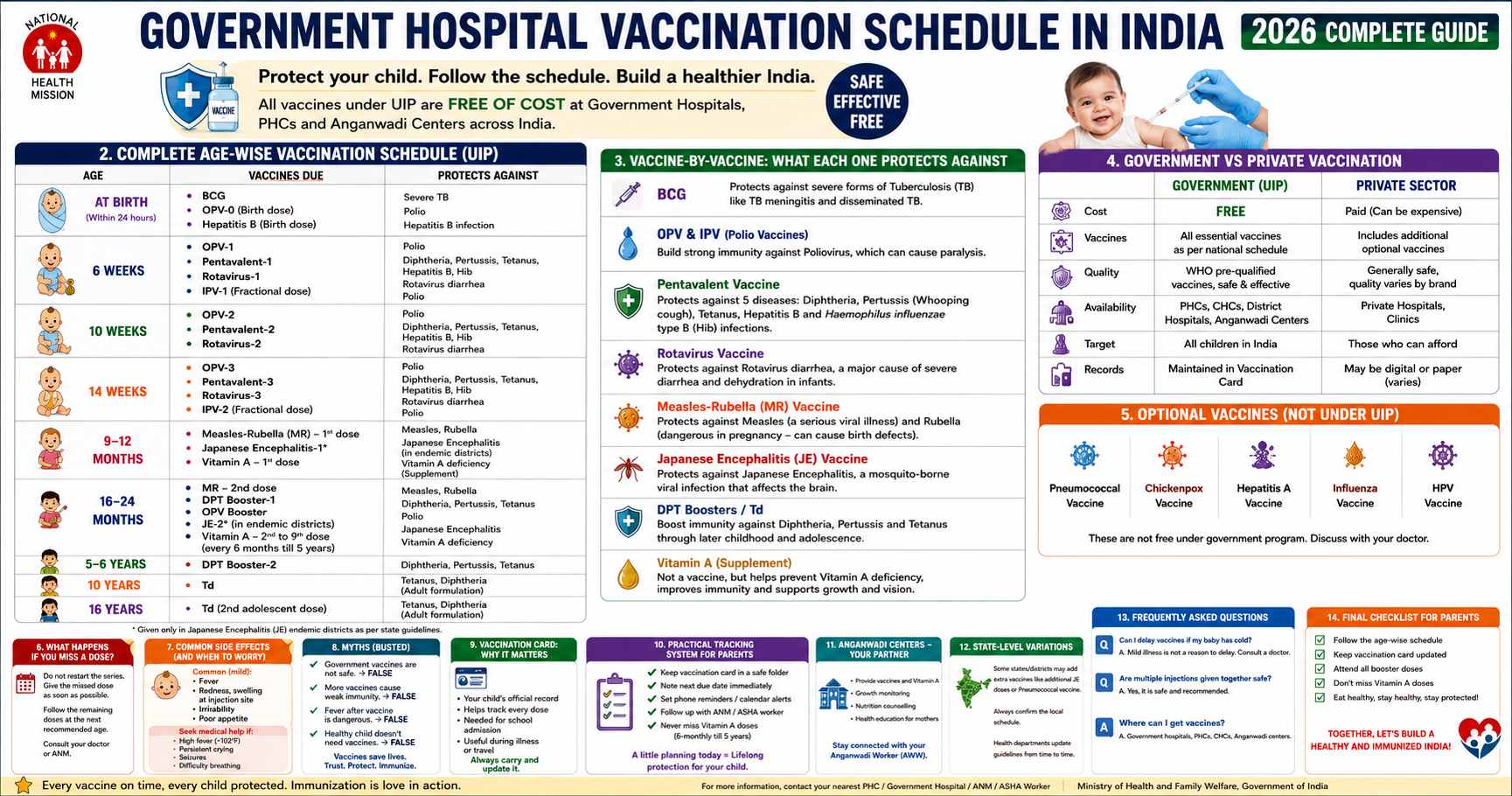
Getting your baby vaccinated on time is one of the most important responsibilities of new parenthood — and in India, this is made significantly easier through the government’s Universal Immunization Programme (UIP), which provides a complete set of essential vaccines completely free of cost at government hospitals, primary health centers (PHCs), and Anganwadi centers across the country.
This guide covers everything a new parent needs to know: the full age-wise schedule, what each vaccine actually protects against, government vs private vaccination differences, how to handle missed doses, common myths, state-level variations, and a practical system for tracking every dose without stress.
India runs one of the largest public health vaccination programs in the world. The Universal Immunization Programme, launched in 1985 and expanded significantly over the decades, aims to provide free vaccination against several life-threatening but preventable diseases to every child born in the country, regardless of family income or location.
This matters enormously for a country as large and diverse as India. Before large-scale immunization efforts, diseases like polio, measles, and diphtheria caused significant child mortality and long-term disability. Today, thanks to sustained immunization coverage, India has been polio-free for several years, and rates of several other vaccine-preventable diseases have dropped dramatically.
For new parents, understanding this program isn’t just about ticking boxes on a schedule — it’s about actively participating in one of the most effective public health interventions available to protect your child’s long-term health.
Below is the standard schedule followed at government hospitals and PHCs across India under the national UIP calendar.
Understanding what each vaccine does can help parents feel more confident about the schedule rather than just following it blindly.
BCG protects against severe, life-threatening forms of tuberculosis in children, particularly TB meningitis and disseminated TB. It’s given as a single dose at birth, leaving a small scar at the injection site over the following weeks — this is normal and expected.
OPV and IPV (Polio vaccines) work together to build strong immunity against poliovirus, which can cause permanent paralysis. India uses a combination of oral drops (OPV) and injectable doses (IPV) as part of its endgame strategy to maintain polio-free status.
Pentavalent vaccine is a combination shot that protects against five diseases in one injection: Diphtheria (a serious throat infection), Pertussis (whooping cough), Tetanus (a nervous system infection often linked to wounds), Hepatitis B (a liver infection), and Haemophilus influenzae type B (a bacteria that can cause meningitis and pneumonia in young children).
Rotavirus vaccine protects against a virus that is one of the leading causes of severe diarrhea and dehydration in infants and young children, particularly serious in areas with limited access to quick medical care.
Measles-Rubella (MR) vaccine protects against measles, a highly contagious viral illness that can cause serious complications, and rubella, which is particularly dangerous if contracted by pregnant women as it can cause birth defects in the developing fetus.
Japanese Encephalitis (JE) vaccine is given in districts where this mosquito-borne viral brain infection is more common, particularly in parts of North and Northeast India.
DPT Booster doses reinforce the immunity built by the initial Pentavalent doses, ensuring protection against Diphtheria, Pertussis, and Tetanus continues into early childhood.
Td (Tetanus-diphtheria) doses given at 10 and 16 years maintain long-term protection into adolescence and adulthood.
One of the most common questions new parents have is whether to vaccinate exclusively at government hospitals, exclusively at private clinics, or use a mix of both. Here’s a detailed breakdown:
| Factor | Government Hospital | Private Clinic |
|---|---|---|
| Cost | Free | ₹500–₹4,000+ per visit depending on vaccine brand |
| Vaccine brand | Standard UIP-approved brands | Parental choice among multiple brands |
| Combination vaccines | Basic combinations (e.g., Pentavalent) | More advanced combinations (e.g., Hexavalent, reducing number of injections) |
| Optional vaccines | Not typically available | Available (Chickenpox, HPV, Typhoid, Hepatitis A, etc.) |
| Appointment scheduling | Fixed immunization days, can involve waiting | More flexible scheduling |
| Record keeping | Physical vaccination card (Mother and Child Protection Card) | Digital + physical records, varies by clinic |
| Follow-up reminders | Often coordinated through Anganwadi workers or ASHA workers | Clinic-dependent, sometimes automated SMS/app reminders |
Neither option is inherently “better” from a safety and effectiveness standpoint — both follow vaccines approved and monitored under India’s national regulatory framework. The real differences lie in convenience, vaccine brand/combination preferences, and access to optional vaccines.
Many families in India follow a hybrid approach: they take the free, government-scheduled vaccines at government hospitals or PHCs, and separately consult a pediatrician for optional vaccines not covered under UIP.
The following vaccines are generally not part of the free government schedule and are usually available only through private pediatric consultation:
If you’re considering any of these, a conversation with your pediatrician about your child’s specific risk factors, family history, and local disease prevalence can help you decide what makes sense for your family.
It’s a common worry among parents — missing a scheduled vaccination date doesn’t mean starting the entire schedule over. India’s immunization guidelines include a “catch-up schedule” specifically designed for this situation.
If you miss a dose:
For longer delays (several months), it’s especially important to consult your child’s healthcare provider so they can determine the safest and most effective way to catch up without unnecessary repeat doses.
Like all medical interventions, vaccines can cause mild, temporary side effects in some children. Common and generally harmless reactions include:
These are typically signs that the immune system is responding to the vaccine, and they usually resolve on their own within a couple of days.
When to contact a doctor promptly: if your child develops a high fever that doesn’t improve, unusual swelling, difficulty breathing, persistent crying that seems different from normal, or any symptom that concerns you and doesn’t fit the usual mild pattern. Trust your instincts as a parent — if something feels off, it’s always appropriate to check with a healthcare provider rather than wait it out.
This section is for general awareness only. Always consult your child’s pediatrician or the attending healthcare provider for guidance specific to your child’s health and vaccination history.
Myth: Government vaccines are lower quality than private ones. Reality: All vaccines administered under India’s UIP undergo the same regulatory approval and quality checks as those used in private clinics. The difference is typically in brand and whether combination formulations are used — not in safety or effectiveness.
Myth: Too many vaccines at once will overwhelm a baby’s immune system. Reality: A newborn’s immune system is capable of responding to far more antigens than are present in the entire vaccination schedule combined. Combination vaccines like Pentavalent are specifically designed to reduce the number of injections while still providing full protection.
Myth: If a disease seems rare now, the vaccine isn’t necessary anymore. Reality: Diseases like polio and diphtheria have become rare specifically because of sustained high vaccination coverage. Reducing vaccination rates can lead to disease resurgence, as has been observed in other countries where coverage has dropped.
Myth: Natural immunity from actually catching the disease is better than vaccine-induced immunity. Reality: While natural infection can sometimes build immunity, it comes with the real risk of severe illness, complications, and even death — a risk vaccines are specifically designed to avoid while still building protective immunity.
While the core UIP schedule is standardized nationally, individual states sometimes introduce additional vaccines or adjust timing slightly based on local disease burden. For example:
Because of this variation, it’s always worth asking your local government hospital, PHC, or ASHA/Anganwadi worker for the exact schedule applicable in your state and district.
Anganwadi centers, part of India’s Integrated Child Development Services (ICDS) scheme, play a significant role in supporting immunization efforts, especially in rural and semi-urban areas. Anganwadi workers often:
If you live in an area with an active Anganwadi center, registering your child there (even if you also visit a government hospital or private clinic) can provide an additional layer of reminders and support.
Every child vaccinated under the government program in India receives a Mother and Child Protection Card, which records every vaccine administered, including dates and batch details. This card matters for more reasons than most parents realize:
Given how important this document is, it’s worth treating it with the same care as other essential documents like a birth certificate.
With so many doses spread across the first two years of a child’s life, it’s easy to lose track. Here’s a simple, low-effort system that works well for busy parents:
If using a mix of government and private vaccination, make sure both providers are aware of doses given elsewhere, to avoid duplication.
Take a photo of the vaccination card after every visit and store it in a dedicated folder in your phone’s gallery or a cloud storage app — this acts as a backup in case the physical card is lost or damaged.
Set a recurring phone reminder a few days before each due date, rather than relying on memory alone.
Keep a simple note or spreadsheet listing each vaccine name, due date, and actual date given — useful for quickly answering questions at school admission or during travel.
Carry the physical card to every doctor visit, even for unrelated illnesses, since healthcare providers may check or update it regardless of the visit’s purpose.
Yes. Many families do this — taking free doses at government facilities and choosing optional vaccines privately. Just ensure your child’s vaccination card reflects everything given, regardless of where, to avoid duplicate or missed doses.
This varies by location. In many areas, Anganwadi centers host vaccination camps in coordination with the nearest PHC, while in others they primarily handle reminders and record-keeping, with actual vaccination happening at the PHC or hospital.
Bring any existing vaccination records to a government hospital or pediatrician, who can help map previous vaccines to the Indian schedule and determine what (if anything) still needs to be given.
The HPV vaccine has traditionally been recommended primarily for adolescent girls, though guidance is evolving in some contexts to include boys as well, given HPV’s role in several types of cancer beyond cervical cancer. This is a good topic to discuss directly with a pediatrician as your child approaches adolescence.
Premature babies often follow a schedule based on their actual (chronological) age from birth rather than adjusted for prematurity, but this can vary based on individual health factors — always follow your pediatrician’s specific guidance for premature infants.
No, the Mother and Child Protection Card is provided free of cost at government hospitals and is meant to be retained by the family throughout the child’s early years.