Physical Address
304 North Cardinal St.
Dorchester Center, MA 02124
Physical Address
304 North Cardinal St.
Dorchester Center, MA 02124

Meera hadn’t planned it to be a thing.
It started on a Tuesday in February when she’d run out of both indoor ideas and patience. She bundled up her two-year-old and four-year-old, opened the back door, and announced: ‘We’re going outside for one hour. I don’t care what we do.’
She sat on the step with a cup of chai going cold. The four-year-old found a stick. The two-year-old found a puddle. An hour passed. Both children were calmer at dinner, easier at bedtime, and — she noticed — less interested in screens the following morning.
She did it again the next day. And the next.
Six weeks later she had a name for it: the One Wild Hour. And it had quietly become the anchor of her entire daily routine.
This is not a guide to elaborate outdoor adventures. You don’t need a forest, a hiking trail, or a kit bag. You need one hour, your children, and the willingness to stop managing what happens in it.
Here’s the full system — and the science that explains why it works better than anything else you’ll try this year.
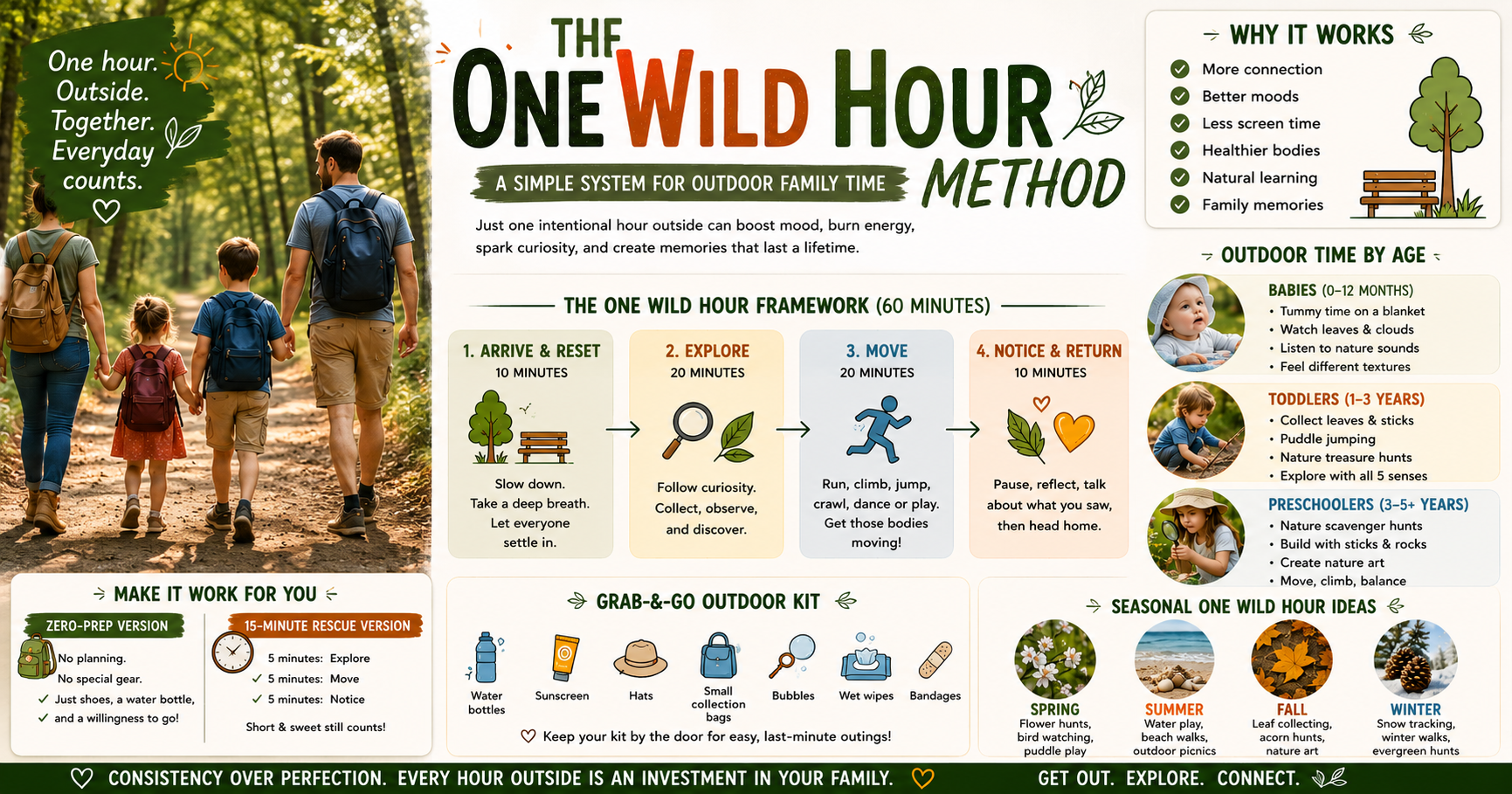
The One Wild Hour Method is a simple daily practice: one hour outside, every day, with as little structure as possible.
No planned activities. No objectives. No organised games. Just open outdoor time — ideally at the same time each day — where children lead, parents follow at a distance, and nature does most of the heavy lifting.
‘Wild’ here doesn’t mean dangerous or extreme. It means unmanaged. It means your four-year-old can spend twenty minutes studying a crack in the pavement if that’s what calls to them. It means mud is allowed. It means the schedule has one rule: we’re outside for one hour.
| THE PARENTNEST DEFINITION The One Wild Hour Method is a daily outdoor family practice built on a single principle: one unstructured hour outside, every day, at a consistent time. No planned activities, no screens, no agenda. Just a child, the outdoors, and the freedom to be genuinely, messily, wonderfully bored. |
Research from the UK and Canada consistently points to 60–90 minutes of outdoor unstructured time as the sweet spot for measurable benefits to children’s mood, behaviour, and sleep. Less than 30 minutes rarely produces the full effect. More than 90 minutes is wonderful but unsustainable for most working families.
One hour is enough. One hour is achievable. One hour, every day, is transformative.
There’s an important distinction between organised outdoor activities and wild outdoor time. Organised activities — football practice, playground visits with structured games, nature craft sessions — are wonderful, but they’re not the same thing. The One Wild Hour is specifically unstructured: no instructions, no outcome, no adult agenda.
This distinction matters because the research benefits (reduced anxiety, improved focus, better emotional regulation) are most strongly associated with self-directed nature play — not organised outdoor time.
The case for daily outdoor time isn’t intuition — it’s one of the most well-researched areas in child development. Here’s what the evidence actually says.
Multiple studies have found that children who spend more unstructured time in natural environments show significantly better emotional regulation — fewer tantrums, less impulsive behaviour, and better ability to manage frustration. One landmark 2004 study by Andrea Faber Taylor found that even 20 minutes in a green space improved attention in children with ADHD. The effect was comparable to medication.
For children without ADHD, the effect on behaviour is still measurable — and many parents report it as the most noticeable change from implementing a daily wild hour.
Natural light exposure — especially morning outdoor time — helps regulate children’s circadian rhythms more effectively than any sleep training technique. The link between outdoor physical activity and sleep onset, sleep duration, and sleep quality in young children is robustly supported in the research literature.
Parents who implement a consistent One Wild Hour often report improved bedtime routines as a secondary benefit they weren’t expecting.
Exposure to natural environments measurably reduces cortisol (stress hormone) levels in both children and adults. ‘Forest bathing’ — the Japanese practice of shinrin-yoku — has been studied extensively with consistent results. You don’t need a forest. A garden, a park, or even a treeline visible from a street delivers meaningful stress reduction.
Outdoor time is now strongly linked to reduced incidence of myopia (short-sightedness) in children — a public health issue of growing concern globally, including across Asia. The mechanism is believed to involve natural light stimulating dopamine release in the retina, which regulates eye growth.
The recommended outdoor time for myopia prevention in children? Around 60–90 minutes daily. Sound familiar?
Author Richard Louv coined the term ‘nature deficit disorder’ in 2005 to describe the growing disconnection between children and the natural world — and its consequences: increased anxiety, reduced creativity, and diminished sensory awareness. While not a clinical diagnosis, the concept has shaped two decades of early childhood education research and policy.
The One Wild Hour is a direct, practical antidote.
| RESEARCH SNAPSHOT A 2019 study tracking over 20,000 people in England found that spending at least 120 minutes in nature per week was associated with significantly better health and wellbeing compared to those who spent no time in nature — with the effect seen across age groups, income levels, and urban vs rural settings (White et al., Nature, 2019). |
The beauty of this method is its simplicity. But ‘simple’ and ‘easy’ are not the same thing — especially for families where screens have become default downtime and outdoor time requires overcoming real logistical and motivational barriers.
The single most important factor in making the One Wild Hour a genuine daily habit is timing. Choose a time that is structurally consistent — tied to something that already happens every day. The best anchor times:
Avoid aspirational times (‘whenever we can’) — they don’t survive busy weeks. Choose the time that already has a natural gap and protect it as a non-negotiable.
You don’t need wilderness. You need outdoor. In order of preference (but any will work):
| Space | What Works Well |
| Private garden / courtyard | Most sustainable — zero friction daily |
| Local park (within 10 min walk) | Excellent for toddlers and preschoolers |
| Street, alleyway, neighbourhood walk | Underrated — urban micro-nature is everywhere |
| Building terrace / rooftop | Viable for apartment families — wind, light, space |
| School grounds (afterschool) | High convenience for school-age children |
| Nature reserve / forest | Wonderful for weekend wild hours — deeper immersion |
Tell your children the one rule: we are outside for one hour. Everything else is open. You can explore, be bored, get muddy, make something, do nothing, climb things (within reason), and lead the way.
Do not add rules about what they must do. The absence of instruction is the entire point.
This is where most parents struggle — because ‘doing nothing’ doesn’t come naturally when you’re parenting. Your role during the One Wild Hour is:
Some parents find this role genuinely difficult. If you struggle to ‘do nothing,’ bring a book, journal, cup of tea, or garden task. Having a quiet activity of your own helps you resist the pull to manage your children’s play.
The most important step in the One Wild Hour is the simplest and hardest: beginning. On the days when it’s overcast, when you’re tired, when the children are whining about going outside — those are the days the wild hour matters most.
Build a family phrase. Meera’s family uses ‘wild hour time.’ Other families use ‘outside now, inside later.’ The ritual of the phrase helps children transition, and it signals that this isn’t negotiable — but it also isn’t punitive. It just is.
| THE ‘3 BEFORE 3’ RULE For families with toddlers, try the ‘3 Before 3’ variation: 3 wild hours before 3pm. This can be broken into smaller chunks — a 20-minute morning garden session, 30 minutes at the park after lunch, and 10 minutes in the evening. The total is what matters, not the single block. |
The paradox of the One Wild Hour is that you’re not supposed to plan it — but parents often feel paralysed without at least a mental toolkit for what might happen. Here’s the truth: you don’t need activities. But knowing what to bring and what to look for makes the experience feel more intentional without compromising the freedom.
| Item | Why It Helps |
| A bag with a change of clothes | Removes mud anxiety — they can get as messy as needed |
| Water bottle | Essential, obvious, often forgotten |
| A loose parts basket | Sticks, stones, etc. — or let them find their own |
| Your own quiet activity | Journal, book, phone-on-silent — for your sanity |
| A camera or phone camera | Document what they notice — not for Instagram, for memory |
| Nothing else | Seriously — less kit means less management |
This section might be the most reassuring thing you read today. Left to their own devices outdoors, children will typically:
The bored period is not a problem. It is the wild hour doing its work. The transition from ‘I’m bored’ to genuine self-initiated play is where the magic happens — and it takes about seven to fifteen minutes.
At the end of each wild hour, make one consistent ritual: ask ‘what did you find today?’ — and genuinely listen. Not correcting, not evaluating, not adding information. Just listening. This simple question builds observation skills, language, and the neural habit of noticing the natural world.
Over weeks and months, children’s answers become more detailed, more poetic, and more surprising. It’s one of the most underrated rituals in early childhood.
One of the most common barriers to daily outdoor time is seasonal resistance — ‘it’s too hot,’ ‘it’s raining,’ ‘it’s too cold.’ Here’s the truth: there is no weather that makes the One Wild Hour impossible. There is only weather that requires different kit.
| Season / Weather | Wild Hour Variation | Best Activity Type | What to Wear |
| Summer / Hot | Morning wild hour (6–8am or post-4pm) | Water play, shade-seeking, shadow study | Sun hat, SPF, light cotton |
| Monsoon / Rains | Covered porch, short puddle dashes, covered outdoor play | Puddle jumping, mud play, rain observation | Waterproofs, old clothes, wellies |
| Winter / Cool | Midday wild hour for maximum light | Leaf piles, frost study, stick building | Layers, waterproof outer, gloves |
| Spring | Any time — the best season for wild hours | Flower finding, bug hunting, blossom art | Layerable clothing, old shoes |
For families in India, the seasonal wild hour calendar looks different — and there’s almost no content addressing this gap. Here’s a practical framework:
| Indian Season | Wild Hour Approach |
| Winter (Nov–Feb) | Peak wild hour season. Morning 8–10am is perfect. Gardens, parks, terrace play all ideal. |
| Summer / Heatwave (Mar–Jun) | Shift to early morning (6–8am) or evening (5–7pm). Shade, water play, and terrace time. |
| Monsoon (Jul–Sep) | The most magical season for young children. Mud play, puddle play, rain watching from covered areas. Don’t avoid it — embrace it. |
| Post-Monsoon (Oct) | Ideal transition season. Evening wild hours, lush garden exploration, insect finding season. |
| Age | What Wild Hour Looks Like | Parent Role | Key Benefit |
| 0–12 months | Blanket on grass, outdoor sensory basket, fresh air and natural light | Hold, narrate gently, let them feel grass and air | Sleep regulation, sensory input, vitamin D |
| 1–2 years | Walking, exploring, collecting, puddles, filling and emptying | Follow at close distance, name what they find | Gross motor, vocabulary, soil microbiome contact |
| 2–4 years | Imaginative worlds, mud, building, running, role play in nature | Observe from a step back, respond to invitations | Creativity, emotional regulation, physical confidence |
| 4–6 years | Projects (building dens, dams, nature art), longer solo exploration | Background presence, available not directing | Executive function, risk assessment, independence |
| 6–8 years | Longer self-directed projects, peer play, nature journalling, outdoor challenges | Near but uninvolved unless safety requires | Self-efficacy, environmental connection, resilience |
The single biggest predictor of whether any parenting practice sticks is whether it becomes a habit — automatic, not effortful. Here’s how to turn the One Wild Hour from an intention into a non-negotiable family rhythm.
Don’t call it a ‘method’ or a ‘system.’ Just say: this week, we’re going outside every day for one hour. Same time. Let’s see what happens. Keep the stakes low. Observe without judging yourself or your children.
By week two, you have data. You know which time worked. You know which space they gravitated toward. You know which child needed the most transition support. Now solidify the anchor time and protect it in the family schedule.
Add one ritual that signals the start of wild hour. This could be: putting on the ‘outside shoes,’ a specific song in the car on the way to the park, or a family phrase. Rituals are how habits survive the hard days.
Start a simple wild hour log — a page, a notes app, a printed tracker. Not to measure performance, but to notice patterns. What are your children drawn to? What changed in their behaviour? What surprises you? The log becomes one of the most treasured records of early childhood.
| PARENTNEST WILD HOUR WEEKLY TRACKER Download the free ParentNest Wild Hour Tracker — a simple printable that records your daily wild hour, what your children noticed, and the one thing that surprised you each week. A beautiful record and a gentle accountability tool in one. |
This is the question every parent asks when they first encounter the One Wild Hour — and it’s usually the question asked by parents of children who need it most.
A few honest, effective approaches:
‘Are you ready to go outside?’ is a question that invites ‘no.’ ‘We’re going outside now’ is a statement that begins a transition. The resistance is usually highest before the door opens. Once outside, most children engage within minutes.
If a child is genuinely reluctant, go outside yourself and start doing something quietly interesting — sketching, gardening, looking at something — without inviting them. Curiosity is a powerful pull.
Without planning the whole hour, you can offer one small hook to get them through the door: ‘I heard there might be a new spider’s web in the corner of the garden’ or ‘there are worms after yesterday’s rain.’ You’re not directing the play — you’re creating an initial pull.
The first five minutes of wild hour are often the hardest. There’s whining, resistance, ‘I’m bored.’ This is normal. Don’t fill the boredom — it resolves itself. Stay calm, stay outside, and wait.
“My son is five and has been on the ADHD radar for two years. Nothing worked for the ‘witching hour’ before dinner — tantrums, meltdowns, constant sibling fighting. We started the wild hour six weeks ago, same time every day, in our small city garden. The witching hour is just… gone. I don’t know what else to attribute it to.” — Parent of two, Bengaluru
“My daughter genuinely wouldn’t go outside without me planning something. She’d stand at the door and ask what we were doing. Now — three months in — she’s the one pulling me out. She has three ongoing ‘projects’ in the garden simultaneously. It changed how I see her.” — Parent, Delhi
“The thing I didn’t expect was what it did for me. Standing in the garden for an hour while they play, with nowhere else to be — it’s the most present I feel all day.” — Stay-at-home parent, Pune
The One Wild Hour is not an anti-screen practice — it’s a pro-nature practice. The distinction matters. Framing outdoor time as ‘instead of screens’ creates a battle. Framing it as a daily non-negotiable family ritual — as natural as mealtimes — sidesteps the battle entirely.
Over time, families who implement the One Wild Hour consistently report a natural reduction in screen time — not because of rules or restrictions, but because children’s default pull toward screens lessens when their need for stimulation, movement, and sensory input is genuinely met outdoors.
The wild hour doesn’t fight the screen. It makes the screen less necessary.
| Mistake | What to Do Instead |
| Planning activities for the wild hour | Bring materials if needed, but don’t lead — let children find their own direction |
| Expecting immediate buy-in from children | The first week is an adjustment. Trust the process past day 3. |
| Checking your phone throughout | Bring your own quiet activity. Your presence matters. |
| Giving up on bad weather days | There is no bad weather, only wrong clothing. The rainy wild hours are often the best. |
| Making it conditional (‘if you’re good…’) | Treat it as a daily non-negotiable, not a reward or privilege |
| Comparing your wild hour to Instagram | Your garden, your street, your park is enough. Really. |
| Only doing it when convenient | Convenience-based habits don’t survive. Anchor it to a fixed daily time. |
| Day | Location | Duration | What to Bring | Parent Focus |
| Day 1 | Your garden or nearest outdoor space | 60 min | Nothing extra | Observe what they go to first |
| Day 2 | Same space | 60 min | One loose parts basket | Notice: what do they build or collect? |
| Day 3 | Walk to local park | 60 min | Water + change of clothes | Let them lead the direction of the walk |
| Day 4 | Back garden or terrace | 60 min | Journal for you | Record one surprising thing they did |
| Day 5 | Your choice — familiar space | 60 min | Nothing extra | Note: has anything shifted in behaviour or mood? |
| Day 6 | Somewhere new (new park, different route) | 60 min | Camera on phone | Photo document what they find — don’t direct |
| Day 7 | Wherever feels right | 60 min | Wild hour tracker printable | Review the week: what worked? What anchor time? |
Every parent wants to give their children more nature. More space. More of the unhurried, unmediated childhood that somehow slips away in the scroll and the schedule and the structured activities.
The One Wild Hour doesn’t ask you to overhaul your life. It asks you to step outside, every day, for one hour — and then get out of the way.
It asks you to trust that your child, given outdoor space and time and genuine freedom, knows what they need. And it asks you to be present for it.
Start tomorrow. Start today. One hour. Outside. Wild.