Physical Address
304 North Cardinal St.
Dorchester Center, MA 02124
Physical Address
304 North Cardinal St.
Dorchester Center, MA 02124

It was 7:13 on a Tuesday morning. My daughter was sitting at the breakfast table — toast untouched, juice getting warm — with her eyes locked on a cartoon she’d already seen four times. When I asked her something simple, she didn’t hear me. Didn’t even flinch. She was gone.
I don’t share that story to judge. Lord knows I’ve handed over my phone to buy myself ten minutes of peace. But that morning something shifted in me. I didn’t want to be at war with screens forever. I wanted to build something different — a home where boredom was a launchpad, not a problem. Where play was physical and loud and sticky and sometimes boring in the best possible way.
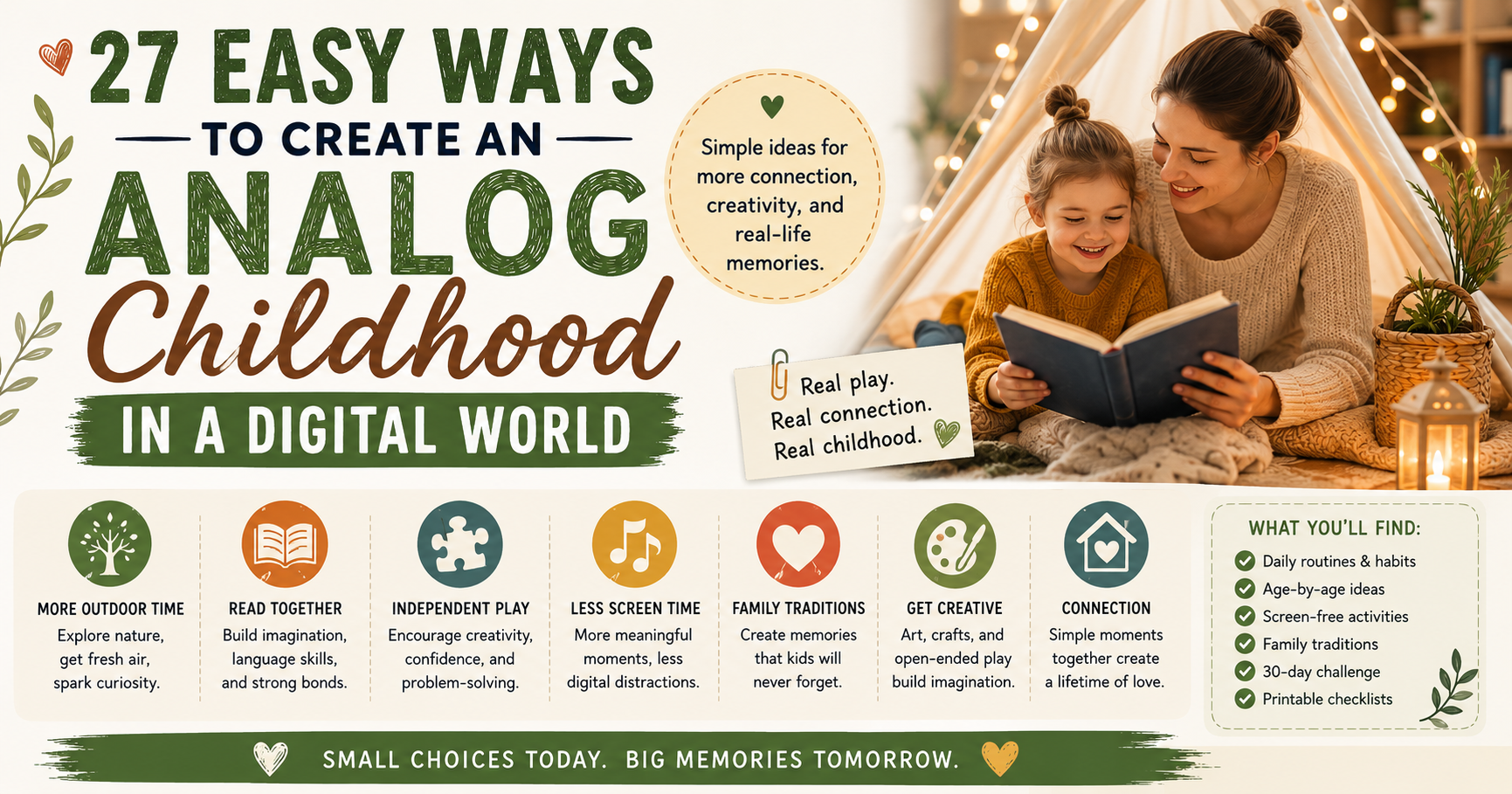
What I was after had a name, though I didn’t know it yet: an analog childhood.
This article is everything I’ve learned — from research, from parenting coaches, from other families, and from the glorious trial and error of my own living room — about how to actually create one. Not perfectly. Not all at once. But meaningfully.
An analog childhood doesn’t mean zero screens, zero TV, or living off-grid. It means prioritising hands-on, imaginative, sensory, and social experiences over passive digital ones — especially in the early years, when little brains are doing the most significant growing.
Think mud pies instead of Minecraft. Building block towers instead of watching someone else build on YouTube. Drawing your own weird horse instead of colouring a perfect digital template. It’s about giving children the raw ingredients of experience and trusting them to make something out of it.
| Analog childhood = more doing, more exploring, more being bored-then-brilliant. It’s not anti-technology. It’s pro-childhood. |
Child development researchers have been ringing alarm bells about passive screen time for nearly a decade. But beyond the research, parents are reporting something simpler: their kids are struggling to entertain themselves, tolerating frustration less, sleeping worse, and showing anxiety at younger ages. Correlation isn’t causation — but the pattern is hard to ignore.
Here is what we DO know about unstructured, screen-free play:
Babies and young toddlers are in their sensory golden window. Every texture, sound, smell, and temperature is new data. This is the easiest age to go analog because they don’t yet KNOW what a screen is — but it’s also the age when habits get formed for them by us.
This is when ‘pretend play’ bursts open. A cardboard box becomes a rocket. A stick becomes a wand. This stage is your greatest analog ally — lean into it hard.
| ParentNest Tip: The ‘rotation box’ changed our mornings. We keep half the toys in a storage bin in the garage. Every other Sunday, we swap. Monday morning feels like a toy store. |
Children this age love structure, roles, and rules — which is why games, crafts, and building projects hit differently now. They want to know who they are in the game.
School-age kids need projects with a beginning, middle, and end. They want to make something real.
The word ‘screen-free’ makes some parents’ eyes twitch. Because a screen-free Tuesday when you work from home and have a toddler and a 7-year-old is… a lot. Here’s what a realistic analog day actually looks like — with grace built in.
| Time | Analog Activity | What It Develops |
| 7:00 AM | Breakfast + conversation (no devices at table) | Connection, language, gratitude habits |
| 8:30 AM | Outdoor free play or sensory bin time | Gross motor, sensory processing, creativity |
| 10:00 AM | Reading time / parent reads aloud | Vocabulary, imagination, bonding |
| 11:00 AM | Arts, crafts, or building project | Fine motor, focus, creative expression |
| 12:30 PM | Lunch + help in kitchen | Life skills, sensory, math (measuring) |
| 1:30 PM | Quiet rest / independent play | Self-regulation, solo creativity |
| 3:00 PM | Outdoor adventure / neighbourhood walk | Physical health, nature connection |
| 4:30 PM | Board game / family project | Social skills, strategy, family bonding |
| 6:00 PM | Dinner + table conversation ritual | Family identity, emotional intelligence |
| 7:30 PM | Bedtime story + quiet wind-down | Language, attachment, sleep quality |
Don’t announce a screen revolution. Just pick one morning — Saturday works well — and quietly fill it with pancakes, play dough, and a walk. No fanfare. No lecture. Kids adapt when they have good things to adapt to.
Fill a cardboard box with activity starters: a bag of rubber bands, some blank paper, a magnifying glass, coloured tape, pipe cleaners, a deck of cards. When your child says ‘I’m bored,’ point to the box. Resist the urge to explain. Watch what happens.
| The magic of boredom is that the brain eventually fills it. That restlessness is actually creativity warming up. |
This one is non-negotiable in our house and the single change that’s had the biggest ripple effect. Meals are when conversation happens. When kids learn to wait their turn, ask questions, and feel seen. A 20-minute device-free dinner does more for a child’s emotional intelligence than a week of apps.
It doesn’t need to be big or fancy. A corner with a low shelf, some open-ended toys, and natural light is enough. The key is that it’s theirs — and it signals ‘this is where we make things and play.’
Before any screen time is requested, outside time happens. Even 15 minutes in the backyard, on the balcony, or at the park changes the chemistry of the morning. Kids who have moved their bodies are calmer, more focused, and — crucially — less desperate for stimulation.
Many parents stop reading aloud when kids learn to read independently. This is a mistake. Reading aloud together builds vocabulary, imagination, and bonding well into the tween years. Pick a chapter book and do one chapter per night. The conversation it sparks is worth everything.
Building a birdhouse. Starting a kitchen garden. Making a family scrapbook. Learning to bake bread. A shared project gives children a sense of investment, patience, and pride that no single game or app can create.
Modern childhood is often over-scheduled. Swimming lessons, coding class, football practice, piano. The loss of unstructured time is one of the quiet crises of contemporary childhood. Protect at least one afternoon per week that has nothing on it. Nothing at all.
Instead of ‘if you eat your dinner you can watch TV,’ try ‘if you eat your dinner we’ll do the glow-in-the-dark star craft after bath time.’ Reframe the reward hierarchy so screens aren’t the ultimate prize.
A weekly family walk. A nature table where treasures get displayed (pinecones, feathers, interesting stones). A bird feeder they’re responsible for. A connection to the natural world is the oldest form of analog childhood — and still the most powerful.
Folding laundry. Sweeping. Watering plants. Washing vegetables. Children who participate in the household feel capable and important. These tasks are also deeply sensory and satisfying in a way that no digital task can replicate. Plus — life skills.
Kids follow social norms. If their friends are also engaged in analog play, the pull of screens weakens dramatically. Start a rhythm with one or two families where play dates are device-free. The kids usually don’t miss them at all.
A big wicker basket next to the sofa filled with picture books, chapter books, graphic novels, and magazines for different ages. Visible, accessible, and ready. Reading replaces scrolling when it’s the easier option.
Not ‘art project’ art — just: paper is accessible, crayons are in a cup on the table, an easel is in the corner. When drawing is the path of least resistance, children draw constantly. The quality of what they create when no one is directing them is astonishing.
Even with toddlers, you can say ‘we’re going to draw this morning because drawing helps your brain grow.’ Children who understand the why buy into the system far more willingly than children who feel controlled. You’re not the screen police. You’re the architect of their childhood.
Let’s be real. The first week you reduce screens, there will be grumbling. Maybe tears. This is not failure. This is withdrawal. Their brains have been calibrated to expect a certain level of stimulation, and you’re recalibrating that thermostat.
| Category | Must-Have Items |
| Sensory Play | Play dough, kinetic sand, water table, sensory bin fillers |
| Building & Making | Wooden blocks, magnetic tiles, LEGO Duplo, cardboard boxes |
| Art & Creativity | Crayons, watercolours, blank paper, chalk, easel |
| Outdoor Play | Sandbox, balance beam, balls, scooter, nature tools |
| Books & Stories | Board books, picture books, chapter books, poetry collections |
| Games & Puzzles | Age-appropriate board games, card games, floor puzzles |
| Role Play & Pretend | Dress-up clothes, toy kitchen, puppets, doctor kit |
| Music & Movement | Simple instruments, scarves for dancing, music playlist |
| You don’t need all of this at once. Start with one category per room and rotate. The goal is accessibility, not overwhelm. |
I want to be clear about something: an analog childhood is not about hating technology. It’s about being intentional with it. Screens have real value for educational content, connecting with faraway grandparents, rainy-day movies, and yes — even some games that build real skills.
The goal is to make screens the exception rather than the default. To make analog experience the water your child swims in, and digital experience a conscious choice. That shift alone changes everything.
A child who has learned to be bored and creative will navigate technology far more healthily as a teenager than one who has been plugged in since infancy. You’re not depriving them. You’re building them.
Start from birth. The earlier you establish screen-free norms, the more natural they feel. Newborns and babies don’t need screens at all — their greatest developmental inputs are faces, voices, textures, and movement.
Have a calm, honest conversation with grandparents before visits. Frame it as a health choice, not a criticism. Bring an analog activity box to visits so there’s always something ready. Most grandparents are thrilled to have an excuse to play card games again.
This is completely normal and usually peaks in the first two weeks of reducing screen time. Give a five-minute warning before turning off screens. Have a ‘what’s next’ activity ready before the TV goes off. Validate the feelings without reversing the decision. It gets easier.
Screens are a legitimate childcare tool in working households. The analog childhood goal isn’t zero screens — it’s intentional screens. Use them when you genuinely need them, without guilt. Then protect analog time on evenings and weekends as sacred.
Educational apps are still digital — and most are more passive than they claim. For children under 3, there’s limited evidence that touchscreen apps provide developmental benefit over hands-on play. For older children, apps with building, coding, or drawing functions can have real value, but they work best as a supplement to, not a replacement for, physical play.
Community parks, library story times, indoor sensory play, window herb gardens, and neighborhood walks all count. Small-space analog childhood is absolutely possible. Focus on what’s accessible rather than what’s ideal.
Some of that worry is valid — especially as children get older. The solution isn’t to pretend screens don’t exist, but to help children develop a robust identity and range of interests beyond screens. Kids with strong offline skills and real-world interests navigate peer dynamics better, not worse.
Screen-free means avoiding passive viewing screens (TV, tablets, phones). Tech-free means avoiding all technology including audio devices, digital cameras, etc. Most families aim for screen-free rather than tech-free — audiobooks, music, and digital cameras for nature journaling can all be part of an analog childhood.
Keep it simple and positive: ‘Right now is hands-play time!’ or ‘We’re having a making-things morning!’ Three-year-olds don’t need a philosophy lecture — they need engaging alternatives and a parent who’s present.
No. In fact, the opposite is more likely. Children who develop strong attention spans, creative thinking, and emotional regulation through analog play are better equipped to engage meaningfully with technology when they encounter it. A child who can focus and think critically will learn to use technology well. A child who has only ever scrolled will struggle more.