Physical Address
304 North Cardinal St.
Dorchester Center, MA 02124
Physical Address
304 North Cardinal St.
Dorchester Center, MA 02124

My son found a dead worm on the footpath once and carried it home in his fist for twenty-five minutes. He named it Derek. He was devastated when Derek did not survive the journey.
I tell you this not to be gross, but because that worm — and what followed — was one of the most developmentally rich experiences he had all week. He noticed something tiny. He felt curious. He felt sad. He asked questions about life and death at age three. He dug a hole and held a small funeral.
No app, no classroom, no toy could have done that. Nature did it for free, in twelve minutes, on a Tuesday.
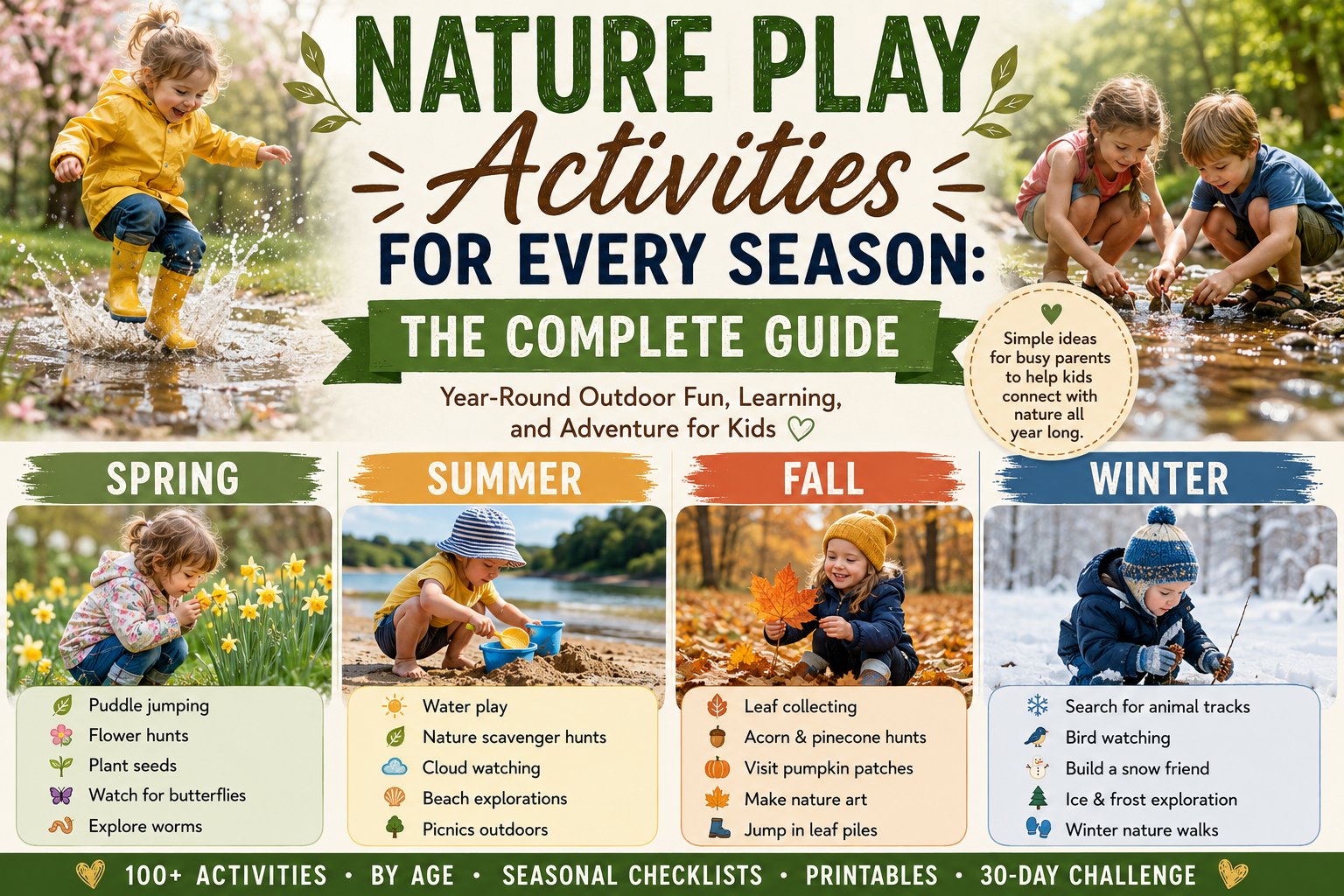
This guide is for parents who want more of those moments — not the dead worms specifically, but the aliveness that comes from children engaging directly with the natural world. It’s organised by season so you can come back to it all year long, use whatever fits your climate and backyard (or nearest park), and build a rhythm of outdoor nature play that becomes the spine of your family’s year.
Nature play isn’t a trend. It’s a return — to the way children have always learned best. Here’s what decades of research and the experience of thousands of families confirms:
| Nature play doesn’t require a forest. It requires attention. A windowsill, a pot of soil, a puddle — these are enough to begin. |
You don’t need much. But having a few basics ready means you’ll actually go outside instead of spending ten minutes searching for a bucket and giving up.
| Season | Kit Essentials | Optional Extras |
| Spring | Wellies, waterproofs, buckets & spades, magnifying glass | Bug catchers, seed packets, nature journal, watercolour paints |
| Summer | Sun hat, sunscreen, water shoes, small spade | Water table, spray bottles, shells & pebbles, butterfly net |
| Autumn | Wellies, warm layers, small basket for collecting | Press-and-dry kit for leaves, nature bingo cards, conker bag |
| Winter | Waterproofs, gloves, boots, thermos for warm drinks | Binoculars for bird watching, bird seed, ice tray for ice art |
| SPRING Spring is the sensory jackpot season. Everything is growing, buzzing, blooming, and getting muddy. Children’s curiosity is perfectly matched to a season that offers endless change and discovery. |
Spring is perfect for introducing nature to the very youngest. They don’t need to do anything — just be in it.
This age group is built for spring. Puddles. Mud. Worms. Flowers to pick and destroy. They are in their element.
| Mud kitchen tip: the best mud kitchen is two old pots, a wooden spoon, a patch of dirt, and water. It costs nothing. Children will play in it for hours. |
| SUMMER Summer is expansive. There’s more time, more light, more freedom. The challenge isn’t finding things to do — it’s resisting the pull of screens and pools and over-scheduled camps long enough to let children be in unstructured nature. |
| Ice excavation is genuinely one of the most absorbing summer activities for toddlers. Freeze toys in a large ice block the night before and let them excavate with warm water and tools. |
| AUTUMN Autumn is the most visually dramatic season for children — the colours, the crunch, the smell of earth and decay. It’s also the most underrated season for free, loose-parts nature play. |
| ParentNest Tip: The ‘stick fairy house’ is endlessly replayable. Every walk becomes a building-materials run. Children who struggle with sitting and focusing will spend 45 minutes on this without noticing. |
| WINTER Winter is where many parents give up on outdoor play. The cold, the dark, the endless layers. But children who play outside in winter develop a relationship with nature that fair-weather play can never build. There is beauty in frozen things. |
| Coloured ice cubes on a white tray: one of the simplest, most magical winter activities. Add glitter, flower petals, or small toys before freezing for an extra layer of wonder. |
Sometimes it rains sideways. Sometimes it’s dangerously cold, or you’re recovering from illness, or the park genuinely isn’t accessible today. Here’s how to bring nature inside without losing the benefits of nature-connected play.
| Even a 10-minute puddle check counts. Consistency beats duration. Children who go outside briefly but regularly build a deeper connection with the natural world than those who only go on ‘big nature days’. |
| Season | Key Skills Developed | Developmental Window |
| 🌸 Spring | Curiosity, life cycle understanding, sensory discrimination, patience (planting) | 0–10 years — the season of firsts |
| ☀️ Summer | Risk tolerance, physical confidence, water play, sustained concentration | All ages — peak outdoor energy |
| 🍂 Autumn | Classification, fine motor (collecting/sorting), loose parts creativity | Toddlers & preschoolers especially benefit |
| ❄️ Winter | Resilience, observation skills, delayed gratification, weather literacy | Older children benefit most from winter challenges |
The goal isn’t a one-off nature day. It’s a rhythm. A weekly habit that becomes so embedded in your family’s life that it feels strange NOT to go outside.
Pick one slot per week — Sunday morning, Saturday afternoon, one weekday after school — and call it your Wild Hour. Keep it loose. No agenda. No crafts to finish. Just: go outside, follow what interests them, stay for an hour. That’s the whole plan.
| Day | Nature Play Habit |
| Monday | 5-minute outdoor check-in: what’s changed since last week? |
| Wednesday | Backyard free play or nearby park — 20-30 mins, no agenda |
| Friday | Nature tray swap: bring inside one new found object from a walk |
| Saturday/Sunday | Wild Hour: one hour of unstructured outdoor nature time together |
One of the biggest barriers to outdoor nature play is parental anxiety about safety. Mud is germy. Sticks are pointy. Trees fall. Streams have currents. The hedgehog might have fleas.
Here’s what child development researchers consistently find: age-appropriate risky play — climbing, building, exploring unknown environments — is essential for the development of risk assessment skills. Children who are never allowed to assess risk for themselves grow into adults who struggle with it.
That doesn’t mean ignoring real danger. It means teaching children to assess it. Phrases that help:
| The goal is not fearless children. It’s children who have learned to read the environment, assess real risk, and make considered choices. Nature is the best classroom for this. |
You don’t need to do all of this. Start with one season — whichever one is coming next. Pick two or three activities from the age range that fits your child. Go outside. Follow their lead.
A child who grows up playing in the mud in spring, building dens in summer, collecting conkers in autumn, and crunching frost under their boots in winter is building a childhood they will remember, a connection with the living world that will serve them for life, and a kind of unhurried joy that is harder and harder to find in a world that keeps speeding up.
It starts with one walk. One stick. One worm named Derek.
| Save this guide and come back each season. It’s designed to grow with your child and work no matter your climate, your backyard size, or your budget. Nature play is free. It always has been. |
From birth. Nature play begins with a newborn lying on a blanket in the garden, feeling a breeze, hearing birdsong, and watching leaves move. There’s no minimum age — just adjust the activity to suit the developmental stage.
Yes, with appropriate supervision and age-appropriate activities. The risks of NOT doing nature play — reduced physical confidence, low risk-assessment skills, poor sensory development — generally outweigh the minor risks of outdoor play. Always supervise near water, ensure no toxic plants are within reach, and check for hazards before free play in a new area.
No garden required. A windowsill can hold seed pots. A local park offers every season’s activities. A walk down any street provides leaves, birds, sky, and weather to observe and discuss. A balcony tray with soil is enough for digging play. Nature is everywhere — the only requirement is attention.
Even 10–15 minutes makes a difference. Consistency matters more than duration. A daily 10-minute outdoor check-in develops more than a monthly 3-hour nature trip. Aim for regular, brief, child-led time outside rather than occasional grand events.
Start with them, not the outdoors. Go out yourself and do something interesting. Most children follow a parent who’s digging, examining, or building something. Avoid ‘go outside!’ as an instruction — it rarely works. ‘I’m going to look for slugs, do you want to come?’ nearly always does.
Yes and no. The specific plants, creatures, and weather conditions vary enormously, but the approach is universal. A child in a hot dry climate can do all the same activities with different plants and different creatures. The principles — follow curiosity, use loose parts, observe and respond — work everywhere.
Loose parts play uses moveable, open-ended natural objects — sticks, stones, pine cones, leaves, mud, water — that children can combine and use in unlimited ways. Unlike fixed playground equipment, loose parts can become anything: a fire, a soup, a bridge, a crown. This open-endedness is what makes it so powerfully creative.
Yes. Mud, soil, and natural environments contain microbes that are beneficial to the developing immune system. Research suggests children who play in soil and natural environments may have better immune function. More practically: clothes wash, shoes dry, and the joy of a thoroughly muddy child is one of parenting’s simple pleasures.
A nature journal is any notebook where a child records what they observe in nature — through drawing, writing, or both. Start simply: one blank-paged notebook, any pencils or crayons, and a prompt like ‘draw something you found today.’ Don’t worry about neatness or accuracy. The habit of observation is what you’re building.
There’s a Scandinavian phrase: there’s no bad weather, only bad clothing. Invest in proper waterproofs and wellies — they genuinely transform your outdoor experience. Cold-weather play becomes magical rather than miserable when everyone is warm and dry. Warm drinks in a thermos help enormously with buy-in from reluctant family members.
Use transitions. The walk to school is a nature play opportunity. The drive-by park visit on the way to a supermarket. Five minutes in the back garden before dinner. Nature play doesn’t need its own slot in the calendar if it becomes part of how you move through everyday life.
Activities that work across age gaps: foraging walks (everyone finds something), building dens (different roles for different ages), scavenger hunts with different difficulty levels, mud kitchens (babies explore, toddlers make, older kids run the ‘restaurant’), water play, and building with natural loose parts. The outdoors naturally differentiates for mixed-age groups.