Physical Address
304 North Cardinal St.
Dorchester Center, MA 02124
Physical Address
304 North Cardinal St.
Dorchester Center, MA 02124

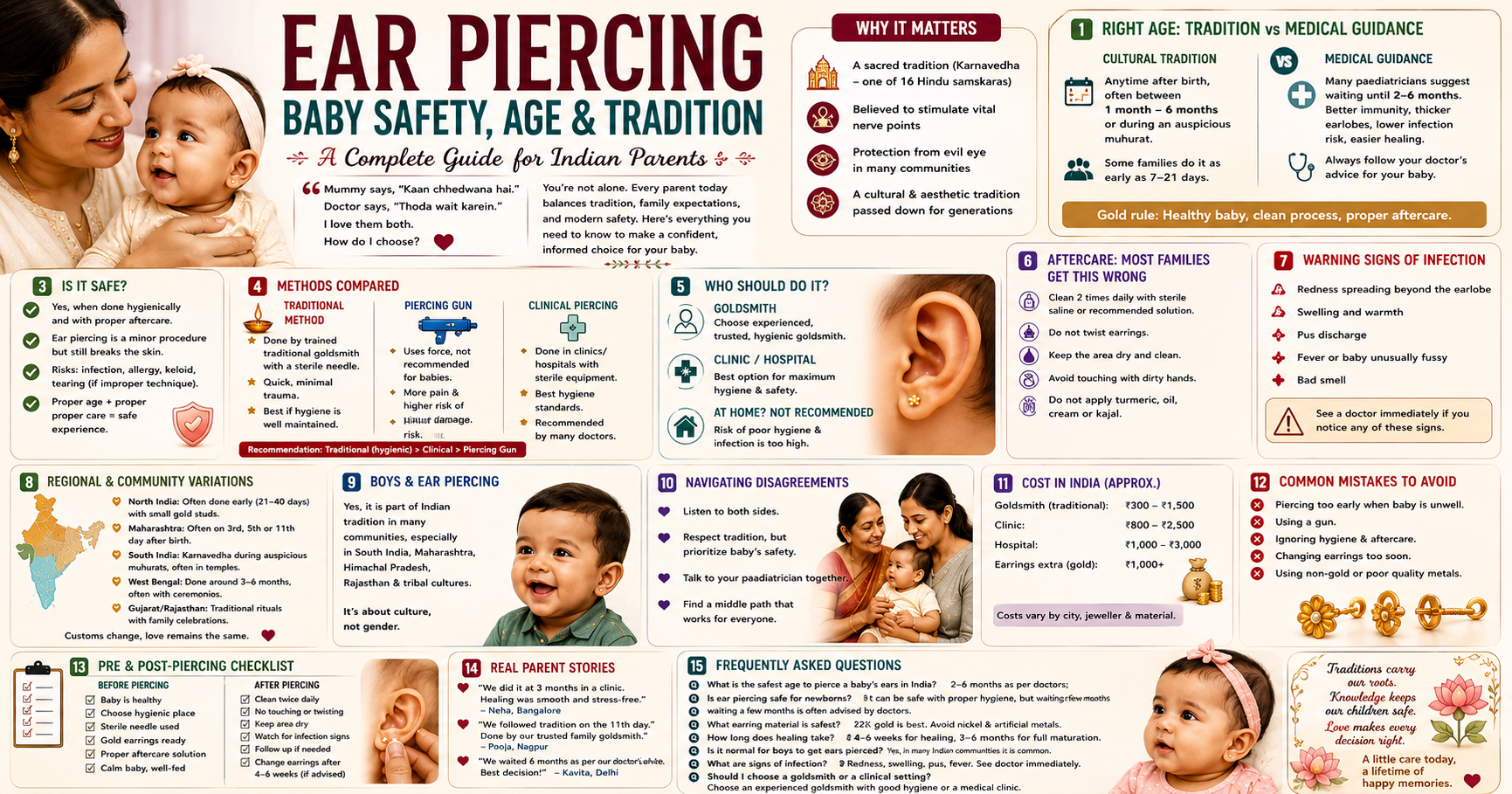
Kavita sat in the goldsmith’s shop with her six-week-old daughter asleep in her arms, and for the first time since the pregnancy began, she felt genuinely torn between two people she trusted completely — her mother, who’d been saying “kaan chhedwana hai, jaldi karo” since the day the baby was born, and her paediatrician, who’d gently suggested waiting until at least a few months, when the baby’s immune system was a little sturdier and healing would be more predictable. Neither was wrong, exactly. They were just answering two different questions — one rooted in generations of cultural meaning, the other in modern clinical caution — and Kavita, holding her sleeping daughter in a shop that smelled of incense and gold polish, realised nobody had actually told her how to weigh those two things against each other.
That’s the gap this guide is built to close. Ear piercing is one of the most commonly performed, least discussed-in-detail infant procedures in Indian family life — so culturally normalised that many families barely pause to ask the safety questions a first-time parent, especially one straddling two generations’ worth of expectations, genuinely deserves clear answers to. This is a complete, practical guide: what the tradition actually means, the real safety considerations, the right age from both a cultural and medical lens, how the procedure is actually done, and how to navigate it if your own instinct and your family’s expectation don’t fully align.
Karnavedha, the traditional Sanskrit term for ear piercing, is formally recognised as one of the sixteen Hindu samskaras (life-stage sacraments) — placing it in the same category of ritual significance as naamkaran (naming) and mundan (first haircut), which is precisely why it carries weight far beyond simple aesthetics in most Indian families.
The traditional belief system around ear piercing includes several layered meanings: a health-linked belief tying earlobe piercing to nerve points believed, in traditional Ayurvedic and folk understanding, to be connected to the eyes and overall wellbeing; a protective belief in some communities that piercing wards off evil eye (nazar); and a straightforward cultural and aesthetic expectation, particularly for daughters, that’s been passed down largely without question for generations.
Family pressure around timing can feel intense precisely because it’s not framed as optional in many households — for a lot of grandparents, “kab karwa rahे ho” (when are you getting it done) isn’t a casual question, it’s treated as a slightly overdue milestone the moment a baby crosses a few weeks of age, which is exactly the tension Kavita’s story captures.
Understanding why this tradition carries such weight — rather than dismissing it as simply old-fashioned pressure — genuinely helps parents navigate the conversation with more empathy, even while making an informed, safety-conscious decision about timing and method.
Traditional cultural timing varies by community but commonly falls within the first few months of life, with many families specifically favouring the naming ceremony period, the mundan ceremony (often combined as a single efficient family gathering), or a specific auspicious date within the first six months, sometimes even within the first few weeks.
Modern paediatric guidance generally suggests waiting longer than the earliest traditional timing favours — many paediatricians recommend waiting until at least a few months of age, with some suggesting waiting until closer to 6 months or beyond, reasoning that a slightly older infant’s immune system is more robust, the healing process is more predictable, and the baby is somewhat better able to tolerate the brief discomfort of the procedure itself.
The core tension isn’t “tradition vs no piercing” — it’s about timing and method, not about whether to pierce at all. Very few paediatricians frame this as an issue of avoiding ear piercing altogether; the actual clinical caution centres specifically on doing it at a slightly later, immunologically sturdier age, and using a hygienic, appropriately trained method — which means the conversation with family doesn’t have to be framed as “doctor vs tradition” at all, but rather “let’s do this the way that’s genuinely safest for the baby, at a time that still respects what matters to the family.”
A reasonable middle-ground many families land on: waiting until at least 2–3 months at the earliest, ideally closer to 4–6 months if family timing allows flexibility, rather than defaulting to the very earliest traditional window purely out of habit or urgency, while still comfortably completing the ritual well within the broader first-year window most traditions consider appropriate.
It’s worth having this specific conversation with your own paediatrician directly, since individual health factors (premature birth, any existing skin or immune conditions, general health at the time) can reasonably shift the recommended timing for an individual baby beyond general guidance.
Ear piercing in infants is generally considered a low-risk procedure when performed correctly, using sterile equipment, by someone appropriately trained, with proper aftercare followed — the overwhelming majority of babies who are pierced heal without complication.
The primary risks, when they do occur, are almost entirely related to hygiene and aftercare rather than the piercing itself — infection from unsterilised equipment, infection from inadequate aftercare cleaning, allergic reaction to certain earring metals (particularly nickel-containing alloys), and, less commonly, keloid scarring in individuals with a personal or family predisposition to keloid formation.
Choosing hypoallergenic earring material matters more for infants than for older children or adults, given infant skin’s relative sensitivity — surgical-grade stainless steel, titanium, or genuine gold (typically 14-22 karat depending on family preference and local custom) are generally considered safer choices than lower-quality alloys more prone to triggering allergic reactions.
A sterile, single-use or properly sterilised instrument is the single most important safety factor, more significant than almost any other variable in this decision — this is precisely why who performs the piercing and how they maintain their equipment (covered in Section 8) deserves more careful consideration than many families give it, especially compared to how much attention timing alone typically receives.
There is no strong medical evidence that ear piercing itself is inherently unsafe for babies when done properly — the caution paediatricians commonly express is almost always about method, hygiene, and timing specifically, not a blanket objection to the practice.
Traditional goldsmith/jeweller method (often using a needle): historically the most common method in Indian families, performed by an experienced goldsmith, often as part of a ritual ceremony — quality and safety vary considerably depending on the specific practitioner’s hygiene standards and equipment, making this the method where careful vendor selection matters most.
Piercing gun method: commonly used in some jewellery store chains and dedicated piercing counters, using a spring-loaded mechanism to place a stud earring through the earlobe quickly — generally faster and often perceived as less painful for a brief moment, though some clinical guidance notes that piercing guns can be harder to fully sterilise between uses compared to single-use needle systems, and can cause slightly more tissue trauma than a properly performed needle piercing.
Clinical/hospital-based piercing: increasingly available, particularly in larger cities, performed by a trained medical professional (often a paediatrician or nurse) using single-use sterile needles in a clinical setting — generally considered the gold standard for hygiene and safety, though it comes without the ritual/ceremonial context many families specifically want as part of the occasion, and typically costs somewhat more than a traditional goldsmith visit.
A reasonable approach many modern Indian families take: use a clinical or medically-supervised setting for the actual piercing procedure itself, while still incorporating the family’s traditional ritual elements (blessing, ceremony, family gathering) around that safer method — separating the ritual meaning of the occasion from the specific mechanical act of piercing, which don’t actually need to happen in the same physical location to both be honoured properly.
This is, by a wide margin, where most complications actually originate — not from the piercing procedure itself, but from aftercare gaps.
Clean the area gently, 2–3 times daily, typically with a saline solution or the specific antiseptic solution recommended by whoever performed the piercing — avoid alcohol-based solutions unless specifically directed, since these can be unnecessarily harsh on a baby’s sensitive skin.
Rotate the earring gently during cleaning (a commonly recommended practice, though guidance varies slightly by practitioner) to prevent the skin from healing around and adhering to the earring itself.
Avoid touching the area with unwashed hands, and be particularly mindful during any activity that might introduce bacteria near the ear — bath time, for instance, deserves slightly more careful attention during the initial healing window.
Keep the initial stud in place for the full recommended healing period (commonly 4–6 weeks, though this can vary) before changing to a different earring, since premature changing is a common, avoidable cause of irritation and delayed healing.
Watch for normal healing signs versus concerning signs — mild redness and slight crustiness in the first few days is typically normal; anything beyond that (covered in detail in Section 7) warrants attention.
Dress the baby thoughtfully during the healing period — avoiding clothing or accessories that might catch or pull at the earring, and being mindful during activities where another child or pet might inadvertently tug at it.
Normal healing signs (typically nothing to worry about):
Signs that warrant a doctor’s attention:
If in doubt, it’s always reasonable to have a paediatrician take a quick look, even for what seems like a minor concern — infant skin healing can look slightly different from adult expectations, and a brief professional check tends to resolve most parental uncertainty quickly and reassuringly.
If choosing a traditional goldsmith/jeweller, ask directly about their sterilisation practices — whether they use single-use, pre-sterilised needles (preferable) or reusable equipment sterilised between clients (requires more careful verification), and don’t hesitate to ask this question even if it feels culturally unusual to question an experienced, trusted family jeweller directly — a good, safety-conscious practitioner will answer confidently and without offence.
If choosing a clinical/hospital setting, confirm whether the piercing is performed by a trained nurse, paediatrician, or other qualified medical staff specifically, and ask about the earring material options available, since clinical settings sometimes offer a more limited range of hypoallergenic options compared to a traditional jeweller’s broader stock.
If choosing a piercing gun at a retail jewellery counter, verify whether the specific cartridge/needle component is single-use and sealed until use (most reputable chains follow this standard today), since this is the primary hygiene safeguard specific to gun-based piercing.
Regardless of setting, a few consistent questions are worth asking anyone performing the procedure: What specific equipment will be used, and is it single-use or sterilised between clients? What earring materials are available, and which do they recommend for infant skin specifically? What aftercare instructions do they provide, and are they willing to answer follow-up questions if a concern arises during healing?
South Indian communities often combine ear piercing with other early infant ceremonies, sometimes as part of a broader naming or first-milestone ceremony, with specific auspicious timing considerations similar to those discussed for naamkaran and mundan elsewhere in Indian tradition.
Rajasthani and Gujarati communities often place particular ceremonial emphasis on the specific earring style and metal chosen, sometimes tied to family jewellery traditions passed down for the occasion specifically, making the choice of jeweller and earring design a more elaborate family decision than in some other regions.
Ear piercing for boys carries meaningfully different regional and community patterns, covered in more detail in Section 10, with some communities maintaining strong traditional practice for sons and others having largely moved away from it in recent generations.
Urban, multi-regional, and interfaith families increasingly approach this tradition more flexibly — blending elements from both parents’ community customs, or choosing a more secular, purely aesthetic approach to timing and method without strict adherence to any single community’s specific ritual calendar.
Ear piercing for boys has deep historical roots in many Indian and broader South Asian traditions, particularly within specific communities and, notably, within Ayurvedic medical tradition itself, where karnavedha was historically prescribed for both sons and daughters as a health-linked ritual, not exclusively a daughters’ aesthetic tradition as it’s sometimes assumed to be today.
Contemporary practice varies considerably by region, religion, and generation — some communities (particularly certain South Indian and specific North Indian traditional families) maintain a strong, unquestioned practice of piercing sons’ ears as part of standard infant ritual; others have moved away from the practice for boys specifically over recent generations, often tied to shifting ideas about gendered aesthetic norms rather than any change in the tradition’s original meaning.
Families navigating this specifically for sons often find it useful to understand that the tradition’s original basis (in most classical formulations) wasn’t gender-specific at all — a genuinely helpful piece of context for parents facing scepticism or surprise from either direction, whether that’s a grandparent surprised a family isn’t piercing a son’s ears, or a modern relative surprised that a family is.
This tension — exactly the one Kavita faced in the goldsmith’s shop — is genuinely common, and worth addressing directly rather than treating as an unusual family conflict.
Reframe the conversation around “how” and “when,” not “whether.” Most disagreements soften considerably once it’s clear the parents aren’t rejecting the tradition itself, simply wanting to approach timing and method with a bit more caution than the earliest possible window — a framing that tends to land better with grandparents than a conversation that feels like a rejection of the custom altogether.
Bring the paediatrician’s specific guidance into the conversation directly, rather than presenting it as the parents’ own personal preference — hearing “the doctor specifically recommended waiting until X months for healing reasons” often carries more weight with grandparents than “we’d prefer to wait,” even when the underlying reasoning is identical.
Offer a concrete alternative timeline rather than an open-ended “later” — grandparents navigating this conversation generally respond better to “we’re planning to do it at the 3-month mark, combined with X ceremony” than to a vague deferral that feels like it might never happen.
Let grandparents remain involved in the parts of the tradition that matter most to them, even if the specific piercing method changes — inviting them to the clinical appointment, letting them lead a small blessing before or after, or incorporating the earrings they’ve chosen even if a doctor performs the actual piercing, are all ways of honouring the relationship without compromising on safety specifics.
Traditional goldsmith/jeweller piercing: typically ₹200–₹1,000 for the piercing service itself, though many families combine this with purchasing gold earrings for the occasion, which can range from a few thousand rupees for simple studs to significantly more depending on design and gold weight/purity chosen.
Piercing gun at retail jewellery chains: often bundled with the cost of a specific earring set, typically ranging ₹500–₹2,000 depending on the chain and earring material/style selected.
Clinical/hospital-based piercing: generally the most expensive option, typically ranging ₹1,000–₹3,000 for the procedure itself in most cities, reflecting the medical setting, professional staff, and sterile single-use equipment involved, though pricing varies meaningfully by city and specific hospital or clinic.
Additional costs to consider: any ceremonial elements planned around the occasion (small family gathering, priest/blessing if combined with another ritual), and the cost of the actual earrings themselves, which can range enormously from simple, inexpensive studs to elaborate traditional gold jewellery depending entirely on family preference and budget.
Kavita, Delhi — “We ended up waiting until four months, doing it at a paediatric clinic instead of the traditional goldsmith visit my mother originally wanted. She was disappointed for about a day, and then completely came around once she saw how quickly it healed and how calm the whole process was. She still tells people about her granddaughter’s ‘doctor piercing’ like it’s a slightly unusual but ultimately fine choice.”
Ramesh and Sunita, Chennai — “We did it traditionally, through our family goldsmith, at six weeks, exactly as tradition in our family expects. No complications at all. I know the medical guidance leans toward waiting longer, but our goldsmith has been doing this for thirty years, uses sealed sterile needles, and honestly I trusted the process completely. Both approaches can be done safely if you’re careful about who’s doing it.”
Farah, Hyderabad — “We pierced our son’s ears, which genuinely surprised some of my husband’s more modern colleagues when they found out, even though it’s a completely normal, expected tradition in my own family. It was interesting navigating two completely different sets of assumptions about whether piercing a boy’s ears was even a real ‘thing’ at all.”
Priya, Bangalore — “Mild infection around week two, nothing serious, but enough to genuinely scare me. Turned out we weren’t cleaning quite thoroughly or consistently enough. Cleared up within a few days once we got the routine right with our paediatrician’s guidance. I wish someone had emphasised the aftercare part as strongly as the piercing decision itself beforehand — that’s honestly the part that actually mattered most in our case.”
Before the procedure
Immediately after
During healing (typically 4–6 weeks)
While many families traditionally pierce within the first few weeks, many paediatricians recommend waiting until at least a few months of age, ideally closer to 4–6 months, when the immune system is more robust and healing is more predictable — it’s worth discussing specific timing with your own paediatrician.
Ear piercing is generally low-risk at any infant age when performed with sterile equipment by a trained practitioner and followed by proper aftercare, though many medical professionals suggest slightly older infants tend to heal more predictably than very young newborns.
Hypoallergenic materials — surgical-grade stainless steel, titanium, or appropriate-purity gold — are generally recommended over lower-quality alloys, particularly those containing nickel, which carries a higher risk of allergic reaction in sensitive infant skin.
Typically 4–6 weeks for the initial healing period, though this can vary by individual baby and should be confirmed with whoever performed the piercing, since premature earring changes before this window is a common cause of irritation.
Yes — ear piercing (karnavedha) historically applied to both sons and daughters in classical Ayurvedic and cultural tradition, and remains a strong, expected practice for boys in certain regions and communities today, even though contemporary practice varies considerably by family and generation.
Spreading redness beyond the piercing site, persistent warmth, thick or foul-smelling discharge, worsening swelling, and fever or unusual fussiness are all signs warranting a paediatrician’s attention, distinct from mild, localised redness typical of normal early healing.
Both can be done safely if proper sterile equipment and hygiene practices are followed — many modern families choose a clinical setting for the piercing itself while still incorporating traditional ceremonial elements separately, honouring both safety and cultural meaning.
This article provides general information on baby ear piercing safety and tradition in India and does not replace professional medical advice. Please consult your paediatrician regarding the appropriate timing and any specific health considerations for your own baby before proceeding.