Physical Address
304 North Cardinal St.
Dorchester Center, MA 02124
Physical Address
304 North Cardinal St.
Dorchester Center, MA 02124

Neha remembers the exact aunty, at the exact family function, who asked — in front of at least six other relatives — “Doodh nahi aata kya?” Does your milk not come? Neha’s son was three weeks old, she’d been trying to breastfeed through cracked, bleeding nipples for eleven straight days, her lactation consultant had gently suggested supplementing with formula while they kept working on it, and here was an aunty she saw twice a year making her feel, in front of her own mother-in-law, like she’d failed at the most basic job of motherhood before it had properly begun.
“I actually started crying in the bathroom of that function,” Neha says now, two years later, with the particular calm of someone who’s fully made peace with a decision she once felt ashamed of. “And what gets me, looking back, is that nobody in that room would have blinked twice if I’d said the baby had a cough and needed medicine. But ‘formula’ still felt like a confession.”
That gap — between how normal and unremarkable formula feeding actually is, medically and practically, and how loaded it still feels socially in a lot of Indian families — is exactly why this guide exists. Whatever brought you here — low milk supply, a medical reason you or your baby can’t breastfeed, returning to work, exhaustion, a genuine informed preference, or simply wanting a backup plan — you deserve clear, practical, judgment-free information. This is that guide: how to choose, prepare, and give formula safely, how to combine it with breastfeeding if that’s your situation, what it actually costs in India, and how to handle the social side of it with a little more confidence than Neha had that day in the bathroom.
India’s public health messaging around breastfeeding, for genuinely good reasons rooted in maternal and child health outcomes, has been consistently strong for decades — hospitals actively promote it, government campaigns reinforce it, and most Indian families have absorbed the message deeply. The problem isn’t the message itself; it’s that the messaging has, for many families, hardened into judgment rather than support, leaving very little cultural room for the many entirely valid reasons a mother might need or choose to formula feed, partially or fully.
The reasons families turn to formula are wide-ranging and almost always legitimate: insufficient milk supply despite genuine effort, medical conditions in the mother (certain medications, illnesses, or previous surgeries) that make breastfeeding unsafe or impossible, a baby with specific medical needs that breastfeeding alone can’t address, the physical and emotional toll of an especially difficult breastfeeding journey, returning to work without adequate pumping support, adoption, or simply an informed, personal preference — none of which reflect a lack of love, effort, or commitment to a baby’s wellbeing.
It’s worth saying directly: a fed baby, raised by a present, attentive parent, thrives regardless of whether that nutrition came from breast or bottle. The overwhelming majority of long-term developmental and health outcomes research shows healthy, well-cared-for children from both feeding paths growing up equally well — the anxiety many Indian parents carry about this decision is often disproportionate to any actual, measurable difference in outcome for their individual family’s circumstances.
This section exists not to relitigate a decision you may have already made, but to give an honest, non-judgmental picture for anyone still weighing options or looking for reassurance about a choice already underway.
Breastfeeding, where it’s medically possible and going well, offers some well-documented advantages — including specific immune-supportive components unique to breastmilk, no preparation required, and typically lower ongoing cost — which is precisely why it’s the default recommendation from major health bodies including the WHO and Indian paediatric guidance where feasible.
Formula feeding offers its own genuine, practical advantages worth acknowledging rather than treating as consolation prizes — precise knowledge of exactly how much a baby has eaten (useful for tracking growth and feeding patterns), the ability for any caregiver (partner, grandparent, nanny) to participate fully in feeding, more predictable feeding schedules for some families, and complete removal of the physical toll breastfeeding can take on a mother’s own body and rest.
Neither path guarantees a specific outcome, and neither is a moral failure. Modern infant formula sold in India is closely regulated, nutritionally complete, and has supported healthy infant development for generations of babies worldwide — this isn’t a fringe or second-best option, it’s a well-established, safe feeding method used by millions of families for entirely legitimate reasons.
For many Indian families, the real-world answer isn’t “either/or” at all, but a combination approach (Section 7) that flexes with what’s actually working for that specific mother and baby, rather than a rigid all-or-nothing commitment to either method.
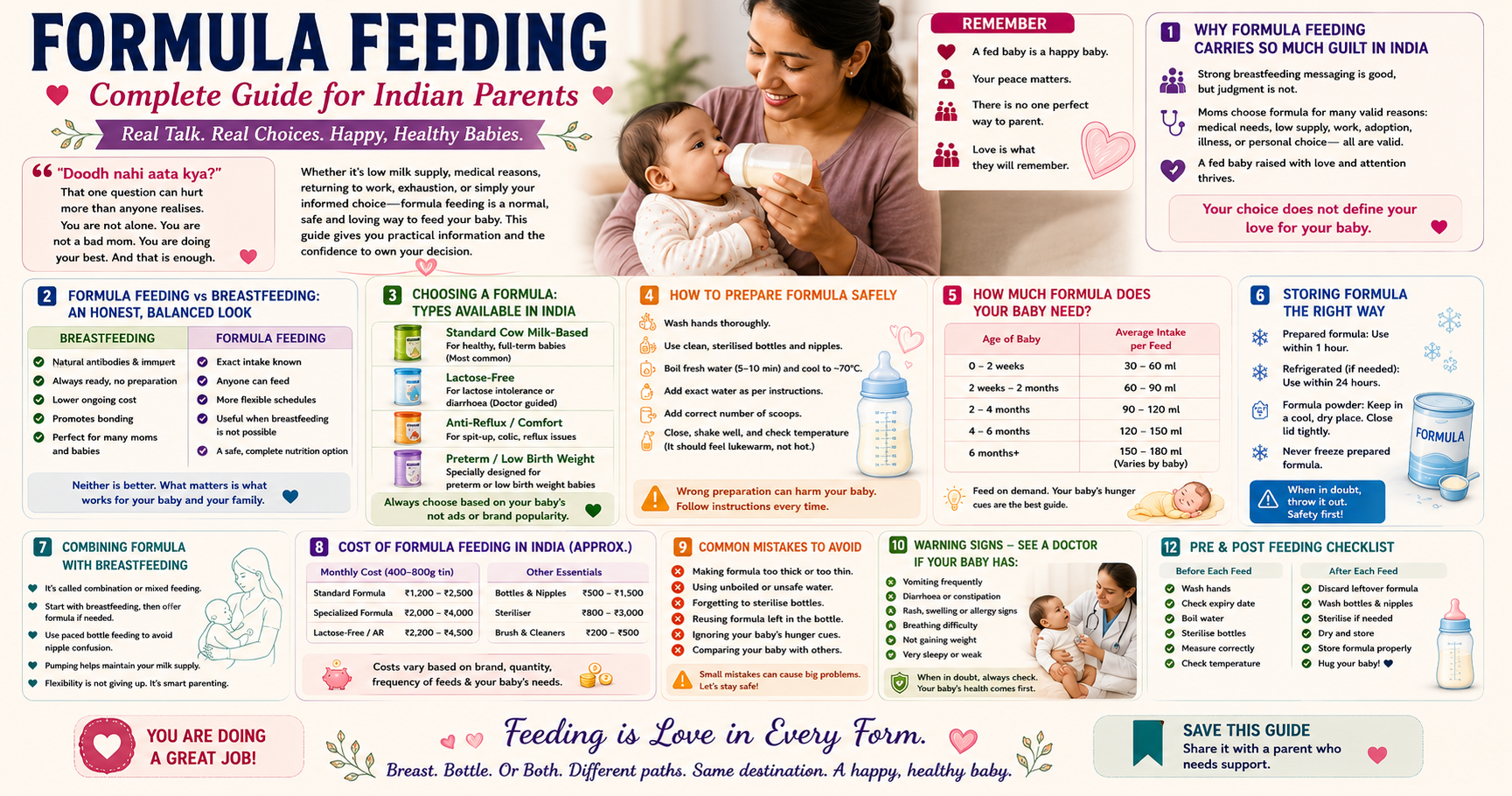
Cow’s milk-based infant formula is the most common and widely available type in India, suitable for the large majority of healthy full-term infants, formulated to closely approximate breastmilk’s nutritional profile.
Soy-based formula is available for specific situations, typically recommended only under paediatric guidance for particular medical circumstances (such as galactosemia or specific lactose intolerance situations), rather than as a general alternative preference.
Hypoallergenic/extensively hydrolysed formula is available for babies with diagnosed or suspected cow’s milk protein allergy, where the proteins are broken down into smaller components less likely to trigger an allergic reaction — this category should be used specifically on a paediatrician’s recommendation, not as a precautionary default.
Premature/low-birth-weight specific formula is available and often recommended for babies born prematurely or at low birth weight, formulated with adjusted nutritional composition to support catch-up growth needs specific to that situation, again typically under direct medical guidance from the paediatric team involved in the baby’s care.
Follow-on/toddler formula (typically for 6+ months and beyond) is a distinct category from infant formula, and it’s worth understanding this distinction clearly — follow-on formulas are formulated differently and are not interchangeable with infant formula for younger babies, so checking the specific age-appropriate labelling matters more than brand loyalty when transitioning stages.
The single most important guidance in this entire section: the specific formula type appropriate for your baby should be a conversation with your paediatrician, particularly for anything beyond standard cow’s milk-based formula for a healthy, full-term infant — this isn’t a section meant to help you self-diagnose a need for a specialised formula, but to help you understand the landscape well enough to have an informed conversation with your doctor.
Age-stage labelling (typically Stage 1 for 0-6 months, Stage 2 for 6-12 months, and onward) indicates the specific nutritional formulation appropriate for that developmental window — always match the stage to your baby’s actual age, and don’t advance early purely because a baby seems to be feeding well on the current stage.
FSSAI approval and manufacturing details — checking that a formula carries appropriate Food Safety and Standards Authority of India approval and clear manufacturing/expiry information is a basic but important safety check, particularly if purchasing from a less familiar retailer or, especially, if considering an imported product not specifically formulated or labelled for the Indian regulatory context.
Preparation instructions specific to that exact product — different formula brands and even different product lines within the same brand can have different powder-to-water ratios, and this is the single detail most important to follow exactly as printed on that specific tin, rather than assuming a ratio from a previous formula or a general internet guideline applies universally.
Expiry date and storage instructions, both for the sealed tin and, separately, guidance on how long an opened tin remains good for use (commonly around 3-4 weeks after opening for most powdered formulas, though this varies by brand and should be confirmed on the specific product).
Avoid being swayed primarily by marketing claims (“closest to breastmilk,” specific added ingredients marketed for cognitive development, and similar language) without independently verifying these claims hold real, well-established evidence — a paediatrician’s guidance on formula selection is generally a more reliable input than packaging language alone.
This is the single most safety-critical section in this entire guide, because improper preparation — not formula itself — is where real risk to a baby’s health can arise.
Because exact ratios, temperatures, and storage timeframes vary meaningfully by specific formula brand, always defer to the instructions printed on your specific product’s packaging over any general guidance, including this article’s general framework — this section is meant to explain the safety principles behind formula preparation, not to substitute for your specific product’s exact instructions.
General feeding frequency patterns (always to be confirmed against your specific baby’s growth and your paediatrician’s guidance, since individual variation is significant):
Following your baby’s hunger and fullness cues matters more than rigid volume targets — most paediatric guidance encourages responsive feeding (feeding when a baby shows hunger cues, stopping when they show fullness cues like turning away or slowing down) rather than insisting a baby finish a specific pre-measured amount regardless of these cues.
Specific volume-per-feed and daily-total recommendations should come from your paediatrician, tailored to your individual baby’s weight, growth trajectory, and overall health — general online guidelines, including anything in this article, are meant as a rough orientation only, not a substitute for guidance tailored to your specific baby at their specific check-ups.
Combination feeding — using both breastmilk and formula, in whatever proportion works for a specific family — is an entirely valid, common approach that doesn’t need to be framed as a failure to fully breastfeed or a hedge against fully formula feeding.
Common combination feeding patterns: breastfeeding directly for some feeds and formula for others (often used to allow a partner or other caregiver to participate in feeding, or to manage a return to work), supplementing with formula after breastfeeding sessions if milk supply concerns exist, or a more flexible day-to-day mix based on what’s practically working.
A note on nipple confusion: some babies transition between breast and bottle without any difficulty; others show a temporary preference shift, particularly early on — if this becomes a genuine concern, a lactation consultant or paediatrician can offer strategies specific to your baby’s situation, including specific bottle/teat shapes designed to more closely mimic breastfeeding’s sucking mechanics.
Milk supply considerations: for mothers wanting to maintain or protect breastfeeding while introducing formula, understanding that milk supply generally responds to demand (meaning reduced breastfeeding frequency can, over time, reduce supply) is useful context for planning a combination approach that protects whatever balance you’re aiming for, whether that’s mostly breastfeeding with occasional formula, or the reverse.
There’s no fixed “correct” ratio in combination feeding — what matters is that the approach is sustainable for the specific mother’s physical and emotional wellbeing and meets the baby’s nutritional needs, which a paediatrician can help monitor through regular growth checks regardless of the specific breastfeeding-to-formula ratio a family settles into.
For the first several months, sterilising bottles, teats, and any equipment that touches formula or breastmilk is generally recommended, given a young infant’s still-developing immune system — common sterilisation methods include boiling in water for several minutes, using a steam steriliser (electric or microwave-safe), or using cold-water sterilising solutions/tablets designed for this purpose.
As babies grow older (commonly, though guidance varies, somewhere in the range of 6–12 months), many paediatricians consider thorough washing with hot soapy water sufficient for daily equipment cleaning, reserving full sterilisation for specific situations (illness in the household, particularly for premature or medically vulnerable infants) — this transition timing is worth confirming with your own paediatrician rather than assuming a fixed universal cutoff.
Bottle and teat replacement: regularly inspecting bottles and teats for wear, cracking, or discolouration, and replacing them as needed, is a simple but often overlooked safety habit, since damaged equipment can harbour bacteria more easily even with regular cleaning.
Water quality for cleaning and preparation: in areas with uncertain tap water quality, using boiled or appropriately filtered water for both bottle-washing rinse water and formula preparation water is a reasonable additional precaution many Indian families take, particularly in the earliest months.
Possible signs of formula intolerance or sensitivity worth discussing with a paediatrician include persistent excessive fussiness clearly linked to feeding times, unusual or persistent skin reactions (rashes, eczema flare-ups), notable changes in stool (unusually frequent, very hard, or containing blood or mucus), excessive gas or visible discomfort well beyond typical newborn fussiness, and poor weight gain despite seemingly adequate feeding volume.
It’s important not to self-diagnose or switch formulas repeatedly without guidance — many of these signs overlap with entirely normal newborn adjustment patterns unrelated to formula at all, and frequent unguided formula switching can actually make it harder to identify what’s genuinely causing a specific symptom, since each switch introduces a new variable.
If genuine intolerance is suspected, a paediatrician will typically guide a structured approach — potentially a trial of a different formula type (such as an extensively hydrolysed formula for suspected cow’s milk protein allergy) over a defined period, with symptoms tracked systematically rather than judged after just one or two feeds.
Most fussiness, gas, and minor digestive adjustment in the early weeks is a normal part of a newborn’s developing digestive system, not necessarily a sign the specific formula is wrong — this distinction is worth holding onto before assuming a switch is needed, since most babies settle into whatever formula they’re started on without any issue at all.
Pre-measuring formula powder into individual, clean, sealed containers for each expected feed, carrying water separately (either pre-boiled and cooled in an insulated flask, or purchased sealed bottled water for on-the-go mixing) is the most practical approach for outings and travel.
Ready-to-feed liquid formula, where available in India, offers a convenient no-preparation-needed alternative specifically for travel and outings, though typically at a higher cost per feed than powdered formula — worth considering for specific high-convenience situations even if using powdered formula as the everyday default.
Insulated bottle bags/flasks help maintain appropriate water temperature for longer outings, though it’s worth checking specific product guidance on how long pre-boiled water safely maintains the necessary preparation temperature.
Air travel specifically: most airlines and security protocols in India accommodate baby formula and the water needed to prepare it as an exception to standard liquid restrictions, though it’s worth checking the specific airline’s current policy and allowing extra time at security for the additional screening this sometimes requires.
Hygiene remains just as important away from home — carrying hand sanitiser, and being mindful of preparation surface cleanliness in less controlled environments (restaurants, public spaces), matters just as much on the go as it does at home.
Standard cow’s milk-based infant formula typically costs roughly ₹500–₹1,200 for a 400g tin, depending on brand, with a single tin typically lasting anywhere from a few days to around a week depending on the baby’s age and feeding volume, meaning monthly costs for full formula feeding can reasonably range from approximately ₹3,000–₹8,000 or more depending on brand choice and the baby’s specific feeding volume.
Specialised formulas (hypoallergenic, premature-specific, or other medically-indicated types) generally cost meaningfully more than standard formula, sometimes significantly so, which is worth factoring into planning if your paediatrician recommends a specialised type for a specific medical reason.
Combination feeding naturally reduces overall formula cost proportionally to the amount of breastfeeding included in the feeding plan, which is a practical, non-judgmental consideration some families do factor into their combination feeding decisions alongside the health and logistics factors discussed in Section 7.
Equipment costs (bottles, sterilising equipment, bottle brushes, and replacement teats as babies grow) represent a meaningful one-time and ongoing cost as well, typically ranging from a few thousand rupees for a basic starter set to more for premium bottle systems, though functional, safe feeding doesn’t require the most expensive options on the market.
It’s worth budgeting formula feeding as a genuine, ongoing household expense category, similar to how families budget for other essential baby needs, rather than treating it as a smaller, incidental cost — for families where this budget is a genuine constraint, discussing options with a paediatrician, including whether any government or hospital-based support programs are available in your specific state, is a reasonable, practical step.
Given how common Neha’s bathroom-crying moment actually is across Indian families, a few practical, tested responses many mothers have found useful:
The brief, boundary-setting response: “Yeh humne doctor se discuss karke decide kiya hai.” (We decided this after discussing it with our doctor.) This tends to close the conversation quickly without inviting further debate, since it positions the decision as medically informed rather than open for casual opinion.
The warm redirect: simply changing the subject to something else about the baby entirely (“Dekho na, aaj pehli baar muskura rahा hai”) often works better than engaging with the comment directly, especially in a group social setting where a lengthy explanation isn’t really welcome by either party.
For closer family members where a fuller conversation feels worthwhile: sharing the specific reason (if you’re comfortable doing so) tends to shift the conversation from judgment to understanding fairly quickly in most cases — most relatives who make an unkind comment are working from an assumption that formula feeding reflects insufficient effort, and directly correcting that assumption, once, often resolves ongoing commentary.
For persistent or repeated unkind comments despite a clear response, it’s entirely reasonable to set a firmer boundary directly (“Please, main iske baare mein baat nahi karna chahti”) — you don’t owe every relative an ongoing justification for a decision you’ve made thoughtfully and in your baby’s best interest.
Perhaps most importantly: finding even one or two people — a partner, a close friend, an online or in-person parent support group — who are unreservedly supportive of your specific feeding decision makes an enormous difference in how sustainable the social side of this decision feels over time, precisely because it means you’re not relying solely on convincing every skeptical relative.
Neha, Delhi — “I combination fed for the first four months, then switched fully to formula once my supply just wasn’t keeping up despite everything I tried. My son is thriving, hitting every milestone early if anything. That aunty from the wedding function actually saw him recently and commented on how big and healthy he looks. I didn’t say anything. I didn’t need to anymore.”
Ritu, Chennai, adoptive mother — “Formula was simply always going to be our path, since I adopted my daughter at three weeks old. Almost nobody in my extended family even thought to question it once they understood the context, which honestly made me a little sad for all the biological mothers I know who faced real judgment for the exact same feeding method, just without an ‘acceptable’ reason attached to it in other people’s eyes.”
Farhan and Ayesha, Bangalore — “Ayesha had a medical condition that made breastfeeding genuinely unsafe for her recovery. We formula fed from day one, on clear medical advice, and honestly the practical side of it — being able to split night feeds evenly between us — became one of the better parts of an otherwise really difficult postpartum period for her.”
Priya, Mumbai, working mother — “I went back to work at four months and pumping at the office just wasn’t sustainable for me, logistically or emotionally. We transitioned to formula for daytime feeds, breastfeeding remained for mornings and evenings. My mother-in-law was initially confused, but once I explained the return-to-work logistics plainly, she was completely supportive, even started keeping formula ready herself on days I got home late.”
Before starting formula feeding
Every preparation
Ongoing
Modern, FSSAI-approved infant formula is nutritionally complete and safe when prepared correctly, and has supported healthy infant development for generations of babies; breastfeeding offers certain specific advantages where medically possible, but formula feeding is a well-established, legitimate feeding method, not an inferior fallback.
Boil water and cool it to the temperature specified on your formula’s packaging (commonly around 70°C), measure water first into a sterilised bottle, add the exact number of scoops specified for that product, shake thoroughly, cool to a safe feeding temperature, and use promptly rather than storing prepared formula for extended periods.
Yes — combination feeding is a common, entirely valid approach used by many families for reasons ranging from milk supply concerns to returning to work, and there’s no fixed “correct” ratio, as long as the baby’s nutritional needs and growth are monitored by a paediatrician.
Standard formula feeding typically costs roughly ₹3,000–₹8,000 per month depending on brand and the baby’s feeding volume, with specialised medically-indicated formulas generally costing more.
Persistent excessive fussiness linked to feeding, unusual skin reactions, notable changes in stool consistency, excessive discomfort beyond typical newborn fussiness, and poor weight gain are worth discussing with a paediatrician, though many mild adjustment symptoms in early weeks are normal and unrelated to the specific formula.
Generally yes, for the first several months, given a young infant’s developing immune system; many paediatricians consider thorough hot, soapy washing sufficient from somewhere around 6–12 months onward, though this transition should be confirmed with your own paediatrician.
A brief, medically-framed response (“we decided this with our doctor”) often closes unwanted conversation quickly; for closer family, sharing the specific reason when comfortable tends to shift judgment toward understanding, and it’s entirely reasonable to set a firm boundary with anyone who persists despite a clear response.
This article provides general information on formula feeding safety and practice and does not replace professional medical or nutritional advice. Please consult your paediatrician for guidance specific to your baby’s individual needs, including formula type, feeding volume, and any signs of intolerance.