Physical Address
304 North Cardinal St.
Dorchester Center, MA 02124
Physical Address
304 North Cardinal St.
Dorchester Center, MA 02124

It’s 11:47pm.
The children are asleep. The house is quiet — that particular quality of quiet that only exists after everyone else is finally down. You’ve been waiting for this moment for approximately seven hours. You have been desperate for bed since approximately 4pm. You changed into your pyjamas at 7:30pm while pretending you were just “getting comfortable.”
And now that you’re here, actually lying down in the actual dark, your brain has decided that now — right now — is the perfect time to think about whether you sent that important email, what you need to get for the school trip, whether you’ve been too shouty lately, the thing you said at the school gate three weeks ago that still sounds wrong, and whether that sound the boiler made last Tuesday is something you should have called someone about.
You are exhausted. You cannot sleep. And somehow this feels like a personal failing on top of everything else.
It isn’t. It is, as it turns out, a very specific physiological and psychological pattern that affects an enormous number of mothers — and one that has real, practical solutions that don’t involve “just relaxing” or “trying not to think about things” or any other advice that suggests the person giving it has never actually tried to switch off a brain that is permanently set to moderate emergency.
This is a post about mum sleep tips and routines that actually work. Not the aspirational ones. The real ones — for the mum who is tired all day and wired at night, who wakes at 3am with a list running in her head, who has forgotten what it feels like to wake up and not be exhausted before the day has even started.
Let’s talk about sleep. Properly.
Before we get to solutions, we need to name the problem clearly. Because mum sleep deprivation isn’t simply “not enough hours.” It’s a more complex situation than that, and treating it as a simple hours problem leads to solutions that miss the point.
When you become a parent — particularly a primary caregiver — your brain undergoes a real neurological shift. The part of your nervous system responsible for threat detection becomes more sensitised. You sleep lighter. You respond to sounds you wouldn’t have noticed before. You wake at the slightest change in your child’s breathing pattern from the next room.
This is not anxiety, though it can develop into anxiety. It’s a primal protective function. Your brain is doing what it has evolved to do — keeping one ear permanently open for the small humans in your care.
The problem is that this system doesn’t reliably switch off when it’s no longer needed. Many mums remain in a state of low-level hypervigilance long after their babies are sleeping through the night. The system learned to be alert. Unlearning takes time and deliberate practice.
This is the experience of feeling utterly exhausted but unable to actually sleep — and it has a physiological explanation. Chronic sleep deprivation combined with ongoing stress creates a dysregulation of the hypothalamic-pituitary-adrenal (HPA) axis — the system that manages your stress hormones.
What this means in practice: cortisol — the hormone that should peak in the morning to wake you up and taper off through the day — starts behaving erratically. It can surge at night when it should be low, creating the experience of being wired precisely when you most need to wind down. Adrenaline, similarly elevated by chronic stress, keeps your nervous system in a state of low activation that makes falling and staying asleep genuinely difficult.
This is not a willpower problem. It’s a nervous system regulation problem. And it responds to nervous system regulation strategies — not to simply “going to bed earlier.”
Even when your body is exhausted, your working memory — the part of your brain that holds the running list of everything that needs to happen — keeps processing. The dentist appointment that needs booking. The permission slip. The thing your child said last week that you’ve been meaning to look up. The conversation with your partner you’ve been putting off. The worry about whether your child is eating enough.
This cognitive content doesn’t respect bedtime. It waits, patiently, until the moment the house is quiet and you have nothing else to distract from it. Then it surfaces.
Understanding all of this is the foundation for actually fixing it. Because the solutions have to address the actual causes — hypervigilance, cortisol dysregulation, mental load overflow — not just the symptom of not having enough hours.
The most important thing I want to say first: you cannot fix mum sleep in one night. You can start to shift things in one night. But the real improvement comes from consistency — from building a routine that your nervous system learns to recognise as the signal that it’s genuinely safe to rest.
Give any new sleep routine at least two weeks before you judge whether it’s working. Two weeks is approximately how long it takes for a new behavioural pattern to begin to feel automatic rather than effortful.
The hour before bed is where most mum sleep problems begin or are prevented. Most of us spend that hour in a state of low-grade activity — finishing tasks, scrolling phones, watching something vaguely stimulating — and then expect our brain to flip immediately into sleep mode when we get into bed.
Brains don’t work like that. Sleep onset requires a gradual downregulation of the nervous system — a slow dimming, not a sudden switch. The evening wind-down routine is the mechanism for that dimming.
Here is what an evidence-backed wind-down routine looks like for mums, designed for real life rather than an aspirational lifestyle blog.
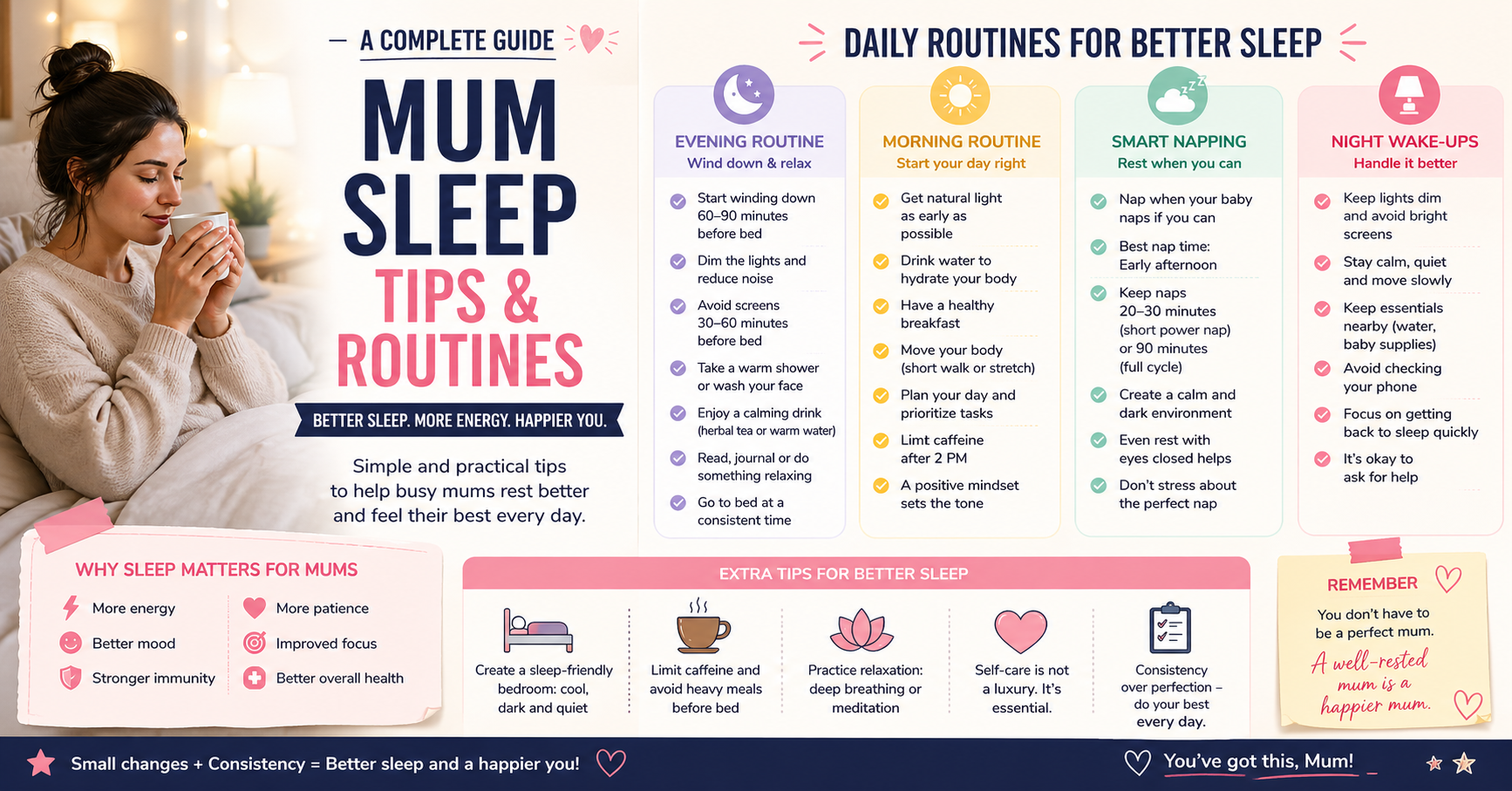
Pick a time — let’s say 9:30pm if you’re aiming to be asleep by 11 — and treat it as the moment you stop doing tasks. Not the moment you get into bed. The moment you stop doing anything that requires cognitive effort or emotional engagement.
This means: no responding to messages. No sorting laundry. No online shopping. No planning tomorrow’s schedule. No reading anything that requires concentration or decision-making.
The tasks will still be there tomorrow. Setting a stop time trains your brain to release them rather than continuing to process them through the evening.
Bright overhead lighting — particularly the blue-light dominant LED lighting in most modern homes — suppresses melatonin production. Melatonin is the hormone that regulates your sleep-wake cycle. If your brain is getting signals from bright blue-toned light that it’s still daytime, melatonin production is inhibited and sleep onset is delayed.
This is well-established, well-replicated science. It’s not alternative wellness — it’s basic circadian biology.
From your “stop doing things” time onward, switch to dimmer, warmer lighting. Side lamps instead of overheads. If you have smart bulbs, set them to warm amber tones. Candles, if that’s a thing you enjoy. The goal is a visual signal to your nervous system that the day is ending.
I know. I know. The phone in the evening is the only time that belongs entirely to you. It’s where you scroll, decompress, check in with the world, and have something that isn’t about children or household management. I completely understand why mums resist this one.
But here is the specific problem with phones and mum sleep that goes beyond the blue light issue:
Social media, news, and messaging apps are all designed to engage your threat-detection system. They’re engineered to trigger mild anxiety, outrage, curiosity, and comparison — because those emotional states keep you scrolling. For a mum whose nervous system is already running elevated, a pre-bed scroll reliably elevates cortisol exactly when you need it to be falling.
Even if the content is benign — even if you’re looking at lovely pictures of gardens or recipes you’ll never make — the passive consumption habit keeps your brain in a receptive, alert state rather than a winding-down one.
The practical fix: Charge your phone in another room, or on the far side of the bedroom. Not within arm’s reach of the bed. If you use it as an alarm, buy a separate alarm clock — they cost less than ten pounds and this is worth every penny.
Implement this for two weeks before you decide whether it works.
This is the single most effective mum sleep tip that nobody talks about with enough emphasis.
Take a notebook — a simple one, nothing precious — and spend five to ten minutes writing down everything that is in your head. Not as a gratitude journal. Not with any particular structure. Just: everything that is in there.
The dentist appointment. The thing you said that you’re still thinking about. What you need to do tomorrow. The worry that’s been sitting at the back of your mind since Tuesday. The thing you’re looking forward to. Whatever is there — write it down.
This is called expressive writing or “externalisation,” and it has been studied extensively as a sleep intervention. A 2017 study published in the Journal of Experimental Psychology found that participants who spent five minutes writing a to-do list before bed fell asleep significantly faster than those who journaled about completed tasks. The act of offloading your working memory onto paper reduces the brain’s need to keep processing the content overnight.
In simpler terms: if it’s written down, your brain trusts that it won’t be forgotten. It can release it. It can rest.
This is about temperature, not just relaxation. Your core body temperature needs to drop by approximately one degree Celsius for sleep onset to occur. A warm bath or shower raises your core temperature — and then, as you step out and your body cools, you experience a rapid temperature drop that naturally triggers drowsiness.
This mechanism is real and measurable. A 2019 meta-analysis in Sleep Medicine Reviews found that bathing in warm water one to two hours before bed reduced sleep onset latency (the time it takes to fall asleep) by an average of ten minutes. For a sleep-deprived mum, ten minutes less time lying awake is significant.
You don’t need to make it elaborate. A ten-minute shower will achieve the same physiological effect as a full bath. The temperature mechanism works regardless of duration.
This part of the routine is yours to choose. Something that is genuinely pleasurable and has no output requirement.
Some options that work well for mums:
The important thing is that it’s something you look forward to. If you don’t look forward to your wind-down routine, you won’t do it consistently. The routine has to contain something that feels like a treat, not another task.
This is the section most people skip because it feels too obvious. Please don’t skip it. The sleep environment is where many mums lose significant sleep quality without realising it.
The optimal sleep temperature for most adults is between 16 and 19 degrees Celsius (60–67 degrees Fahrenheit). Most UK bedrooms, particularly in winter with central heating, run warmer than this. A room that feels cosy and warm is actually not optimal for deep sleep.
Open a window slightly before bed. Turn the heating down or off in the bedroom. Use a lighter duvet if you run warm. Use separate duvets if you and your partner have very different temperature preferences — the Scandinavian model of separate duvets for bed-sharing partners is genuinely evidence-backed for improving sleep quality for both.
True sleep-optimising darkness means no standby lights, no streetlight creeping under the curtain, no light from the landing if the children need it. Your skin, not just your eyes, detects light — photoreceptors throughout your body can register light levels and influence circadian signalling.
Blackout curtains or a quality eye mask are both worth the investment. The eye mask is the more affordable and immediately actionable option. A silk or satin eye mask that sits comfortably and blocks light completely is one of the most practical sleep investments a mum can make.
If you have young children, or live in a noisy environment, or have a partner whose breathing pattern wakes you — white noise is worth trying.
White noise works by creating a consistent sound level that masks the contrast of sudden noises. It’s the sudden noise — a car door, a child stirring, a creak in the house — that triggers the hypervigilant mum’s brain to wake fully. White noise doesn’t eliminate sounds; it reduces the jarring contrast between silence and sudden noise that triggers waking.
Apps like Calm, dedicated white noise machines like the LectroFan, or even a simple fan all serve this function. Some mums find brown or pink noise (lower frequencies) more soothing than standard white noise — experiment with what works for your nervous system specifically.
If you work on your laptop in bed, scroll your phone in bed, watch television in bed, eat in bed, worry in bed regularly — your brain has learned that the bed is a place for being alert and active, not just for sleep. This is called poor “sleep hygiene” and it measurably impairs sleep quality because your brain hasn’t established the association between bed and sleep.
Ideally, your bed is used for sleep and sex only. Everything else happens elsewhere. This is one of the most consistently recommended sleep hygiene principles in clinical psychology and it works because it trains a conditioned response — bed means sleep is coming.
If you share a bed with children who join you in the night, this is harder to control. But the principle still applies in whatever way is achievable for your specific situation.
This is, for many mums, the most disruptive sleep issue. Not the falling asleep — the waking at 3am, or 2am, or 4am, with a mind that is immediately and thoroughly awake, and then lying there for an hour or more unable to get back to sleep.
This pattern has a specific name — “middle of the night insomnia” or “sleep maintenance insomnia” — and it’s extremely common in mothers, particularly those with elevated stress or anxiety.
Here is what actually helps:
The moment you look at the clock when you wake at night, your brain performs a calculation — “it’s 3am, I need to be up at 6:30, that’s only three and a half hours” — and the cortisol spike from that calculation makes you significantly more awake than you were before you checked.
Turn the clock away from you. Don’t look at your phone. The time is irrelevant. The only relevant thing is getting back to sleep, and knowing exactly what time it is doesn’t help with that.
Breathe in through your nose for 4 counts. Hold your breath for 7 counts. Breathe out through your mouth for 8 counts.
The extended exhale is the mechanism here. A long, slow exhale activates the vagus nerve and the parasympathetic nervous system — the “rest and digest” system that is the physiological opposite of the fight-or-flight state. It is one of the fastest, most reliable ways to bring your nervous system out of alert mode.
Do four complete cycles. Then continue breathing slowly and naturally.
Many mums report falling back to sleep during or immediately after this exercise, even when they believed they were “too awake” to do so.
This is counterintuitive and deeply unpopular advice, but it’s what sleep science consistently recommends.
If you’ve been lying awake for more than twenty minutes, get up. Go to another room. Do something quiet and unstimulating in dim light — read a physical book, do some gentle stretching, make a herbal tea, sit quietly. Do not look at your phone. Return to bed only when you feel genuinely drowsy.
The reason: lying awake in bed for extended periods teaches your brain that the bed is a place where you lie awake. This strengthens the wakefulness association and makes the problem worse over time. Getting up breaks the association and, paradoxically, helps you fall back to sleep faster when you return.
If the get-up approach feels too disruptive, try a progressive muscle relaxation or body scan instead. Starting from your toes and working upward, tense each muscle group briefly and then release it consciously. Notice the sensation of relaxation in each area before moving to the next.
This technique works because it gives your mind something specific and physical to focus on — breaking the loop of anxious thoughts — while simultaneously releasing tension held in the body. It is used extensively in clinical settings for insomnia and anxiety.
Keep the notebook from your brain dump routine by your bed. When you wake with racing thoughts, write them down. Give them a page. Tell yourself: they are recorded, they are safe, you will deal with them tomorrow. Then close the notebook.
This gives your working memory permission to release the content rather than continuing to process it. It is not a cure for 3am waking. But it is often enough to shift from fully awake and spiralling to drowsy enough to drift back.
Mum sleep tips aren’t only about what happens at night. The quality of your sleep is significantly shaped by what happens during the day — often by things that seem completely unrelated to sleep.
Your circadian rhythm — the internal clock that regulates sleep and wakefulness — is primarily set by light exposure. Specifically, by morning light.
Getting bright natural light in your eyes within the first hour of waking is one of the most powerful things you can do to regulate your sleep-wake cycle. It sets the “timer” that tells your brain when to start producing melatonin that evening, and how much to produce.
This doesn’t require anything elaborate. Step outside. Sit by a window. Take the school run without sunglasses if the weather allows. Ten to fifteen minutes of morning light exposure is genuinely sufficient to make a measurable difference to sleep quality that night.
This is Andrew Huberman’s most recommended and most evidence-backed sleep intervention, and it’s free. It costs only the willingness to step outside in the morning.
Caffeine has a half-life of approximately five to seven hours in most adults. This means that a coffee drunk at 3pm still has roughly half its caffeine content in your system at 9pm.
Many mums drink coffee later in the afternoon as an energy management strategy — and then wonder why they can’t fall asleep at 10pm. The coffee is why.
If you’re sensitive to caffeine (and stress increases caffeine sensitivity, so many mums are more sensitive than they realise), consider moving your last coffee to before 1pm. Green tea, which contains L-theanine alongside caffeine, provides a gentler energy lift with less impact on sleep for many people.
Exercise is one of the most consistently effective interventions for sleep quality in the research literature. It doesn’t need to be intense — a 20-30 minute walk at a moderate pace is sufficient to improve both sleep onset and sleep depth when done regularly.
The timing matters slightly: vigorous exercise within two to three hours of bedtime can elevate cortisol and delay sleep onset in some people. Morning or afternoon exercise is generally better for sleep quality than a late evening workout — though gentle movement like yoga or stretching in the evening is beneficial and doesn’t carry this risk.
If your children still nap and you have the opportunity to nap alongside them — take it, especially if you’re in a phase of severe sleep deprivation. Sleep debt is real and napping reduces it.
However, if you’re struggling with nighttime sleep rather than total sleep deprivation, long afternoon naps (over 30 minutes, or naps taken after 3pm) can reduce your sleep drive — the accumulation of adenosine in the brain that makes you sleepy — and make nighttime sleep harder to initiate.
If you nap, aim for 20-25 minutes (set an alarm) and try to do it before 2:30pm. A “nano-nap” or “coffee nap” — drinking a coffee immediately before a 20-minute nap, so the caffeine kicks in as you wake — is a legitimate productivity and energy strategy for sleep-deprived mums.
Anxiety and sleep have a circular relationship. Sleep deprivation increases anxiety. Anxiety impairs sleep. The cycle is self-reinforcing.
Breaking the cycle requires addressing the anxiety during the day rather than trying to suppress it at bedtime. Therapy (particularly CBT for insomnia, known as CBT-I), regular exercise, reduced caffeine, time in nature, creative or absorbing activities, and social connection all reduce baseline anxiety levels in ways that improve nighttime sleep.
If your 3am wake-ups consistently involve the same categories of worry — health anxiety, financial worry, relationship stress — those worries deserve attention during daylight hours. Journaling, talking to a therapist, or discussing specific worries with your partner or a trusted friend during the day reduces their power to ambush you at 3am.
This is the area where wellness content tends to go sideways — either dismissing everything as quackery or overpromising miraculous results from supplements. The truth, as usual, is more nuanced.
This is the sleep supplement with the most consistent evidence behind it, and it’s particularly relevant for mums because magnesium depletion is extremely common during pregnancy and the postpartum period and tends not to resolve without supplementation.
Magnesium plays a key role in the nervous system’s ability to downregulate. Low magnesium is associated with difficulty relaxing, muscle tension, disturbed sleep, and anxiety — all of which are extremely common in chronically stressed, sleep-deprived mums.
Magnesium glycinate (as opposed to magnesium oxide or citrate) is the form best absorbed and least likely to cause digestive upset. A dose of 200-400mg taken 30-60 minutes before bed is the typical recommendation. Consult your GP or a qualified nutritionist before starting if you have any medical conditions.
Lavender is one of the few aromatherapy interventions with genuine scientific backing for sleep. Multiple controlled studies have found that lavender inhalation before sleep reduces anxiety and improves sleep quality, particularly in people with mild to moderate sleep difficulties.
A lavender pillow spray (spritzed on the pillow before bed), a lavender essential oil diffuser, or lavender Epsom salts in a pre-bed bath are all practical ways to use this. It won’t fix structural sleep problems, but as part of a wind-down routine it has a legitimate, evidence-backed role.
Chamomile, passionflower, valerian, and lemon balm all have some evidence for mild anxiolytic (anxiety-reducing) and sleep-promoting effects. None will knock you out — but a warm herbal drink as part of a wind-down routine both provides mild physiological benefit and serves as a behavioural cue that tells your brain: the day is ending, sleep is coming.
Pukka Night Time tea, Clipper Sleep Easy, and any good quality chamomile or valerian blend are worth keeping as part of your routine.
Melatonin is a hormone, not a sedative — and this distinction matters. It doesn’t make you fall asleep; it shifts the timing of your sleep-wake cycle. It’s most useful for jet lag, shift work, and circadian rhythm disruption — less useful for garden-variety insomnia or stress-related sleep difficulties.
In the UK, melatonin is prescription-only for adults. Over-the-counter melatonin supplements available online vary wildly in their actual melatonin content and are unregulated. If you think melatonin might be relevant to your sleep situation, discuss it with your GP.
Alcohol. Many mums use a glass of wine in the evening as a relaxation tool — and it does induce initial drowsiness. But alcohol significantly disrupts sleep architecture, suppressing REM sleep and causing rebound arousal (waking) in the second half of the night. Mums who drink in the evening and then wonder why they wake at 3am feeling terrible — this is almost certainly contributing.
Sleeping tablets for anything other than short-term crisis use. They address the symptom rather than the cause and carry significant dependency risks. CBT-I (cognitive behavioural therapy for insomnia) is significantly more effective than sleeping tablets for chronic insomnia and has no side effects. Ask your GP about a referral or access it online through services like Sleepio.
Let’s be direct about the situation that affects most mums reading this: the sleep problem isn’t just internal. There are small people in the house who wake at night, come into your bed, need settling, have nightmares, get ill, or simply operate on a schedule that is incompatible with yours.
No wind-down routine and no lavender pillow spray fixes a fourteen-month-old who wakes three times a night.
So here are the honest, practical strategies for the externally disrupted sleep that many mums are dealing with.
If you have a partner, this requires an honest conversation about the distribution of night waking. Many couples default to the primary caregiver handling all nighttime needs — often not as an explicit agreement but simply as the path of least resistance. If this is you, it needs to change.
Specific, structured agreements work better than vague offers to help. “You do Monday, Wednesday and Friday nights. I do Tuesday, Thursday, and the weekends” is a conversation worth having. Take turns to have a “protected sleep night” where the other partner handles all nighttime needs and the sleeping parent is genuinely not woken.
One good night’s sleep per week has measurable impact on overall health and cognitive function. Even one protected night matters.
If you have a newborn or a baby who wakes multiple times, consider sleeping in shifts rather than both parents being disrupted all night. One partner takes the first part of the night (say 8pm to 2am), the other takes the second part (2am to the morning). Each gets one sustained chunk of uninterrupted sleep.
Uninterrupted sleep is disproportionately more restorative than the same number of hours fragmented across the night. Four hours of uninterrupted sleep does more for your cognitive and emotional function than eight hours of hourly-interrupted sleep.
If you have a child whose sleep is chronically disrupted and it’s significantly affecting your health, your GP or health visitor can refer you to sleep support services. Many areas have dedicated children’s sleep clinics, and many sleep consultants (including NHS-provided ones) can work with families to implement gradual approaches to improving children’s sleep without the distress of traditional sleep training methods.
You don’t have to accept “babies just don’t sleep” as the end of the conversation. There is support available.
This is the mindset shift that needs to happen before the practical strategies can work: your sleep is not an optional extra that gets whatever’s left after everyone else is taken care of. It is a health requirement. It is, in measurable, documented terms, one of the most significant things you can do for your physical health, mental health, immune function, hormonal health, and quality of parenting.
Treating your sleep as a health priority — not a luxury, not something you’ll sort out once things settle down, but a non-negotiable biological need — is the first and most important step.
Here is a practical template you can adapt. This is not prescriptive — it’s a starting point.
9:30pm — Stop Doing Things Set the stop time. Tasks are done. Anything unfinished is written in the notebook and left for tomorrow.
9:30–9:45pm — Lower the Lights and Phone Away Switch to warm, dim lighting. Phone goes to charge in another room or across the bedroom. Put on a warm lamp, light a candle, shift the environment toward night.
9:45–10:00pm — Brain Dump Five to ten minutes with the notebook. Everything that’s in your head goes on the page. Tomorrow’s list, today’s worries, anything unresolved. Write it and close it.
10:00–10:20pm — Warm Shower or Bath Warm water, ten to twenty minutes. This is the temperature regulation step, not just relaxation.
10:20–10:45pm — Your Wind-Down Thing Whatever you genuinely enjoy. A book. A podcast. Herbal tea and gentle stretching. Skincare done slowly. This is your time. Use it for something you actually like.
10:45pm — Magnesium if you take it, Lavender spray on the pillow Small rituals that signal to the brain: sleep is coming.
11:00pm — Lights Out Dark room. Cool temperature. Eye mask if needed. White noise if helpful. Phone out of reach. No clock visible.
If you wake in the night: breathing technique first. Don’t look at the time. Notebook if needed. Get up if awake more than twenty minutes.
The “tired but wired” experience is very common in mothers and has a physiological explanation. Chronic sleep deprivation and ongoing stress dysregulate the HPA axis — the system that manages cortisol and adrenaline. This can cause cortisol to surge at night when it should be low, keeping you in a state of alertness even when your body is exhausted. Additionally, maternal hypervigilance — a neurological change that makes primary caregivers more alert to sounds and movement — keeps the nervous system in a low-level alert state that resists sleep. This is a nervous system regulation problem, not a willpower problem, and it responds to specific strategies rather than simply “trying to relax.”
The most effective mum bedtime routine involves stopping all tasks and putting the phone away 60-90 minutes before your intended sleep time, switching to dim warm lighting, doing a brain dump (writing everything in your head into a notebook), having a warm bath or shower, and spending 20-30 minutes doing something genuinely enjoyable that doesn’t involve a screen. Supporting tools include magnesium glycinate, a lavender pillow spray, and a cool dark bedroom. Consistency is more important than perfection — the routine’s power comes from repetition, which trains your nervous system to recognise the sequence as a sleep signal.
When you wake at 3am, avoid looking at the clock or your phone — the time calculation triggers cortisol and makes you more alert. Try the 4-7-8 breathing technique (inhale for 4, hold for 7, exhale for 8 counts) to activate the parasympathetic nervous system. If you have racing thoughts, write them in a notebook to offload them from your working memory. If you’ve been awake for more than 20 minutes, get up, go to another room, do something quiet in dim light, and return to bed only when genuinely drowsy. This prevents the bed from becoming associated with wakefulness over time.
Adults generally need 7-9 hours of sleep per 24-hour period, and mothers are no exception — despite the cultural expectation that they should somehow function on less. Sleep deprivation below 7 hours consistently impairs cognitive function, emotional regulation, immune health, hormonal balance, and parenting quality. The quality of sleep matters alongside quantity — uninterrupted sleep is disproportionately more restorative than the same number of fragmented hours. If you cannot consistently achieve 7 hours due to young children’s night waking, structured napping and shared night duties with a partner can partially compensate.
Magnesium glycinate has genuine evidence for improving sleep quality, particularly in people with stress-related sleep difficulties — which describes many mums. Magnesium plays a key role in nervous system downregulation and muscle relaxation. Deficiency is associated with difficulty relaxing, poor sleep, and anxiety. It is particularly relevant for mums because magnesium depletion is common during pregnancy and postpartum and may not resolve without supplementation. A dose of 200-400mg of magnesium glycinate taken 30-60 minutes before bed is the standard recommendation. Consult your GP before starting any supplement, especially if you have medical conditions or are breastfeeding.
Phones affect mum sleep in two distinct ways. First, the blue light emitted by screens suppresses melatonin production, delaying sleep onset. Second, and more significantly for mums specifically, social media, news, and messaging apps are designed to engage the threat-detection system — triggering mild anxiety, outrage, and comparison — which elevates cortisol precisely when it should be falling. Many mums find that their sleep improves significantly within two weeks of moving their phone to charge in another room. A separate alarm clock (available for under ten pounds) removes the only practical obstacle to this change.
For mums with newborns, the priority is maximising the quality of any sleep available. Key strategies: sleep during the baby’s longest sleep window rather than trying to do tasks, use a white noise machine to mask household sounds and improve sleep quality, ask your partner for at least one “protected sleep” night per week, consider sleeping in shifts, keep the bedroom as dark and cool as possible, and resist the urge to check your phone during night feeds (use a dim lamp instead). The conventional advice to “sleep when the baby sleeps” is frustratingly impractical for many mums but contains a real kernel of wisdom — prioritising rest over tasks during the newborn period is genuinely important for recovery.
Yes — regular physical exercise is one of the most consistently effective interventions for sleep quality in the research literature. Even a 20-30 minute daily walk at a moderate pace improves sleep onset time and increases slow-wave (deep) sleep. The timing matters slightly — vigorous exercise within two to three hours of bedtime can elevate cortisol and delay sleep onset in some people, so morning or early afternoon exercise is generally preferable. Gentle movement like yoga, stretching, or a short evening walk does not carry this risk and can be part of an effective wind-down routine.
CBT-I (Cognitive Behavioural Therapy for Insomnia) is a structured psychological treatment that addresses the thoughts, behaviours, and sleep habits that perpetuate insomnia. Multiple large studies have found it significantly more effective than sleeping tablets for chronic insomnia, with lasting results and no side effects. It typically involves sleep restriction, stimulus control, cognitive restructuring, and sleep hygiene guidance. In the UK, it’s available via NHS Talking Therapies (self-refer online) or through the Sleepio digital programme, which is evidence-based and available for free through some NHS trusts. If you’ve struggled with sleep for more than three months, ask your GP about CBT-I.
Have an explicit, structured conversation rather than a vague one. Instead of “I need more help at night,” try: “I need us to agree on specific nights where you handle all nighttime waking and I’m not disturbed at all.” Structured rotation — alternating nights or splitting the night into early and late shifts — is more effective than an “I’ll help whenever you need it” arrangement, which tends to default back to the primary caregiver doing everything. One genuinely protected night of sleep per week makes a measurable difference to health and wellbeing. If your partner is resistant, information about the health consequences of chronic sleep deprivation in mothers — and the research on shared parenting and relationship quality — can help frame it as a family health issue rather than a personal complaint.
Sleep is not a reward for getting everything done. It never will be, because in motherhood everything is never done.
Sleep is a physiological need. It is the foundation of your mood, your patience, your immune system, your hormonal health, your ability to be the mum you want to be. It is not a luxury to be earned. It is a necessity to be protected.
The 11:47pm brain spiral is not a character flaw. The 3am wake-up is not a personal failing. These are patterns — physiological and psychological patterns that have real causes and real solutions. They’re not permanent. They can be shifted.
Start with one thing tonight. Just one.
Put your phone in another room before you go to bed. Write down what’s in your head before you turn the light off. Open the window slightly. Try the breathing exercise if you wake at 3am.
Small, consistent changes to mum sleep tips and routines accumulate into something genuinely different. Something that feels, eventually, like waking up and not being exhausted before the day has started.
That feeling is worth working toward. You deserve to know what it feels like again.