
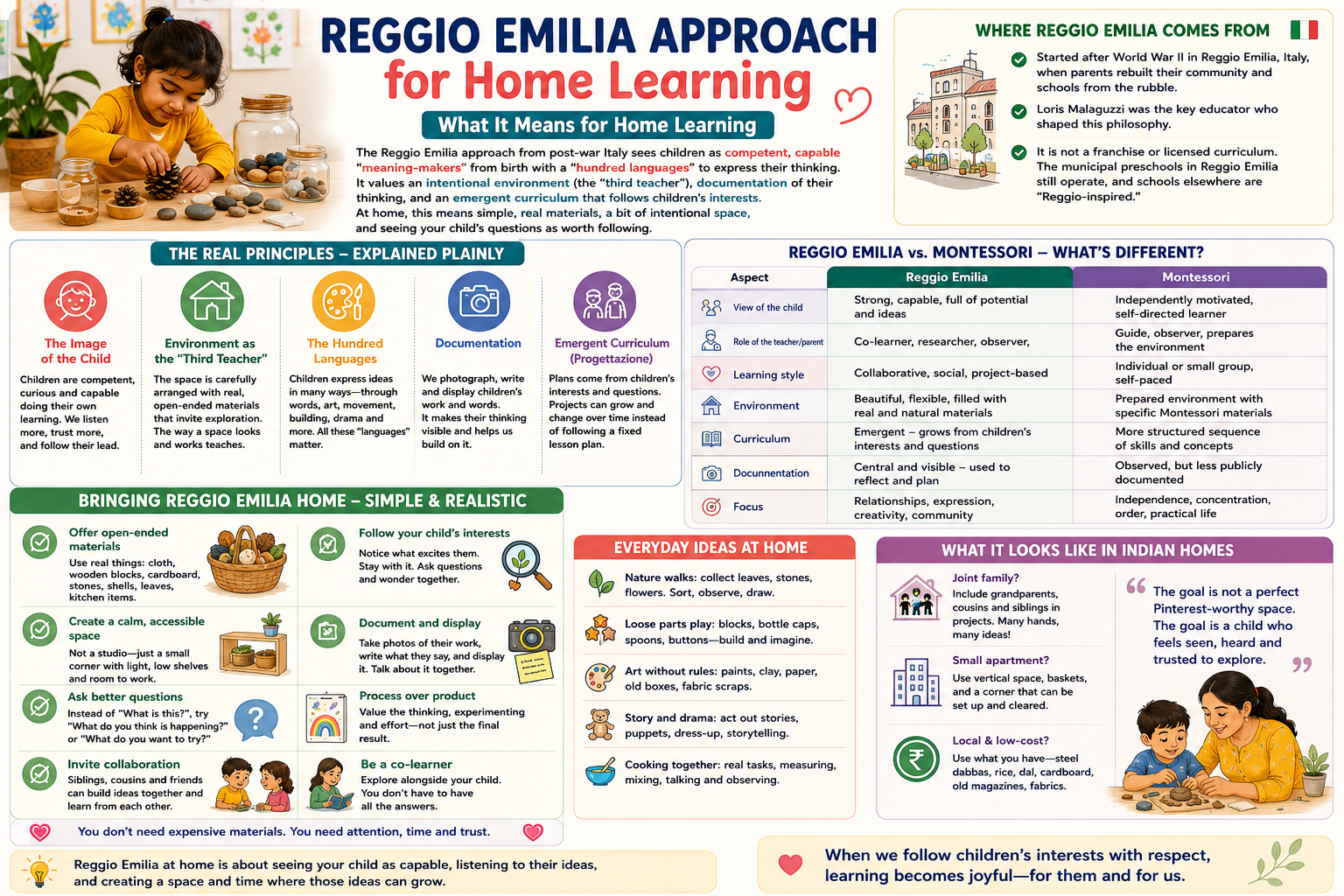
The Reggio Emilia approach is an early-childhood philosophy from post-war Italy that treats children as competent, capable “meaning-makers” from birth, expressing their thinking through many forms — words, art, movement, building — described as their “hundred languages.” Its core practices are an intentionally prepared environment (called the “third teacher”), documentation of children’s thinking and work, and an emergent curriculum that follows children’s genuine interests rather than a fixed lesson plan. At home, this doesn’t require a studio or imported materials — it translates into simple, real, open-ended materials, a bit of intentional space, and treating your child’s questions as worth following rather than redirecting.
Reggio Emilia Approach for Home Learning — What It Means for Home Learning
Somewhere on Instagram, in the last year or two, “Reggio-inspired” has become a phrase that shows up on preschool signboards next to a photo of a wooden shelf with neatly arranged pinecones and glass jars, and it can feel like a whole aesthetic and price tag rather than an actual educational philosophy. It’s a fair thing to be skeptical of. Underneath the aesthetic, though, is a genuinely well-documented, decades-old approach from a small city in Italy, built by parents and educators who had very specific, thoughtful ideas about what a young child is capable of — ideas that don’t actually require a particular shelf, a particular light fixture, or a particular budget to practice.
This article explains what the Reggio Emilia approach actually is, based on its own founding principles rather than the version sold on a brochure, compares it honestly to Montessori (since that’s the comparison most parents are actually trying to make), and lays out specific, low-cost ways to bring its spirit into an ordinary Indian home — joint family, small apartment, and all.
Table of Contents
Where Reggio Emilia actually comes from
The Reggio Emilia approach began after the Second World War in villages around the city of Reggio Emilia, in northern Italy, where parents — rebuilding their communities from the rubble, quite literally — decided to build a school for their children themselves, with materials salvaged from the wreckage of the war. An educator named Loris Malaguzzi joined this early effort and became the philosophy’s central figure over the following decades, shaping it into the approach recognized worldwide today. It’s not a franchise or a licensed curriculum; the original Reggio Emilia municipal preschools still operate in Italy, and schools elsewhere that adopt these ideas are more accurately described as “Reggio-inspired,” since there’s no formal certification that makes a school “official Reggio Emilia” outside that city’s own system.
The real principles, explained plainly
The image of the child
Reggio Emilia’s foundational idea is what’s called “the image of the child” — the belief that children are inherently competent, curious, and capable of constructing their own understanding of the world, rather than empty containers waiting to be filled with information by adults. This isn’t just a nice sentiment; it changes practical decisions, like how much a teacher (or parent) talks versus listens, and how much a child is trusted to direct their own exploration.
The environment as the “third teacher”
In Reggio thinking, a child effectively has three teachers: their parent, their teacher, and the physical space around them. The environment is treated as an active participant in learning — deliberately arranged, aesthetically considered, and stocked with real, open-ended materials that invite exploration, rather than a neutral backdrop or a space designed mainly for adult convenience. This is where the well-known aesthetic (natural light, plants, materials displayed at a child’s eye level) actually comes from — it’s not decoration for its own sake, it’s a specific claim that the arrangement of a space itself teaches.
The hundred languages of children
This phrase comes from a poem Malaguzzi wrote, and it’s arguably the most quoted idea in the whole philosophy: the belief that children have a hundred different ways of thinking, expressing, and understanding — through words, yes, but also through drawing, building, movement, sculpture, pretend play, and more — and that a good early environment should let a child use many of these “languages,” not just the verbal and written ones adults tend to prioritize.
Documentation
Reggio classrooms take documentation seriously as a core practice, not an afterthought — photographing a child’s block tower mid-build, transcribing what they said while building it, and displaying this alongside the finished work. The point isn’t just record-keeping; it’s making a child’s thinking visible, to the child, to their parents, and to the teacher, so that learning can be revisited, discussed, and built on rather than disappearing the moment the activity ends.
Emergent curriculum (progettazione)
Rather than following a fixed, pre-planned lesson calendar, Reggio programs use what’s called “progettazione” — a difficult-to-translate Italian term for flexible, responsive planning that develops in collaboration with the children themselves, based on what they’re genuinely curious about, sometimes stretching into weeks-long projects that follow a specific question a group of children became interested in. This is a meaningfully different approach from a curriculum decided entirely in advance by an adult with no room for a child’s own direction.
Reggio Emilia vs. Montessori — what’s actually different
This is the comparison almost every parent researching Reggio Emilia is actually trying to make, so it’s worth being specific rather than vague.
| Aspect | Reggio Emilia | Montessori |
|---|---|---|
| View of the child | Competent meaning-maker with “a hundred languages” of expression | Capable of self-directed learning through structured, purposeful materials |
| Curriculum | Emergent, follows children’s interests and projects, no fixed sequence | Structured sequence of specific, purpose-built materials, often used in a defined order |
| Materials | Open-ended, real, often natural or recycled; varies project to project | Specific, designed didactic materials (self-correcting, purpose-built) used consistently across Montessori settings |
| Environment’s role | An active “third teacher,” aesthetically and intentionally arranged | Carefully ordered and prepared, but oriented more around structured, sequential material use |
| Documentation | Central practice — visible, revisited, discussed | Present but generally less central to the philosophy’s core identity |
| Teacher’s role | Co-researcher and listener, following the child’s lead into projects | Careful observer and guide, introducing materials at the right developmental moment |
Neither is “better” in an absolute sense — they emerged from different founders, different countries, and somewhat different assumptions about how structure supports independence. A family drawn to open-ended, project-based exploration and lots of art and expression may prefer Reggio’s spirit; a family drawn to a very ordered, sequential, materials-driven approach may prefer Montessori’s. Many home educators, honestly, borrow ideas from both.
Does Reggio Emilia teach academics?
Not in the sense of worksheets, letter drills, or a fixed early-literacy schedule. Reggio Emilia doesn’t reject literacy or numeracy — they emerge naturally within projects (a child measuring ingredients during a cooking project is doing real, embedded math) — but the approach doesn’t organize learning around isolated academic skill drills the way a more traditional or heavily academic preschool might. This is worth knowing plainly if your family is weighing Reggio-inspired ideas against a more structured, exam-oriented schooling culture: the approach is genuinely, intentionally not built around early formal academics, and that’s a real trade-off to think through, not something to be smoothed over. If you’d like to explore that trade-off more directly, ParentNest’s guide on play-based versus academic preschool covers the research on this comparison in more depth.
7 ways to bring Reggio Emilia home
1. Rearrange one corner to be genuinely yours-for-them
You don’t need a dedicated room. Pick one low shelf, one basket, or even the bottom drawer of an existing cupboard, and put a few open-ended materials at your child’s height, where they can reach and choose independently rather than asking permission every time. This is the “environment as third teacher” idea in its smallest, most doable form.
2. Swap a few branded toys for open-ended, real materials
A branded toy usually does one thing. A collection of steel katoris, wooden spoons, fabric scraps, bottle caps, or dried lentils in jars can become a hundred different things across a hundred different play sessions — sorting, building, pretend cooking, counting. Reggio-inspired classrooms lean heavily on real, natural, and recycled materials specifically because open-ended objects invite more of a child’s “hundred languages” than a single-purpose toy does.
3. Follow a genuine question instead of redirecting it
If your child gets fixated on something — why the ceiling fan spins, where the milk in the fridge comes from, how a lizard climbs a wall — resist the instinct to give a quick answer and move on. Spend a few days actually following it: look at a picture book about it together, watch how it behaves outside, draw it, talk about it again the next day. This is a small, home-sized version of “progettazione” — letting genuine curiosity shape what you do together, rather than sticking to an unrelated, pre-decided plan for the day.
4. Document, even informally
You don’t need a gallery wall. A simple photo of your toddler’s block tower, saved with a one-line note about what they said while building it, does the same job a Reggio classroom’s documentation panel does — it makes their thinking visible and worth revisiting. Many Indian families already do a version of this by sharing photos in a family WhatsApp group; the small shift is adding a sentence about what the child was thinking or trying to do, not just the finished result.
5. Offer materials across several “languages,” not just one
If a topic comes up — say, monsoon rain — offer more than one way to explore it: talking about it, drawing it, collecting rainwater in a container to look at, acting out thunder with body movement. This reflects the “hundred languages” idea directly: the same idea explored through several different forms tends to build a richer, more layered understanding than one format alone.
6. Let your child see the process, not just the answer
Rather than telling your child the answer to a question outright, try genuinely wondering alongside them: “I’m not sure — how do you think we could find out?” This reflects the “image of the child” as a capable thinker in their own right, and it’s a small, repeatable habit that changes the tone of a lot of everyday interactions.
7. Bring the outside in, and let the inside go outside
Reggio classrooms often treat the boundary between “classroom” and “outdoors” as soft rather than fixed — bringing natural materials indoors, and taking indoor activities (painting, building) outside when possible. A balcony, a building terrace, or even a windowsill collection of leaves and stones works the same way at home.
Reggio Emilia in a small Indian apartment
Space constraints are probably the most common practical worry, and it’s a fair one — a lot of Reggio imagery online shows spacious, sunlit studio rooms that don’t reflect most Indian homes. A few honest adjustments:
- One shelf beats one room. The principle behind the “third teacher” environment is intentional arrangement, not square footage. A single, well-chosen shelf at your child’s height does real work.
- Rotate rather than accumulate. Keep a small, changing selection of materials available rather than trying to have everything out all the time — this is both more space-efficient and, genuinely, closer to how Reggio classrooms actually manage materials, refreshing what’s available based on current interest rather than displaying everything permanently.
- Multi-use furniture works fine. A trunk, a repurposed drawer, or a cloth hanging organizer can serve as a materials shelf without needing dedicated furniture.
- Vertical space counts. A wall at a child’s eye level for displaying their drawings or a simple documentation photo does the same job as a larger documentation panel.
Reggio Emilia in a joint family
There’s an interesting, underused fit here worth naming directly: a joint family is, in a sense, a built-in source of “hundred languages” that a nuclear family or a single classroom often has to work harder to create. A grandparent’s storytelling, a grandmother’s cooking, an uncle’s carpentry or gardening, a teenage cousin’s drawing — these are all different “languages” and different forms of expertise a Reggio-inspired household can genuinely draw on, more easily than most Western Reggio-inspired families, who typically have to import this variety through planned activities or hired specialists (the atelierista role in an Italian Reggio school, roughly a studio-art specialist, is something many Indian joint families arguably already have built into daily life through a relative’s particular skill or hobby).
The adjustment worth making explicitly is inviting a grandparent to show rather than just tell — a grandmother demonstrating how she rolls a roti, with a child watching and then trying it themselves, uses several of a child’s “languages” (movement, tactile exploration, observation, language) in a way that’s closer to the Reggio spirit than a simple verbal instruction would be.
A worked example: what a home “project” actually looks like
Progettazione can sound abstract until you see it play out. Here’s a realistic, small-scale version of it, the kind that could unfold over a week without any special planning.
Your three-year-old spots ants on the balcony and gets fixated — pointing, crouching, asking “kahan ja rahe hain” (where are they going) over and over. In a fixed-curriculum approach, this is a two-minute detour before moving on to the planned activity. In a Reggio-inspired approach, this is the plan.
Day 1: Watch the ants together for a few minutes. Ask open questions rather than giving facts: “Where do you think they’re going? What are they carrying?” No lecture, just noticing.
Day 2: Draw the ants together, however messily. Talk about how many legs, what shape their bodies are. This is the “hundred languages” idea in action — the same interest, now explored through drawing instead of only watching.
Day 3: Look at a picture book about insects if you have one, or describe what an ant nest might look like underground. Let your child ask questions; answer the ones you can, and say “let’s find out” for the ones you can’t.
Day 4: Build an “ant hill” out of building blocks, sand, or dough. Physical, tactile, another language for the same idea.
Day 5: Take a photo of the drawing, the building blocks structure, and your child near the real ants, and write one line underneath each: “Aarav noticed the ants were carrying tiny pieces of leaf.” That’s documentation, in its smallest, most doable form.
Nobody bought anything. No worksheet was involved. The interest came from the child, and the adult’s job was mostly to slow down and follow it a little further than usual. That, in miniature, is what a Reggio-inspired week at home actually looks like — not a curriculum, a habit of paying closer attention.
Common myths about Reggio Emilia, cleared up
“It means no rules or structure at all.” Not true. Reggio classrooms have routines, boundaries and adult guidance. What’s flexible is the content of learning, not the presence of any structure whatsoever.
“You need to buy specific ‘Reggio’ toys or furniture.” Also not true, and arguably backwards. The philosophy’s own history involves building a school from salvaged wartime materials. Real, ordinary objects fit the spirit better than a curated, purchased set with a label on it.
“It’s only for wealthy, Western schools.” The core ideas — trusting a child’s competence, arranging a space with intention, following genuine interest, writing down what a child says and does — don’t require a particular budget. What often does cost money is the aesthetic version sold by some private preschools, which is a different thing from the underlying philosophy.
“Reggio and Montessori are basically the same. They share a respect for the child’s capability, but they come from different founders, different countries, and different ideas about structure. Montessori leans on a defined sequence of specific materials; Reggio leans on emergent, open-ended projects. See the comparison table above for the specifics.
“It’s a religion or a strict method with rules you must follow exactly.” It’s an educational philosophy with documented principles, not a certification or a doctrine. Reggio Children and NAREA describe it as an evolving, reflective practice, not a fixed checklist.
How to tell if a “Reggio-inspired” preschool is the real thing
If you’re choosing a preschool and the brochure says “Reggio-inspired,” a few direct questions during a tour will tell you more than the interiors will:
- “How do you plan a typical week? Is it fixed in advance, or does it change based on what the children are curious about?” — a real answer should mention following children’s interests, not just a themed calendar decided months ahead.
- “Can you show me an example of documentation you do with the children?” — look for genuine notes and photos tied to a child’s thinking, not just a bulletin board of finished artwork.
- “How much of the day is child-directed versus teacher-directed?” — there’s no single correct ratio, but the answer should reflect real thought, not just “we let them play sometimes.”
- “What does the classroom environment change based on?” — a thoughtful answer will mention children’s current interests or projects, not just a seasonal decoration swap.
A school can be excellent without using the term at all, and a school can use the term loosely without practicing much of the substance. The questions above matter more than the word on the sign.
Age-specific notes for home practice
Under 2: Keep it sensory and simple. A basket of a few safe, real household objects (a wooden spoon, a steel cup, a soft cloth) to explore is enough “environment as third teacher” for this age. Documentation can be as light as one photo a week with a short caption.
2 to 4 years: This is where following a genuine interest for a few days at a time (like the ant example above) becomes realistic, since attention and language are developing enough to sustain a small “project.” Offering two or three “languages” (talking, drawing, building) for the same idea works well here.
4 to 6 years: Children at this age can often help direct their own documentation — asking your child “what should we write next to this photo?” involves them directly in the practice, rather than doing it only for them. Longer, multi-day projects become more realistic, and children can start to notice and ask their own follow-up questions.
Indian festivals as natural Reggio-style projects
One thing that makes this approach unusually easy to adapt in an Indian home: the festival calendar already hands you a steady stream of rich, multi-sensory, naturally recurring topics that Reggio’s emergent, project-based spirit fits perfectly.
Diwali isn’t just an event to prepare for; it’s a ready-made project. Making diyas from clay involves touch and building. Rangoli involves pattern, color, and fine motor planning. Talking about why the festival is celebrated involves language and story. Lighting a diya safely (with supervision) involves real cause and effect. Across a week, a child can explore the same festival through five or six different “languages” without you inventing a single activity from scratch — the festival already provides the material.
Holi offers color mixing (a genuine, hands-on science exploration of what happens when colors combine), texture (wet versus dry colors), and physical, whole-body play, all wrapped into one occasion.
Navratri and Durga Puja bring music, rhythm, movement (garba, dandiya), storytelling (the stories behind the festival), and often multi-day preparation your child can watch and help with, from decorating to helping choose an outfit.
A wedding or a naming ceremony in the family offers real-world observation of ritual, food, clothing, and social roles a child can ask endless questions about and later draw, act out, or talk through.
None of this requires you to plan a “unit” the way a classroom might. It requires noticing that the festival your family is already celebrating is, functionally, exactly the kind of rich, real-world material Reggio-inspired documentation and multi-language exploration is built around — and perhaps taking one more photo, or asking one more open question, than you might have otherwise.
A simple starting checklist
If all of this feels like a lot to hold at once, here’s a minimal, realistic starting point rather than trying to apply every idea simultaneously:
- Pick one shelf, basket, or drawer and put 5–8 open-ended, real objects on it, at your child’s height.
- Pick one ongoing interest your child already has (an animal, a vehicle, a festival, a kitchen task) and follow it for a week instead of redirecting it.
- Take one photo a day of something your child made, built, or noticed, with one sentence about what they said or did.
- Once a week, offer the same idea through two different “languages” instead of one (talk about it and draw it; build it and act it out).
- Ask “how do you think we could find out” at least once a day instead of answering immediately.
Five small habits, none requiring a purchase, none requiring a dedicated room. That’s a genuinely faithful, if modest, home version of the philosophy.
Reggio Emilia and multilingual homes
Since a Reggio-inspired approach already treats language as just one of a child’s “hundred languages,” it sits unusually comfortably with a bilingual or multilingual household — the kind common across urban India, where a toddler might hear Hindi, English, and a regional language across different caregivers in the same week. There’s no principle in the philosophy that favors one language over another; what matters is rich, responsive interaction and multiple forms of expression, which can happen in any language a caregiver speaks naturally. A grandparent narrating a story in Marathi while a child draws what they’re hearing is, in Reggio terms, two “languages” working together — verbal and visual — regardless of which spoken language is involved. If you’re also navigating questions about bilingual development specifically, ParentNest’s guide on building vocabulary through everyday conversation covers that ground in more depth.
What not to do
- Don’t treat this as requiring a specific aesthetic (neutral tones, wooden toys only, a particular Pinterest-worthy shelf) — the underlying principles matter, the styling doesn’t.
- Don’t assume “Reggio-inspired” printed on a preschool’s signboard automatically means the school genuinely practices documentation, emergent curriculum, and the image of the child as described here — ask specific questions about how they actually plan a week and what documentation looks like, rather than taking the label at face value.
- Don’t abandon all structure entirely in the name of “following the child” — even Reggio classrooms have routines, boundaries, and adult guidance; the emergent curriculum applies to content and direction, not to the absence of any structure at all.
- Don’t feel you need to fully choose between Reggio ideas and more structured or academic elements — many families genuinely blend both, using open-ended, documented, interest-led time alongside some more direct instruction, especially as children approach school age.
- Don’t buy a large set of new materials before trying this — the philosophy’s own roots (a school literally built from salvaged wartime materials) argue directly against needing anything new or expensive to begin.
Realistic expectations and honest limits
It’s worth being honest about a few things. Reggio Emilia was developed in and for a specific municipal school system in Italy, with trained educators, a specific staffing structure (including the atelierista studio specialist), and years of institutional practice behind it — a home version, however thoughtfully adapted, is genuinely a translation, not a replica, and it’s fine to hold that loosely rather than aiming for exact fidelity to the original. There also isn’t a large body of independent, rigorously controlled research directly comparing Reggio-educated children’s long-term academic outcomes to other approaches in the way some other early-childhood models have been studied — the philosophy’s case rests more on its coherent, well-documented pedagogical reasoning and decades of practical use than on a specific outcomes study you could cite the way you might for something like the Perry Preschool Project. None of this makes the ideas less worth trying at home; it just means the honest framing is “a thoughtful set of principles worth borrowing from,” not “a scientifically proven method guaranteed to outperform alternatives.”
Real moments parents recognize
You might watch your toddler spend twenty minutes sorting steel katoris by size on the kitchen floor and only later realize, reading about Reggio’s “hundred languages,” that this was already exactly the kind of open-ended, self-directed exploration the philosophy is built around — no new toy required, no intervention needed.
Or you might catch yourself, mid-answer to “why is the sky blue,” realizing you could instead say “hmm, I’m not totally sure — should we look it up together?” and watch your child light up at being asked rather than told, a small, repeatable shift rather than a whole curriculum change.
Or a preschool might advertise itself as “Reggio-inspired” with a beautifully lit brochure, and you might ask, gently, what a typical week’s planning actually looks like there — and the answer to that one question will tell you more about whether the philosophy is genuinely practiced than the shelf styling ever could.
Frequently Asked Questions
What is the Reggio Emilia approach?
It’s an early-childhood educational philosophy from post-war Italy that views children as competent, capable meaning-makers with “a hundred languages” for expressing their thinking, built around an intentionally arranged environment (the “third teacher”), documentation of children’s learning, and a flexible, child-interest-driven curriculum rather than a fixed lesson plan.
Who started the Reggio Emilia approach?
It began after World War II with parents in villages around Reggio Emilia, Italy, who built a school themselves using salvaged materials. Educator Loris Malaguzzi joined this effort and became the philosophy’s central, defining figure over the following decades.
What age is the Reggio Emilia approach for?
It was developed for and is most associated with early childhood, roughly infancy through age six, though its underlying principles (following genuine interest, treating a learner as capable, documenting the learning process) are often applied more broadly by educators inspired by the approach.
Does Reggio Emilia teach academics like reading and math?
Not through isolated drills or a fixed early-literacy schedule. Literacy and numeracy tend to emerge naturally within child-led projects rather than being taught as separate, structured academic subjects, which is a genuine and intentional difference from a more traditional or heavily academic preschool.
What is the “environment as the third teacher”?
It’s the Reggio Emilia idea that a child has three teachers — their parent, their classroom teacher, and the physical space around them — and that an intentionally arranged, aesthetically considered environment stocked with open-ended materials actively contributes to learning, rather than being a neutral backdrop.
What does “hundred languages of children” mean?
It refers to the many different ways children think, express themselves, and understand the world — through speech, but also drawing, building, movement, and more — and the belief that a rich early environment should welcome many of these forms of expression, not just verbal and written ones.
How is Reggio Emilia different from Montessori?
Reggio Emilia uses an emergent, project-based curriculum built around children’s genuine interests and open-ended materials, with documentation as a central practice. Montessori uses a structured sequence of specific, purpose-built, self-correcting materials, generally introduced in a defined order. Neither is objectively better; they reflect different founding philosophies.
Can I do Reggio Emilia at home without special materials?
Yes — the approach’s own origins involved building a school from salvaged wartime materials, and real, open-ended household items (containers, fabric scraps, natural materials, kitchen tools) reflect the philosophy’s actual principles more closely than a set of newly purchased, branded “Reggio” toys.
Is Reggio Emilia suitable for a joint family or small apartment?
Yes, arguably with some natural advantages. A joint family offers built-in variety in skills and storytelling that mirrors the “hundred languages” idea, and a small apartment can still apply the “environment as third teacher” principle through one well-chosen shelf or corner rather than a dedicated room.
Is there research proving Reggio Emilia produces better outcomes than other approaches?
There isn’t a large body of rigorously controlled, independent research directly comparing long-term outcomes the way some other early-childhood models have been studied. The approach’s case rests mainly on decades of documented pedagogical practice and coherent educational reasoning rather than a specific outcomes study.
Do I need to speak only one language to follow a Reggio-inspired approach at home?
No. The philosophy treats language as just one of many “languages” a child uses to express thinking, alongside drawing, building, and movement, and doesn’t favor any single spoken language. Rich, responsive interaction in whichever languages your household speaks naturally fits the approach well.
What does “atelier” mean in Reggio Emilia?
The atelier is a studio space within Reggio schools dedicated to visual and expressive exploration, typically guided by a specialist teacher called an atelierista. At home, this translates loosely into simply making art and building materials genuinely available, rather than requiring a dedicated studio room.
Is Reggio Emilia expensive to try at home?
No — it can be done with ordinary household and recycled materials. The philosophy’s own origins involved building a school from salvaged wartime materials, which argues directly against needing anything new or costly to begin.
Final thoughts
Strip away the styled shelves and the Instagram aesthetic, and the Reggio Emilia approach is really a set of fairly humble, fairly translatable ideas: trust that your child is more capable than they’re often given credit for, arrange a small part of their world with a bit of intention, notice and write down the interesting things they say and build, and follow their genuine curiosity a little further than you might otherwise. None of that requires a shopping trip, a studio, or a particular light fixture. It mostly requires paying closer attention to something your child was probably already doing on the kitchen floor.
You don’t need to adopt every idea in this article at once, and you don’t need to abandon whatever else is already working in your home. Start with one shelf, one followed question, one photo with a sentence underneath it. The philosophy was never really about getting the aesthetic right. It was about taking a child’s own thinking seriously enough to slow down for it.
Read Also
- Building Vocabulary Through Everyday Conversation: 7 Scripts That Work
- Hand-Eye Coordination Activities for Toddlers: 9 That Actually Work
- Attention Span by Age: 6 Realistic Expectations That Help
- How to Encourage Talking in a Late Talking Toddler : 8 Ways to Help
- Teaching Sharing Without Forcing It: 7 Gentle Ways That Work