
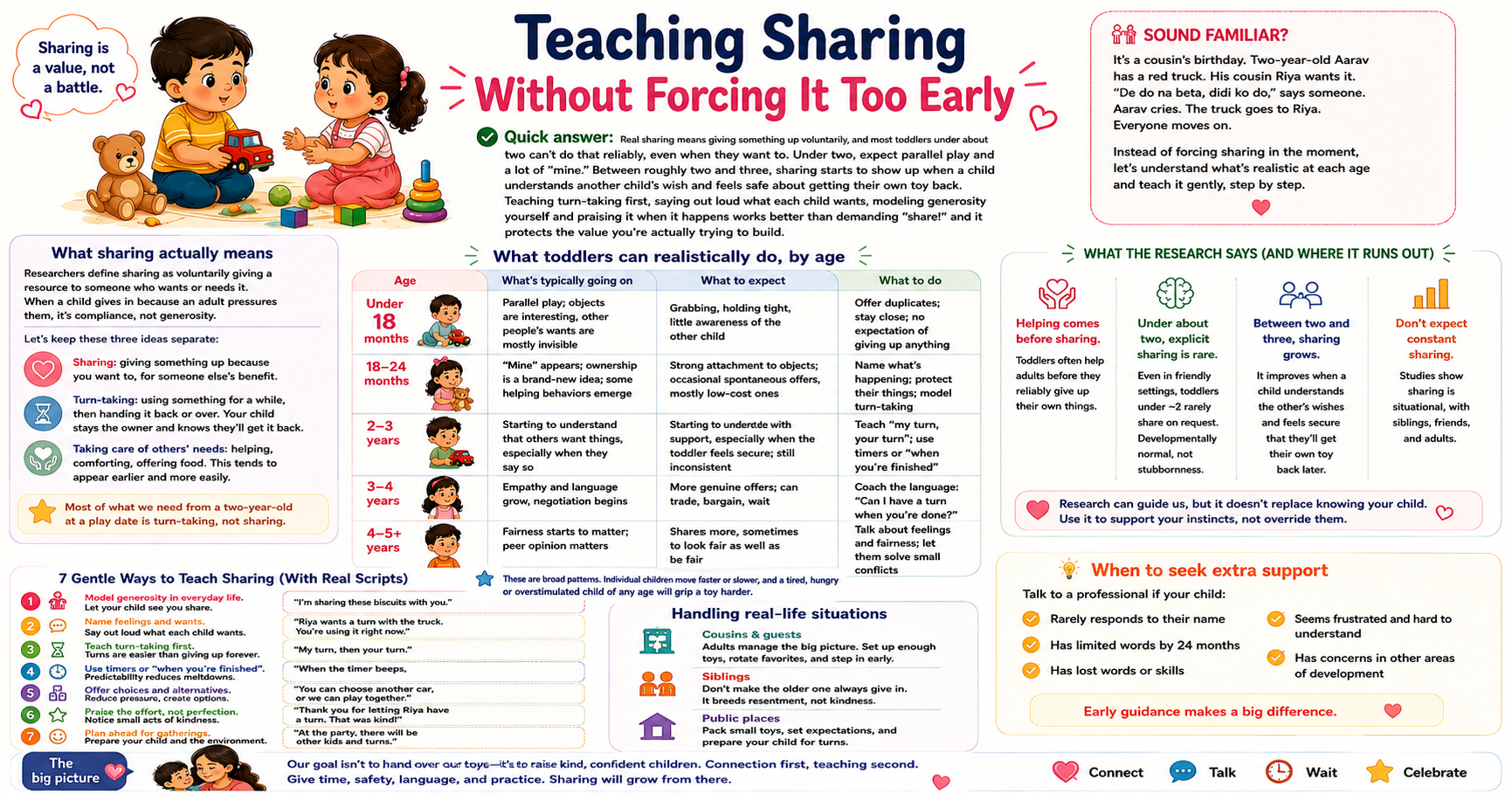
Quick answer: Real sharing means giving something up voluntarily, and most toddlers under about two can’t do that reliably, even when they want to. Under two, expect parallel play and a lot of “mine.” Between roughly two and three, sharing starts to show up when a child understands another child’s wish and feels safe about getting their own toy back. Teaching turn-taking first, saying out loud what each child wants, modeling generosity yourself and praising it when it happens works better than demanding “share!” and it protects the value you’re actually trying to build.
Teaching Sharing Without Forcing It Too Early
Picture this. It’s a cousin’s birthday, the living room is full, and there’s a small red toy truck in the middle of the carpet. Two-year-old Aarav has been pushing it around for twenty minutes. His cousin Riya, who is four, wants it. Someone’s aunty says, in the sweetest voice, “Aarav, de do na beta, didi ko do.” Aarav’s fingers tighten. His mother, who has one eye on the cake and one eye on the aunty, says it again, a little sharper. Aarav starts to cry. The truck goes to Riya. Everyone moves on. Aarav’s mother spends the rest of the party feeling like she either raised a selfish child or made a sad one, and she isn’t sure which is worse.
If you’ve lived some version of that scene, this article is for you. It’s not an argument against sharing. Sharing matters, and Indian families in particular carry it as one of the first values we pass on, from the tiffin you split at school to the last jalebi on the plate. The argument here is smaller and, I think, more useful: the way most of us try to teach it, by demanding it in the moment, asks a very young child to do something their brain often isn’t ready to do. There’s a gentler route that gets you to the same place.
We’ll go through what sharing actually is, what the research says about when it becomes possible (and where that research stops), seven strategies with real scripts, and how to handle cousins, siblings and guests without turning every gathering into a negotiation.
Table of Contents
What sharing actually means (and why forced sharing isn’t quite sharing)
Researchers who study early kindness define sharing as voluntarily giving a resource to someone who wants or needs it. That word “voluntarily” carries a lot. When a toddler hands over a truck because an adult’s voice got sharp, the truck has changed hands, but what happened inside the child was closer to compliance than generosity. He learned that grown-ups get louder when he holds on. He may also have learned that his feelings about his own things don’t count, which is not the lesson anyone intended.
It helps to separate three things that often get lumped together:
- Sharing: giving something up because you want to, for someone else’s benefit.
- Turn-taking: using something for a while, then handing it back or over. Your child stays the owner and knows they’ll get it back.
- Taking care of others’ needs: helping, comforting, offering food. This tends to appear earlier and more easily than giving up a favorite object.
Most of what parents need from a two-year-old at a play date is turn-taking, not sharing. That’s a smaller ask, and it’s one a toddler can actually learn.
What toddlers can realistically do, by age
| Age | What’s typically going on | What to expect | What to do |
|---|---|---|---|
| Under 18 months | Parallel play; objects are interesting, other people’s wants are mostly invisible | Grabbing, holding tight, little awareness of the other child | Offer duplicates; stay close; no expectation of giving up anything |
| 18–24 months | “Mine” appears; ownership is a brand-new idea; some helping behaviors emerge | Strong attachment to objects; occasional spontaneous offers, mostly low-cost ones | Name what’s happening; protect their things; model turn-taking |
| 2–3 years | Starting to understand that others want things, especially when they say so | Sharing is possible with support, especially when the toddler feels secure; still inconsistent | Teach “my turn, your turn”; use timers or “when you’re finished” |
| 3–4 years | Empathy and language grow; negotiation begins | More genuine offers; can trade, bargain, wait | Coach the language: “Can I have a turn when you’re done?” |
| 4–5+ years | Fairness starts to matter; peer opinion matters | Shares more, sometimes to look fair as well as be fair | Talk about feelings and fairness; let them solve small conflicts |
These are broad patterns. Individual children move faster or slower, and a tired, hungry or overstimulated child of any age will grip a toy harder.
What the research says (and where it runs out)
Here’s what’s reasonably well supported, in plain terms, and where I’d be careful not to overclaim.
Helping tends to show up before sharing. Studies of toddlers in their second year find that many will help an adult, for example by fetching something out of reach, well before they reliably hand over something of their own. Giving up a thing you want is a harder task than helping.
Under about two, explicit sharing is rare, even in a friendly setup. In one well-known experiment, 18-month-olds and 25-month-olds could choose to deliver food to themselves only or to themselves and another person, at no cost to themselves. When the other person stayed silent, both groups chose randomly. When she said out loud what she wanted, the 25-month-olds shared and the younger toddlers did not. Two things to take from this: language about needs matters, and there seems to be a real developmental shift around the second birthday. Keep in mind it was a lab task with food and a small group of children, so it shows a pattern rather than a rule for every child.
How parents talk seems to matter. Another study of 18- and 24-month-olds found that toddlers whose parents talked more about other people’s emotions while reading together tended to show more sharing and helping. This was a small correlational study, so it can’t prove that emotion talk causes generosity, but it points to something parents can do easily: put feelings into words.
Rewards can backfire on kindness. In a much-cited study, 20-month-olds who were rewarded with a toy for helping later helped less than children who were never rewarded. That study was about helping, not sharing, so I wouldn’t stretch it too far, but it’s a reason to be cautious about sticker charts for generosity. The goal is a child who gives because they care, not because a prize is coming.
Children copy what they see, in India as well. A study involving children aged three to eight in India and the United States found that children shared less after watching a parent model a stingy donation. Generosity is, in part, caught rather than taught, and this appeared in both countries.
Understanding feelings helps too. Research on preschoolers has found that children become more generous as they understand how good sharing can feel, for the giver and the receiver.
Where the research runs out. I’m not aware of solid evidence that a single instance of adult-pressured sharing causes lasting harm, and I wouldn’t tell you otherwise. The case for going gently rests on developmental readiness, on the definition of sharing as voluntary, on what we know about motivation, and on what modeling does. Also, most of this research comes from a limited range of children and settings, and much of it uses short lab tasks rather than messy family living rooms. Treat it as a useful compass, not a rulebook.
Why “mine!” is a healthy stage, not a character flaw
Somewhere around eighteen months to two years, a child discovers that some things belong to them. It’s a real cognitive leap, a bit like discovering the edges of themselves. “Mine” isn’t greed. It’s the beginning of understanding that the world has owners and that they are one.
A child has to feel secure about what’s theirs before they can comfortably lend it. That’s the piece adults often miss. If every time a toy is wanted it gets taken, a toddler learns that the safest strategy is to hold on tighter. If instead they learn that their things are respected and will come back, holding on gets easier to loosen.
So when your toddler yells “mine,” try hearing “this matters to me and I’m not sure you’ll give it back.” Then speak to that.
Sharing in an Indian family: values, cousins and “de do beta”
Let me say something before the tips: sharing being a core value in our homes is a strength. In many families, food is passed around a table without anyone counting, cousins grow up like siblings, and prasad, sweets and tiffin are shared as a matter of course. Nothing here asks you to drop that.
What changes is the timing and the method. A few patterns worth noticing:
- “De do, woh chhota hai.” The younger cousin or sibling gets priority, which teaches consideration but, if it happens every time, can leave an older child feeling that their belongings and feelings always come second.
- “Tum bade ho, samajh jao.” Older children are asked to be mature about giving in. Sometimes that’s fair. When it’s constant, resentment builds, and the older child learns that generosity means losing.
- The audience effect. Parents feel watched, and quite reasonably want their child to look gracious in front of relatives. The child feels the pressure and tends to dig in.
- Guests and their children. Toys, cycles and books that a child is still attached to get handed to visitors on request. It’s hospitable, but it can feel like a loss to a three-year-old whose favorite truck is suddenly gone.
- Elders’ good intentions. A grandparent who says “sharing karo” is passing on something precious. You can honor that and still change how you go about it (more on that below).
Nothing here needs a family argument. It usually needs a small, kind conversation and a plan.
7 gentle ways to teach sharing
1. Start with turn-taking, not giving away
Turn-taking is the beginner version of sharing, and it’s the one a toddler can master. The rule is simple: you play, then I play, and the toy comes back.
Script: “Aarav’s turn with the truck. When he’s finished, it’s Riya’s turn. Aarav, tell me when you’re done.”
The words “when you’re finished” do quiet work. They tell your child that the toy isn’t being taken; it’s being borrowed, on their schedule. A visual helps: a small sand timer or a song (“we’ll sing twice, then it’s her turn”) gives a toddler a concrete way to see that the wait ends.
2. Say out loud what each child wants
The 25-month-old research points to something useful: toddlers respond when the other person’s wish is stated clearly. So make the wish visible.
Script: “Riya wants the truck. Aarav wants the truck. Hmm, we have one truck and two kids who love it. What should we do?”
Let there be a pause. Sometimes the child will offer a solution. Often not, and that’s fine. You’re building the habit of noticing the other person’s want, which sits underneath every later act of generosity.
3. Protect their things, so they can lend other things
Before a play date or a family visit, sit down with your child and let them choose one or two special toys that stay in a cupboard. Everything else is for playing together.
Script: “Which toys are just for you today? We’ll put them in the cupboard. All the others are for everyone.”
That gives your child a safe place for the objects they can’t bear to lose, and it removes most of the fights before they start. It’s also good manners in the truest sense: it respects the child and the guest.
4. Model it, visibly and often
Children watch what you do far more than what you say, and the research on parental modeling in both India and the US suggests generosity spreads by example. So let your child see you share: your food, your time, your phone charger, your good chair.
Script: “I’ve got two rotis. Want to share one with Papa? He looks hungry.” Then say what happened: “That made him happy. Did you see his face?”
Small, daily, unforced.
5. Use feelings words when it goes right and when it goes wrong
Emotion talk seems to be associated with more sharing and helping in toddlers, so make it a habit.
When it goes wrong: “You’re upset. You wanted the truck and it went to Riya. That’s hard.”
When it goes right: “You gave Riya a turn. Look, she’s smiling. How do you feel?”
You aren’t scripting a performance; you’re giving your child language for what’s going on inside them and inside the other child.
6. Notice generosity instead of paying for it
Given what we know about rewards and kindness, I’d skip the sticker chart for sharing. Instead, describe what you saw, warmly and specifically.
Instead of: “Good boy! You get a sticker!” Try: “You handed Riya the blocks without me asking. That was kind.”
A small, real observation gives your child evidence that they’re a giving person, which is a better prize than anything from a shop.
7. Practice with low-stakes things first
Sharing a favorite toy is hard. Sharing a snack, a page of a book or a job is much easier.
- Let your toddler hand out pieces of fruit to family members.
- Let them “help” by passing a spoon or a napkin.
- Read a book together and let them turn the page, then you turn the page.
- At mealtimes, let them serve a bit from the katori to someone else.
These are small, cheerful practice rounds in giving. Helping is also something toddlers tend to do sooner than handing over favorite objects, so it builds the muscle without a fight.
Scripts for the hard moments
When your toddler grabs a toy from another child
Move in calmly, close and low, and stop the grab without shaming.
Script: “I won’t let you grab. Ouch, that toy was in Riya’s hands. She’s upset. Let’s see what else we can do. You can ask, ‘Can I have a turn, please?'”
Then give the toy back to the child it was taken from if you can, and offer your child something else, or a definite next turn.
When your toddler refuses to share and the other child is crying
Acknowledge both children. Don’t demand.
Script: “You’re using the truck and you’re not ready to give it. That’s okay. Riya’s sad because she wants a turn. Let’s set the timer. When it rings, it’s Riya’s turn. Meanwhile, Riya, here’s another truck you can use.”
If there’s no second truck, offer something else, a hug for the disappointed child, or a distraction. It’s okay for a child to feel disappointed for a minute.
When a relative pushes: “De do beta”
You don’t have to win the argument. You can quietly protect your child and keep the peace.
Script (to the relative, warmly): “Woh abhi khel raha hai, jab ho jayega tab dega. Tab tak yeh wala le lo.” (He’s playing right now, he’ll give it when he’s done. Meanwhile, take this one.)
Or, with an elder you want to bring along gently: “Aap bilkul sahi keh rahe hain ki share karna zaroori hai. Hum usse seekh rahe hain, thoda time lagta hai.” (You’re right that sharing matters. We’re learning it, it just takes some time.)
Agreeing with the value while gently changing the method is usually the smoothest path.
When your toddler has a meltdown after giving in
If the toy has already gone and the tears have started, skip the lecture.
Script: “That was hard to give up. I know. It’s okay to feel sad. You’ll get it back soon.” Hold them if they want to be held.
The lesson of the moment is that big feelings are survivable, which is a useful lesson too.
Siblings: when the older one always has to give in
If you’ve got two, you’ve probably said “tum bade ho” more times than you’d like. It’s hard not to. The little one wants everything and the big one is (often) more able to cope with a “no.”
Some ways to keep it fair:
- Give the older child things that are truly theirs. A shelf, a box or a cupboard that the younger sibling isn’t allowed into. This is their safe place.
- Ask both children. “How can we work this out?” beats a ruling from above.
- Don’t automatically side with the younger one. Sometimes the fair answer is that the toddler waits.
- Notice and thank the older child’s generosity, out loud and in private. “I saw you let Meera use your crayons. That was really generous.”
- Avoid the label. “The big one is so mature, the little one is so difficult” can stick for years.
Some parents find it helps to keep a couple of “family toys” (shared by rule) and some “own toys” (not shared unless the owner chooses). Children handle that distinction more easily than we expect.
Guests and relatives: a simple prep plan
Festivals, weddings and long weekends bring cousins together, and toys with them. A little planning beats a lot of firefighting.
Before they arrive:
- Tell your child who is coming and what to expect. “Riya and Rohan are coming. They’ll play with the blocks and the cars.”
- Let your child choose their “special” toys to put away.
- Set out a few toys that are clearly for everyone, ideally duplicates or several of the same kind.
While they’re there: 4. Stay nearby for the first ten minutes, since that’s when most conflicts start. 5. Use turn-taking language for popular toys and timers if needed. 6. Have a backup plan (bubbles, a ball outside, a snack) to redirect a spiral.
With relatives: 7. If you know an elder tends to say “de do,” a quick word beforehand (“Please let him choose today, he does better that way”) can save a scene.
Myths about sharing worth letting go of
A few ideas float around family gatherings and WhatsApp forwards so often that they start to feel like facts. Here are the ones that cause the most stress.
“A child who won’t share is spoiled.” Spoiled usually means a child who never hears “no” or never has to wait. A toddler holding a truck for twenty minutes is doing something quite different: they are practicing ownership and self-control, both of which they’ll need later. Plenty of thoughtful, kind adults were once toddlers who yelled “mine.”
“If I don’t insist, my child will grow up selfish.” The research on modeling points the other way. Children pick up generosity from the way the people around them behave, and from how their own feelings are treated. A child whose “no” is respected today is more likely to feel safe saying “yes” tomorrow.
“Sharing should happen by two.” Some two-year-olds hand things over cheerfully and some can’t manage it until closer to three or four. That range is normal. A child who shares at three isn’t behind a child who shared at two.
“Girls share more than boys.” You’ll hear this a lot, and it can quietly shape what we expect from a child. The evidence I’ve seen doesn’t support using gender to predict which individual toddler will share. Temperament, mood, hunger and how secure a child feels matter far more.
“If the other child is crying, mine must give in.” Another child’s tears are real and deserve kindness, but they don’t automatically decide who gets the toy. You can comfort the crying child, offer alternatives and set a turn, all without making your own child hand over what they’re using.
“A sticker chart will speed things up.” It might change behavior for a week. Given what the reward research suggests, though, it can also make kindness feel like a trade. Noticing and naming generosity is slower, but it tends to stick.
Sharing at the playground, at school and with the tiffin
Sharing doesn’t only happen at home. Some of the trickiest moments are in places where you can’t control who’s playing with whom.
At the park. Playground equipment belongs to everyone, so the rule is turn-taking by default: a slide, a swing and a ball are shared spaces. Your child doesn’t have to hand over a toy they brought, though. A simple line usually works: “That’s Aarav’s ball. He might let you play in a minute. The swings are free right now, want to go there?” If your child wants something another child has, coach them to ask (“Can I have a turn when you’re done?”) and to wait, which is a skill in itself.
At preschool or daycare. Most early-years teachers already work with turn-taking, sand timers and “waiting” spots, and it’s worth asking what phrases they use. If your child comes home saying “It’s my turn, you wait,” that isn’t rudeness. They’re rehearsing a school routine, and you can use the same language at home. If a teacher mentions your child struggles to share, ask for specifics: what happens, when, and what helps. Sharing difficulties at this age are usually about timing, tiredness or a particular toy, not a lasting pattern.
With the tiffin. Sharing food is one of the most natural forms of generosity in India, and it’s also where young children can feel most anxious, since food is tied to hunger and comfort. If your child is asked to share their lunch and doesn’t want to, it’s okay to let them decide. You can also make sharing easy: packing a few extra pieces of fruit or a small sweet to offer makes generosity cost nothing. Teach a polite way to say “not today” too, since being able to decline kindly is part of being generous on purpose.
With neighborhood children. Housing societies, lanes and colony gardens mean your child meets the same children again and again. That’s a gift. Repeated meetings with the same kids build trust, and trust makes sharing easier. A toddler is far more likely to lend a favorite toy to a friend they know than to a stranger.
When your child is the one who gets told no
Almost all advice about sharing focuses on the child who’s holding the toy. But your toddler will spend just as much time on the other side, wanting something and hearing “no.” How they handle that is part of the same skill set.
Try not to rescue them from every refusal. If another child says “no, I’m using it,” you can stay close and acknowledge the disappointment (“You really wanted that truck. That’s hard.”) without asking the other child to hand it over. Then help your child find something else to do, or wait for a turn.
This matters for a simple reason. A child who learns that waiting works, and that disappointment passes, becomes more patient. And patient children are usually more generous, because they aren’t panicking about losing out. It also shows your child the same respect for ownership you want them to show others. If they see you accept another child’s “no,” they learn that everyone’s things are protected.
You can put words to the moment: “Riya isn’t ready to share yet. When she’s finished, she might let you have a turn. What would you like to do while we wait?”
A two-week practice plan
Skills like this grow with repetition, not lectures. If you’d like a gentle starting point, here’s a simple two-week plan. Take what works and ignore the rest.
Week one: build the groundwork.
- Day 1–2: Name feelings during play. “You’re happy. You love the blocks.” Just noticing, no teaching.
- Day 3–4: Introduce “my turn, your turn” with you. Take a turn with their toy, hand it back, and say thank you.
- Day 5: Choose one or two special toys that stay in the cupboard when others visit.
- Day 6–7: Model generosity out loud. “I’m giving Nani half my chai biscuit because she likes them too.”
Week two: bring in other children.
- Day 8–9: Try a short play date with one child, ideally someone your child knows. Stay close, and use the timer or “when you’re finished.”
- Day 10: Practice “asking for a turn” with a family member using a script you can repeat.
- Day 11–12: Give them small jobs that involve giving, such as passing snacks or handing out spoons at mealtime.
- Day 13: Notice and describe one act of kindness. “You gave Papa the remote. He looked happy.”
- Day 14: Reflect. What made things easier? What triggered meltdowns? Adjust the plan.
There’s no pass or fail here. If the tenth day looks like the second, that’s not failure; it’s how a two-year-old learns. Progress in this area is slow and uneven, and small wins are worth noticing.
Sharing screens and gadgets
Many families now have a shared tablet or phone that siblings and cousins fight over. It’s worth naming this separately, because screens are a different kind of object: they’re hard to split, hard to hand back, and highly absorbing.
A few ideas that help:
- Use a visible timer and let the timer be the referee, not you. “The timer says your turn is over” is easier to accept than “I said so.”
- Set the order before the device comes out. Deciding turns in advance avoids in-the-moment negotiation.
- Watch together sometimes. Shared viewing (one screen, two children, a parent nearby) turns a competition into a joint activity.
- Keep gadgets out of the “must share” category for very young children. A two-year-old doesn’t need to learn generosity through the family phone. Save the practice for toys, snacks and books.
- Be consistent. If the rule changes every time someone cries, the fighting will continue.
For more on managing screen time in general, see ParentNest’s screen-time guide.
What not to do
- Don’t force the handover in front of an audience. It teaches embarrassment and resistance more than generosity.
- Don’t label your child “selfish” or “greedy,” even as a joke. Labels harden.
- Don’t reward sharing with treats or stickers as a routine. Warm acknowledgment is enough and works better for lasting kindness.
- Don’t insist your toddler share favorite objects, such as a blanket or comfort toy. Those aren’t toys, they’re regulators.
- Don’t punish a child for not sharing with time-out or shame. The point is to teach, not to win.
- Don’t expect two-year-olds to behave like four-year-olds. The ability grows with the child.
- Don’t shame the other child either. If your toddler is the one on the receiving end of the refusal, model graciousness for them too.
When it’s worth a closer look
Most difficulty with sharing is ordinary, developmental and temporary. It might be worth a chat with your pediatrician or your child’s preschool teacher if you see:
- Frequent, intense aggression (hitting, biting) that continues well beyond the toddler years and doesn’t ease with consistent, calm responses
- Very little interest in other children at all, alongside other differences in communication or play
- Extreme distress at any hint of another child touching their things that seems out of proportion and persistent
- A sudden change from a previous pattern
These aren’t diagnoses or reasons to panic. A short conversation with someone who knows your child is usually enough to sort out what’s typical.
Real moments parents recognize
You might find yourself, mid-play-date, hovering over two toddlers and one truck like a referee, wondering how something this small can create so much drama. That’s normal. It’s not a verdict on your parenting or their character.
Or a relative might say, “Mere bachpan mein toh hum sab share karte the,” and it’s worth remembering that children of every generation grabbed things and cried about it. What has changed is that we now have research on why and how to guide them.
Or your three-year-old, who screamed over the truck yesterday, hands a biscuit to the neighbor’s child without being asked. Don’t make a fuss. Just say quietly, “That was kind.” Those small moments are the whole story.
Frequently Asked Questions
At what age do toddlers learn to share?
Most toddlers begin to share voluntarily somewhere around age two to three, when they start to understand what another child wants and feel secure about their own belongings. Before about age two, sharing on request is rare, and expecting it usually leads to conflict rather than kindness.
Should you force a toddler to share?
Generally no. Real sharing is voluntary, and toddlers under two often can’t do it reliably. Teaching turn-taking, naming each child’s wants and modeling generosity tends to work better than demanding “share,” and it keeps the lesson positive.
What’s the difference between sharing and taking turns?
Sharing means voluntarily giving something up for someone else. Taking turns means using something for a while and then passing it on, with the understanding that it comes back. Turn-taking is a simpler, more realistic goal for toddlers and is a good stepping stone to sharing.
Is it okay if my toddler doesn’t want to share?
Yes. Saying “mine” and holding on to belongings is a normal stage tied to a new sense of ownership. It isn’t selfishness. Respecting it, while teaching turn-taking, helps children feel secure enough to become generous later.
Why does my toddler say “mine” all the time?
Around eighteen months to two years, children discover that things can belong to them. “Mine” is the language of that discovery. It usually eases as language, empathy and self-control grow.
What should I say when my toddler won’t share?
Acknowledge both children and use turn-taking language. For example: “You’re using the truck, and Riya wants a turn. When you’re finished, it’s her turn.” Avoid demanding, shaming or labeling.
How do I handle relatives who insist my child share?
Stay calm and kind, and agree with the value while changing the method. Something like “He’s learning, and he’ll give it when he’s done” usually works. A quiet word before visits can prevent most scenes.
How do I stop my older child always giving in to the younger one?
Give the older child belongings that are just theirs, ask both children to solve conflicts, don’t always side with the younger one and thank the older one privately for generosity. Avoid labeling them as “the mature one.”
Do stickers or rewards help teach sharing?
Research on toddlers suggests extrinsic rewards can reduce later helpfulness, so routine rewards aren’t recommended. Describing what you saw and naming the kindness (“You gave her a block, that was kind”) tends to build lasting generosity.
Is forced sharing bad for children?
There isn’t strong direct evidence that a single instance causes lasting harm. But sharing is defined as voluntary, toddlers often aren’t developmentally ready, and rewards and pressure can undermine motivation. A gentler approach supports the same goal with fewer downsides.
How can I help my child share at family gatherings?
Prepare them beforehand, put away a few special toys, provide toys meant for everyone, stay close during the first ten minutes and use timers or turn-taking language. Have a backup plan, such as a snack or outdoor game, if things get tense.
Final thoughts
Sharing is one of the loveliest things a child learns, and it deserves better than to be squeezed out of them in a crowded room. The children who grow into truly generous people usually got there by feeling secure, by watching the adults around them give freely, by having their feelings named, and by being given time. That takes patience, and a few well-chosen words. The next time a small hand tightens on a toy and someone says “de do,” you have another option: take a breath, get down to their level and say, “When you’re finished, it’s her turn.” It may not end the drama immediately. But over months and years it builds the thing you were hoping for all along: a child who gives because they want to.