Physical Address
304 North Cardinal St.
Dorchester Center, MA 02124
Physical Address
304 North Cardinal St.
Dorchester Center, MA 02124

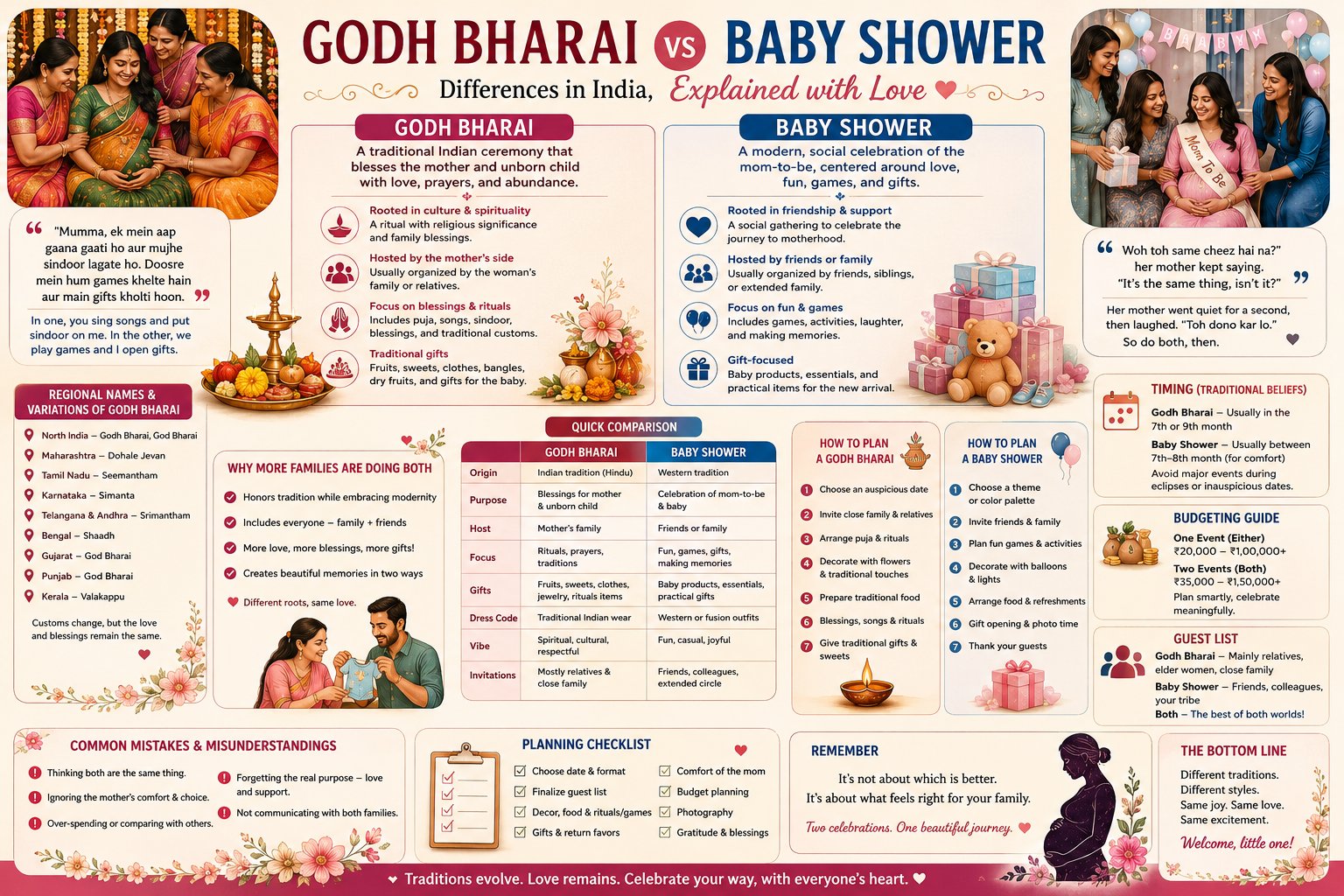
Aisha spent an entire evening on the phone with her mother trying to explain why she wanted a “baby shower” when her mother had already booked the pandit, the flowers, and half the extended family for a godh bharai on the exact same weekend. “Woh toh same cheez hai na,” her mother kept saying — it’s the same thing, isn’t it? Aisha, seven months pregnant and exhausted from the back-and-forth, finally just said, “Mumma, ek mein aap gaana gaati ho aur mujhe sindoor lagate ho. Doosre mein hum games khelte hain aur main gifts kholti hoon.” In one, you sing songs and put sindoor on me. In the other, we play games and I open gifts. Her mother went quiet for a second, then laughed. “Toh dono kar lo.” So do both, then.
That conversation — half comic, half genuinely confused — happens in some form in an enormous number of Indian households today, especially in cities where two generations are planning a pregnancy celebration together and discover, often for the first time, that they’re picturing two entirely different events. Godh bharai and the Western-style baby shower aren’t the same occasion wearing different clothes. They come from different traditions, serve different emotional purposes, and — increasingly — coexist beautifully in the same family, sometimes even the same weekend, once everyone actually understands what each one is.
This guide untangles exactly what separates the two, why so many modern Indian families are choosing to celebrate both, and how to plan either — or a thoughtful blend of both — without anyone in the family feeling like their tradition got sidelined.
If there’s only one thing to take from this entire guide: godh bharai is a religious and cultural ritual centred on blessing the mother and unborn child, traditionally hosted by the woman’s own family; a baby shower is a social, gift-focused celebration among friends and family, imported from Western culture, with no religious ritual at its core. Everything else in this guide is really just an elaboration of that one distinction.
Godh bharai literally translates to “filling the lap” — a beautifully specific phrase that captures the ceremony’s central symbolic act: the expectant mother’s lap is filled with fruits, sweets, and gifts, symbolising the fullness and abundance she’s about to receive with the arrival of her child.
Traditional timing is typically during the seventh or ninth month of pregnancy, considered an auspicious window in most Hindu traditions, often timed to avoid the more medically and astrologically sensitive early months of pregnancy entirely.
Core rituals typically include:
The spiritual and cultural purpose goes beyond simple celebration — many families view it as a protective ritual, invoking blessings for a safe delivery and a healthy child, and as a formal, communal acknowledgment of the mother’s transition into motherhood, witnessed and blessed by the women of her family specifically.
Traditionally hosted by the mother’s own family (maternal side), not the in-laws — a detail with real cultural significance in many communities, reflecting the tradition’s roots in a daughter returning, symbolically or literally, to her natal family’s care and blessing during this vulnerable, significant transition.
The baby shower, as most Indians now recognise the term, is a Western import — historically rooted in American social custom, centred on practically and socially preparing the parents-to-be for the baby’s arrival rather than on religious ritual or blessing.
Typical format includes:
Who typically hosts: unlike godh bharai’s traditional maternal-family hosting, baby showers in Western custom are traditionally hosted by a close friend or the mother’s social circle rather than family — though in the Indian adaptation of the format, family members frequently host it directly, blending the Western format with more familiar Indian family-hosting norms.
Increasingly popular in urban India, particularly among couples with international exposure through education, travel, or workplace culture, and especially common among couples who want a lighter, more casual celebration alongside or instead of the more ritually elaborate godh bharai.
| Aspect | Godh Bharai | Baby Shower |
|---|---|---|
| Origin | Hindu religious/cultural tradition, rooted in Indian custom | Western social custom, imported into urban India |
| Core purpose | Religious blessing, protection ritual, family transition acknowledgment | Social celebration, practical gifting, community bonding |
| Traditional host | Mother’s own (maternal) family | Friends or family, more flexible |
| Central ritual | Lap-filling with fruits/sweets, aarti, sindoor, blessings | Games, gift-opening, cake-cutting |
| Religious component | Central and essential | None inherently |
| Typical attire | Traditional Indian clothing, often a specific auspicious colour | Any attire, often themed to match décor |
| Gifts given | Fruits, sweets, symbolic items, sometimes jewellery or clothing | Practical baby items — clothes, gear, toys |
| Timing | 7th or 9th month, astrologically/culturally guided | More flexible, though similarly late-pregnancy timed |
| Music/songs | Traditional generational songs specific to the ritual | Modern playlists, no ritual song requirement |
| Who can host it | Traditionally specific to Hindu families following this custom | Open to any family regardless of religious background |
| Formality level | Ritually structured, more solemn/reverent tone | Casual, party-like, playful tone |
Much like the naming traditions covered elsewhere on this site, godh bharai isn’t a single uniform national custom — it carries different names and specific regional variations across India:
Seemantham (South India, particularly Tamil, Telugu, and Kannada-speaking communities) — a similar pregnancy ritual with its own distinct rituals, often more elaborate and religiously structured than the North Indian godh bharai, sometimes including a formal puja and hair-braiding ceremony for the mother-to-be.
Valaikaapu (Tamil Nadu specifically) — literally “bangle protection,” a ceremony centred specifically on the mother-to-be wearing colourful glass bangles, believed to have a soothing sound that calms the baby in the womb, along with other blessing rituals similar in spirit to godh bharai.
Shrimant or Dohaljevan (Maharashtra) — Maharashtrian pregnancy celebration customs carrying similar core meaning (blessing, protection, celebration of the pregnancy) but with distinctly Marathi ritual specifics and traditional songs.
Godh Bharai (North India — Uttar Pradesh, Bihar, Delhi, Punjab, Rajasthan, Haryana) — the term most commonly recognised nationally, given North Indian cultural influence on mainstream Hindi media, though the specific rituals still carry regional variation even within the broader Hindi-belt.
This regional diversity matters practically for families navigating a marriage between two different Indian regional traditions — understanding that “godh bharai” isn’t necessarily what a South Indian in-law expects, or that “seemantham” isn’t automatically familiar to a North Indian daughter-in-law’s family, is a genuinely useful piece of pre-planning awareness for many modern Indian families.
The rise of “doing both” isn’t simply modern excess — it reflects a genuine, understandable desire many expectant parents describe: honouring the emotional and religious weight of family tradition, while also creating space for a lighter, more personally curated celebration with their own friend group and generation.
Godh bharai often satisfies the emotional needs of parents and grandparents specifically — the ritual blessing, the generational continuity, the specific cultural meaning that resonates deeply with an older generation’s understanding of how a pregnancy should be honoured.
A baby shower often satisfies the expectant parents’ own social and generational needs — a chance to celebrate specifically with peers, in a format that feels personally reflective of their own friend circle and aesthetic preferences, distinct from a family-elder-led ritual event.
Combining both also solves a genuine logistical and emotional problem for many families: rather than one event trying to satisfy two very different sets of expectations (which often leads to a compromised version of both), two distinct events allow each to be done fully and well, on its own terms, for its own specific audience.
Financial and time constraints sometimes push families toward a blended single event instead (covered in Section 9), which is equally valid — there’s no obligation to do two separate full events if resources, energy, or family preference favour a thoughtful combination instead.
For families choosing a single combined event rather than two separate celebrations, a workable structure many Indian families have landed on:
Structure the day in two clear phases, not a blended mess. Begin with the traditional godh bharai ritual portion — attire, aarti, blessings, lap-filling — completed with appropriate reverence and family elder involvement, before transitioning into a more casual baby-shower-style second phase with games, music, and social celebration.
Consider a attire change between phases — traditional wear for the ritual portion, a more comfortable or differently styled outfit for the celebratory second half, which many mothers-to-be describe as genuinely practical given how different the two phases’ physical demands (a formal seated ritual vs a more mobile, social party) actually are.
Communicate the structure clearly to guests in the invitation, so relatives arriving specifically for the ritual portion and friends arriving primarily for the social celebration both understand the day’s flow and can time their attendance accordingly if not staying for the full event.
Let the elders lead the ritual portion fully, without rushing it for the sake of the second phase — several families specifically advise against treating the godh bharai ritual as a quick formality to get through before the “real” party, since doing so can genuinely hurt grandparents’ feelings even when unintentional.
Budget and vendor planning should account for both phases distinctly (covered further in Section 12), since décor, catering, and even guest-list needs can differ meaningfully between the two halves of a combined event.
Godh bharai guest lists traditionally skew toward family and close family friends, particularly women from both families, reflecting the ritual’s roots as a female-centred, family-blessing occasion — though modern celebrations increasingly include male family members and a broader guest circle than strictly traditional custom.
Baby shower guest lists typically skew toward the expectant parents’ own friend circle, colleagues, and a more mixed-gender, peer-generation guest composition, reflecting its social rather than familial-ritual origins.
A common, entirely reasonable approach for combined or separate celebrations: keep godh bharai intimate and family-centred as tradition suggests, while treating the baby shower (whether the same day’s second phase or a separate event entirely) as the appropriate occasion for a broader friend-circle guest list — letting each event’s guest composition follow its own natural logic rather than forcing identical guest lists onto two very differently-purposed occasions.
The “not too early” belief — many Indian families deliberately avoid celebrating pregnancy milestones, including godh bharai, too early in the pregnancy, reflecting a widely held cultural caution around openly celebrating before the pregnancy is considered more medically secure, typically past the first trimester at minimum, and often specifically timed to the 7th or 9th month for godh bharai itself.
Avoiding baby showers/gift-opening before birth, in some more traditional interpretations — while increasingly less strictly followed in urban India, some families and individuals still hold a cultural or personal preference against receiving baby items before the birth itself, a belief worth being sensitive to and asking about directly rather than assuming universally, particularly with more traditionally-inclined family members who may be planning or attending the event.
Specific numerological or astrological timing preferences, similar in spirit to the muhurat considerations discussed for other ceremonies on this site (naamkaran, mundan) — some families consult a priest or astrologer specifically for the godh bharai date, treating it with the same level of astrological care as other major life-cycle rituals.
These beliefs vary enormously by family, region, and generation, and this section is offered as an awareness point for the range of beliefs a family might encounter — worth an honest, direct conversation with the specific families involved rather than assuming any single practice is universal across all Indian communities.
Combined single event: generally the more budget-efficient option, since venue, catering, and core décor costs are shared across both phases rather than duplicated — a well-planned combined celebration for a moderate guest list can often be managed in a similar overall budget range to a single elaborate event of either type alone.
Two separate events: while costing more in aggregate, allows each celebration’s budget to be scaled independently — for example, keeping the traditional godh bharai modest and family-focused (lower cost, smaller guest list) while allocating a larger portion of the overall budget to a more elaborate baby shower with the wider friend circle, or vice versa, depending on the family’s specific priorities.
Typical relative cost drivers: godh bharai costs tend to concentrate in traditional attire, jewellery/gifts for the ritual, and a family feast; baby shower costs tend to concentrate in themed décor, games/activity materials, and often a more elaborate cake — understanding where each event’s costs actually concentrate helps with more deliberate budget allocation rather than an undifferentiated total spend guess.
As with the first-birthday budget guidance elsewhere on this site, the same core principle applies here: neither event needs to be elaborate to be meaningful, and family memory of the day tends to centre on warmth and genuine presence far more than on decor elaborateness or spend.
Aisha, Mumbai — “We ended up doing both, on the same day, exactly the structure this guide describes — ritual portion in the morning with just family, baby shower with my friends in the afternoon. It was honestly the best compromise. My mother got her full traditional godh bharai, unrushed, and I got my own celebration afterward that actually felt like mine.”
Priyanka, Chennai — “We did seemantham, the South Indian version, and skipped a separate baby shower entirely. It genuinely has enough of both elements already — blessing, celebration, gifts, a joyful atmosphere — that a second Western-style event felt unnecessary for us specifically. I know friends who felt differently and added a baby shower anyway, and that’s valid too.”
Farah and Imran, Hyderabad, interfaith family — “Godh bharai isn’t part of Imran’s family tradition at all, so we did a baby shower only, hosted jointly by both families, blending some symbolic elements — my mother insisted on a small blessing moment before the games started, which felt like a lovely, low-key way to honour that part of our family without a full separate ritual event.”
Meera, joint family, Lucknow — “My mother-in-law was originally confused about why I wanted ‘an extra party’ when we already had godh bharai planned. Once I actually explained it wasn’t a replacement, just a different kind of celebration with my own friends, she was completely on board — even ended up attending part of the baby shower herself, which I hadn’t expected but loved.”
Decision phase
Godh bharai specific
Baby shower specific
Combined event specific
Guest list
Godh bharai is a Hindu religious and cultural ritual focused on blessing the mother and unborn child, traditionally hosted by the mother’s own family; a baby shower is a social, gift-focused celebration imported from Western culture, with no inherent religious ritual.
Yes, and it’s increasingly common in modern Indian families — many host both as separate events or structure a single day into two phases: a traditional ritual portion followed by a more casual, social celebration.
Traditionally, the mother-to-be’s own (maternal) family hosts godh bharai, though modern celebrations increasingly involve both families jointly.
Seemantham is the South Indian (Tamil, Telugu, Kannada) equivalent pregnancy blessing ceremony, often more elaborate and religiously structured, sometimes including a formal puja and hair-braiding ceremony, distinct in specific ritual detail from North Indian godh bharai despite sharing similar core meaning.
Most families celebrate godh bharai during the 7th or 9th month of pregnancy, considered auspicious in Hindu tradition, though the exact preferred month and timing can vary by family and regional custom.
Not inherently — many interfaith, non-Hindu, or simply personal-preference families choose a baby shower only, sometimes incorporating a small symbolic blessing element to honour family tradition without a full separate ritual event.
Godh bharai costs typically concentrate in traditional attire, ritual items, and a family feast, while baby shower costs typically concentrate in themed decor, games/activities, and cake — understanding this difference helps with more deliberate budget planning for either or both events.
This guide describes commonly practiced traditions across Indian communities; specific rituals, regional names, and beliefs vary significantly by family, religion, and region. For guidance specific to your own family’s tradition, elders and family priests remain the most reliable source.