Physical Address
304 North Cardinal St.
Dorchester Center, MA 02124
Physical Address
304 North Cardinal St.
Dorchester Center, MA 02124

“You get 26 weeks of paid maternity leave” is the headline most Indian working women hear early in pregnancy — but the moment HR sends the actual number, a second, quieter question shows up: paid based on what, exactly? Full CTC? Just basic salary? Does it include HRA? What about the variable bonus?
This confusion is genuinely common, and it isn’t because the law is vague — it’s because most workplace conversations skip the actual calculation and jump straight to “26 weeks, fully paid.” This guide walks through exactly how maternity leave salary is calculated in India under the Maternity Benefit Act, 1961, what recently changed with the Code on Social Security, 2020, who’s eligible, how the ESI Scheme works differently for lower-income employees, and what to do if your employer’s numbers don’t seem to add up.
A quick note before we start: this article explains the general legal framework and calculation method for informational purposes. Individual situations can vary — always confirm your specific entitlement with your HR/payroll team, and consult a labour law professional for anything genuinely in dispute.
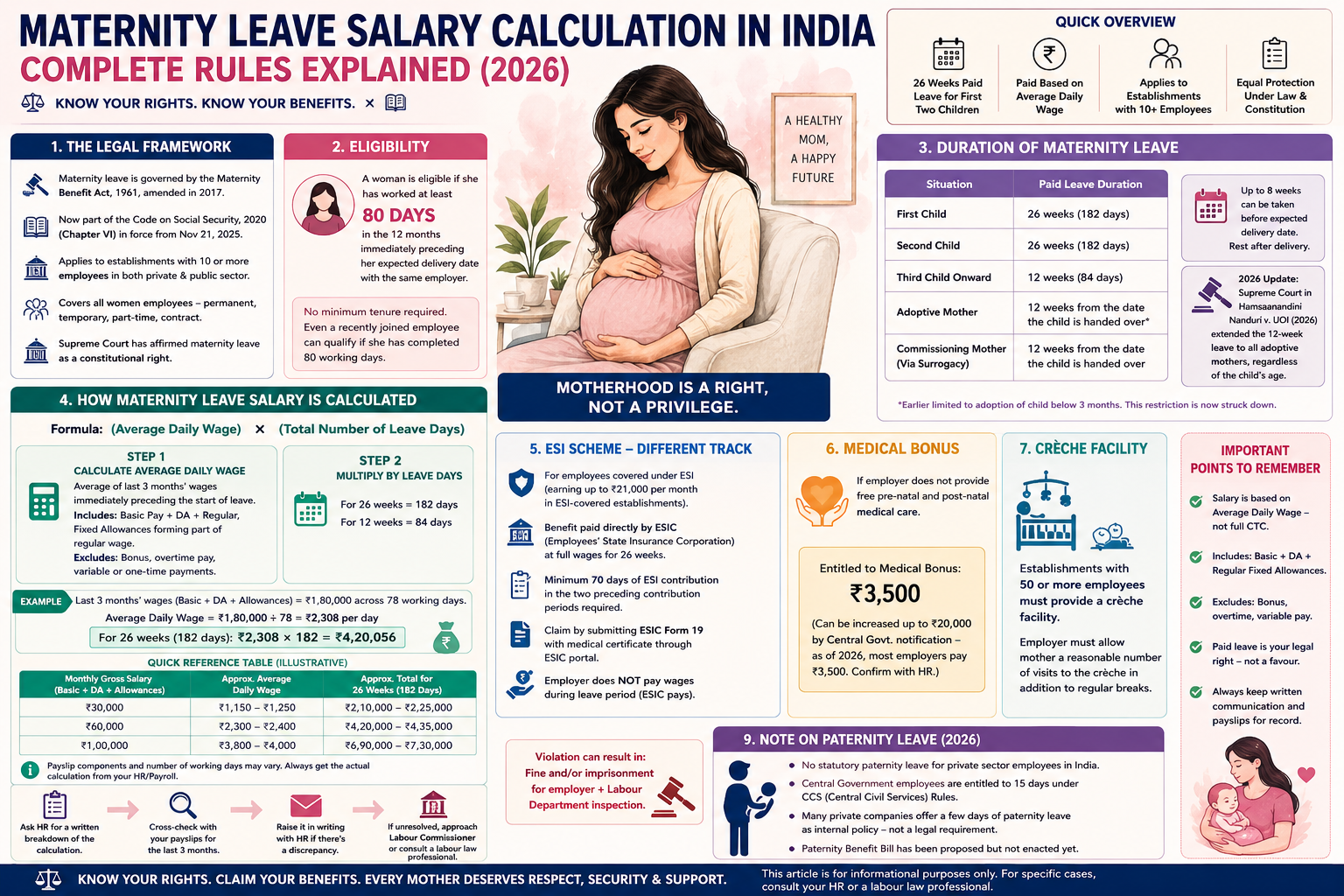
Maternity leave in India is governed by the Maternity Benefit Act, 1961, significantly amended in 2017 to extend paid leave from 12 to 26 weeks for the first two children. More recently, the Code on Social Security, 2020 came into force on November 21, 2025, consolidating the Maternity Benefit Act’s provisions into Chapter VI of the new Code — the underlying entitlements and calculation formula remain essentially the same, but it’s worth knowing the current legal reference has technically shifted.
Who this applies to: Any establishment with 10 or more employees, across the private and public sector, is legally required to provide these benefits — this includes permanent, temporary, part-time, and contract women employees, not just full-time permanent staff.
Constitutional weight: A Supreme Court ruling reinforced maternity leave protections as connected to constitutional rights, strengthening the legal standing of these entitlements beyond ordinary labour law.
To be eligible for paid maternity leave under the Act, a woman must have:
That’s the core test — it doesn’t require a minimum tenure like “one year of continuous service,” which surprises many employees who assume otherwise. A relatively recently hired employee can still qualify if she’s completed 80 working days with that employer in the year before her expected delivery date.
| Situation | Paid Leave Duration |
|---|---|
| First child | 26 weeks (182 days) |
| Second child | 26 weeks (182 days) |
| Third child onward | 12 weeks |
| Adoptive mother (adopting a child) | 12 weeks from the date the child is handed over |
| Commissioning mother (via surrogacy) | 12 weeks from the date the child is handed over |
Timing: Of the 26-week entitlement, up to 8 weeks can be taken before the expected delivery date, with the remainder taken after — though the exact pre/post split can be adjusted based on individual circumstances and medical advice.
A significant 2026 update: In Hamsaanandini Nanduri v. Union of India (2026), the Supreme Court struck down the earlier rule that limited adoptive mothers’ maternity benefit to only those adopting a child under three months of age. The Court extended the 12-week paid leave entitlement to all adoptive mothers, regardless of the adopted child’s age at placement — a meaningful expansion that many employer HR policies had not yet updated to reflect as of this writing. If your organization’s policy still references a “child under 3 months” limit for adoption leave, that language is now outdated and worth flagging to HR.
This is the part almost no one explains clearly upfront. Here’s the formula:
Average daily wage is calculated from the average of your last three months’ wages immediately preceding the start of your leave — specifically, your basic pay plus Dearness Allowance (DA) plus any regular, fixed allowances that form part of your regular wage.
What’s excluded: Bonuses, overtime pay, and other variable or one-time payments are not included in this calculation.
A relevant technical detail: under the Code on Social Security’s wage definition, allowances counted toward “wages” cannot exceed 50% of total remuneration (CTC) — this is a broader wage-definition rule that also applies to maternity benefit calculations, and is worth knowing if your compensation structure is unusually allowance-heavy.
Once you have your average daily wage, multiply it by the number of days of leave you’re entitled to — 182 days for the standard 26-week entitlement, or 84 days for the 12-week entitlement.
A payroll executive’s last three months’ wages (basic + DA + applicable allowances) total ₹1,80,000 across 78 working days in that period.
This is paid by the employer in line with the employee’s normal salary cycle (typically monthly), with standard TDS treatment as regular income — it isn’t a lump-sum payout, it continues to arrive like a normal salary across the leave period in most companies.
| Monthly Gross Salary (Basic + DA + Regular Allowances) | Approx. Average Daily Wage | Approx. Total for 26 Weeks |
|---|---|---|
| ₹30,000 | ₹1,150 – ₹1,250 | ₹2,10,000 – ₹2,25,000 |
| ₹60,000 | ₹2,300 – ₹2,400 | ₹4,20,000 – ₹4,35,000 |
| ₹1,00,000 | ₹3,800 – ₹4,000 | ₹6,90,000 – ₹7,30,000 |
Important: these are illustrative approximations based on common calculation patterns. Your exact figure will depend on your specific basic pay, DA, and allowance structure, and the exact number of working days used in your company’s calculation — always request the exact calculation from your HR/payroll team rather than relying solely on an approximation.
If you’re covered under the Employees’ State Insurance (ESI) Scheme — generally applicable to employees earning up to ₹21,000 per month in ESI-covered workplaces — your maternity benefit works differently:
If you’re unsure whether you’re ESI-covered or on the standard employer-paid track, this is worth confirming directly with HR — the calculation method, payment source, and claim process are genuinely different between the two.
If your employer does not provide free pre-natal and post-natal medical care as part of your benefits, you are entitled to a separate medical bonus. The originally notified amount was ₹3,500, and while the Act allows the Central Government to raise this up to ₹20,000 by future notification, as of 2026 the amount most employers are actually paying remains ₹3,500 — worth confirming directly with your HR team which figure applies at your organization, since notifications can change this over time.
Separately from the leave and salary provisions, establishments with 50 or more employees are required to provide a crèche facility, and the employer must permit the mother a reasonable number of visits to the crèche during the workday, in addition to her regular breaks. If your organization has crossed this employee threshold and doesn’t yet have this facility, it’s a compliance gap worth raising with HR — this is a mandatory obligation, not a discretionary benefit.
Non-compliance carries real legal consequences for employers — violations can result in a fine and potential imprisonment for the employer, and can trigger a labour department inspection. If you believe your maternity benefit has been calculated incorrectly, denied, or reduced improperly:
Since this often comes up in the same conversation: as of 2026, there is no statutory paternity leave entitlement for private-sector employees in India. Central government employees are entitled to 15 days under separate CCS (Central Civil Services) rules, and a number of private companies voluntarily offer a few days of paternity leave as internal policy — but this isn’t currently a legal requirement for private employers. A Paternity Benefit Bill has been discussed but has not been passed into law as of this writing.
Your average daily wage is calculated from the average of your last three months’ wages (basic pay + Dearness Allowance + regular fixed allowances, excluding bonuses and overtime) before your leave starts. This daily rate is then multiplied by your total leave days — 182 days for the standard 26-week entitlement.
Yes — for eligible employees (80 days worked in the preceding 12 months, in an establishment with 10 or more employees), maternity leave is fully paid at the average daily wage rate, for 26 weeks for the first two children or 12 weeks from the third child onward.
No — only basic pay, Dearness Allowance, and regular fixed allowances are included. Bonuses, overtime, and other variable payments are excluded from the calculation.
Employees covered under the ESI Scheme (generally those earning up to ₹21,000/month) receive their maternity benefit directly from ESIC rather than their employer, provided they meet a minimum contribution requirement (generally 70 days in the two preceding contribution periods), claimed via ESIC Form 19.
Yes — 12 weeks of paid leave from the date the child is handed over. Following a 2026 Supreme Court ruling, this now applies to all adoptive mothers regardless of the adopted child’s age at placement, removing an earlier restriction that limited this benefit to children under three months old.
Request a written breakdown of the calculation from HR, cross-check it against your own payslips for the relevant three-month period, raise any discrepancy in writing, and if unresolved, escalate to your state labour commissioner’s office or consult a labour law professional.
The 26-week figure is the headline, but the real number that matters to your household budget is the one underneath it — your average daily wage, calculated from three specific months of basic pay, DA, and regular allowances, multiplied out across your leave period. Understanding this calculation before your leave starts — and knowing whether you’re on the standard employer-paid track or the separate ESI track — means you can plan your maternity leave finances with a real number instead of a rough guess, and know exactly what to check if your payslip during leave doesn’t look right.
Planning your baby’s first-year finances around your maternity leave? Check out our Baby Budget Calculator to see how your leave income fits into your overall first-year budget.